
Parts of a Compound Bow: Diagram and Terms
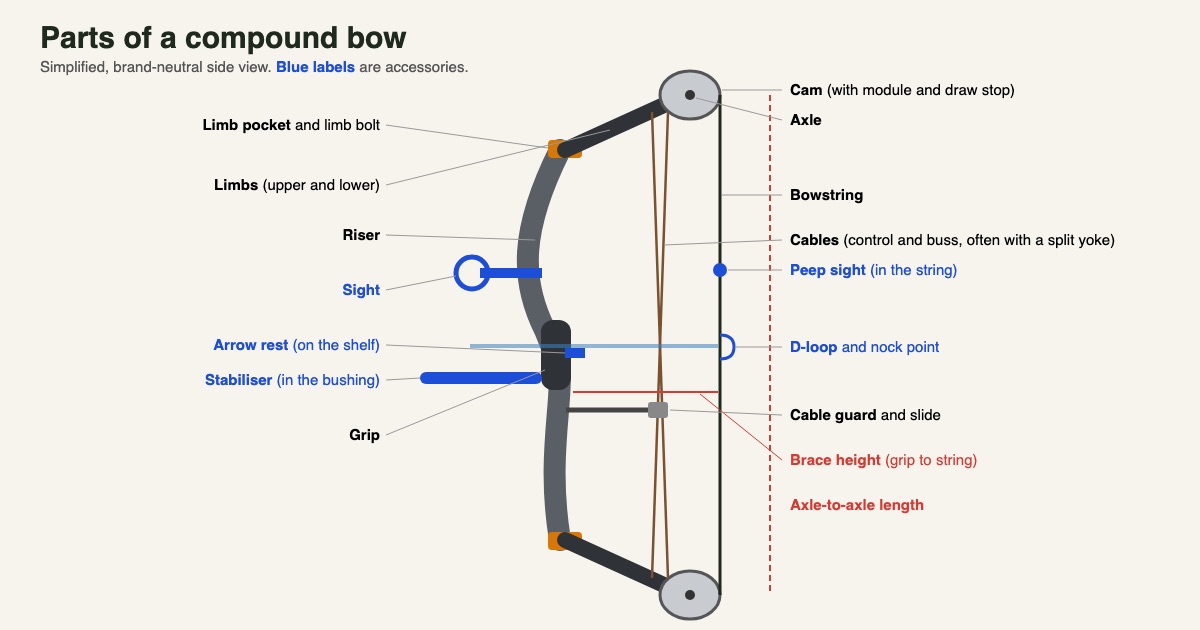
A labelled diagram of the parts of a compound bow: riser, limbs, cams, cables, cable guard and string, plus accessories, key measurements and safety notes.

By Archery Insider Editorial Team
· 10 min read
In this article
A compound bow has more parts than any other bow: cams, cables, a cable guard, limb pockets, modules and draw stops, plus all the accessories that bolt on. Knowing what each part is called and what it does makes it far easier to follow a setup guide, understand a spec sheet, talk to a pro shop and spot problems early.
This guide labels the parts of a compound bow in one diagram, explains what each does, covers the accessories that attach to the bow and string, explains the key measurements on a spec sheet, and flags the parts you shouldn't adjust yourself. Part names follow Hoyt's owner's manual and glossary, using generic terms where makers use brand names.
The bow itself
Riser
The riser is the central body of the bow, which everything else attaches to. Hoyt's parts list includes several features on it:
- Grip: where your bow hand sits; its deepest point is the pivot point used for measurements.
- Sight window: the cut-out above the grip.
- Shelf (Hoyt lists a "Silent Shelf Pad"): the ledge where the arrow rest sits.
- Stabilizer bushing: the threaded hole on the front of the riser for a stabiliser.
Limbs, limb pockets and limb bolts
The limbs flex as you draw and store the energy that launches the arrow. They sit in limb pockets on the riser and are held by limb weight adjustment bolts, which raise or lower draw weight. Hoyt's glossary notes that tiller adjustments "are made by adjusting either the top or bottom limb weight adjustment bolt." Hoyt's parts list also shows rockers, which help seat the limbs in the pockets on its bows.
Cams, modules, draw stops and axles
The cams (wheels) at the limb tips rotate as you draw. They shape the draw-force curve and create let-off; our let-off guide explains how. Each cam turns on an axle through the limb tip.
- Modules: Hunter's Friend explains that draw length is changed "by making an adjustment to a small metallic insert in the cam called a module," and is "NOT adjusted by altering the length of the bow's strings or cables."
- Draw stops: Archery 360 explains that at full draw "part of the cam hits a limb or cable, which stops the cycle." That creates the back wall you feel at full draw.
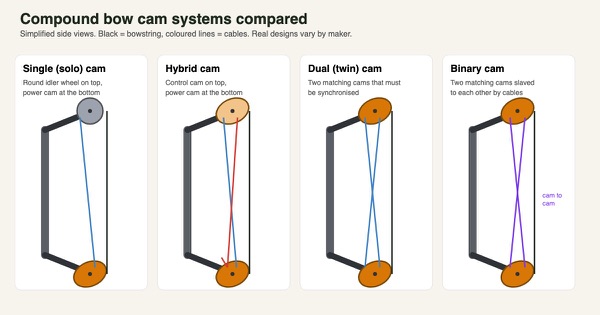
Bows use different cam systems (single, hybrid, dual or binary); our cam systems comparison explains them.
Bowstring and cables
The bowstring (Hoyt calls it the "shooting string") runs between the cams and launches the arrow. The cables connect the cams, either to each other or to the opposite limb or axle. Hoyt's parts list includes a control cable and a split yoke buss cable, whose split end attaches either side of the axle. Archery 360's history of the compound notes that cables "work with the cams as draw-force multipliers."
Cable guard and cable slide
The cables run past the arrow, so a cable guard (a rod from the riser) with a cable slide (or an in-line roller guard on some bows) holds them to one side so the arrow and fletching can pass. Hoyt's manual is clear: "Do not draw or shoot bow without the cable guard, cable slide and/or rollers properly installed."
Dampers and string stops
Many bows have limb dampers (Hoyt's are called LimbShox) and a string stop or suppressor (Hoyt's is called Stealth Shot), which reduce vibration and noise after the shot.
How the parts work together during a shot
- Drawing: you pull the string with a release aid on the D-loop. The cams rotate on their axles, the cables wrap and unwrap, and the limbs flex towards each other, storing energy.
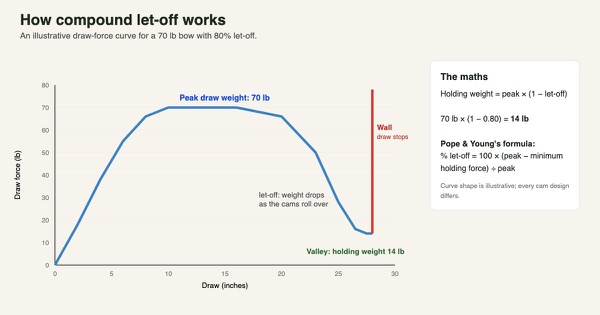
- Peak and let-off: the draw weight rises to its peak, then drops as the cams roll over into the valley.
- Full draw: the draw stops hit and you feel the wall. Your anchor, peep and sight line up, and the arrow sits on the rest.
- Release: the release lets go of the D-loop. The limbs spring back, the cams rotate the other way and the string drives the arrow forward.
- Arrow clears the bow: the arrow passes the rest while the cable guard holds the cables clear; then the string stop and dampers absorb leftover vibration.
Every part has to be set up and working for a clean, quiet, accurate shot, which is why inspection matters.
Accessories that attach to the bow
These are usually added separately, though many packages include them:
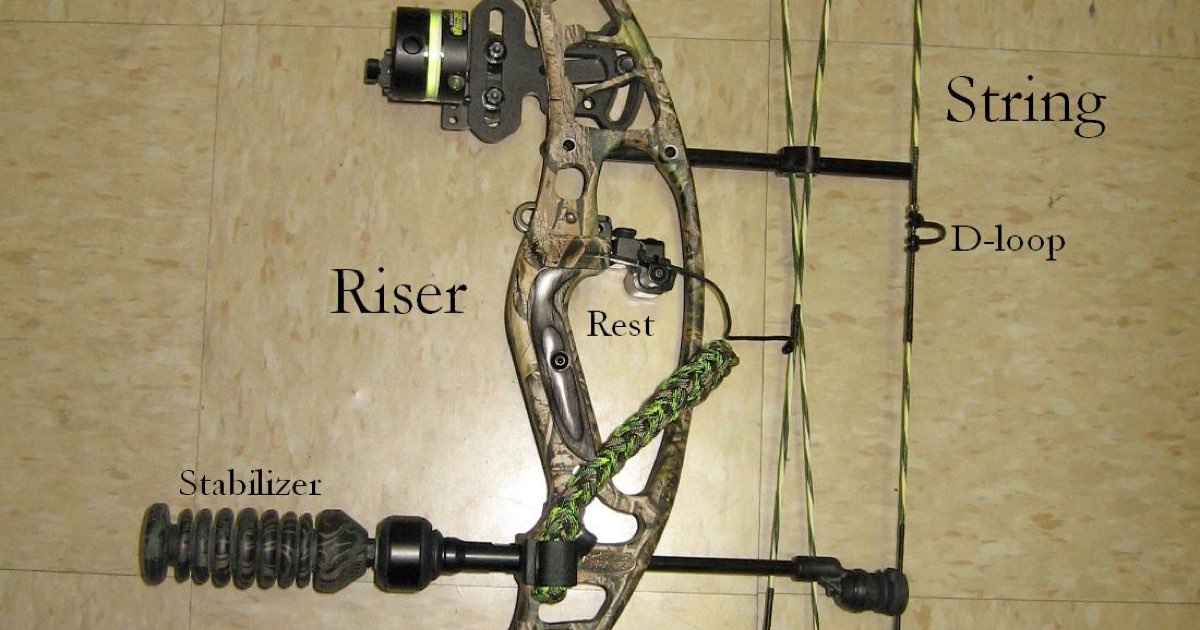
- Sight: mounted on the riser above the sight window; our single-pin vs multi-pin comparison and Trophy Ridge React Pro review explain sights.
- Arrow rest: mounted on the riser at the shelf; see our arrow rests guide and Whisker Biscuit review.
- Stabiliser: screws into the stabiliser bushing; see our stabilizer guide and Bee Stinger review.
- Quiver: often bow-mounted for hunting.
Things on the string
Hoyt's manual lists string accessories including "peep sight, kisser button, nock points, D-Loop, string silencers, string weights, and speed weights."
- Peep sight: a small aperture in the string that lines up your eye with the sight; see our kisser button and peep sight guide.
- D-loop: the loop your release aid clips to; see how to tie a D-loop and our release aid guide.
- Nock points: mark where the arrow sits on the string.
- Kisser button: an optional facial reference point.
- Silencers and string weights: reduce noise and vibration.

Key measurements on a spec sheet
| Measurement | What it means | Source |
|---|---|---|
| Axle-to-axle length | "The distance between the axles" | Archery 360 |
| Brace height | "The distance between the pivot point of the grip and the string at rest" | Hoyt glossary |
| Draw length (ATA) | From "the string's nock point to a vertical line through the pivot point of the grip, and adding 1 and 3/4 inches" | Hoyt glossary |
| Draw weight | The peak force needed to draw the bow | General definition |
| Let-off | The percentage drop from peak to holding weight | See our let-off guide |
Archery 360 notes that "hunting compounds typically measure 27 to 34 inches long, but target compounds generally are 34 to 40 inches long." As an example, Hoyt lists its 2026 RX-10 with a "30 1/2″ Axle-to-axle," a "6 1/8″ Brace height," a "25-30″ Draw length" range and a "40-80# Draw weight" range. Our brace height guide, draw weight vs draw length guide and draw length guide explain each measurement.
Reading a spec sheet: an example
Take Hoyt's published figures for its 2026 RX-10: a 30½-inch axle-to-axle length, a 6⅛-inch brace height, a 25 to 30-inch draw length range and a 40 to 80 lb draw weight range. Reading them with the parts in mind:
- Axle-to-axle: 30½ inches sits within the 27 to 34-inch range Archery 360 gives for hunting compounds.
- Brace height: the distance from the grip's pivot point to the string, which affects forgiveness and speed.
- Draw length range: set with the cam's module or settings, so check your draw length falls inside it.
- Draw weight range: set with the limb bolts, within the limbs' rated range.
Different names for the same parts
Makers and archers use different words for similar parts. Cams are also called wheels; the buss cable and control cable are sometimes just "the cables"; some bows use an in-line roller guard instead of a cable guard rod and slide; and dampers and string stops go by many brand names. If a manual or shop uses an unfamiliar term, ask which part they mean.
Hunting vs target compounds
The parts are the same, but they're set up differently:
- Length: Archery 360 notes hunting compounds are typically 27 to 34 inches axle to axle and target compounds 34 to 40 inches. Shorter bows are easier to manoeuvre in a stand or blind; longer ones are often steadier to aim.
- Accessories: hunting bows usually carry a short stabiliser, a pin sight, a containment or drop-away rest and a bow-mounted quiver. Target bows often use long stabilisers with side rods, a scope sight and a target rest.
- Let-off and feel: target archers often choose lower let-off for a firmer hold, as our let-off guide explains.
Parts to check before every session
- String and cables: fraying, broken strands, serving gaps.
- Cable slide: moving freely, not cracked.
- Limbs: cracks, splinters or lifting layers.
- Cams and axles: no bends, chips or loose clips.
- Accessories: sight, rest, stabiliser and quiver tight.
- Peep and D-loop: in position and undamaged.
Left- and right-handed compounds
Compounds are made in right-hand and left-hand versions. A right-handed bow is held in the left hand and drawn with the right, with the sight window, rest and cable guard arranged for that side. Choose based on your dominant eye and hand; a shop can help you check.
Safety: parts you shouldn't adjust yourself
- Limb bolts. Hoyt warns: "Never loosen your limb weight adjustment bolts more than 8 turns as it could cause the bow to violently disassemble." Other makers have their own limits.
- Cable guard and slide. Never draw the bow without them properly installed.
- Strings, cables and modules on many bows need a bow press to change; see how a bow press works.
- Cam timing and yoke adjustments are best left to a pro shop unless you have the tools; see our cam timing guide.
- Never dry fire a compound; see our dry firing guide.
Compound vs recurve parts
A recurve shares the riser, limbs, grip, sight window, rest and string, but has no cams, cables, cable guard or modules. Our parts of a recurve bow explains its parts, and our guide to how long a compound bow lasts explains which compound parts wear out.
Learning your compound's parts
Advantages
- Makes spec sheets and setup guides easy to follow
- Helps you inspect the bow and spot problems
- Helps you talk clearly with a pro shop
Trade-offs
- Brands use different names for similar parts
- Some parts need a press and expertise to adjust
You can browse compound bow accessory kits or drop-away arrow rests on Amazon.
Frequently asked questions
What are the main parts of a compound bow?
The riser, grip, limbs, limb pockets and bolts, cams and axles, bowstring, cables and cable guard, plus accessories such as a sight, rest, stabiliser, peep and D-loop.
What is the riser on a compound bow?
The central body of the bow, which holds the grip, sight window, shelf and stabiliser bushing, and to which the limbs attach.
What do the cables on a compound bow do?
They link the cams and work with them to control the draw. Archery 360 describes them as "draw-force multipliers."
What is a cable guard?
A rod, usually with a slide or rollers, that holds the cables to one side so the arrow can pass. Hoyt warns not to draw the bow without it installed.
What is axle-to-axle length?
The distance between the bow's axles. Archery 360 says hunting compounds are typically 27 to 34 inches and target compounds 34 to 40 inches.
What is brace height?
The distance between the pivot point of the grip and the string at rest.
What's the difference between a cam and an idler wheel?
A cam is shaped to change the draw force and create let-off; an idler wheel is round and guides the string, as on top of a single-cam bow.
What is a limb pocket?
The fitting on the riser that holds each limb in place. The limb bolt passes through it and is used to adjust draw weight.
What is a module on a compound bow?
A small insert or rotating part of the cam that sets draw length. Hunter's Friend notes draw length is changed with the module, not by altering the string or cables.
Related articles
 Guides
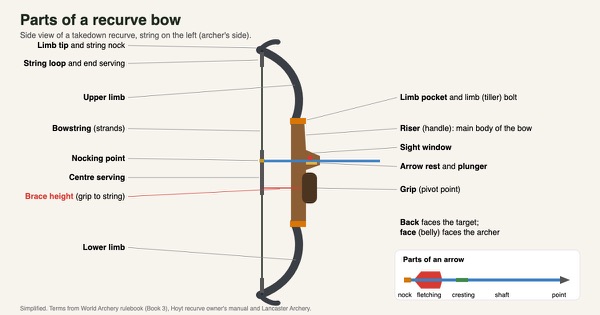
Parts of a Recurve Bow: Diagram and Terms
A labelled diagram of the parts of a recurve bow: riser, limbs, limb bolts, sight window, rest and plunger, plus the bowstring, measurements and arrow parts.
October 25, 2026 · 9 min read
 Comparisons
Single Cam vs Dual Cam vs Hybrid Cam Bows Explained
Single cam vs dual cam vs hybrid and binary cam bows: how each system works, timing, nock travel, speed, maintenance, a short history, and how to choose.
November 2, 2026 · 10 min read
 Gear
Compound Bow Let-Off Explained: 65%, 80% and 90%
What compound bow let-off is, how cams create it, how it's measured, holding weights at 65 to 90 per cent, adjustable let-off, zero let-off bows and the rules.
November 3, 2026 · 10 min read