
How Does a Bow Press Work? Types and Safety
How a bow press works, what it is used for, the main types, which presses Mathews, Elite and Bear allow, crossbow presses, safety, and whether you need one.

By Archery Insider Editorial Team
· 9 min read
In this article
A compound bow's limbs are always under tension, even when the bow is at rest. That is why you can't simply slip the string off a compound the way you can with a recurve. A bow press is the tool that safely takes that tension off, by flexing the limbs so the string and cables go slack and can be worked on.
This guide explains how a bow press works, what pro shops use one for, the main types, the press rules set by major bow makers, crossbow presses, safety, and whether you need your own press.
What a bow press is used for
Nock On Archery lists the main jobs as string replacement, peep adjustment and serving repair. In more detail, a press lets a shop or experienced archer:
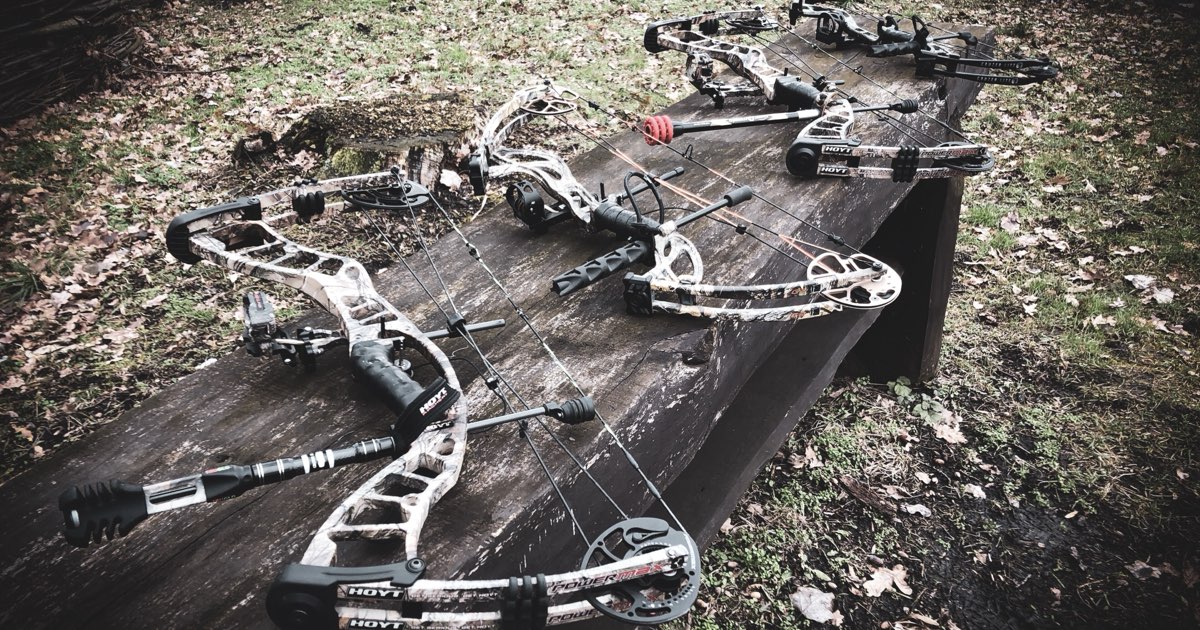
- Replace strings and cables, the most common reason; see how long bow strings last.
- Install a peep sight or turn it by adding or removing twists in the string; our kisser button and peep sight guide explains why a peep may need rotating.
- Repair or replace serving.
- Adjust cam timing on bows that need twists in the cables, the kind of cam and cable work our paper tuning guide mentions.
- Change draw-length modules on some bows (many modern bows don't need a press for this, so check your manual).
- Install a D-loop or speed nocks on a new string.
How a bow press works
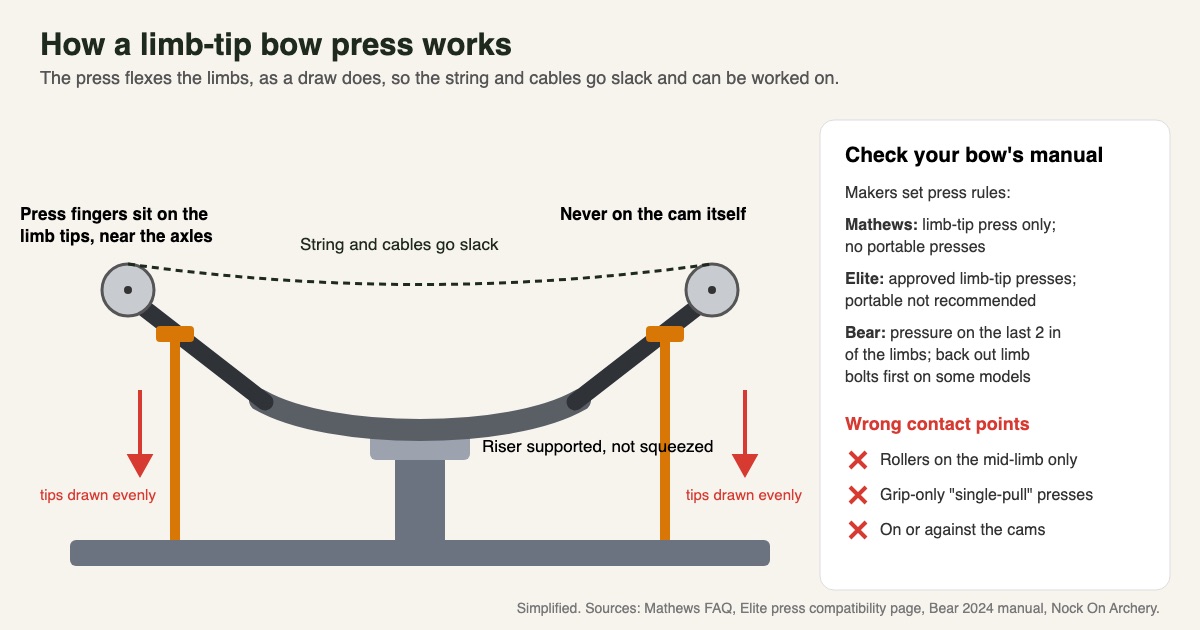
When you draw a compound bow, the limbs bend towards each other and the string tension is taken up by the cams. A bow press does the same thing mechanically. The bow sits in the press with the riser supported, and press fingers or arms contact the limb tips, near the axles. As the operator turns a handwheel or crank, the fingers draw the limb tips evenly, flexing the limbs. With the limbs flexed, the string and cables lose tension and can be removed or adjusted. Reversing the handwheel lets the limbs relax again under control.
Last Chance Archery describes its limb-tip system this way: it "presses the bow from the limb tips, resulting in less stress to the bow's riser and eliminating torque." Nock On Archery's rule of thumb is to "use your bow press to compress the limbs, not the riser," with contact on "the limb directly in line with the axle area," and to "never press on or near the cam."
Types of bow press
| Type | How it contacts the bow | Notes |
|---|---|---|
| Bench-mounted limb-tip (linear) press | Fingers on the limb tips near the axles; riser supported | The standard type for modern compounds; many makers require it |
| Older mid-limb roller presses | Rollers press on the middle of the limbs | Bear says these "CANNOT BE USED" on its bows |
| Grip-contact "single-pull" presses | Contact only at the grip area | Bear warns they "can result in bent or broken risers" |
| Portable presses | Cable or strap systems that hook the limbs | Mathews and Elite say not to use them on their bows |
| Crossbow presses | Designed for crossbow limbs; often brand-specific | Ravin's press is "designed exclusively for use on all Ravin Crossbow models" |
Limb-tip presses and past-parallel limbs
Many modern compounds have limbs that sit near or beyond parallel at full draw. Elite explains that "due to the 'beyond parallel' nature of some Elite bows, a portable bow press is not recommended." Some bench presses have adjustable limb supports designed for past-parallel bows so the bow does not slip in the press.
Check your bow maker's press rules
The most important point in this guide: bow makers specify which presses can be used on their bows, and using the wrong one can damage the bow and affect the warranty.
| Maker | What they say |
|---|---|
| Mathews | "Only a limb tip press should be used on your Mathews bow." "Portable bow presses should not be used on your Mathews bow." |
| Elite | "Elite bows should only be pressed with a 'limb tip' style bow press," with a list of approved presses; "a portable bow press is not recommended." |
| Bear | Only presses "capable of applying pressure to the last 2" of the limbs should be utilized." Limb bolts must be backed out several turns first on some limb types. "The use of any bow press other than those approved by Bear Archery will void this warranty." |
Other makers have their own rules, which are usually in the owner's manual or on the support pages. If you are unsure, ask the manufacturer or a dealer before pressing a bow.
Bow press safety
A press holds a great deal of stored energy. A bow that slips out of a press can cause serious injury and damage. These general rules come from press makers and manufacturers' manuals:
- Wear safety glasses. Ravin's press manual says: "Always wear safety glasses."
- Use the right press for the bow, with the correct adapters or fingers.
- Follow the bow maker's steps, such as backing out limb bolts before pressing where Bear requires it.
- Place the fingers correctly on the limb tips, near the axles, never on the cams or the outer edges of the limbs.
- Check the bow is centred and the limb tips are even before compressing. Last Chance says to "confirm limb tips are equal before pressing."
- Compress only as far as needed. Ravin warns: "Do not over-compress the limbs."
- Keep hands clear of pinch points, and never stand directly over the limbs.
- Don't leave a bow in the press longer than necessary. Last Chance says to "never leave bows under pressure longer than necessary," and Nock On notes that "unnecessary pressing puts additional stress on components."
- Release slowly and check that strings and cables are seated in the cam tracks before letting the bow out.
What to check after a bow comes out of the press
Whoever does the work, check these before you shoot:
- Strings and cables seated in the cam tracks at both ends, with nothing twisted across a track.
- Peep sight sitting square to your eye at full draw.
- Cam timing marks (if your bow has them) where the manual says they should be.
- Draw length and draw weight still as intended.
- D-loop, nocking point and rest in their original positions.
- Sight marks, confirmed by shooting at known distances, because a string change can move your point of impact.
Crossbow presses
Crossbow limbs are short and very stiff, and many modern crossbows are designed around specific presses. TenPoint says: "You need a specially made bow press to change the string and cables on your crossbow." Ravin's press is "designed exclusively for use on all Ravin Crossbow models," and its manual says: "Do not use the Ravin Multi Press on any other crossbows." The same manual recommends that, unless you have significant experience, you have string and cables replaced at a pro shop or by Ravin's service department. Our crossbow maintenance checklist covers what owners can do at home.
Bow press and draw board
Many shops pair a bow press with a draw board, a bench device that draws the bow mechanically so a technician can watch the cams at full draw. The press is used to make adjustments; the draw board is used to check the result, such as cam timing and draw length. Together they let a shop set up a bow precisely.
Do you need a bow press for a recurve or longbow?
No. Recurves and longbows are strung and unstrung with a bow stringer, a cord with pockets or a saddle that lets you bend the limbs safely by hand. Our recurve stringing guide explains how. Never use a compound press on a recurve.
Do you need your own bow press?
Most compound archers don't. A pro shop already has a suitable press, the right adapters and the experience to set timing and draw length after a string change. Owning a press makes more sense if you:
- Shoot a lot and change strings, peeps and D-loops regularly.
- Tune your own bows and have the knowledge to do it safely.
- Live far from a pro shop.
What affects the cost of a press
We don't quote prices, but presses vary widely because of:
- Construction: heavy steel frames and precision screws cost more.
- Compatibility: adapters for past-parallel limbs, different limb widths or crossbows.
- Features: quick-adjust fingers, built-in draw boards and mounting options.
- Manufacturer approval: presses on makers' approved lists.
Remember to check your bow maker's approved list before you buy.
Can you replace a compound string without a press?
You shouldn't. Some archers use string-splitting tricks or portable devices, but Mathews and Elite specifically say not to use portable presses on their bows, and a compound's stored energy makes improvised methods dangerous. The safe options are a proper press or a pro shop. For crossbows, TenPoint and Ravin say a specific press is needed.
If your bow has been dry fired and the string came off, don't try to re-string it yourself; see our guide to dry firing a bow.
Owning a bow press
Advantages
- Change strings, peeps and D-loops at home
- Make timing adjustments on your own schedule
- Useful if you live far from a pro shop
Trade-offs
- A significant purchase for occasional use
- Must match your bow maker's rules and adapters
- Real risk of injury or damage if used incorrectly
You can browse bow presses or recurve bow stringers on Amazon.
Frequently asked questions
What is a bow press used for?
Replacing strings and cables, installing or turning a peep sight, repairing serving, and some cam timing and draw-length adjustments.
Can I use any bow press on my compound?
No. Bow makers specify suitable presses. Mathews and Elite say limb-tip presses only; Bear bans mid-limb roller and grip-only presses. Check your manual.
Are portable bow presses safe?
Mathews and Elite say not to use portable presses on their bows. Check your own bow maker's guidance before using one.
Do I need a bow press for a recurve or longbow?
No. Use a bow stringer.
Can I replace a compound string without a press?
You shouldn't. Use a suitable press or a pro shop.
Do crossbows need a special press?
Yes. TenPoint says a specially made press is needed, and Ravin's press is designed only for Ravin crossbows.
Why are bow presses expensive?
Heavy-duty construction, precision parts, adapters for different bows and crossbows, and manufacturer approval all add cost.
Related articles
 Gear
How Long Do Bow Strings Last? When to Replace Them
How long do bow strings last? What Hoyt, Bear and string makers recommend, how storage affects strings, signs of wear, and when to replace string and cables.
October 19, 2026 · 10 min read
 Gear
Kisser Button and Peep Sight: What They Do, Where They Go
Kisser buttons and peep sights explained: what each does, where they go, how to install and tie in a peep, fixing peep rotation, and kisser vs nose button.
October 9, 2026 · 8 min read
 Training
Paper Tuning a Bow: How to Read Tears and Fix Them
How to paper tune a bow: what it shows, frame setup, reading nock-high, low, left and right tears, the order of fixes, and when to see a pro shop.
October 8, 2026 · 10 min read