
How Long Does a Compound Bow Last? Parts and Warranties
How long does a compound bow last? Which parts wear out, what Hoyt, Mathews, Bowtech and Bear warranties cover, signs a bow is unsafe, and buying used.

By Archery Insider Editorial Team
· 9 min read
In this article
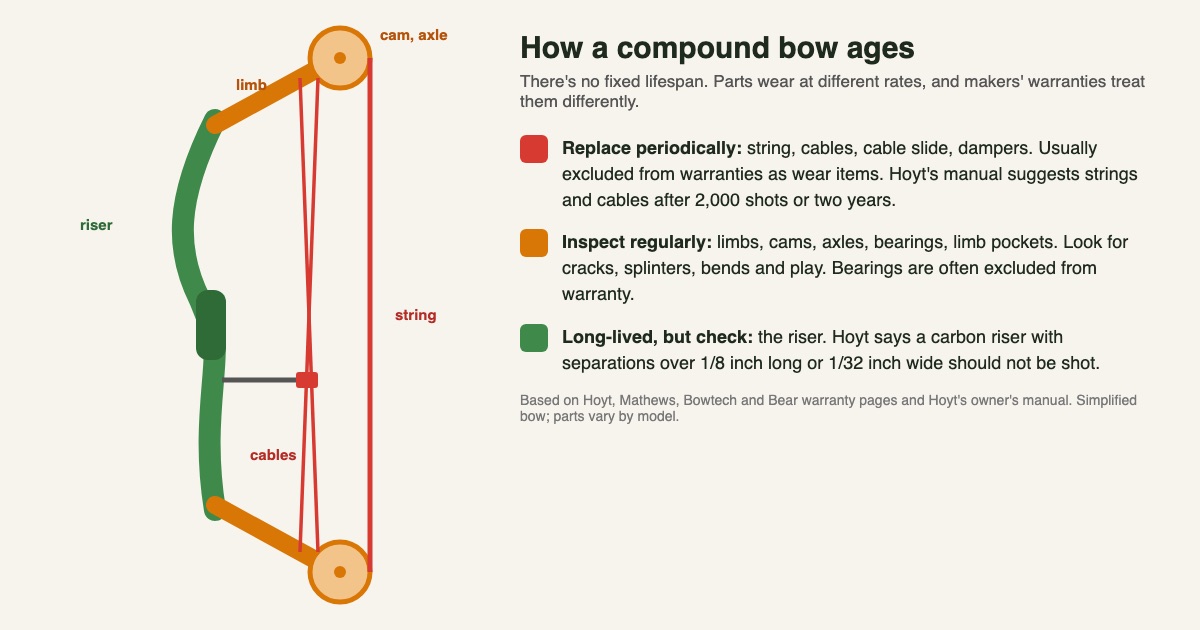
Search for how long a compound bow lasts and you'll find confident numbers: 15 years, 25 years, even 50. None of them come from the people who make bows. The honest answer is that there is no fixed lifespan. A compound is a set of parts that wear at different rates. Strings and cables are consumables; limbs, cams and axles need regular inspection; the riser usually outlasts everything else. How long a bow lasts depends on how it's used, stored and maintained, and on whether you can still get parts.
This guide explains what wears out, part by part, what major manufacturers' warranties cover (and what they exclude), what shortens a bow's life, the signs a bow is unsafe, and what to check when buying used. Warranty terms were checked on manufacturer pages in October 2026; always read the current terms for your bow.
The short answer: no fixed lifespan
A well-made compound can give many years of service if it's maintained, stored properly and never dry fired. But "the bow" isn't one thing. Some parts are expected to be replaced regularly, others should last much longer if nothing goes wrong. The question is really how long each part lasts, and whether you can keep the bow safe and supplied with parts.
What wears out, part by part
| Part | How it ages | What to do |
|---|---|---|
| String and cables | Stretch, fray and dry out; excluded from warranties as wear items | Wax, inspect, replace on schedule or when worn |
| Cable slide, dampers, suppressors | Wear with use | Replace as needed |
| Bearings | Can wear or become rough; often excluded from warranty | Check for roughness or play during inspection |
| Limbs | Can crack, splinter or delaminate, especially after damage or heat | Inspect regularly; stop shooting if damaged |
| Cams and axles | Can bend or chip, especially after dry fires or drops | Inspect; have a shop check timing |
| Riser | Usually the longest-lived part | Check for cracks; Hoyt gives limits for carbon riser separations |
Strings and cables
Strings and cables are the parts you will replace most often. Hoyt's owner's manual recommends replacing "your string and cables after 2,000 shots or after two years, whichever comes first." Our guide to how long bow strings last covers the details, and our string wax guide explains how to make them last.
Limbs
Limbs store the bow's energy and flex on every shot. Archery 360 warns that "storing your bow in direct sunlight or high heat can affect the epoxies that are in your limbs," and that "deep scratches on your limbs can affect their integrity because of moisture." Inspect limbs for cracks, splinters and lifting layers, especially near the tips and pockets.
Cams, axles and bearings
Cams can be bent or chipped by dry fires, drops and knocks. Axles can bend, and bearings can wear. A shop can check cam timing and lean; see our cam timing guide.
Riser
The riser is usually the most durable part. Hoyt's manual gives a specific limit for carbon risers: separations over "1/8 inch in length and/or wider than 1/32 inch" mean "the bow should not be shot."
What manufacturer warranties tell you
Warranties are the clearest evidence of how long makers expect their parts to last. Terms change, so check the current page for your bow.
| Maker | Coverage | Who and when | Key exclusions |
|---|---|---|---|
| Hoyt | Riser, limbs, limb pockets and cams; lasts "as long as you own your Hoyt bow" | First buyer only; register "within thirty (30) days" | Strings, cables, bearings, damping materials, finish; arrows under 5 grains per pound |
| Mathews | Lifetime warranty to the Original Registered Owner | Register "within three (3) months" | Strings, cables, suppressors, dampers; wear and tear, misuse, dry fires, alteration, improper storage |
| Bowtech | "Non-transferable lifetime warranty to the registered original owner" | Original owner; internet purchases not covered unless from an authorised dealer's site | Cable slide, cables, strings, hush kit, bearings, finishes; abuse, dry firing; arrows under 5 grains per pound |
| Bear | Limbs: "100% covered for the first 5 years, 50% of replacement cost after"; risers and cams: lifetime | Original owner; register "within 30 days of purchase" | Unapproved bow presses void the warranty |
Hoyt also notes that "if original parts are not available, suitable replacement parts or components may be used." That's a hint at the real limit on an old bow's life: parts.
Registering a new bow
Because warranties depend on registration, do it straight away. Hoyt and Bear ask for registration within 30 days, and Mathews within three months. Keep your receipt, note the serial number, and buy from an authorised dealer: Bowtech, for example, says bows bought online are not covered unless bought through an authorised dealer's own website. Registering also makes it easier to prove ownership if the bow is ever lost or stolen.
Things that shorten a bow's life
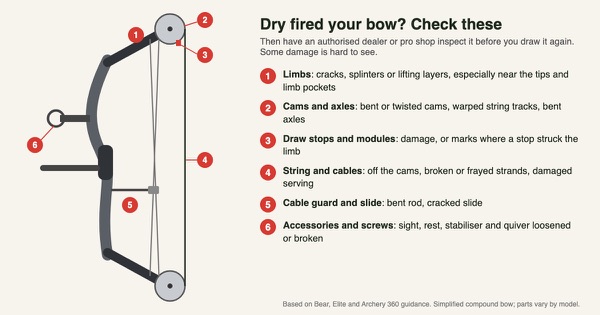
- Dry firing. Mathews and Bowtech exclude dry-fire damage, and Hoyt's manual warns "there could be both seen and unseen damage." See our dry firing guide.
- Light arrows. Hoyt and Bowtech exclude damage from arrows under 5 grains per pound of draw weight; see our arrow weight guide.
- Heat and sun. Hot cars and attics can damage limb epoxies and strings.
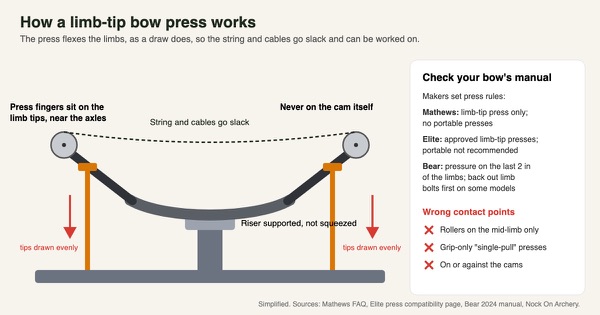
- The wrong bow press. Bear says unapproved presses void its warranty; see how a bow press works.
- Neglect. Dry strings, loose screws and skipped inspections let small problems grow.
- Poor storage. A good case protects against knocks; our Plano PillarLock review explains one option.
Signs your bow is unsafe to shoot
Stop shooting and have the bow inspected if you see or notice:
- Cracks, splinters, chips or lifting layers in the limbs.
- Bent, cracked or chipped cams, or bent axles.
- Frayed or broken strands in the string or cables, or serving separation.
- Separations or cracks in the riser.
- A dry fire, a hard drop or a string coming off the cams.
- Sudden changes in draw weight, draw length, noise or feel.
Hoyt recommends taking the bow "to a Genuine Hoyt Retailer at least once a year" for inspection of "axles, spacers, e-clips, strings, cables, limbs, cams, pockets, pocket rockers and slides, and riser." That's good advice for any brand.
A yearly routine to keep a bow going
- Every session: check the string, cables and limbs; wax the string when it feels dry.
- Every few months: check that screws and accessories are tight, and that cam timing marks haven't moved.
- Once a year: take the bow to a pro shop for a full inspection, as Hoyt recommends.
- On schedule or when worn: replace the string and cables, and re-tune afterwards.
- Always: store the bow cased, cool and dry, and never dry fire it.
Old bows: strings and parts
Archery 360's article on old bows highlights two common problems. First: "One of the primary issues that affects old compound bows is that they remain strung at all times," and "what usually happens with old compound bows that sit around for years is the string or a cable dries out and then breaks." Second: "Manufacturers quit making parts for discontinued models after a certain period." Its advice for an unfamiliar old bow is to take it "to an archery pro shop and have them assess it."
A bow you no longer use
If you're putting a bow away for a long time, wax the string and cables, case it and store it somewhere cool and dry. Before shooting it again, inspect it carefully, and have a shop check it if it has been stored for years. If you're selling or passing it on, be honest about its age, history and any dry fires, and suggest the new owner has it inspected.
Buying a used compound
A used bow can be good value, but check carefully:
- Inspect the limbs for "gouges, splinter and cracks," and the cams for "chips, bends, sharp edges and cracks," as American Hunter advises.
- Have the seller draw and let down the bow (with an arrow, at a target) and listen for odd noises.
- Check the string and cables; plan to replace them if they're old or worn.
- Check draw length and draw weight suit you, and whether modules are available.
- Check parts availability for the model.
- Remember the warranty probably won't transfer. Hoyt, Mathews, Bowtech and Bear all limit cover to the original owner.
- Get a shop inspection before you rely on it.
Repair or replace?
If a bow fits you, shoots well and parts are available, replacing strings, cables or even limbs is often worthwhile. Consider replacing the bow if parts aren't available, the riser is damaged, or the bow no longer suits your draw length or draw weight. Our IBO speed guide explains how much real speed newer bows offer, and our 2026 launches article shows what current models look like.
Keeping an older compound
Advantages
- Familiar bow you already shoot well
- Strings, cables and some parts can be replaced
- Saves the cost of a new bow
Trade-offs
- Parts may be unavailable for discontinued models
- Warranties usually end with the original owner
- Older designs may be slower or less adjustable
You can browse bowstring wax or compound bow cases on Amazon.
Frequently asked questions
How long does a compound bow last?
There's no official lifespan. With maintenance, careful storage and available parts, a compound can serve for many years, but strings and cables need regular replacement.
Do compound bow limbs wear out?
They can be damaged by heat, deep scratches, dry fires and knocks. Bear covers limbs 100% for five years, then 50%; Hoyt, Mathews and Bowtech offer lifetime cover on key parts for the original owner.
Is a 10-year-old compound bow still safe?
It can be, if it passes a pro-shop inspection and the strings and cables are in good condition. Old strings that have dried out are a common failure point.
Can I get parts for an old compound bow?
Sometimes. Archery 360 notes manufacturers stop making parts for discontinued models after a time, and Hoyt says suitable replacements may be used if originals aren't available.
Does a bow warranty transfer if I buy used?
Usually not. Hoyt, Mathews, Bowtech and Bear limit cover to the original owner.
How often should strings and cables be replaced?
Hoyt's manual suggests after 2,000 shots or two years, whichever comes first, or sooner if worn.
Is it bad to leave a compound bow strung?
Compounds are designed to stay strung. Archery 360 notes old bows that sit strung for years often suffer dried-out strings, so keep them waxed and inspected.
What voids a compound bow warranty?
Common exclusions include dry fires, misuse, alteration, unapproved bow presses (Bear) and arrows lighter than 5 grains per pound (Hoyt and Bowtech). Check your bow's own terms.
Should I replace limbs or the whole bow?
If the riser and cams are sound, parts are available and the bow fits you, replacing damaged limbs can make sense. If parts aren't available or the riser is damaged, replacing the bow is usually the safer choice.
Related articles
 Gear
How Long Do Bow Strings Last? When to Replace Them
How long do bow strings last? What Hoyt, Bear and string makers recommend, how storage affects strings, signs of wear, and when to replace string and cables.
October 19, 2026 · 10 min read
 Gear
Dry Firing a Bow: What Happens and What to Do
What dry firing a bow means, what it can damage on a compound or recurve, what to do right away, why a bow that looks fine still needs checking, and warranties.
October 20, 2026 · 9 min read
 Gear
How Does a Bow Press Work? Types and Safety
How a bow press works, what it is used for, the main types, which presses Mathews, Elite and Bear allow, crossbow presses, safety, and whether you need one.
October 20, 2026 · 9 min read