
Kisser Button and Peep Sight: What They Do, Where They Go
Kisser buttons and peep sights explained: what each does, where they go, how to install and tie in a peep, fixing peep rotation, and kisser vs nose button.

By Archery Insider Editorial Team
· 8 min read

In this article
A bow sight is only half of an aiming system. The other half is your eye's position behind the string, and that depends on your anchor. Two small pieces of kit help you repeat that anchor exactly: a peep sight, a small aperture tied into the bowstring that you look through, and a kisser button, a small disc on the string that touches the corner of your mouth at full draw.
This guide explains what each does, where they go, how a peep is installed and tied in, how to stop a peep rotating, the difference between kisser and nose buttons, and the problems to watch for.
The quick answer
| Peep sight | Kisser button | |
|---|---|---|
| What it is | A small aperture set between the strands of the bowstring | A small plastic or rubber disc clipped to the string |
| What it does | Lines up your eye with the sight, like a rear sight on a rifle | Gives a touch reference at the corner of your mouth |
| Who uses it | Compound archers with sights; some sighted recurve archers | Compound and recurve archers, especially those without a peep |
| Main benefit | Precise, repeatable eye position | Consistent anchor height |
| Main drawback | Can rotate, and limits light at dawn and dusk | Can interfere with the lips or release if set badly |
What a peep sight does
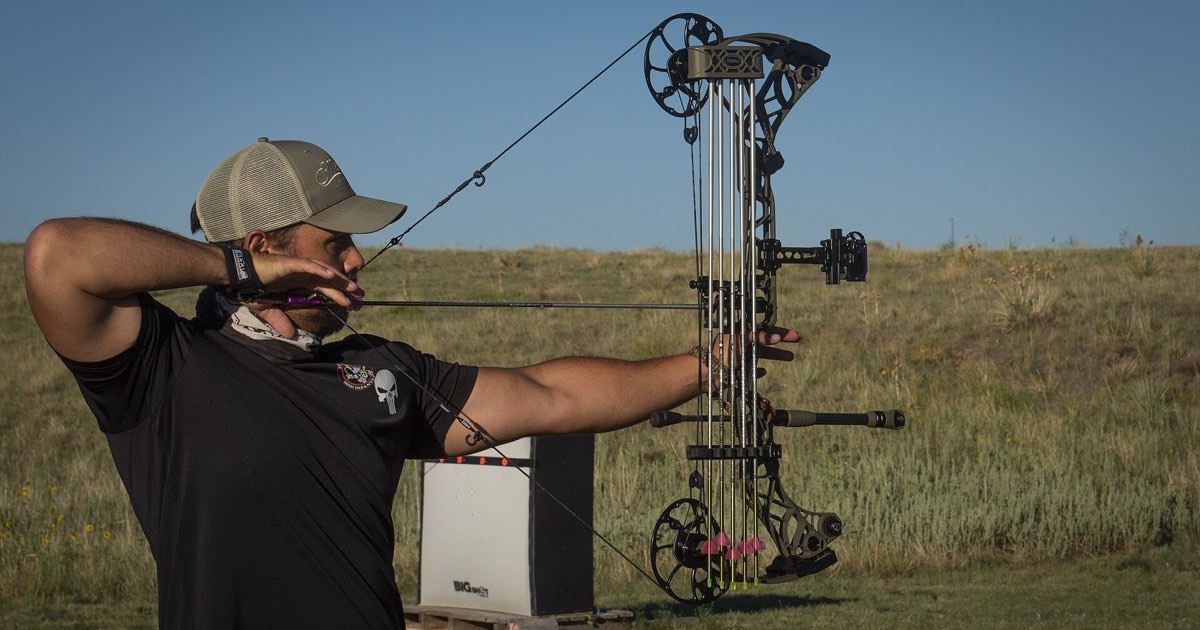
When you aim with a sight, the pin is your front sight. Without a rear reference, a slightly different head position or anchor changes where you are really aiming. A peep fixes that: at full draw you look through the small hole in the string, centre the sight housing in it, and put the pin on the target. If your eye is not in the same place, the housing will not centre and you know something is off before you shoot.
Peep size
Peeps come with different aperture sizes. A smaller hole gives a sharper, more precise sight picture; a larger hole lets in more light, which helps when hunting at dawn and dusk. Nock On Archery's tie-in guide uses a 3/16-inch peep as its example. Target archers often choose smaller apertures; hunters usually choose larger ones.
Tube or tubeless
Some peeps attach to the cable with a rubber tube that pulls them straight at full draw. Others are tubeless and rely on correct string twist to line up. Tubes are reliable but can make noise or snap; tubeless peeps are simpler but must be set carefully.
Where the peep goes
Nock On Archery suggests "approximately 6 inches works well for most adult archers" above the nocking point, but notes it depends on your anatomy and anchor. The right height is wherever your eye naturally lines up at your anchor, not where the peep ends up when you crane your neck.
To find it:
- Draw to your normal anchor with your eyes closed. Settle into your natural head position.
- Open your aiming eye.
- Have a helper mark the string level with your eye, or note where the peep sits if one is already installed.
- Adjust the peep until it is in front of your eye without moving your head.
How a peep is installed
Nock On Archery's procedure, in outline:
- Put the compound bow in a bow press and relieve string tension.
- Find the centre of the string and separate the strands evenly at the marked height. If the peep is not in the centre of the strands, it is more likely to spin.
- Insert the peep between the two bundles.
- Slowly release the press so tension holds the peep.
- Draw and check the position, then press the bow again and adjust if needed.
- Tie it in with serving thread. Nock On's method stacks alternating overhand and underhand knots tightly against the peep, building "a solid column of 22 complete knots", then adds a safety tie through the peep's grooves.
Fixing a peep that rotates
A tubeless peep that comes back tilted at full draw is a common problem. Nock On explains that "for every complete revolution (twist) you add to your bowstring, the peep will rotate approximately one quarter turn," and recommends "always add twists to your string rather than removing them." Twisting the string requires a bow press. After any change, re-check draw length, peep height and your sight marks.
What a kisser button does
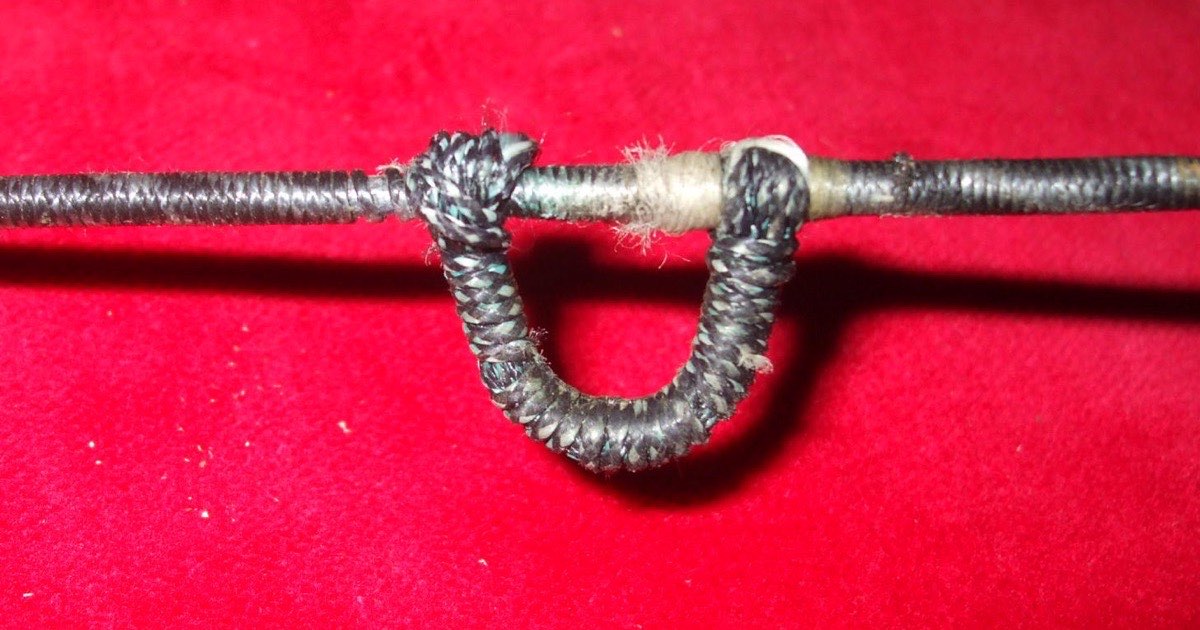
Legend Archery describes a kisser button as "a small disc or nock that sits on the bowstring and touches the corner of your mouth at full draw." It gives "a reliable tactile reference point every single shot" and confirms your vertical anchor, but it is a check, not a replacement for good form.
Kisser buttons are useful for:
- Recurve and barebow archers who anchor at the corner of the mouth or under the chin.
- Compound archers who want a second check alongside the peep.
- Archers rebuilding form, who need a clear signal that they have reached the same anchor.
Where the kisser goes
Legend Archery advises that the button should touch "the corner of your mouth, specifically the commissure, the point where your lips meet" at full draw. Some archers prefer a point on the lower lip; consistency matters more than the exact spot.
- Clip the kisser loosely onto the string. Most "open along one edge to clip onto the string without needing to remove any hardware."
- Draw to your full anchor, ideally with a helper.
- Have the helper slide the button until it sits comfortably at the corner of your mouth.
- Lock it in place with its locking mechanism or small clamps.
- Shoot and confirm it touches the same place every time.
Legend Archery's key warning: "Do not eyeball it while the bow is undrawn."
Using a peep and a kisser together
If you use both, they must agree. Legend Archery's advice is to "set your peep first, then fit the kisser button to match." If the peep lines up but the kisser is high or low, move the kisser, not your head. If you have to stretch to reach either one, your draw length or anchor may be wrong.
Kisser button vs nose button
A nose button works the same way but touches "the bridge or tip of the nose", in Legend Archery's words. It is "common in traditional shooting where face contact with the string is normal," and some compound archers use a string-to-nose touch as an extra check. Either works, as long as it is repeatable.
Common problems and fixes
| Problem | Likely cause | Fix |
|---|---|---|
| Peep comes back tilted | String twist or uneven strands | Add twists to the string on a bow press, or use a tube |
| Sight housing not centred in the peep | Head position or peep height | Re-set peep height at your natural anchor |
| Peep too dark at dawn | Aperture too small | Fit a larger aperture for hunting |
| Kisser touches different spots | Inconsistent anchor or button set while undrawn | Re-set at full draw; work on anchor consistency |
| Kisser hits the lips on release | Button too large or set too close to the mouth | Use a smaller button or adjust position |
| You "chase" the kisser with your face | Kisser set in the wrong place | Move the kisser to meet your natural anchor |
Rules and competitions
Peeps and kisser buttons are widely allowed in sighted compound divisions. Classes without sights, such as barebow and most traditional classes, generally do not use peeps. Check the rules for your class before competing; our barebow guide explains how sightless classes work.
Peep sight
Advantages
- Precise, repeatable eye position
- Makes sight pins far more effective
- Inexpensive
Trade-offs
- Can rotate if the string is not set up well
- Small apertures darken the view in low light
- Installation needs a bow press
Kisser button
Advantages
- Simple, cheap check of anchor height
- Works for compound and recurve
- Easy to fit and adjust
Trade-offs
- Can interfere with the lips or release
- Must be set at full draw to be useful
- Not a substitute for a consistent anchor
You can browse peep sights, kisser buttons or bow presses on Amazon. Check aperture size and string compatibility before buying.
Frequently asked questions
Where should a kisser button be placed?
At the corner of your mouth at full draw, set while drawn to your normal anchor. Lock it once it touches the same spot every shot.
How high should a peep sight be?
About 6 inches above the nocking point is a common starting point for adults, but set it where your eye naturally lines up at your anchor.
Do I need a peep sight on a compound bow?
If you shoot with a sight, a peep makes your aim far more repeatable. Some archers shoot compounds without one, but most sighted compound archers use a peep.
Why does my peep sight rotate?
Usually string twist or uneven strands. Adding twists to the string on a bow press, or using a peep tube, fixes it.
Can I use a kisser button on a recurve?
Yes. Many recurve and barebow archers use a kisser to confirm their anchor height.
Related articles
 Comparisons
Single-Pin vs Multi-Pin Bow Sights: Which Should You Choose?
Single-pin vs multi-pin bow sights compared: fixed pins vs sliders, speed in the field, long-range precision, low light, gap shooting, hybrids and scopes.
February 25, 2026 · 5 min read
 Training
How to Aim a Bow: Sights, Gap and Instinctive
How to aim a bow: eye dominance, anchor points, sights, gap shooting, string walking, face walking and instinctive aiming, with practice drills for each.
October 7, 2026 · 11 min read
 Training
Archery Form: 11 Steps to a Consistent Shot
Archery form step by step: stance, hook and grip, set-up, draw, anchor, transfer, aiming, release and follow-through, plus common faults and fixes.
Updated March 21, 2025 · 10 min read