
Compound Bow Let-Off Explained: 65%, 80% and 90%
What compound bow let-off is, how cams create it, how it's measured, holding weights at 65 to 90 per cent, adjustable let-off, zero let-off bows and the rules.

By Archery Insider Editorial Team
· 10 min read
In this article
Let-off is the reason compound bows feel so different from recurves. Draw a 70 lb compound and the weight builds to a peak, then suddenly drops as the cams roll over, leaving you holding a fraction of that weight at full draw. That lets you aim calmly, hold longer and shoot heavier draw weights than you could manage with a recurve.
This guide explains what let-off means, how cams create it, how it's measured, how much weight you actually hold at different let-off settings, whether you can adjust it, zero let-off bows, and what competition and record-book rules say.
What let-off means
Hunter's Friend explains: "The amount of let-off a bow achieves is properly expressed as a percent of the peak weight. So if a bow has a 60 pound peak draw weight and 50% let-off, it would require only 30 pounds of pressure to hold at full draw." Modern bows typically have much higher let-off than that example.
Archery 360 describes how cams "roll over during the draw cycle to reduce the bow's draw weight at full draw," adding that let-off "goes as high as 90%, meaning archers only hold 7 pounds at full draw on a bow with a 70-pound peak draw weight."
Our draw weight vs draw length guide introduces let-off; this article goes deeper.
How cams create let-off
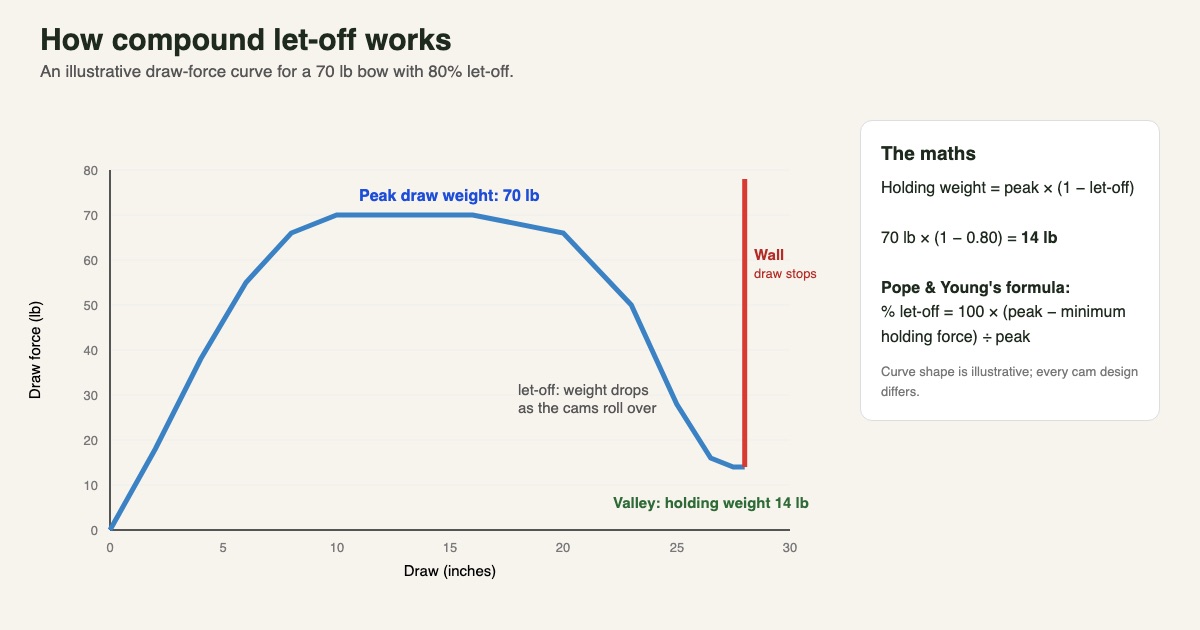
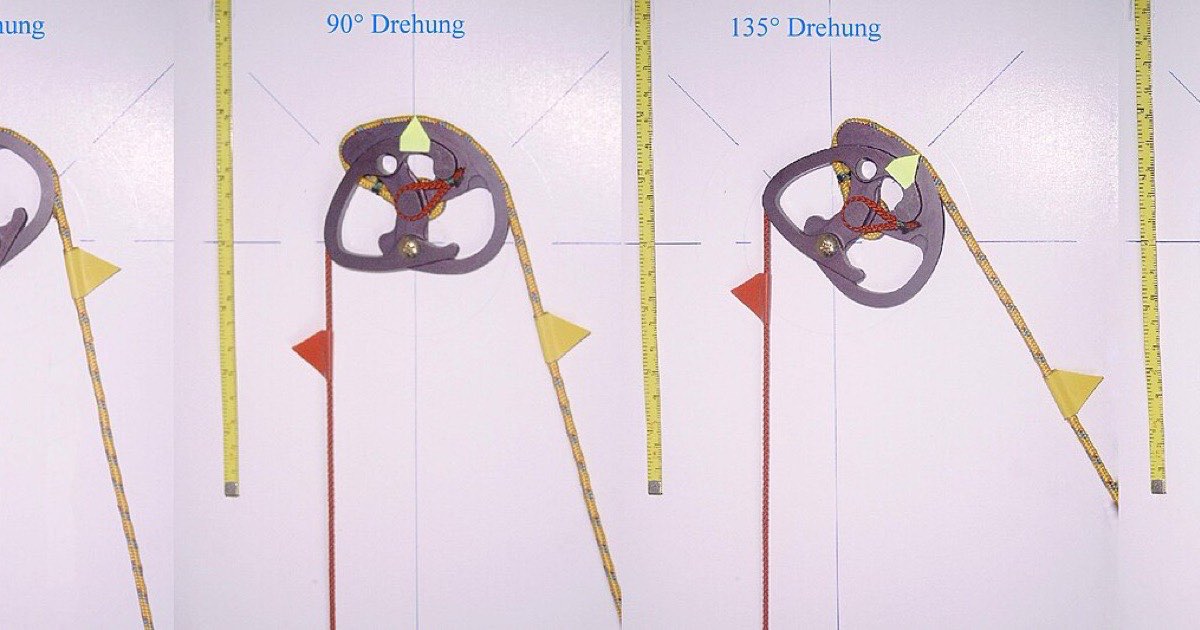
As you draw a compound, the cams rotate. Early in the draw, they increase the force needed, building to the peak draw weight. Near the end of the draw, the cams' shape changes the leverage so the force drops into the valley, where the holding weight is lowest. Then the draw stops hit and you feel the wall: you can't draw any further. Archery 360's history of the compound notes that early cams "grew larger over time and took on oblong shapes to increase let-off."
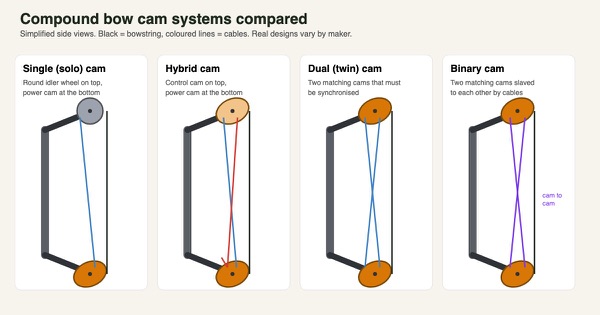
The featured chart above shows an illustrative draw-force curve with each stage labelled. Our cam systems comparison explains how different cam designs shape the draw.
How let-off is measured
The Pope and Young Club, which keeps North American bowhunting records, gives a precise definition. Let-off is "measured near the end of the draw cycle where the minimum holding force is reached. This point in the draw cycle on a compound bow is known as 'the bottom of the valley.'" Its formula:
% Let-off = 100 × [(Peak Draw Force) − (Minimum Holding Force)] ÷ (Peak Draw Force)
Pope and Young adds that both values should be read "during a single and continual pull condition, without relaxation," which "eliminates the introduction of hysteresis" (the slight difference in force readings when you let the string down compared with drawing it).
Holding weight table
Our arithmetic, using holding weight = peak × (1 − let-off):
| Peak draw weight | 65% let-off | 75% let-off | 80% let-off | 85% let-off | 90% let-off |
|---|---|---|---|---|---|
| 50 lb | 17.5 lb | 12.5 lb | 10 lb | 7.5 lb | 5 lb |
| 60 lb | 21 lb | 15 lb | 12 lb | 9 lb | 6 lb |
| 70 lb | 24.5 lb | 17.5 lb | 14 lb | 10.5 lb | 7 lb |
Remember: let-off reduces the weight you hold, not the weight you draw. You still have to pull through the peak draw weight on every shot.
Let-off and the back wall
Let-off and the back wall work together. When the draw stops hit, you feel a solid stop (or a softer one, depending on the bow). Most archers aim by pulling gently into that wall, which keeps the bow in the valley at the lowest holding weight. If you relax forward ("creep"), the cams start to roll back and the weight rises sharply, which pulls you out of the valley and makes a clean, consistent release harder. A solid wall and a reasonable valley make that less likely.
Measuring holding weight
A simple bow scale is usually used to read peak draw weight. Measuring let-off properly means reading both the peak and the minimum holding force during one continuous draw, as Pope and Young describes, which is easiest on a shop's draw board with a scale. If you want to know your bow's real let-off, ask your pro shop to measure it.
High vs low let-off
Higher let-off (around 80–90%)
- Easier to hold at full draw, which helps when waiting for an animal to step clear.
- Less fatigue over long sits or sessions.
- A lighter holding weight can make it harder for some archers to hold the bow steady against the wall, or to execute a back-tension release.
Lower let-off (around 65–75%)
Archery 360 says "many target archers like a lower let-off — 65 and 70 percent are common — because it increases the holding weight at full draw." A firmer holding weight can feel more stable and give the archer something solid to pull against, which some find helps a clean release.
Hunters often choose higher let-off; target archers often choose lower. Both are personal preferences.
Let-off in practice
- Holding for a shot. On a hunt, you may have to hold at full draw while an animal steps out from behind a tree. Lower holding weight makes that easier.
- Aiming. With the weight off, many archers find it easier to settle the pin, but the bow can feel "floaty" if the holding weight is very light.
- Letting down. If the shot doesn't feel right, let down slowly and under control: you'll pull back through the peak as the cams roll back.
- Fatigue. Over a long practice session, lower holding weight means less strain, but the repeated peak draws still tire you.
Common misconceptions
- "Higher let-off means an easier draw." It means an easier hold; the peak weight is the same.
- "Let-off makes heavier bows easy." You still have to pull through the peak smoothly every shot.
- "All compounds have high let-off." Let-off varies by model and setting, and some youth bows have none.
- "Let-off is the same as draw weight." They're different numbers: draw weight is the peak; let-off is the percentage drop at full draw.
Let-off for different archers
- New compound archers often appreciate moderate-to-high let-off while learning to hold steady and execute a release.
- Bowhunters commonly choose higher let-off for long holds in a stand or blind.
- Target and 3D archers often prefer lower let-off for a firmer hold, as Archery 360 notes.
- Young archers may start on zero let-off bows like the Genesis before moving to compounds with let-off.
Can you adjust let-off?
On many modern bows, yes:
- Modules. Hoyt's manual says its "GTX cams are available with either 65% or 75% modules," adding that "changing the let-off should be done by Hoyt or a Genuine Hoyt Retailer." That work requires a bow press; see how a bow press works.
- Draw stops. Many bows let you move draw stops, changing the let-off and the feel of the wall. Hoyt says its 2026 RX-10 lets you adjust "let-off and the feel of the back wall."
Our 2026 compound launches article and our Diamond Infinite 305 review give examples of published let-off figures. Always check your bow's manual before changing anything.
Zero let-off bows
Not every compound-style bow has let-off. The Genesis bow used in the National Archery in the Schools Program "has no let-off," according to NASP. It uses a single cam to give a universal draw length but holds its full (light) draw weight at full draw, like a recurve. Our age guide explains how NASP uses it.
Does let-off affect arrow speed?
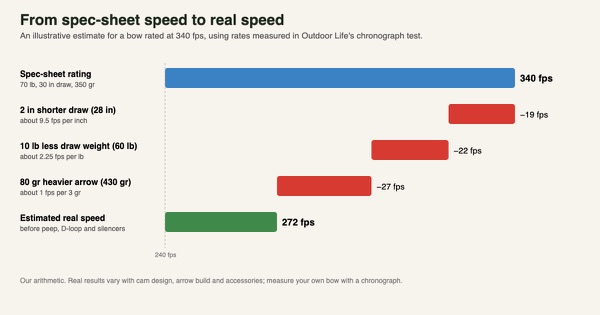
Let-off itself is about holding weight, but the cam design that produces it also shapes how much energy the bow stores, and makers' speed figures are measured at specific settings. We haven't found a reliable source putting a number on how much let-off changes speed, so treat any such claim with caution. Our IBO speed guide explains what affects real arrow speed.
Rules: competitions, record books and hunting
- World Archery: its 2026 rules define a compound as a bow where "the draw is mechanically varied by a system of pulleys or cams," and say "the peak draw weight must not exceed 60 lbs." There's no let-off limit in that section.
- Pope and Young: "There is no maximum let-off for a hand-held, hand-released bow."
- Hunting regulations: Hunter's Friend recalls that "many states had laws regulating how much let-off a compound bow could achieve… One by one, states dissolved their let-off rules." We found no let-off cap in the current regulations we checked for Oregon, Colorado and Ohio. Some states have related equipment rules: Oregon, for example, bans "any device… for the purpose of maintaining the bow at full draw." Montana's 2025 rules also say let-off may be no more than "80 percent as advertised by the manufacturer." Always check your state's current rules.
Let-off, draw weight and hunting
Because let-off reduces holding weight, hunters can often handle a higher peak draw weight on a compound than on a recurve. But you still have to draw through the peak, often slowly, quietly and while cold or seated. Choose a peak draw weight you can pull smoothly in hunting conditions; our draw weight for deer hunting guide explains how. If you struggle to hold steady or to release cleanly, a lower holding weight isn't always the answer; see our target panic guide.
High let-off
Advantages
- Low holding weight makes long holds easier
- Helps hunters wait for the right shot
- Lets archers shoot higher peak draw weights
Trade-offs
- Still need to draw through the full peak weight
- Very light holding weight doesn't suit every archer or release
- Some hunting rules may limit let-off; check your state
You can browse bow scales on Amazon to measure your bow's peak draw weight.
Frequently asked questions
What does 80% let-off mean?
At full draw you hold 20% of the peak draw weight. A 70 lb bow with 80% let-off holds at 14 lb.
What is the best let-off for hunting?
There's no single best figure. Many hunters prefer higher let-off for easier holding; target archers often prefer 65–70%.
Does let-off affect arrow speed?
We haven't found a reliable figure. Speed depends on the whole cam design, draw weight, draw length and arrow weight.
How do you calculate let-off?
Pope and Young's formula: 100 × (peak draw force − minimum holding force) ÷ peak draw force.
Can you change the let-off on a compound bow?
Often, with different modules or draw stop positions. Some changes need a bow press and should be done by a dealer.
What is a zero let-off bow?
A bow that holds its full draw weight at full draw, such as the Genesis bow used in NASP.
Is there a maximum let-off for hunting?
Pope and Young sets no maximum, and we found no cap in Oregon, Colorado or Ohio's current rules, but Montana's 2025 rules limit let-off to 80% as advertised. Check your state.
What is holding weight?
The force you hold at full draw, in the valley. It equals peak draw weight multiplied by one minus the let-off.
Is let-off listed on a bow's spec sheet?
Usually, yes, often as a single figure or a range for bows with adjustable let-off. Check how the maker describes it, and ask a shop to measure it if you need the exact value.
Related articles
 Guides
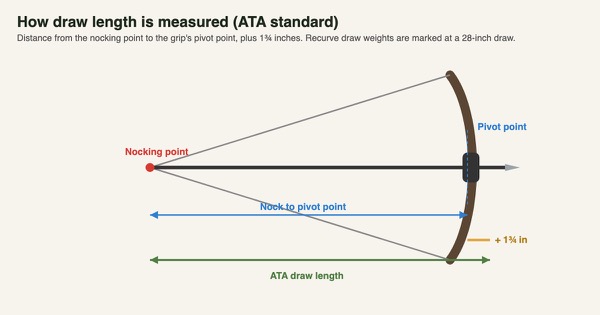
Draw Weight vs Draw Length Explained
Draw weight vs draw length explained: what each means, how they are measured (ATA standard), how they interact on recurves and compounds, and how to set both.
October 15, 2026 · 10 min read
 Comparisons
Single Cam vs Dual Cam vs Hybrid Cam Bows Explained
Single cam vs dual cam vs hybrid and binary cam bows: how each system works, timing, nock travel, speed, maintenance, a short history, and how to choose.
November 2, 2026 · 10 min read
 Gear
IBO Speed vs Real Arrow Speed: What to Expect
What IBO and ATA bow speed ratings mean, why your arrows are slower, rules of thumb for estimating real speed, chronographs, and why speed isn't everything.
October 28, 2026 · 9 min read