
Draw Weight vs Draw Length Explained
Draw weight vs draw length explained: what each means, how they are measured (ATA standard), how they interact on recurves and compounds, and how to set both.

By Archery Insider Editorial Team
· 10 min read
In this article
Draw weight and draw length are the two numbers that matter most when choosing or setting up a bow, and they are easy to confuse. Draw length is how far you pull the string back. Draw weight is how hard it is to pull. They are linked, and on a recurve one directly changes the other, but they solve different problems: draw length is about fit, draw weight is about strength and energy.
This guide explains each one, how they are measured, how they interact on recurves and compounds, and the order to set them in.
The quick answer
| Draw length | Draw weight | |
|---|---|---|
| What it is | How far you pull the string back | How much force it takes to pull |
| Measured in | Inches | Pounds |
| Depends on | Your body size and anchor | Your strength and the bow's setting |
| Affects | Fit, form, consistency, energy | Energy, speed and how easy the bow is to control |
| Recurve | Changes your actual draw weight | Marked at a standard draw length |
| Compound | Set by cam or module | Adjusted with limb bolts within a range |
What draw length is
Draw length is the distance you pull the string back at full draw. It depends mostly on your arm span, your shoulder width and where you anchor. A correct draw length lets you stand straight, keep your bow arm in a strong position and anchor consistently.
How it is measured
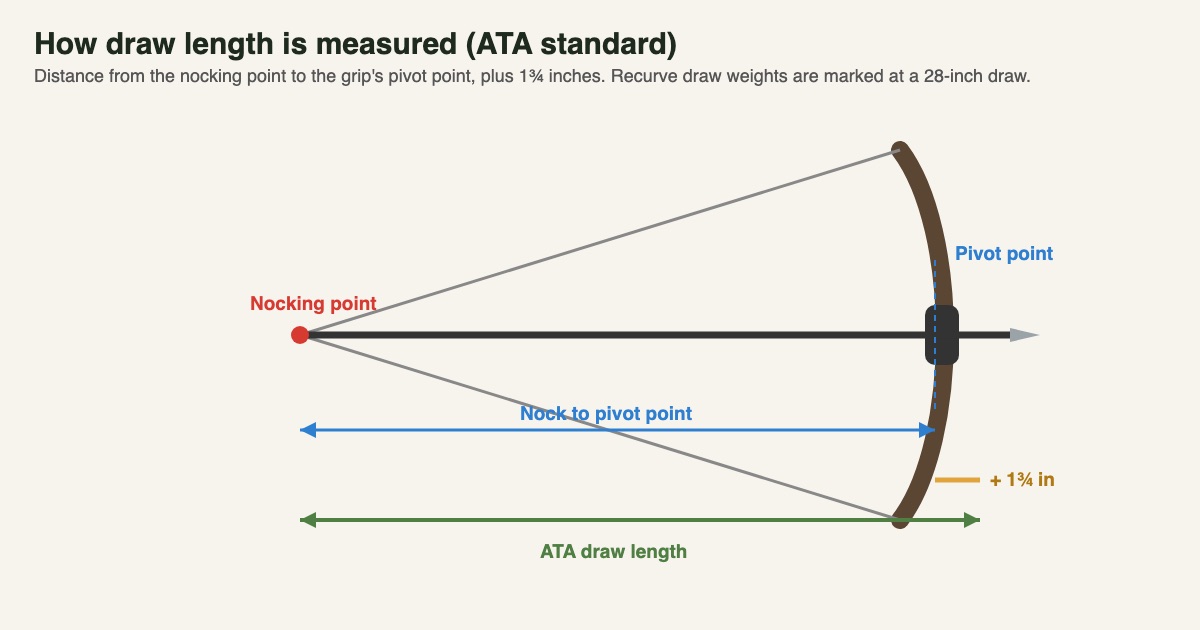
Manufacturers use the ATA standard. Hoyt's glossary defines ATA standard draw length as "the distance from the string's nock point to a vertical line through the pivot point of the grip, and adding 1 and 3/4 inches." Shore Shot Archery explains that the 1¾ inches "represents the average distance from the far side of the bow to the bow grips pivot point." That is why your measured "arrow at full draw" length is not the same number as the bow's labelled draw length.
To estimate your own draw length, the common starting point is your wingspan divided by 2.5. Our draw length guide explains the methods, and an archery shop can confirm it with a draw-length arrow.
Too long or too short?
- Too long: you lean back, your bow arm locks and rotates into the string's path, your anchor drifts behind your face, and string slap on the forearm becomes common.
- Too short: you feel cramped, your bow arm bends too much, and you lose energy and consistency.
What draw weight is
Draw weight is the force, in pounds, needed to pull the bow to full draw. It determines how much energy the bow stores and therefore how fast and hard it shoots an arrow of a given weight. Missouri's conservation department notes that the force required "is less than most people think," and that accuracy matters more than maximum draw weight.
How it is measured
Draw weight is measured with a bow scale at the archer's draw length. For compounds, the figure that matters is the peak weight during the draw; the holding weight at full draw is much lower because of let-off.
Signs your draw weight is too heavy
Draw weight is the setting most often chosen badly, usually too high. Watch for these signs:
- Skylining or lifting: pointing the bow up at the sky, or lifting it over your head, to get it back.
- Shaking at full draw after only a few seconds.
- Struggling seated: if you cannot draw smoothly while sitting on a chair or bucket with your feet flat, you will struggle in a tree stand or blind.
- Form breaks down as the session goes on, with groups opening up after a dozen arrows.
- Shoulder or elbow pain during or after shooting.
If any of these sound familiar, turn the limb bolts down on a compound or choose lighter limbs on a recurve. Missouri's conservation department makes the same point: accuracy matters more than maximum draw weight.
How they interact on a recurve
On a recurve or longbow, draw weight keeps rising as you draw further. Manufacturers mark the limbs with the draw weight at a standard draw length, usually 28 inches. If your draw is longer, you pull more than the marked weight; if shorter, less. A commonly used rule of thumb is roughly 2 to 3 pounds per inch, though it varies with the bow's design. That means two archers with the same "30 lb" recurve may actually be pulling quite different weights.
Our first recurve guide explains how to choose limbs with this in mind.
A worked example
Imagine two archers sharing a recurve whose limbs are marked "30 lb at 28 inches."
- Archer A has a 30-inch draw. Using the 2-to-3-pounds-per-inch rule of thumb, they are pulling roughly 34 to 36 lb, noticeably more than the label.
- Archer B has a 26-inch draw. They are pulling roughly 24 to 26 lb, noticeably less.
Neither archer is wrong, but each needs to know their real number. Archer A may find the bow harder to control than expected, and both need arrows spined for the weight they actually pull, not the weight printed on the limb. The only way to know for certain is to put the bow on a bow scale at your own draw length, which many archery shops will do in a few seconds.
How they interact on a compound
A compound bow separates the two settings:
- Draw length is set by the cam system. Many bows use adjustable modules or rotating cam settings; others need a different cam or module for each length. Once set, the bow stops at that draw length (the "wall").
- Draw weight is adjusted by turning the limb bolts, within the range the manufacturer specifies.
Changing draw length on a compound can slightly change the peak draw weight and the arrow speed, and may need the peep sight and sight marks adjusting. Draw length on a compound is not something to fudge: because the cams stop the string at a fixed point, a bow set too long forces you to stretch to reach it every shot, while one set too short leaves you crunched behind the string.
Let-off and holding weight
A compound's cams reduce the weight you hold at full draw. This reduction is called let-off and is given as a percentage of peak weight. A bow drawing 70 lb with 80% let-off, for example, has a holding weight of about 14 lb (20% of 70). That is why a compound can feel easy to hold at full draw even when its peak weight is high. Let-off does not reduce the effort needed to get there, though: you still have to pull through the peak weight on every shot, and in cold weather, from a seated position, or after hours in a stand. Our reviews of the Bear Cruzer G3 and Diamond Infinite 305 show how widely adjustable some bows are.
How both affect arrow speed and energy
- Longer draw length means the string pushes the arrow over a longer distance, so the bow stores and delivers more energy at the same draw weight.
- Higher draw weight stores more energy at the same draw length.
- Arrow weight decides how that energy is split between speed and momentum.
That is why advertised compound speeds are measured at a standard setup, typically 70 lb, a 30-inch draw and a 350-grain arrow (the IBO standard). Most archers shoot shorter draws, lighter weights or heavier arrows, so their real arrow speed is lower. Our draw weight for deer hunting guide explains energy and momentum in detail.
The order to set them
- Measure your draw length and get it confirmed by a shop or coach.
- Set the bow's draw length (compound) or choose limbs with your actual draw in mind (recurve).
- Choose a draw weight you can pull smoothly, seated and cold, and hold steady.
- Fit the arrows to your draw length and the bow's actual draw weight, using the manufacturer's spine chart; our arrow guide explains how.
- Fine-tune the anchor, peep and sight once both are right.
Never compensate for a wrong draw length by changing your form, and never choose a draw weight so high that you have to strain or lift the bow to draw it.
Draw length and arrow length
Draw length and arrow length are related but not the same. Arrows must be long enough that the point stays safely in front of the arrow rest at full draw, so a longer draw length generally means longer arrows. The exact cut length depends on your bow, rest position and broadhead, so follow the arrow maker's guidance or have a shop measure you at full draw. Arrow length also changes the arrow's dynamic spine: a longer arrow acts weaker, which is another reason to fix draw length before buying arrows. Never shoot an arrow shorter than your draw length, because the point can be drawn behind the rest and strike your hand or the bow.
Youth and growing archers
Children's draw lengths change as they grow, and so does their strength. Many youth compound bows adjust over wide ranges of both draw length and draw weight, so the bow can grow with the child. For recurves, a light, short bow that suits their current draw is best, with limbs changed as they grow. Our guide to choosing a bow for a child covers sizing and safety.
Common myths
- "More draw weight makes you more accurate." It usually makes you less accurate, by damaging form.
- "A longer draw length is always better for speed." Only if it fits you. An over-long draw ruins form and consistency.
- "The number on the limb is what I pull." On a recurve, only if your draw length matches the marking length.
- "I can fix draw length later." Arrows, peep height and anchor all depend on it, so set it first.
Getting draw length right first
Advantages
- Comfortable, repeatable anchor and form
- Better accuracy and fewer string slaps
- Arrows and sight can be set up correctly
Trade-offs
- Takes a fitting session or careful measurement
- May require a different cam or module on some compounds
You can browse bow scales or draw-length measuring arrows on Amazon.
Frequently asked questions
What is the difference between draw weight and draw length?
Draw length is how far you pull the string; draw weight is how hard it is to pull. Length is about fit, weight is about strength and energy.
Does draw length affect draw weight?
On a recurve or longbow, yes: drawing further increases the weight. On a compound, draw length is set separately, though changing it can slightly change the peak weight.
How is draw length measured on a bow?
By the ATA standard: from the nocking point to the grip's pivot point, plus 1¾ inches.
Should I choose draw length or draw weight first?
Draw length first, for fit. Then choose a draw weight you can control.
Can I change the draw length on my compound bow?
Many compounds have adjustable modules or cam settings; others need a different cam or module. Check your bow's manual or ask a shop.
Does a heavier draw weight need stiffer arrows?
Yes. Higher draw weight and longer draw length both call for stiffer (lower-number) spine. Use the arrow maker's chart with your actual draw weight and arrow length.
What is let-off on a compound bow?
Let-off is the reduction in weight you hold at full draw, given as a percentage of peak weight. With 80% let-off, a 60 lb bow holds at about 12 lb.
How do I know if my draw weight is too high?
If you have to lift the bow skyward to draw it, shake at full draw, or cannot draw smoothly while seated, reduce the weight.
Related articles
 Training
Archery Draw Length: How to Measure It and Why It Matters
How to measure archery draw length with the wingspan method or at full draw, what the AMO standard means, and how it affects bow size, draw weight, and arrows.
Updated February 6, 2025 · 8 min read
 Guides
What Draw Weight Do You Need for Deer Hunting?
How much draw weight do you need for deer? Legal minimums, why arrow energy matters, compound vs traditional bows, elk, and choosing a weight you can shoot.
October 5, 2026 · 10 min read
 Guides
How to Choose Your First Recurve Bow: A Beginner's Guide
How to choose a first recurve bow: takedown vs one-piece, draw weight, bow length for your draw length, riser types, eye dominance, and essential accessories.
Updated February 6, 2025 · 11 min read