
Arrow Rests Explained: Drop-Away, Containment, Shelf
Arrow rests explained: shooting off the shelf, stick-on and plunger rests for recurves, launcher, containment and drop-away rests for compounds, and setup.

By Archery Insider Editorial Team
· 10 min read
In this article
The arrow rest is a small part with a big job: it holds the arrow in position while you draw and aim, then gets out of the way as the arrow leaves the bow. The right rest depends on the kind of bow you shoot, how you release the string, and whether you hunt or shoot targets.
This guide covers every common type of arrow rest, from shooting off the shelf on a traditional bow to drop-away rests on modern compounds. It explains how each one works, who it suits, how a drop-away rest operates, and how to set a rest up.
What is an arrow rest?
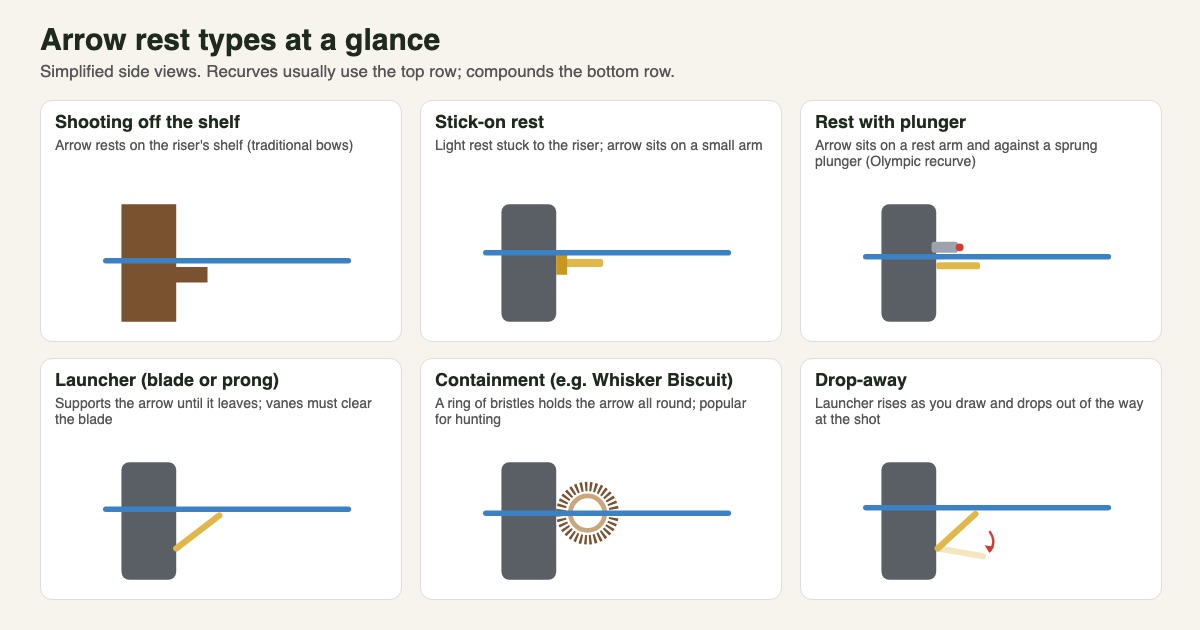
An arrow rest is the support that the arrow sits on between nocking and release. On a compound bow it is usually a separate accessory bolted to the riser. On a recurve it can be a small stick-on rest, a rest combined with a plunger, or simply the bow's shelf. Lancaster Archery's guide to bow parts puts the recurve options simply: "On recurves, you can shoot the arrow directly off the shelf, or with assistance from traditional shelf-mounted rests."
A rest affects how cleanly the arrow leaves the bow. A rest that touches the fletching, pushes the arrow sideways or is set at the wrong height will show up as poor groups or bad paper tears.
Recurve and traditional rests
Shooting off the shelf
Many traditional recurves and longbows have a shelf cut into the riser, often covered with a piece of leather, fur or felt. The arrow sits directly on it. This is simple, quiet and durable, and is common in traditional archery. World Archery's rules for the Traditional division in field and 3D events say "the athlete can use the bow shelf," and that the shelf "may be covered with any type of material (on the shelf only)."
So can you shoot a recurve "without an arrow rest"? Yes, if the bow has a shelf designed for it. Feathers are generally preferred for shelf shooting because they flex out of the way; our feathers vs vanes comparison explains why.
Stick-on rests
Archery 360 explains that "stick-on rests simply adhere to the riser on the shelf side of the bow" and are "lighter in mass weight." They have a small arm that the arrow sits on, often a flexible plastic "flipper" that moves out of the way as the arrow passes. They are inexpensive and common on beginner recurves.
Rests with a plunger
Olympic-style recurves usually pair a rest with a plunger (pressure button): a spring-loaded button that the side of the arrow rests against. Archery 360 describes wrap-around rests, which have a "plate" fixed "under the collar of the plunger on the sight-mounting side of the bow," and notes that "archers want the arrow to touch the plunger directly in the middle of the plunger tip." The plunger cushions the sideways push of a finger release and is an important tuning tool; our recurve tuning guide covers plunger setup.
Not every setup uses a plunger. Easton notes that "many tournament archers use a Springy™ rest, and some traditional archers use other styles of arrow rests that do not have side pressure tension adjustments."
World Archery's target rules for the Recurve division allow "an arrow rest" that "can be adjustable," and "any movable pressure button, pressure point or arrow plate," with the pressure point placed "no further back than 4 cm towards the athlete from the pivot point of the grip."
Compound rests
Launcher (blade or prong) rests
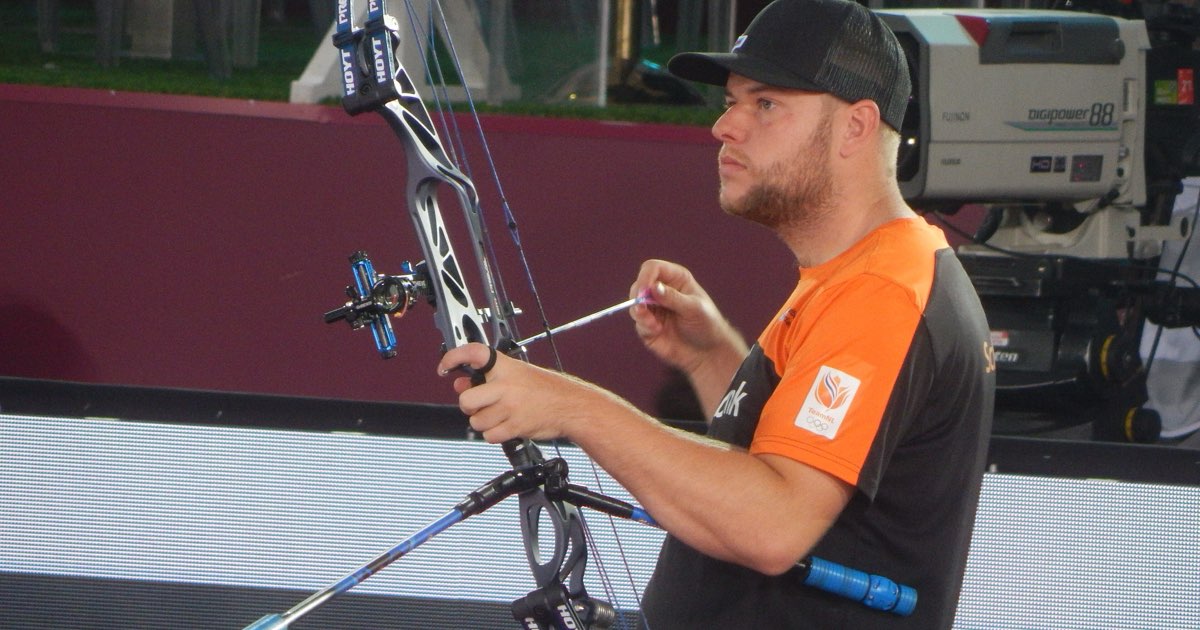
Launcher rests have one or two prongs or a thin blade that the arrow sits on. Lancaster explains that they "support the arrow constantly through draw and release, until the arrow has left the bow." Because the arrow stays on the rest for its whole forward travel, vane clearance matters. Easton says to make sure "the arrow support arm is narrow enough to allow the two lower vanes to pass over the rest without making contact," which "is very important for archers using release aids because the arrow is most often supported on the rest for its full length of forward travel."
Containment rests
Containment rests hold the arrow all the way round, so it can't fall off while you move or wait. The best-known example is the Whisker Biscuit, whose circle of bristles captures the arrow; Lancaster notes it is popular with bowhunters. Containment rests are simple, durable and quiet, which suits hunting and beginners. Our Whisker Biscuit review covers this type in more detail, including vane wear.
Drop-away rests
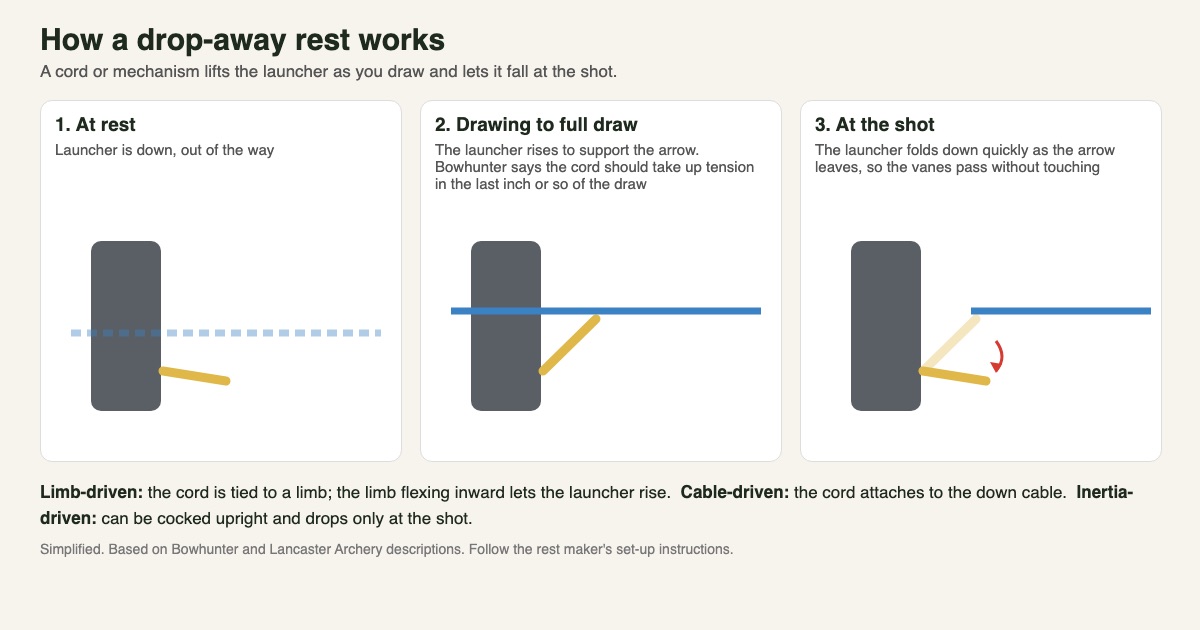
A drop-away rest supports the arrow at full draw and then drops out of the way as the arrow leaves. Bowhunter explains: "As the arrow cycles through the bow, the launcher arm quickly folds out of the way, reducing the chance of fletching contact and torque." Lancaster describes three varieties: limb-driven, cable-driven and inertia-driven (which can stay "cocked" upright and drop only at the shot). Many have a containment feature, such as a bracket or bristles, to keep the arrow in place while the rest is down.
How a drop-away rest works
Limb-driven, cable-driven and inertia
- Limb-driven: a cord connects the rest to a limb. Bowhunter explains that "when the bow is drawn back, the limb moves inward, releasing the cord's tension and allowing the launcher arm to rise."
- Cable-driven: a cord connects the rest to the bow's down cable, which moves as you draw and lifts the launcher.
- Inertia-driven: the rest is set upright before the shot and drops when the bow fires.
Timing
A drop-away needs to be timed so it is fully up at full draw and drops quickly enough for the vanes to clear. Bowhunter says the cord "should be taut and taking up tension the last inch or so of the draw." For cable-driven rests it adds a caution: "You want to apply as little cord tension on the bow's cable as possible, as this could place unwieldly tension on the bow's strings, limbs, and cams." A cord inserted into a cable can even affect cam timing; our cam timing guide explains why. Follow the rest maker's instructions, and have a pro shop set it up if you are unsure.
Comparing the main rest types
| Rest type | Typical bow | Arrow contact | Fletching clearance | Hunting suitability |
|---|---|---|---|---|
| Off the shelf | Traditional recurve, longbow | Shelf and side plate | Feathers flex past | Good for traditional hunters |
| Stick-on | Beginner recurve | Small arm | Flipper moves out of the way | Fair |
| Rest with plunger | Olympic recurve | Arm and plunger | Needs careful setup | Fair |
| Launcher | Target compound | Full forward travel | Vanes must clear blade or prongs | Arrow can fall off |
| Containment | Hunting and beginner compound | All round | Bristles contact vanes | Excellent: holds the arrow |
| Drop-away | Hunting and target compound | Until release | Drops away from vanes | Excellent with containment bracket |
Drop-away vs Whisker Biscuit: which should you choose?
- Choose a containment rest if you want simplicity, durability and an arrow that stays put, especially for a first hunting compound.
- Choose a drop-away if you want to reduce fletching contact, especially with larger vanes or when fine-tuning broadhead flight, and you are happy to time it correctly.
Both are widely used for hunting. We avoid saying one is "more accurate": good setup and tuning matter far more than rest type. Our reviews of the Bear Cruzer G3 and Diamond Infinite 305 show what beginner compound packages commonly include.
Basic setup: height, centre shot and vane clearance
- Mount the rest securely, according to the instructions.
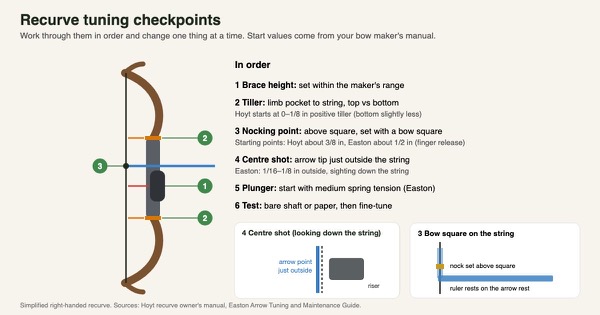
- Set the height. On compounds, Bowhunter suggests positioning the arrow shaft "in the center of the threaded Berger Button hole or slightly above." On recurves, set the nocking point and rest together with a bow square.
- Set centre shot, so the arrow points in line with the string. For finger-release recurves, Easton suggests the arrow tip sits just outside the string.
- Check vane clearance. Easton says that for finger-release flipper rests, "the arrow rest support arm should be adjusted so that it is not visible past the outside of the arrow shaft when observed from an overhead view."
- Paper tune or bare shaft tune to fine-tune the rest position; see our paper tuning guide and bare shaft guide.
A simple way to check clearance is to dust the vanes and rest with foot powder or dry spray and shoot an arrow: marks on the vanes or rest show contact.
Hunting considerations
Bowhunting adds a few practical demands that a target range doesn't:
- Keeping the arrow in place. In a tree stand or blind, you may hold a nocked arrow for a long time and move the bow around. Containment rests, and drop-aways with a containment bracket, stop the arrow falling off.
- Noise. An arrow scraping on a rest can alert game. Check that the arrow sits quietly when you draw slowly, and add the rest maker's silencing pads if they are supplied.
- Cold and wet weather. Cords, bristles and felt can stiffen or soak up water, so check your rest after a wet or freezing hunt.
- Knocks and transport. Rests take bumps in vehicles and when climbing. Mark the rest's position on the mounting bracket with a fine pen so you can see if it has moved, and re-check your sight-in after any hard knock.
- Broadhead tuning. Rest position is one of the main adjustments when broadheads don't hit with field points; our field points vs broadheads guide explains the process.
Matching your rest to your fletching
Fletching and rests have to work together. Larger vanes and stronger helical fletching steer the arrow more, but need more clearance. On launcher rests, Easton's advice about the two lower vanes passing cleanly matters most. Shelf shooters usually choose feathers, which flex if they brush the shelf. If you change your fletching, recheck clearance. Our feathers vs vanes comparison covers the trade-offs.
When to adjust or replace a rest
- Paper tears or walk-back drift that won't go away often point to rest position.
- Vane contact marks show the rest or launcher is hitting the fletching.
- Worn bristles, flipper arms or felt should be replaced.
- Loose screws after a season of shooting should be tightened, and the rest's position checked against marks you made when it was set.
- A drop-away that doesn't fully rise or drop needs its cord or timing checked.
Choosing a rest carefully
Advantages
- Cleaner arrow flight and better groups
- The right rest suits your bow, release and hunting style
- Rests are inexpensive compared with bows
Trade-offs
- Drop-aways need correct timing and setup
- Containment rests can wear vanes
- Recurve plungers and rests need tuning
You can browse drop-away arrow rests or stick-on recurve rests on Amazon.
Frequently asked questions
Can you shoot a recurve bow without an arrow rest?
Yes, if the bow has a shelf. Many traditional archers shoot directly off a covered shelf.
What is the best arrow rest for a beginner compound?
Many beginners start with a containment rest because it holds the arrow securely and is simple to set up.
Are drop-away rests more accurate than a Whisker Biscuit?
Drop-aways reduce fletching contact, but accuracy depends more on setup and tuning than rest type.
Limb-driven or cable-driven drop-away: which is better?
Both work. Limb-driven rests don't add tension to the bow's cables; cable-driven rests need careful setup to avoid affecting the bow. Follow the maker's instructions.
How do I know if my drop-away timing is right?
The launcher should be fully up at full draw and drop as the arrow leaves. Bowhunter says the cord should take up tension in the last inch or so of the draw.
What is an arrow rest called on a bow?
Simply an arrow rest. On traditional bows, the shelf can act as the rest.
Do I need a plunger with a recurve rest?
Not always. Plungers are standard on Olympic-style recurves; many beginner and traditional bows use a stick-on rest or the shelf alone.
Related articles
 Reviews
Trophy Ridge Whisker Biscuit Review: The Full-Containment Rest
Trophy Ridge Whisker Biscuit review: how a full-containment bristle rest works, sizes and versions, set-up, vane wear trade-offs, and who it suits.
Updated September 3, 2025 · 6 min read
 Training
How to Tune a Recurve Bow: Nock Point, Tiller, Plunger
How to tune a recurve bow step by step: brace height, tiller, nocking point with a bow square, centre shot, plunger tension, and testing with bare shafts.
October 23, 2026 · 11 min read
 Training
Paper Tuning a Bow: How to Read Tears and Fix Them
How to paper tune a bow: what it shows, frame setup, reading nock-high, low, left and right tears, the order of fixes, and when to see a pro shop.
October 8, 2026 · 10 min read