
Cam Timing, Cam Lean and Yoke Tuning Explained
What cam timing, cam lean and yoke tuning mean on a compound bow, how to check them, what makers say about adjusting them, and when to take your bow to a shop.

By Archery Insider Editorial Team
· 11 min read

In this article
If you spend any time around compound bow tuning, you will hear three terms that sound alike but mean different things: cam timing, cam lean and yoke tuning. They all concern the cams at the ends of the limbs, and they all affect how consistently a compound shoots. But they describe different problems, are checked in different ways, and are fixed with different adjustments.
This guide explains each term in plain language, how to check them, what bow makers say about adjusting them, and where home tinkering should stop and a pro shop should take over.
How a compound's cams, cables and yoke work together
A compound bow uses cams (oval or irregular wheels) at the end of each limb. As you draw, the cams rotate, giving the compound its let-off. The string runs between the cams, and one or more cables connect the cams to each other or to the limbs. On many bows, one cable splits into a yoke with two legs that attach either side of the axle.
Because the cams, string and cables are linked, any change in the length of one part (a new string, a stretched cable, a twisted yoke) changes how the cams rotate and sit. Our compound vs recurve guide explains the basics of how compounds work.
Symptoms that point to the cams
| What you notice | Possible cam-related cause | Source or note |
|---|---|---|
| High or low paper tears that rest and nocking point changes won't fix | Timing | Easton advises having a shop check cam "timing" (roll-over) |
| Left or right tears or walk-back drift that rest moves won't fix | Cam lean or yoke balance | Bowhunter links poor cam alignment to arrow-flight problems |
| A soft or inconsistent back wall at full draw | Draw stops not hitting together | Check timing on a draw board |
| Lower draw weight than before | String and cable stretch or cam rotation | Listed by Mathews as causes of poundage loss |
| Changes after a new string set | Settling, stretch or a mismatched set | Bear recommends checking after the first 250 shots |
These symptoms can also come from form, arrows or loose accessories, so rule those out first.
What is cam timing?
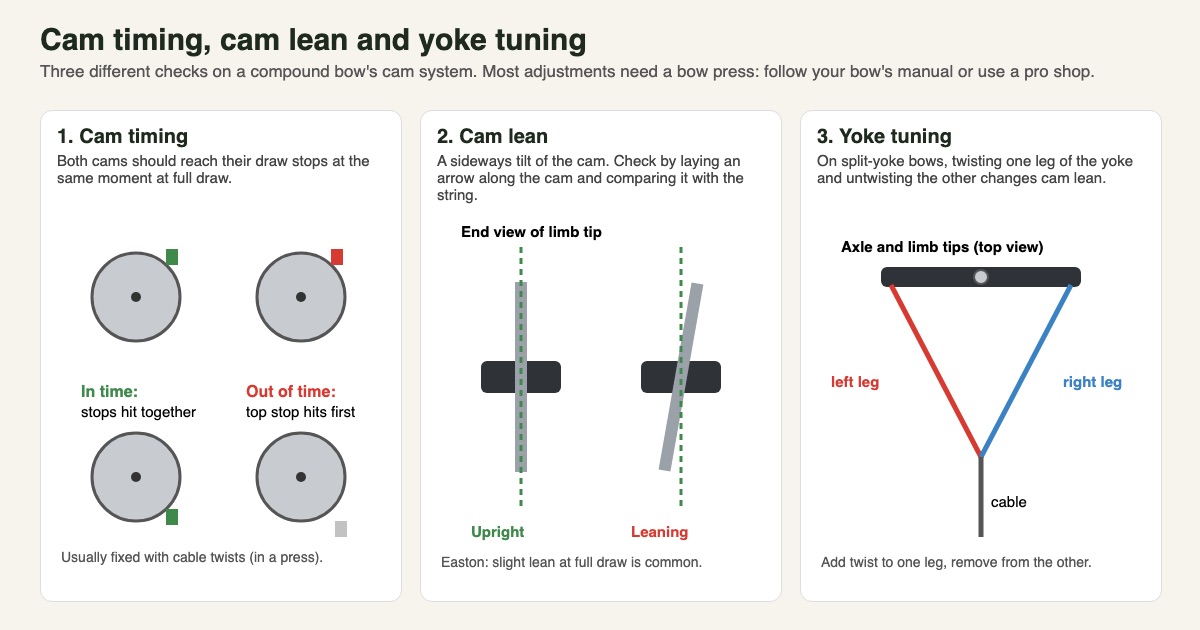
Bear's manual explains it simply: in a correctly timed bow, "the top and bottom cams roll over and hit their respective draw stops at the same time." Bowhunter describes synchronised cams as those that "strike the draw stop at the same time."
When one cam reaches its stop before the other, the bow is out of time. That can change the feel of the draw (a soft or spongy back wall), move the nocking point's path, and cause arrows to fly or tear paper inconsistently.
Why timing drifts
Bear notes that cam timing "is set during assembly at the factory, but once the bow is broken in, or if you change strings/cables it is possible that the cam timing will need to be checked." Common causes include:
- Break-in. New strings and cables settle in the first few hundred shots.
- Stretch and creep. Strings and cables lengthen slightly over time; see how long bow strings last.
- String and cable replacement. A new set may not match the old one exactly.
- Accessories attached to cables. goHUNT notes that a cable-driven drop-away rest cord inserted into a cable "slightly shortens that cable," which can affect timing.
Bear's practical rule: "Bear Archery recommends checking the timing and tune of your bow after the first 250 shots."
How to check cam timing
There are three common ways, from simplest to most precise:
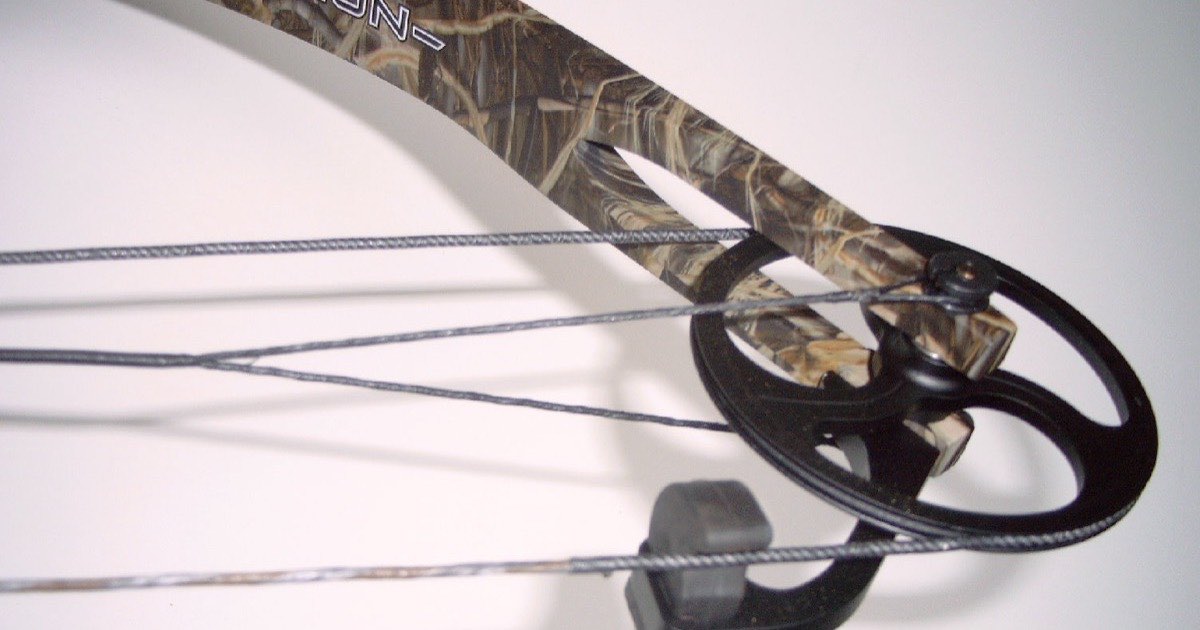
- Timing marks. goHUNT notes that "most modern bows have timing marks. For example, on a Mathews bow, there is a small hole on each cam where the cable will run through." Your owner's manual shows where each mark should sit.
- Draw stops at full draw. On a draw board, or with a helper watching while you draw (always with an arrow nocked and pointed at a target), check whether both draw stops touch at the same moment.
- A draw board. Elite's procedure begins: "Check cam timing at full draw on a draw board. (Note timing condition. Example top cable stop hitting cable first.)" A draw board holds the bow at full draw so a technician can watch both cams safely.
How timing is adjusted
Most bows are re-timed by adding or removing twists in the cables, which changes their effective length. Bear gives an example: "If the cam system is out of time and the top stop hits before the bottom stop, add twists into the up cable until both stops hit at the same time… The same affect could be achieved by taking twists out of the opposite cable." goHUNT adds that cable twists "will have a much greater impact than twisting or untwisting the string."
On most bows, twisting cables means taking tension off them in a bow press; see how a bow press works. Some newer bows have built-in adjusters. Elite, for example, describes micro splitters that let the archer "micro adjust their cam timing without the need of a bow press" on certain models, turning them "clockwise (tighten) – to shorten the cable (add twists)." Check your own bow's manual for its method.
Cable twists and nocking point travel
Timing adjustments also affect how the nocking point moves during the shot. goHUNT explains that "slight adjustments in twisting or untwisting cables… will move the nocking point/D-loop up or down." That is why timing is set before the nocking point and rest are fine-tuned, and why a timing change can mean re-checking your paper tune afterwards.
What is cam lean?
Cam lean is when a cam tilts sideways rather than sitting perfectly upright in line with the string. It can be measured at rest (static lean) or at full draw (dynamic lean). The cables, especially when pulled to the side by the cable guard, can pull the cams slightly out of line.
Is some cam lean normal?
Yes, a little. Easton's tuning guide says: "The wheel often torques or leans over slightly as it reaches the full draw position. This is common and is nothing to be concerned about." Manufacturers set the cams to a starting position at the factory; Elite says its bows ship "with matching pitch on the top and bottom cams" set to "a neutral starting point." Problems come from excessive lean, or a change from how the bow shot when it was well tuned.
How to check cam lean
Elite describes a simple static check: "lay an arrow along the side of the cam pointing toward the other end of the bow… and note the angle of the arrow vs the string. Re-check the cam at the other end." It adds that static lean "can be checked by simply laying an arrow across the top and bottom cams and checking the alignment in relation to the string."
Checking lean at full draw needs a draw board, because nobody should be holding a bow at full draw while someone else peers at the cams.
How cam lean affects arrow flight
Bowhunter explains that "poor cam alignment causes undue bowstring torque and arrow-flight problems." Excessive lean can push the string sideways during the shot, leading to left or right paper tears, inconsistent groups or arrows that drift at longer distances. Our paper tuning guide and bare shaft and walk-back guide explain how those symptoms show up.
What is yoke tuning?
On bows with a split yoke, one cable splits into two legs that attach either side of the axle. Adding twists to one leg shortens it, removing twists from the other lengthens it, and together they tilt the cam one way or the other. That is yoke tuning: adjusting cam lean by balancing the yoke legs.
Bowhunter gives an example tied to paper tuning: for consistent left tears, "twist the left side of the yoke and untwist the right." Make small changes, re-check and re-test.
Other ways to adjust lean
Not every bow uses a split yoke for this. Manufacturers have their own systems:
- Shims. Some bows use spacers on the axle to move cams left or right. Elite gives a traditional shimming rule for right-handed bows: "Tail Right – Move cams to the right; Tail Left – Move cams to the left."
- Built-in adjustment systems. Elite says "adjusting S.E.T. Technology will affect the pitch (lean) of the cams, similar to 'Yoke Tuning.'"
- Spacer tuning. Hoyt answers "How do I 'yoke tune' my HBX cams?" by pointing to "a video and a guide to help you with spacer tuning."
Single-cam bows have their own procedures. Use the manufacturer's tune chart for your model.
Different cam systems
Compounds use different cam layouts: dual (twin) cams, hybrid cams and single cams, among others. The principles in this guide (the cams should roll over consistently, and the cams should sit in line with the string) apply to all of them, but how each system is timed and adjusted varies. Some have timing marks on both cams; some rely on draw-stop contact; some have built-in lean adjustment. Always use the tune chart and procedures for your specific model.
A sensible order of work
- Check draw weight, draw length and timing against the manufacturer's specs.
- Check and correct cam lean (yoke, shims or the maker's system).
- Set the nocking point and rest to the recommended starting positions.
- Paper tune to fix the remaining tears.
- Bare shaft or walk-back tune for fine adjustment.
- Check broadheads against field points if you hunt.
Easton notes that if you "are unable to correct a high/low tear in the paper, have your local pro shop check the 'timing' (roll-over) of your eccentric wheels or cams." In other words, if rest and nocking point changes don't fix a problem, the cams are the next place to look.
What you need
- The owner's manual and tune chart for your bow (string and cable lengths, timing marks, axle-to-axle, brace height).
- A bow press that your bow maker approves.
- A draw board or shooting machine for checking timing and lean at full draw.
- A bow square and Allen keys.
- Paper tuning and a target, to check results.
Bowhunter's tool list for this work includes a bow press and a draw board or shooting machine. Most archers don't own these, which is one reason many timing and lean adjustments happen at a pro shop.
When to take your bow to a pro shop
Take your bow to a shop if:
- You don't have a suitable bow press or draw board.
- The bow is new to you and you don't know its specifications.
- Timing or lean has changed suddenly, which can be a sign of damage (for example after a dry fire).
- Strings and cables have just been replaced.
- Paper tears won't respond to rest and nocking point changes.
- You are not confident about the adjustment or about working on a pressed bow.
Remember that unauthorised alterations and unapproved presses can affect a warranty. Bear and Elite both specify which presses can be used on their bows. And note Hoyt's limb bolt limit for most models: never exceed "eight complete rotations of the limb weight adjustment bolts." Bow-specific limits like this are another reason to keep the manual close.
Common mistakes
- Chasing paper tears with the rest when the real problem is timing or lean.
- Making large changes. Cable and yoke twists have a big effect; small changes are best.
- Changing several things at once, so you don't know which one helped.
- Drawing a bow without an arrow to check the cams. Always use a draw board, or an arrow and a safe backstop.
- Ignoring the manual's specs for string and cable lengths, axle-to-axle and brace height.
- Forgetting to re-check after the first few hundred shots on a new string.
Checking timing and lean regularly
Advantages
- Catches problems before they show up as poor groups
- Keeps the draw feel and back wall consistent
- Makes paper tuning and walk-back tuning easier
Trade-offs
- Most adjustments need a press and draw board
- Easy to over-adjust without experience
You can browse bow squares or draw boards on Amazon.
Frequently asked questions
Is cam lean normal?
A little, yes. Easton says a cam that leans slightly at full draw "is common and is nothing to be concerned about." Excessive or changed lean is the problem.
What causes cam lean?
The pull of the cables, especially where the cable guard pushes them sideways, plus yoke or shim settings and string or cable changes.
How do I check cam timing without a draw board?
Use the timing marks your manufacturer provides. Checking stops at full draw safely needs a draw board or a shop.
Can I yoke tune without a bow press?
Usually not, because twisting yoke legs means taking tension off the cable. Some bows have built-in adjusters; check your manual.
How often should cam timing be checked?
Bear recommends checking timing and tune after the first 250 shots, and it is worth checking after any string or cable change.
Does cam lean affect accuracy?
Excessive lean can torque the string and cause arrow-flight problems, according to Bowhunter.
What is the difference between cam timing and cam sync?
They are generally used to mean the same thing: both cams rolling over and reaching their stops together.
Can I check cam lean myself?
You can check static lean at home by laying an arrow along the side of each cam and comparing it with the string, as Elite describes. Checking lean at full draw, and correcting it, is best done with a draw board and press, usually at a pro shop.
Related articles
 Training
Paper Tuning a Bow: How to Read Tears and Fix Them
How to paper tune a bow: what it shows, frame setup, reading nock-high, low, left and right tears, the order of fixes, and when to see a pro shop.
October 8, 2026 · 10 min read
 Gear
How Does a Bow Press Work? Types and Safety
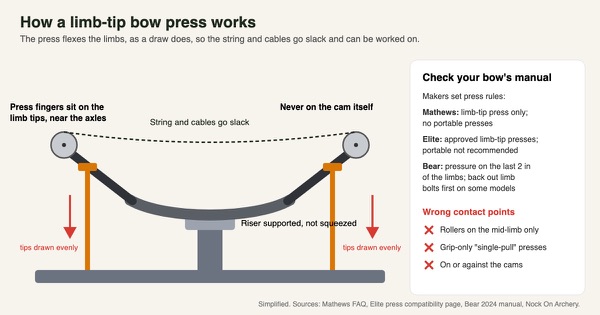
How a bow press works, what it is used for, the main types, which presses Mathews, Elite and Bear allow, crossbow presses, safety, and whether you need one.
October 20, 2026 · 9 min read
 Training
Bare Shaft and Walk-Back Tuning Explained
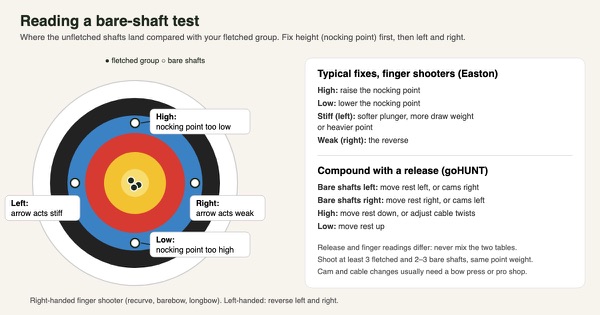
How bare shaft and walk-back tuning work, how to read results for finger and release shooters, what distances to use, and how they fit with paper tuning.
October 21, 2026 · 11 min read