
Archery Sets for Adults: What to Look For Before Buying
What to look for in an archery set for adults: recurve set or compound package, draw weight, matching arrows, reading listings, accessories and safety checks.

By Archery Insider Editorial Team
· 10 min read
In this article
An "archery set for adults" sounds simple: a bow, some arrows and a few accessories in one box. But the quality and suitability of sets varies enormously, and listings often leave out the details that matter most, especially whether the arrows suit your draw length and the bow's draw weight. A set that doesn't fit you can be frustrating at best and unsafe at worst.
This guide explains what an adult set usually includes, how to choose between a recurve set and a compound package, how to pick a draw weight, how to read a listing, what to add, and what to check before your first shot. We haven't tested specific sets; this is a guide to choosing well.
What an adult archery set usually includes
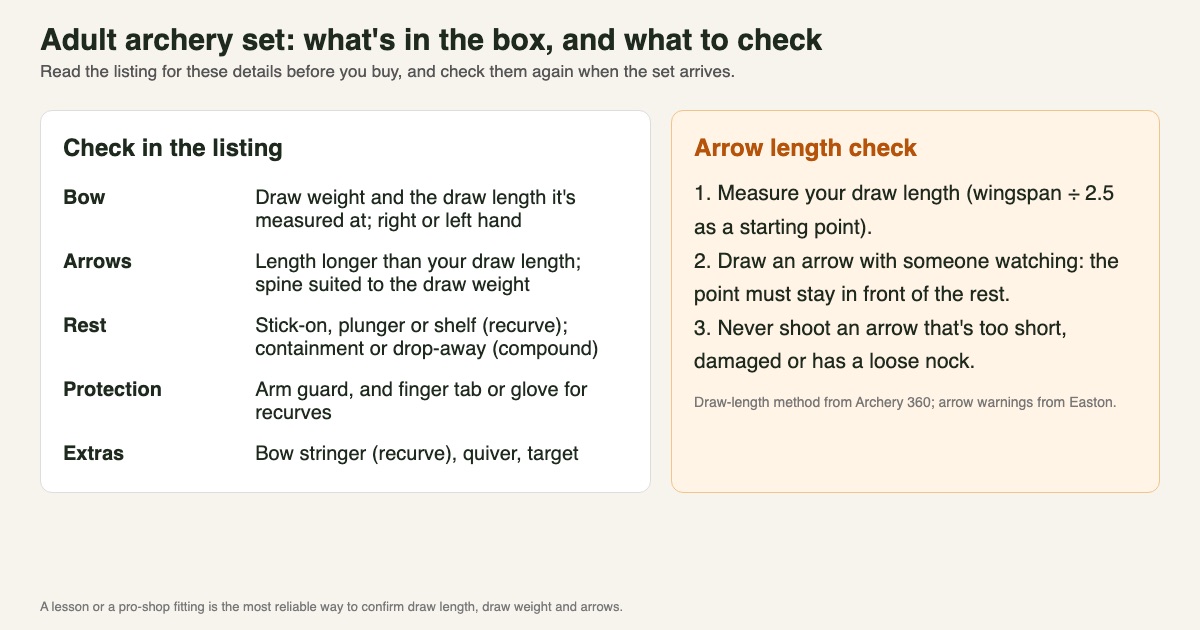
Most adult sets include some combination of:
- A bow: often a takedown recurve, sometimes a compound or a one-piece wooden recurve.
- Arrows, usually a small number.
- An arrow rest, and sometimes a sight.
- A quiver (often a simple bow or hip quiver).
- An arm guard and sometimes a finger tab or glove.
- A bow stringer with some recurve sets.
What's often missing: a target suitable for real arrows, a safe backstop, enough spare arrows, and any guidance on whether the arrows suit you.
Recurve set or compound package?
| Recurve set | Compound package | |
|---|---|---|
| Setup | Simple; string it with a stringer | Must be set to your draw length |
| Draw weight | Fixed by the limbs; takedown limbs can be swapped | Adjustable within a range |
| Holding at full draw | You hold the full weight | Let-off reduces holding weight |
| Typical use | Target, traditional, beginners, some hunting | Hunting, target, 3D |
| What to check | Limb draw weight at your draw length, string, rest | Draw length range, draw weight range, included accessories |
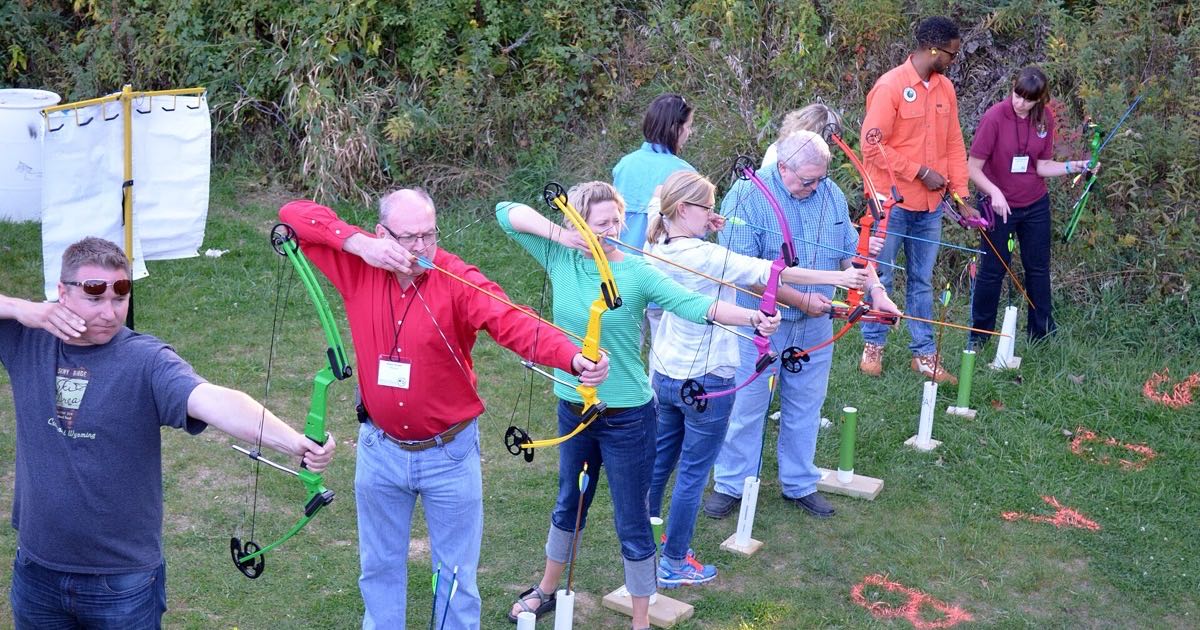
Scouting America, which runs archery for older teens and young adults, recommends take-down recurves for its programmes and notes that "true compound bows are not recommended at this level because they must be set up to fit each individual archer." That's a useful reminder: a compound package bought online still needs to be set to your draw length, ideally by a shop.
Our compound vs recurve comparison explains the differences in depth. For examples, our Samick Sage review covers a popular takedown recurve, and our reviews of the Diamond Infinite 305 and Bear Cruzer G3 cover adjustable compound packages.
Recurve sets: what to check
- The limb marking. Recurve limbs are marked with the draw weight at a standard 28-inch draw. Hoyt's recurve manual advises adding or subtracting "approximately two pounds for each inch your draw length is over or under the 28" standard," so a longer draw means more weight than the label.
- Takedown or one-piece. Takedown limbs can be swapped for heavier ones later.
- The string. Check it's the right length, undamaged and fitted with a nocking point.
- Brace height. Measure it with a bow square and compare with the maker's range; our brace height guide explains how.
- Limb alignment. With the bow strung, the string should run down the centre of both limbs.
Compound packages: what to check
If you choose a compound, look for:
- Draw length range. Many packages use adjustable modules; Archery 360 gives an example of ranges "such as 25 to 30 inches." Make sure your draw length falls inside the range.
- Draw weight range. A wide range lets you start light and increase as you get stronger.
- Included accessories. Packages often include a sight, rest, peep and sometimes a D-loop and quiver. Check what's included and what you'll need to add, such as a release aid; see our release aid guide.
- Bow length. Archery 360 notes that "hunting compounds typically measure 27 to 34 inches long, but target compounds generally are 34 to 40 inches long." Choose for how you'll shoot.
- Setup. Plan for a shop to set draw length, check the peep and rest, and fit arrows.
Choosing draw weight as an adult beginner
Archery 360's advice on recurve draw weight is to start lower and increase gradually, rather than buying the heaviest bow you can pull. For reference, Scouting America's programme guidance suggests take-down recurves of "20- to 35-pound" for its older youth and young adults. Many adult beginners start in a similar range, but strength, size and goals vary.
A good test: you should be able to draw the bow smoothly, hold it steady for a few seconds and let it down under control, repeatedly, without straining. If you plan to hunt, you'll need to meet your state's minimum draw weight eventually, but learn form on a lighter bow first. Our first recurve guide and draw weight vs draw length guide explain more.
The arrow problem: length and spine in bundled sets
Bundled arrows are the weakest point of many sets. Two things matter:
Length
Arrows must be long enough for your draw. Archery 360 suggests measuring your wingspan "then divide this number by 2.5" as a starting point for draw length, and notes that draw length "determines the length of your arrows and can even affect the spine of the arrow you should be using." Being off by an inch can cause problems "ranging from decreased accuracy to injury." An arrow that's too short can be drawn behind the rest, which is dangerous. Our draw length guide explains how to measure.
Spine
Spine is how stiff an arrow is. It needs to suit the bow's draw weight and the arrow's length. Archery 360 notes that "arrows come in different sizes and must match an archer's draw length and draw weight." Easton warns that "arrows should only be used with bows that have a correct pull weight and draw length." Our arrow guide explains spine charts.
If the set's arrows don't suit you, buy a matched set from a shop. It's one of the best upgrades you can make.
How to read a listing
- "Professional": a marketing word, not a standard. Look for specific specs instead.
- "Wooden": usually a one-piece or wood-riser recurve. Attractive and traditional, but check the draw weight and whether limbs can be changed.
- "Takedown": the limbs come off the riser, so you can change draw weight later.
- "Hunting": check the draw weight meets your state's minimum and that the set suits broadheads.
- "Ambidextrous" or "right/left hand": many recurves are handed; choose the right one.
- "Draw weight at 28 inches": recurve limbs are marked at a standard draw length; your actual draw weight changes with your draw.
- Speed or power claims: treat with caution unless backed by a recognised standard.
Accessories worth adding
- An arm guard and a finger tab or glove for recurves; see our arm guard and finger tab guide.
- A bow stringer for recurves; our stringing guide explains why you need one.
- A proper target and backstop; see our backyard range guide.
- Spare arrows that match you.
- String wax to keep the string in good condition.
Our beginner equipment list covers everything else.
Safety checks before the first shot
- Inspect every arrow. Easton: "NEVER SHOOT A DAMAGED ARROW" and "NEVER SHOOT AN ARROW WITH A LOOSE OR DAMAGED NOCK."
- Check arrow length at full draw, with someone watching, the bow pointed at a target.
- String a recurve correctly with a stringer, and check the string sits in both limb grooves.
- Check the limbs for cracks or damage, especially after shipping.
- Shoot in a safe place with a backstop and clear area behind; learn basic range rules from our range safety guide.
- Never dry fire the bow.
Where to buy
- An archery pro shop can fit you, set up the bow and supply matched arrows. Many also offer lessons and try-before-you-buy.
- Large outdoor retailers stock sets and packages, sometimes with in-store setup.
- Online sellers offer the widest choice, but you'll need to check specs carefully and arrange setup and arrow fitting yourself.
Whichever you choose, check the return policy and buy from an established seller.
Upgrading a set over time
A set is a starting point. Common upgrades, roughly in order:
- Matched arrows cut to your draw length and spined for your bow.
- Better finger protection (a quality tab or glove) or a release aid for compounds.
- Heavier limbs for a takedown recurve as your strength improves.
- A better rest, plunger or sight once your form is consistent.
- A proper target and backstop for regular practice.
Common mistakes
- Buying too much draw weight "to grow into."
- Shooting the bundled arrows without checking length.
- Choosing the wrong hand for your dominant eye and hand.
- Skipping finger protection on a recurve.
- Buying a compound online and shooting it without setup.
- Practising without a safe backstop.
Set vs pro-shop fit
A set is a convenient way to start, but a pro shop can measure your draw length and draw weight, fit arrows to you, and set up a compound properly. Archery 360 notes that "a 30-minute one-on-one lesson is a great introduction," and that "most shops offer lessons." Many adults find a lesson first, then a fitted bow, saves money in the long run.
Once you have your equipment, our guide to shooting a recurve bow and our parts of a recurve bow will help you get started.
Buying an adult archery set
Advantages
- Convenient: bow, arrows and accessories in one box
- Takedown recurve sets allow heavier limbs later
- A low-commitment way to try the sport
Trade-offs
- Bundled arrows may not suit your draw length or the bow
- Often missing a proper target and finger protection
- Compound packages still need setting up to fit you
You can browse takedown recurve sets or compound bow packages on Amazon.
Frequently asked questions
What draw weight should an adult beginner use?
Light enough to draw smoothly and hold steady without strain. Archery 360 advises starting lower and increasing gradually; Scouting America's programmes use 20 to 35 lb recurves for older youth and young adults.
Are cheap archery sets any good?
Some are fine for casual shooting, but check the bow's specs and especially whether the arrows suit your draw length and the bow's draw weight.
Is a youth bow OK for an adult?
Usually not. Youth bows have short draw lengths and light draw weights that won't fit most adults.
What does "professional" mean on an archery set?
Nothing specific. It's a marketing term; look for draw weight, draw length, arrow length and spine instead.
Wooden vs takedown recurve sets: which is better?
Takedowns let you swap limbs as you get stronger; one-piece wooden recurves are simple and traditional. Check the draw weight either way.
How long should my arrows be?
Long enough that the point stays in front of the rest at full draw. Measure your draw length first.
Do I need a bow stringer?
For a recurve, yes. It's the safe way to string and unstring the bow.
Should I buy a recurve or compound set first?
A light takedown recurve is simple, affordable and teaches good form. A compound package suits people who want to hunt or prefer sights and a release, but it needs setting up to your draw length.
Can I use the arrows that come with an archery set?
Only if they're long enough for your draw and undamaged. Check them at full draw with someone watching, and replace them with matched arrows if in doubt.
Related articles
 Guides
How to Choose Your First Recurve Bow: A Beginner's Guide
How to choose a first recurve bow: takedown vs one-piece, draw weight, bow length for your draw length, riser types, eye dominance, and essential accessories.
Updated February 6, 2025 · 11 min read
 Reviews
Samick Sage Takedown Recurve Review: Still the Default First Bow?
Research-based Samick Sage review: the 62-inch takedown recurve's published specs, 25–60 lb limbs, who it suits, its limits and how it compares with rivals.
Updated May 21, 2025 · 5 min read
 Guides
Archery Equipment List: What Beginners Really Need
A beginner archery equipment list by discipline: what you need for recurve, barebow, compound, traditional and bowhunting, what can wait, and what to skip.
October 10, 2026 · 11 min read