
Archery Range Safety Rules and Whistle Commands Explained
Archery range safety explained: whistle commands, shooting and waiting lines, collecting arrows safely, equipment checks, and what the Fast call means.
By Archery Insider Editorial Team
· · 10 min read

In this article
Archery has an excellent safety record, and that is not an accident. Every club, school programme and competition in the world runs on the same handful of rules: everyone shoots from one line, nobody goes forward until the range is clear, and a simple whistle system tells everyone what happens next.
If you learn those rules before your first session, you will walk onto any range in the world and know what is going on. This guide explains them in plain language, along with the equipment checks and habits that keep you and the people around you safe.
Why archery ranges have strict rules
A bow stores enough energy to drive an arrow through a target boss. Range rules exist so that there is never a moment when a loaded bow and a person downrange can coincide. They work by controlling three things:
- Where people stand: everyone shoots from the same line, and non-shooters stay behind a second line.
- When people move: nobody goes forward until every archer has finished and the range is called clear.
- What people do with a bow: arrows are only nocked on the line, and bows are only ever drawn toward the target.
Every specific rule below is an application of those three ideas.
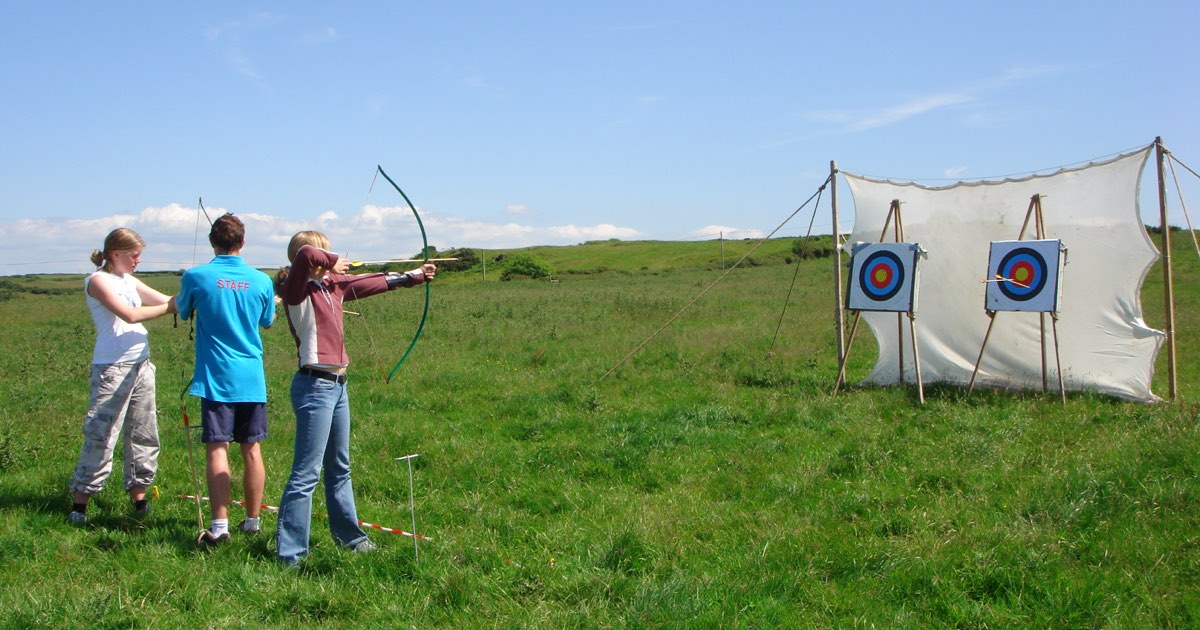
The layout of a range
Whether it is a school gym, a club field or a World Cup venue, every target range has the same zones.
| Zone | What it is | Who can be there |
|---|---|---|
| Waiting line | A line a few metres behind the shooting line | Archers waiting their turn, coaches, spectators behind it |
| Shooting line | The line archers stand on (or straddle) to shoot | Only archers who are shooting the current end |
| Target line | The line the targets stand on | Nobody while shooting is in progress |
| Overshoot area | Clear ground behind and beside the targets | Nobody, at any time during shooting |
Indoor ranges replace the overshoot area with a backstop curtain or net, but the principle is identical: nothing and nobody should ever be in the line of fire.
Whistle commands
The whistle system is used at almost every organised range and competition. It is described in World Archery's rules and taught in every beginner course.
| Signal | Meaning | What you do |
|---|---|---|
| Two whistles | Archers to the shooting line | Walk from the waiting line to the shooting line. Arrows stay in your quiver. |
| One whistle | Start shooting | Nock and shoot your arrows for the end. |
| Three whistles | Collect arrows | Put your bow down or on its stand and walk to the targets. |
| Five or more whistles | Emergency: stop immediately | Stop shooting. If you are at full draw, let down safely. Remove the arrow from the string and wait. |
At competitions the whistle is usually paired with lights or a countdown clock. A red light means the ten-second walk to the line, green means shoot, and amber warns that 30 seconds remain. Since January 2022 World Archery has allowed 30 seconds per arrow in qualification and individual matches: 90 seconds for a three-arrow end and 180 seconds for a six-arrow end.
"Fast!": the word that stops everything
In the UK and many other countries, anyone on the range who sees a hazard must shout "Fast!". Archery GB's Rules of Shooting say that on hearing it, all archers must stop shooting immediately and return unshot arrows to the quiver, and other archers should repeat the call so that everyone hears it. Shooting only restarts when the person in charge says so.
Other countries use "Stop!" or "Hold!" for the same purpose. Learn the word your range uses on day one.
On the shooting line
Most incidents happen at the shooting line, and most of them are avoidable with these habits.
- Wait for the signal. Do not walk up until two whistles, and do not nock until one whistle.
- Straddle or stand on the line. At target archery both feet are usually on either side of the line, so everyone shoots from the same distance and nobody is in front of their neighbour.
- Nock only on the line. Never nock an arrow while walking, waiting, or with anyone forward of the line.
- Point the arrow downrange. A nocked arrow should always point at the ground in front of you or at the target, never sideways, behind you, or up into the air.
- Draw toward the target, not the sky. Raising a bow high and drawing as you lower it, sometimes called sky-drawing, can send an arrow over the backstop if it is released accidentally. Coaches teach drawing with the bow arm level with the target.
- Never dry-fire. Releasing the string without an arrow sends all the stored energy into the limbs instead of the arrow. It can crack limbs, break the string, and throw parts toward your face. If you need to stop mid-draw, let down slowly.
- Step back when you finish. When you have shot all your arrows, step back behind the waiting line so the field captain can see who is still shooting.
- Dropped an arrow? If it falls in front of the line and you cannot reach it with your bow from where you stand, leave it. It can be retrieved when arrows are collected.

Collecting arrows safely
Walking to the target is the other moment when accidents happen, usually to the person pulling arrows or the person standing behind them.
- Walk, never run. Running toward a target lined with protruding arrow nocks is a common way to get a nock in the eye.
- Look down as you approach. Arrows that missed low are often buried in the grass in front of the target. Stepping on them breaks them; tripping over them can hurt you.
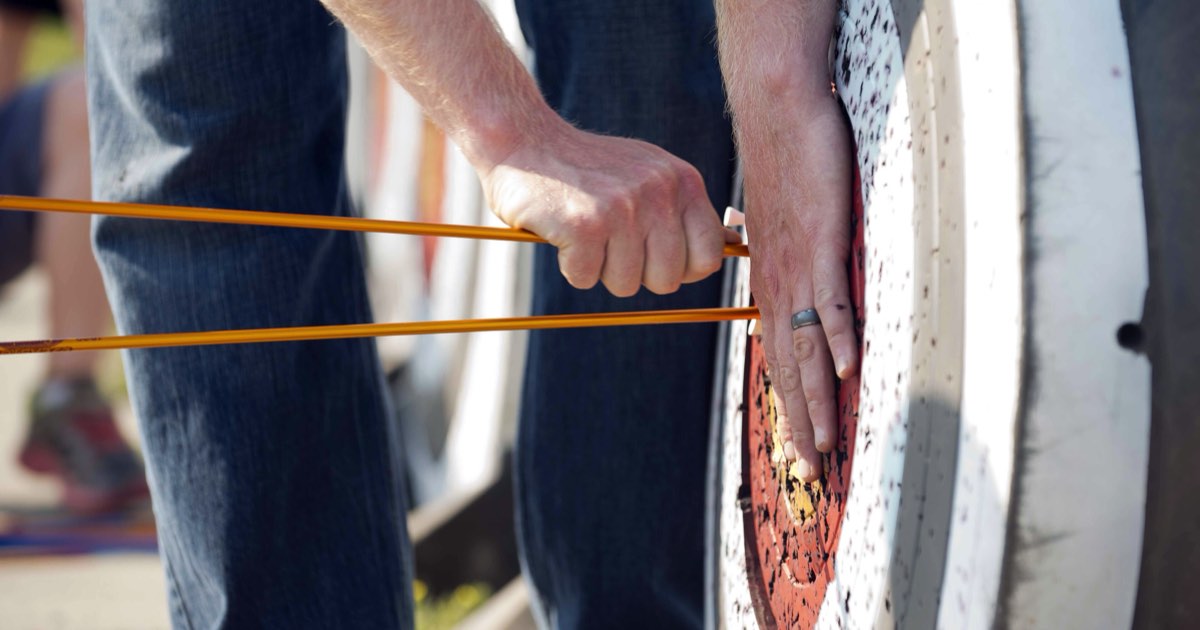
- Stand to the side to pull. Nobody should stand directly behind an arrow being pulled, because arrows can come out suddenly.
- Check behind you before pulling. Say "Clear?" or glance back first.
- Pull close to the target. Put one hand flat on the target face next to the arrow, grip the shaft close to the face with the other, and pull straight back along the line it went in. Twisting slightly helps carbon and aluminium arrows release.
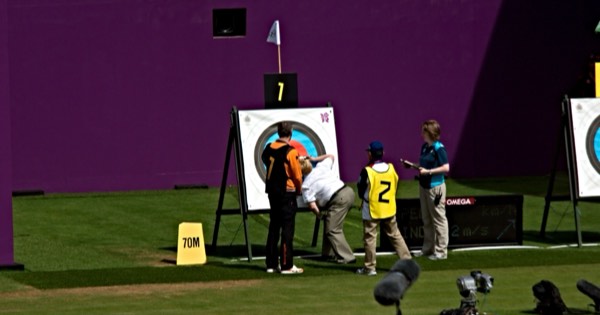
- Score before you pull. At club and competition shoots, nobody touches an arrow until it has been scored. Our guide to how archery scoring works explains the procedure.
- Search behind the target only when the range is closed. If arrows passed the target, look for them while everyone else is collecting, and leave a bow or a marker leaning against the target so nobody starts shooting.
Check your equipment every session
Safe shooting starts before you reach the line. A two-minute check catches most equipment failures before they become accidents.
| Item | What to check |
|---|---|
| Bow limbs | Cracks, splinters, delamination, or twist when you sight down the strung bow |
| String | Fraying, broken strands, loose or worn serving, nocking point in place |
| Limb bolts and accessories | Tight, nothing rattling |
| Arrows | Cracked or split shafts, damaged nocks, loose points or fletching |
| Arrow length | Long enough that the point stays in front of the rest at full draw |
| Arm guard and finger tab | Fitted and worn on every shot |
Carbon arrows deserve special attention. A cracked carbon shaft can shatter on release, and fragments can go into the bow hand. Flex each shaft gently and listen for cracking, and throw away any arrow that has hit something hard and shows damage.
Arrows that are too short for your draw length are dangerous: the point can be drawn behind the rest and the arrow can fall off or be driven into your hand. Our guide to measuring draw length explains how to get it right.
Clothing and protective gear
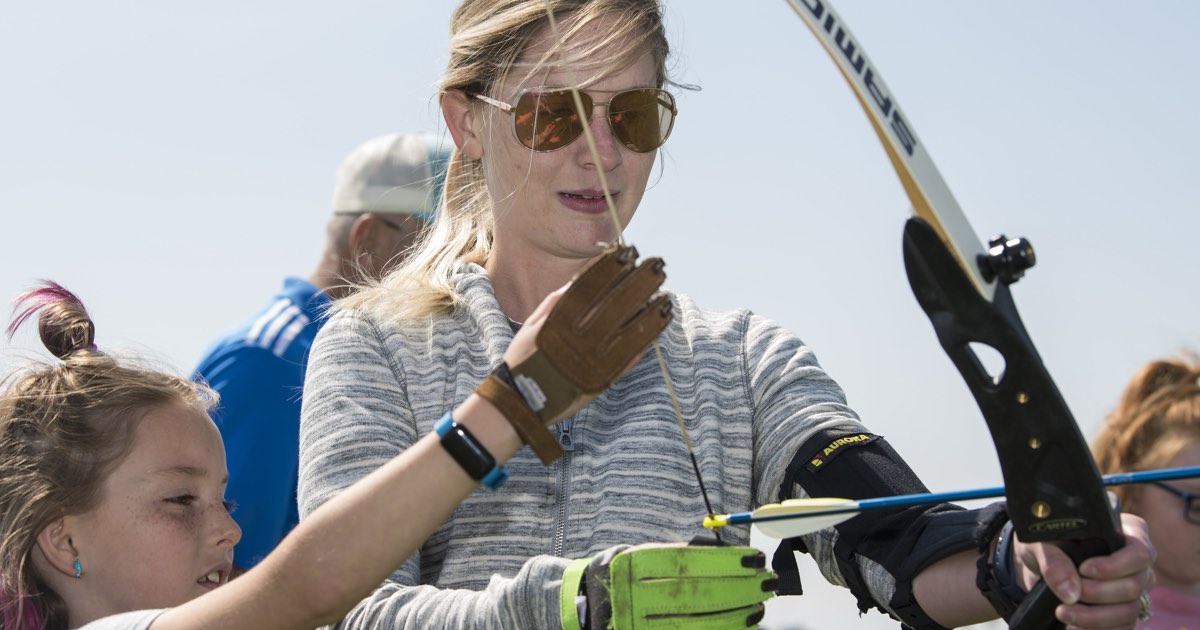
- Arm guard (bracer): protects the inside of your bow arm from string slap.
- Finger tab or glove: for recurve and traditional archers, protects your fingers and gives a cleaner release.
- Chest guard: keeps loose clothing out of the string's path. Useful for anyone wearing a jacket or loose top.
- Closed shoes: fields hide dropped arrows, and sandals offer no protection.
- No loose items near the string: remove dangling lanyards, scarves and hoodie cords on the bow side.
Spectators, children and pets
Ranges are usually happy to have spectators, as long as they stay behind the waiting line and never walk across the range. A few points for families:
- Children should be supervised at all times and taught the whistle commands before they shoot.
- Pets should be kept away from ranges, or leashed well behind the waiting line.
- Never walk across an open range to reach a friend, even when it looks quiet. Use the designated paths.
Field and 3D courses
Field and 3D courses take archers through woods and fields to targets at different distances. The same principles apply with some additions:
- Only shoot from marked shooting pegs, in the direction of the target.
- Follow the course in order, and never cut across the shooting lanes of other targets.
- If you need to search for arrows behind a target, leave a bow propped against the target or post a member of your group to warn the next group.
- Groups waiting for a target stay well back until the group ahead has scored and moved on.
Emergencies
If you hear five or more whistles, or "Fast!", do the same three things every time:
- Stop. If you are at full draw, let down slowly with the arrow pointed downrange.
- Remove the arrow from the string and return it to your quiver.
- Stay where you are and wait for instructions.
Most clubs have a first aid kit and a designated first aider on duty. Find out where both are on your first visit.
Range safety checklist
Print this, or save it to your phone.
- Equipment checked: limbs, string, arrows, accessories.
- Arm guard and tab or glove on.
- Wait behind the waiting line.
- Two whistles: walk to the line.
- One whistle: nock, shoot, step back when done.
- Three whistles: walk forward, look down, stand to the side, check behind, pull.
- Five or more whistles, or "Fast!": stop, let down, unnock, wait.
Frequently asked questions
Do I need to know the whistle commands for my first lesson?
No. Your instructor will teach them before you shoot. Knowing them in advance makes the first session less overwhelming and lets you concentrate on shooting.
Can I shoot if I am the only person at the range?
Many clubs require at least two members to be present, or a designated range officer, for safety and insurance reasons. Check your club's rules before shooting alone.
What happens if my arrow goes over the backstop?
Stop shooting and tell the range officer immediately. Do not go looking for it until the range is closed. Repeated overshoots are a sign you should move closer to the target or have your form checked.
Is archery dangerous?
Archery has a strong safety record when range rules are followed. The rules in this guide exist precisely because a bow is powerful; following them is what keeps the sport safe for everyone.
Where can I learn more?
Start with a beginner course at a local club. Then read our guides to archery form and setting up a safe backyard range if you plan to practise at home.
Sources
- Target archery – Wikipedia
- World Archery Rule Change Reduces Shooting Time for Individual Rounds – USA Archery
- Archery GB Rules of Shooting (October 2014 edition) – Archery GB
- Archery Safety – Bowhunter Ed
- Archery range rules – Oregon Department of Fish and Wildlife
Related articles
 Guides
How Archery Scoring Works: Target Faces, Rings and Match Rules
How archery scoring works: ring values and colours, target face sizes, line cutters, X counts, the recurve set system, compound matches and shoot-offs.
Updated September 14, 2026 · 8 min read
 Guides
How to Set Up a Safe Backyard Archery Range
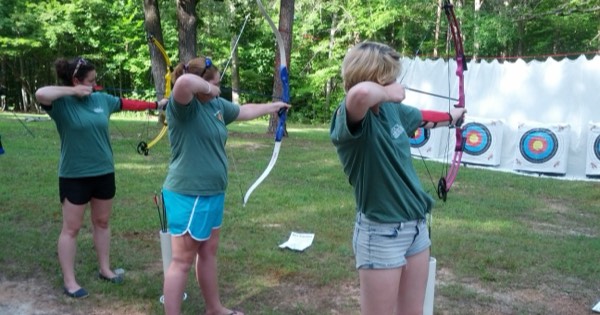
How to set up a safe backyard archery range: legal checks, safe buffer distances, backstops and netting, choosing a target, layout and house rules.
April 8, 2026 · 8 min read
 Training
Archery Form: 11 Steps to a Consistent Shot
Archery form step by step: stance, hook and grip, set-up, draw, anchor, transfer, aiming, release and follow-through, plus common faults and fixes.
Updated March 21, 2025 · 10 min read