
How to String and Unstring a Recurve Bow Safely
How to string and unstring a recurve bow with a stringer, why step-through stringing twists limbs, post-stringing checks, brace height and string care.
By Archery Insider Editorial Team
· · 8 min read
In this article
Stringing a recurve looks like a minor job, and it is the one most likely to damage a new bow or injure the archer if it is done badly. The limbs of a recurve store a lot of energy even when they are only braced, and a limb that slips while you are bending it will snap back toward whatever is in front of it, often the archer's face.
The safe method is simple, takes about thirty seconds, and needs one inexpensive tool: a bow stringer. This guide covers how to use one, why the alternatives are a bad idea, what to check afterwards, and how to look after the string.
Why you should use a bow stringer
A bow stringer is a cord with a pocket at one end and a pocket or saddle at the other. You fit it over the limb tips, stand on the cord and lift the riser. The stringer takes the bend while you slide the string loop into place.
It is safer and kinder to the bow than any alternative:
- Even bending. Both limbs bend the same amount, in the plane they were designed to bend.
- Hands free. You slide the top loop into place with one hand while the other holds the riser.
- Face away. The limb tips are below and away from your face throughout.
Why not step-through or push-pull?
The step-through method (stepping between the string and the riser, bracing the lower limb against your ankle and bending the top limb with your hip) and the push-pull method (bracing one tip against your foot and pushing the riser) both bend the limbs unevenly and sideways. Recurve limbs are not built for sideways loads, and these methods are a well-known cause of twisted limbs. If the string slips off a tip mid-bend, the limb snaps back with your face in its path. Many bow makers will not honour a warranty claim on limbs strung this way.
Types of bow stringer
| Type | How it fits | Good for |
|---|---|---|
| Double pocket | Large pocket over the lower limb tip, small pocket over the upper tip | Most takedown and one-piece recurves; simplest for beginners |
| Pocket and saddle | Large pocket on the lower tip, a rubber or leather saddle on the upper limb below the string loop | Longbows and recurves with tips that will not fit a small pocket |
Both work. Choose one sized for your bow length; most are adjustable or made in lengths for youth and adult bows.
Before you start: string and bow orientation
- Assemble takedown bows first. Attach both limbs and tighten the limb bolts by hand. Check which limb is top and bottom; they are usually marked.
- Check the string. Most strings have a larger loop for the top limb and a smaller loop for the bottom. The nocking point should face up, toward the top limb, when the bow is strung.
- Fit the bottom loop fully into the grooves of the bottom limb tip.
- Slide the top loop over the top limb and down the limb a few inches, so it is loose but cannot fall off.
How to string a recurve with a stringer
- Fit the stringer. Put the large pocket over the bottom limb tip, over the string loop. Fit the small pocket over the top limb tip, or place the saddle on the top limb a few inches below the string loop.
- Check the string is on the belly side of the bow (the side facing you when you shoot) and the stringer cord hangs below the bow.
- Stand on the cord with both feet, about shoulder-width apart, so that the bow is in front of you with the limbs pointing left and right and the string facing the floor.
- Lift the riser straight up by the grip. The cord bends both limbs evenly.
- Slide the top loop up the limb and into the string grooves at the top limb tip with your free hand.
- Ease off slowly while watching the top limb tip to confirm the loop has seated fully in the grooves.
- Remove the stringer, and keep your face away from the limb tips throughout.
How to unstring a recurve
- Fit the stringer exactly as for stringing.
- Stand on the cord and lift the riser to take the tension off the string.
- Slide the top loop out of the grooves and down the limb.
- Lower slowly and remove the stringer.
Leave the bottom loop in place and the top loop on the limb, so the string stays with the bow and does not tangle.
Checks after stringing
Do these every time you string the bow.
| Check | How | What to do if wrong |
|---|---|---|
| String seated in both tips | Look at each limb tip; the loop should sit in the grooves on both sides | Unstring and restring |
| Limb alignment | Hold the bow at arm's length and sight down the string from one end; it should run down the centre of both limbs | Unstring; check limbs are seated correctly in the riser; ask a shop if a limb looks twisted |
| Nocking point | It should face the top limb, just above where the arrow sits | You strung the bow upside down; unstring and turn the string over |
| Brace height | Measure from the deepest part of the grip to the string | Adjust by twisting the string (below) |
| Limb bolts | Tight, and evenly set on takedowns | Tighten; follow the manual for draw-weight settings |
Brace height
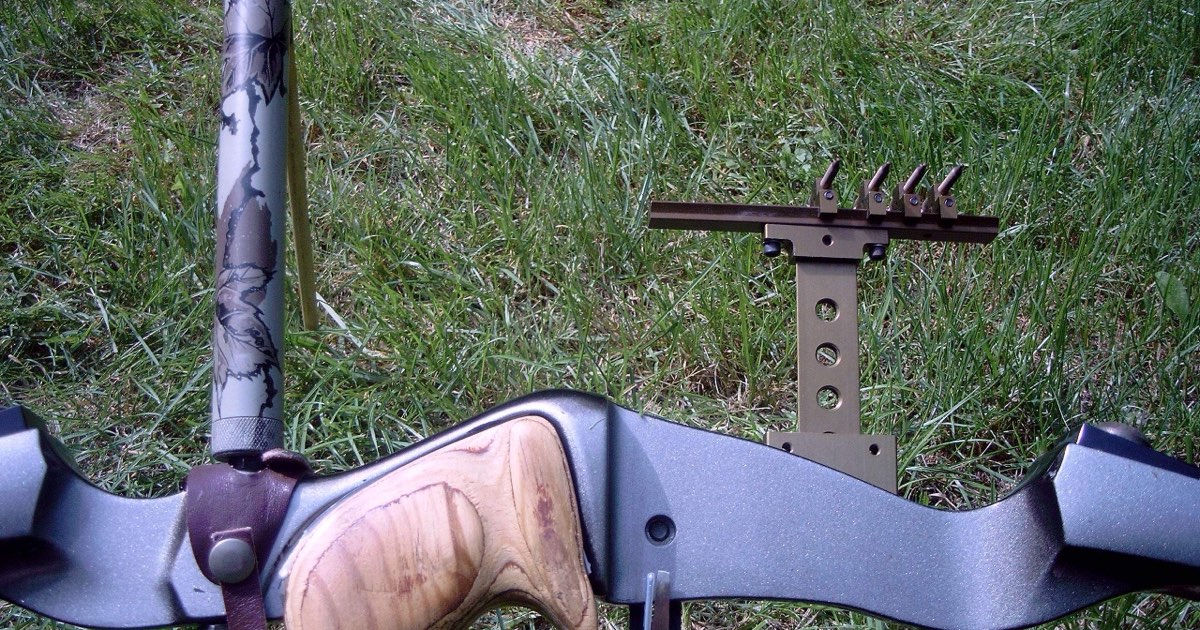
Brace height is the distance from the deepest point of the grip (the pivot point) to the string. Manufacturers publish a recommended range for each bow, often somewhere between about 7 and 9.75 inches depending on bow length and design. Our Samick Sage review, for example, quotes 7.25 to 8.25 inches for that bow.
- Measure with a bow square: hook it over the string and read the distance to the pivot point.
- To raise brace height, unstring and add twists to the string in the direction it is already twisted. This shortens it.
- To lower brace height, remove twists. This lengthens it.
- Restring, measure again, and shoot a few arrows to let the string settle before measuring a final time.
Too low a brace height can let the string slap your arm and make the bow feel harsh; too high reduces arrow speed. Within the manufacturer's range, many archers fine-tune brace height to where the bow sounds quietest.
Should you leave a recurve strung?
| Bow type | Common practice |
|---|---|
| Wooden or laminated recurve | Unstring after each session to reduce limb strain |
| Longbow | Unstring after each session |
| Modern takedown with synthetic limbs | Many archers leave it strung through a session; unstring for storage and transport |
| Any bow, for long-term storage | Unstring and store flat or on a rack, out of heat and sun |
When in doubt, follow the manufacturer's instructions. Never leave a strung bow in a hot car.
String care
- Wax the string every few sessions with bowstring wax, rubbing it into the strands and avoiding the serving.
- Inspect it before every session for frayed or broken strands and loose serving. Replace a damaged string immediately; a failing string can snap on release.
- Replace on schedule. Even undamaged strings stretch and wear. Many archers replace recurve strings every season or after a few thousand shots.
- Order the right length. String makers size recurve strings a few inches shorter than the bow's AMO length. Order by the string length your bow's manufacturer specifies.
- Match the material to the bow. Older and many wooden bows need Dacron strings. Low-stretch materials such as Fast Flight are only safe on limbs with reinforced tips rated for them.
Stringing a longbow
The same stringer method works for longbows, usually with a pocket-and-saddle stringer because longbow tips are often too slim for a second pocket. Longbows are also more prone to damage from step-through stringing, and many bowyers specifically prohibit it.
If you need one, you can browse bow stringers on Amazon. Check that it suits your bow length and tip shape.
Frequently asked questions
Can I string a recurve without a stringer?
You can, but you should not. The methods that do not use a stringer bend the limbs unevenly and are a common cause of twisted limbs and injuries.
Why does my string keep coming off the limb tip?
Usually the loop was not fully seated in both grooves, or the string is too long for the bow. Restring carefully and check both sides of each tip. If it persists, check you have the right string length.
How do I know if my limbs are twisted?
Sight down the strung bow from the top or bottom. The string should run down the centre of both limbs. If it sits off to one side of a limb, unstring and have a shop inspect the bow.
What brace height should I use?
Start in the middle of the range your bow's manufacturer recommends, then adjust within it if the bow feels harsh or noisy.
Sources
- How to String a Recurve Bow: Step-by-Step Stringer Guide – Archery Buddy
- Stringing a Recurve Bow (club help guide) – Wyke Archers
- How to Adjust Brace Height – Archery 360
- Use a Bow Stringer or "Step Thru"? – ArcheryTalk
Related articles
 Reviews
Samick Sage Takedown Recurve Review: Still the Default First Bow?
Research-based Samick Sage review: the 62-inch takedown recurve's published specs, 25–60 lb limbs, who it suits, its limits, and how it compares with the.
Updated May 21, 2025 · 5 min read
 Guides
How to Choose Your First Recurve Bow: A Beginner's Guide
How to choose a first recurve bow: takedown vs one-piece, draw weight, bow length for your draw length, riser types, eye dominance, and essential accessories.
Updated February 6, 2025 · 11 min read
 Guides
Archery Range Safety Rules and Whistle Commands Explained
Archery range safety explained: whistle commands, shooting and waiting lines, collecting arrows safely, equipment checks, and what the Fast call means.
Updated April 10, 2026 · 10 min read