
ILF Limbs and Risers Explained: Fit, Lengths, Weight
What are ILF limbs? How the International Limb Fitting works, brand compatibility, ILF vs Formula, riser and limb length maths, and limb bolt adjustment.

By Archery Insider Editorial Team
· 12 min read
In this article
If you've looked at takedown recurve bows, you've met the letters ILF on almost every riser and set of limbs. ILF stands for International Limb Fitting. It's the closest thing recurve archery has to a universal plug: a shared design for the joint between riser and limbs, so you can mix risers and limbs and upgrade one without replacing the other.
This guide explains how the fitting works, where it came from, how far you can trust cross-brand compatibility, how ILF differs from Hoyt's Formula fitting and from proprietary systems, how riser and limb lengths add up, how to use the limb bolts safely, and what to check before you buy.
What are ILF limbs? The quick answer
ILF limbs are takedown recurve limbs made to the International Limb Fitting pattern. Archery 360 puts it simply: "ILF stands for 'international limb fitting.' This universal system lets archers mate an ILF riser to ILF limbs."
An ILF riser is a recurve handle with limb pockets built to the same pattern. Because the joint is shared, you can buy limbs from one maker and a riser from another, change draw weight by swapping only the limbs, or move to a better riser and keep your limbs. That flexibility is the main reason most target recurves, and many hunting and barebow takedowns, now use ILF. If the riser, limbs and other parts are new to you, start with our parts of a recurve bow.
How an ILF fitting works
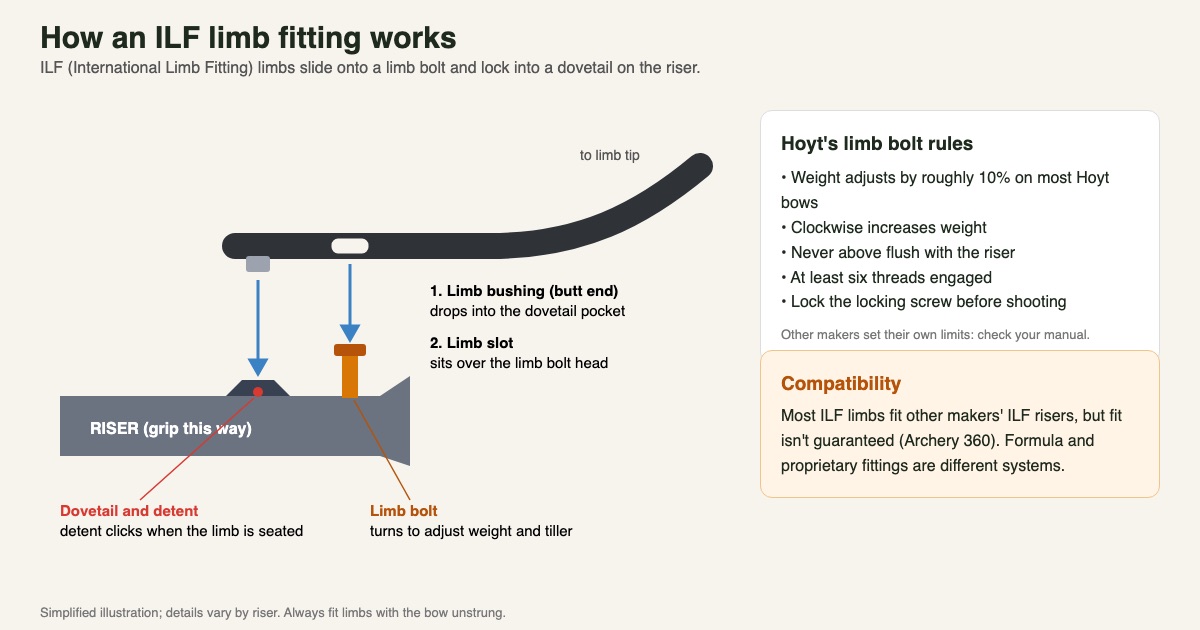
The fitting has two halves. On the riser, each limb pocket has:
- A dovetail pocket near the grip end of the pocket. The base of the limb locks into it.
- A limb bolt further out, towards the riser's tip. It is a large threaded bolt whose head stands proud of the pocket.
- A detent, a small spring-loaded plunger or catch on many risers. It clicks when the limb is fully seated.
- A locking screw on many risers, which stops the limb bolt turning once it's set.
On each limb, the butt end carries:
- A bushing or button at the very end, which slides into the dovetail.
- A slot a little further along, which sits over the head of the limb bolt.
When the bow is strung, string tension pulls the limb's butt firmly into the dovetail and against the bolt. The limb is held by geometry and tension, not by screws through the limb. That's why ILF limbs can be fitted and removed by hand in seconds, and why the bow must always be unstrung before you do it.
The limb bolt does a second job. Screwing it in or out changes the angle at which the limb sits in the pocket. A different angle means more or less preload on the limb, which changes the draw weight and the tiller (the balance between top and bottom limbs). We cover that below.
A short history of the ILF fitting
The UK retailer Quicks Archery explains that the International Limb Fitting "was first designed and producted by Hoyt USA in the mid 1980's as their own limb fitting." Other makers then copied it: "Eventually other bow makers replicated the Hoyt fitting … and it became known as the ILF Fitting." Hoyt still uses its own name for it: "Today Hoyt call this fitting on their bows the 'Grand Prix' fitting."
Sources disagree on the exact year Hoyt introduced the design, so we won't name one. The safe version is that it was a Hoyt design from the mid-1980s that later became the industry's shared standard. Hoyt's current product pages still list "Grand Prix (ILF)" fittings on both target and hunting risers.
Compatibility: can you mix brands?
Usually, yes, but check. Archery 360's guidance is the most useful summary: "ILF interchangeability isn't guaranteed because some manufacturers measure their fittings slightly different. However, most ILF limbs from one manufacturer will fit another manufacturer's ILF riser."
Quicks says the same: "there are slightly different dimensions and tolerances between manufacturers. So if you mix and match manufacturers take care to check the fit of limb to handle."
In practice, check a cross-brand pairing for:
- Seating. The limb should drop into the dovetail and click past the detent without force.
- Wobble. Once strung, the limb shouldn't rock sideways in the pocket.
- Alignment. The string should track down the centre of both limbs. Our recurve tuning guide explains how to check limb alignment.
- Bolt range. The limb should reach your target weight without running the limb bolt past the maker's limits.
If you're buying limbs for a riser you already own, the simplest check is to ask the seller, or the limb maker, whether they've tested the pairing.
ILF vs Formula vs proprietary fittings
ILF isn't the only way to attach takedown limbs. There are three main families.
| ILF (Grand Prix) | Formula | Proprietary | |
|---|---|---|---|
| Who makes it | Hoyt and most other makers | Mostly Hoyt | One maker, for its own bows |
| How limbs attach | Dovetail plus limb bolt | Longer fitting with its own pocket | Varies: often bolts or knobs through the limb |
| Swap with ILF? | Yes, usually | No | No |
| Typical use | Target, barebow, hunting takedowns | Hoyt target bows | Entry-level and some hunting takedowns |
Formula. According to Improve Your Archery, the Formula fitting "is longer and it features a bushing to attach a dampener", and "you can't attach ILF limbs to a Formula bow and vice versa." It notes that Formula is "mostly supported by Hoyt." Hoyt's own range shows the split: some Hoyt risers are listed as Grand Prix (ILF) and others as Formula. Neither system is objectively better. They're simply different, so match limbs to the riser's fitting.
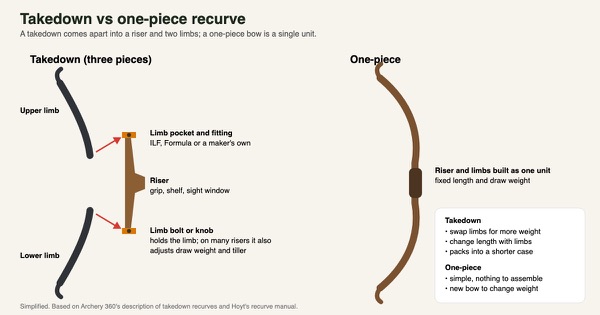
Proprietary fittings. Many entry-level takedowns use a maker's own system. The limbs are typically held by a bolt or knob screwed through the limb into the riser, as on the Samick Sage covered in our Samick Sage review. These bows work well, but you have to buy replacement limbs from the same maker for that model. Our takedown vs one-piece comparison explains the wider trade-offs.
Riser length + limb length = bow length
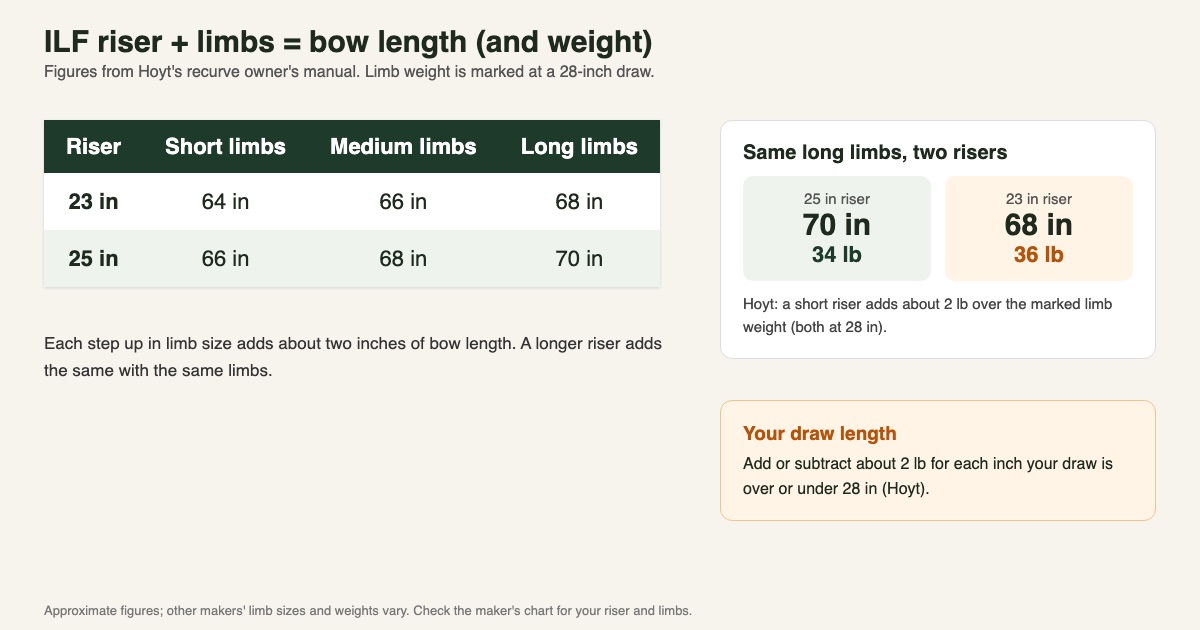
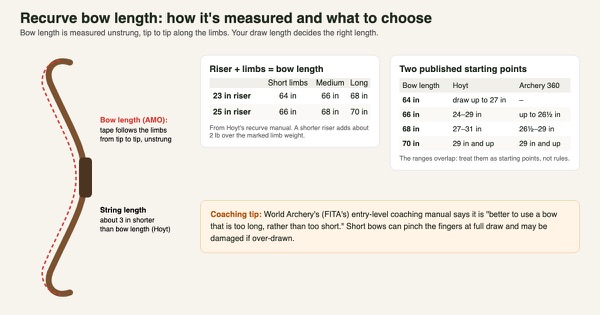
ILF limbs are usually sold as short, medium and long, and risers mostly come in 23-inch and 25-inch versions (with other lengths available). Total bow length is the sum of the two:
| Riser | Short limbs | Medium limbs | Long limbs |
|---|---|---|---|
| 23 in | 64 in | 66 in | 68 in |
| 25 in | 66 in | 68 in | 70 in |
These figures come from Hoyt's manual, and Archery 360 gives the same 66/68/70-inch combinations for a 25-inch riser. Each step up in limb size adds about two inches, and so does a riser two inches longer. Other makers' limb sizes can vary, so always use the maker's stated riser length and limb chart rather than guessing.
Which length do you need? Bow length is chosen mostly from your draw length, so a long-armed archer usually wants a longer bow. Our guide to what recurve bow length you need gives the draw-length charts.
Draw weight markings and the riser effect
Limb weight is marked at a standard draw length. Archery 360 says most makers mark draw weight "at a 28-inch draw length", and Hoyt measures at 28 inches too. Two things change the weight you actually pull.
Your draw length. Hoyt advises adding or subtracting "approximately two pounds for each inch your draw length is over or under the 28" standard." Limbs marked 30 lb will therefore feel close to 32 lb at a 29-inch draw. Our guide to draw weight vs draw length explains why.
The riser length. Hoyt notes that a "short riser will result in an approximate 2 lb. increase over the marked limb weight." Its worked example: long limbs on a 25-inch riser make a 70-inch bow at 34 lb (at 28 inches), while the same limbs on a 23-inch riser make a 68-inch bow at 36 lb. A shorter riser bends the limbs a little more for the same draw, so it pulls heavier.
Put the two together when you order limbs. An archer with a 30-inch draw on a 23-inch riser could be pulling several pounds more than the number on the limb.
Adjusting weight and tiller with the limb bolts
The limb bolts give you fine control without buying new limbs. Hoyt's manual is specific about what they can do and where to stop.
How much range? "The weight on most Hoyt bows is adjustable in a range of approximately 10%." On 30 lb limbs that's roughly 3 lb in total. Other makers quote their own ranges, so check your manual.
Which way? "Turning the weight/tiller adjustment bolt clockwise will increase bow weight." Unscrewing the bolt reduces weight.
The safety limit. Hoyt warns: "The weight/tiller bolt should never go above flush with the riser. There must be at least six threads of engagement between the riser and weight tiller bolt." Running a bolt out too far leaves too few threads holding the limb against string tension. Stay within the limits in your riser's manual.
Lock it. "Be sure to lock down the weight/tiller locking screw before shooting the bow." A bolt that creeps changes your weight and tiller from end to end.
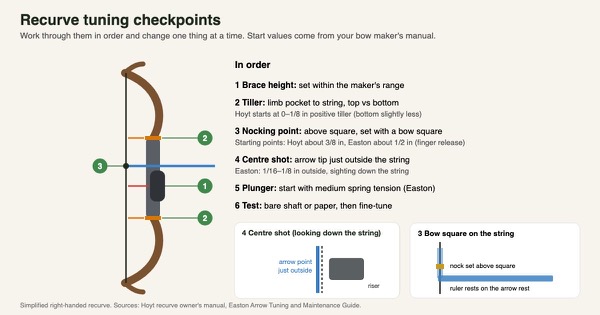
Tiller. Hoyt recommends starting with "0-1/8" positive tiller" (the top limb slightly weaker than the bottom), and explains that "to adjust the tiller without affecting bow weight, adjust both the top and the bottom weight/tiller adjustment bolts in equal but opposite directions." Turn each bolt the same amount and keep notes. Our tuning guide covers tiller in detail.
Changing limb angle can also change your brace height slightly, so recheck it after big adjustments. Our brace height guide explains how.
Installing and removing ILF limbs safely
Fitting ILF limbs is quick, but always do it with the bow unstrung.
- Check the limbs. Make sure each limb goes in the right place (most are marked top and bottom) and that the logos face the right way for your bow.
- Seat the bushing. Hold the riser, angle the limb, and slide its butt-end bushing into the dovetail pocket.
- Drop it onto the bolt. Press the limb down so its slot sits over the limb bolt head. On risers with a detent, you'll feel or hear it click.
- Repeat for the other limb, then check that both sit square in their pockets.
- String the bow with a stringer. Use a bow stringer, never the step-through method. Our guide to stringing a recurve bow shows how.
- Check alignment. Once strung, sight down the string to confirm that it runs down the centre of both limbs.
To remove the limbs, unstring the bow with the stringer, then lift each limb off the bolt and slide it out of the dovetail. Store the limbs flat or in a case so they can't twist.
ILF for hunting and barebow
ILF isn't only for Olympic-style target bows.
Hunting. Several makers build shorter ILF risers for hunting, usually paired with limbs to make a compact bow. Hoyt's Satori 19 hunting recurve uses the "Grand Prix (ILF) Pocket System", which Hoyt describes as "the international standard in takedown recurves." The advantage for hunters is the same as on the range: one riser can take lighter limbs for practice and heavier limbs for the season, and spare limbs can come from more than one maker. Check your local hunting rules on minimum draw weight before choosing limbs.
Barebow. Many barebow archers shoot ILF risers. World Archery's rules say barebow equipment "is the same as for the Recurve division, with the following stipulations: No sight is allowed. No stabilisers are allowed." The rulebook sets further restrictions on barebow equipment, so check the current version. Because ILF limbs are interchangeable, barebow archers can fine-tune draw weight with the limb bolts or change limbs as their form develops. Our guide to barebow archery explains the discipline, and bow stabilizers explained covers the stabilisers barebow leaves off.
ILF buying checklist
Before you buy an ILF riser or limbs, check:
- Fitting type. Is the riser ILF (Grand Prix), Formula or proprietary? Limbs must match.
- Riser length. Use the maker's stated length (for example 23 or 25 inches).
- Limb length. Short, medium or long, so that riser plus limbs gives the bow length your draw needs.
- Weight at your draw. Start from the marked weight, adjust about 2 lb per inch of draw away from 28 inches, and allow for a short riser.
- Handedness. Risers are right-handed or left-handed; most limbs fit either, but check the listing.
- Cross-brand fit. If you're mixing makers, confirm with the seller that the limbs fit the riser.
- A new string. Changing bow length needs a string to match.
Our first recurve bow guide puts these choices into a full buying plan. When you're ready, you can browse ILF recurve limbs or ILF recurve risers on Amazon.
Frequently asked questions
What does ILF mean?
International Limb Fitting. Archery 360 describes it as a "universal system" that lets you fit ILF limbs to an ILF riser. Hoyt calls its version the Grand Prix fitting.
Do all ILF limbs fit all ILF risers?
Most do, but not all. Archery 360 says interchangeability "isn't guaranteed because some manufacturers measure their fittings slightly different." Check the fit, or ask the seller, when mixing brands.
What's the difference between ILF and Formula limbs?
Formula is a separate Hoyt fitting with a longer limb butt. Improve Your Archery notes that "you can't attach ILF limbs to a Formula bow and vice versa." Match limbs to your riser's fitting.
What size ILF riser do I need?
Most adults use a 23-inch or 25-inch riser and choose limbs to reach their target bow length. With Hoyt's sizes, a 25-inch riser makes 66, 68 or 70 inches with short, medium or long limbs; a 23-inch riser makes 64, 66 or 68. Use your draw length to choose bow length first.
How much can I adjust draw weight with the limb bolts?
On most Hoyt bows, about 10%. Never wind the bolts above flush, keep at least six threads engaged, and lock the locking screws. Check your own riser's manual for its limits.
Can you hunt with an ILF bow?
Yes. Several makers sell ILF hunting risers, such as Hoyt's Satori 19. Check your state or local rules on draw weight and equipment before you hunt.
Are ILF limbs good for barebow?
Many barebow archers use ILF risers and limbs, because the limb bolts and limb swaps make it easy to tune draw weight. World Archery's barebow rules ban sights and stabilisers, so check the current rulebook for full equipment rules.
Can I put ILF limbs on a Samick Sage?
No. The Sage uses its own bolt-on limbs, so replacement limbs need to be made for that model. To use ILF limbs, you need an ILF riser.
Related articles
 Comparisons
Takedown vs One-Piece Recurve: Which Should You Buy?
Takedown vs one-piece recurve bows compared: how they differ, limb swaps and fittings, hunting and target use, travel, care and storage, and how to choose.
November 4, 2026 · 8 min read
 Guides
What Recurve Bow Length Do I Need? (Chart by Draw)
What recurve bow length do you need? How bow length is measured, draw-length charts from Hoyt and Archery 360, riser and limb combinations, and when length matters.
November 4, 2026 · 9 min read
 Training
How to Tune a Recurve Bow: Nock Point, Tiller, Plunger
How to tune a recurve bow step by step: brace height, tiller, nocking point with a bow square, centre shot, plunger tension, and testing with bare shafts.
Updated October 27, 2026 · 11 min read