
Takedown vs One-Piece Recurve: Which Should You Buy?
Takedown vs one-piece recurve bows compared: how they differ, limb swaps and fittings, hunting and target use, travel, care and storage, and how to choose.

By Archery Insider Editorial Team
· 8 min read
Research-based: built from maker specs and official sources, fact-checked before publishing. How we review products
In this article
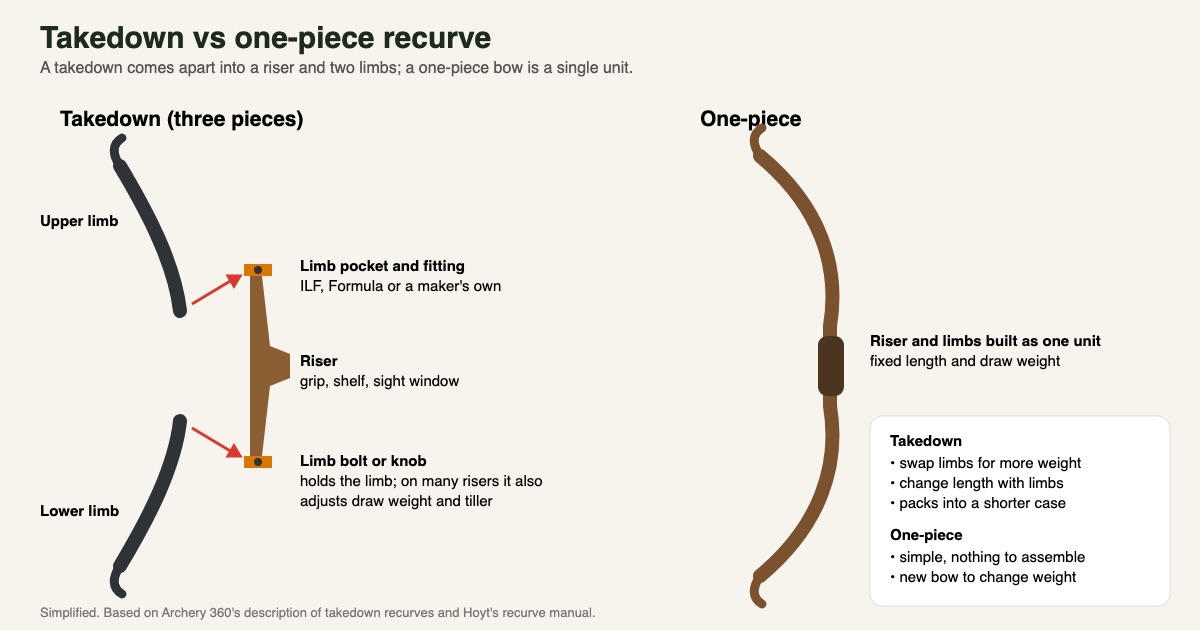
Recurve bows come in two basic constructions. A takedown recurve comes apart into three pieces: a riser and two limbs. A one-piece recurve is built as a single unit. Both shoot arrows the same basic way, but they differ in how you can adjust them, transport them and upgrade them, and that difference matters when you're choosing a bow.
This guide explains what each type is, compares them side by side, covers limb fittings, hunting and target use, travel, care and storage, and helps you choose.
What is a takedown recurve?
Archery 360 explains that "some recurves break down into three pieces, with limbs attaching to the riser with bolts. These takedown recurves are popular for traveling, and for archers who like shooting limbs of different draw weights." The riser is the central handle section, and each limb slots into a limb pocket on the riser, held by a bolt, knob or locking system. Our parts of a recurve bow explains each part.
What is a one-piece recurve?
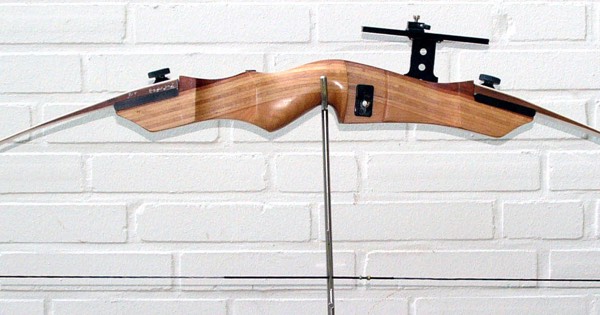
A one-piece recurve has its riser and limbs built together as a single bow. Its length and draw weight are fixed. Outdoor Life notes that "most traditional bows are one-piece designs, but many are takedown models."
Side-by-side comparison
| Takedown recurve | One-piece recurve | |
|---|---|---|
| Construction | Riser plus two detachable limbs | Single unit |
| Changing draw weight | Swap limbs | Buy a new bow |
| Changing bow length | Change limbs or riser | Fixed |
| Transport | Packs into a shorter case | Full length |
| Hardware | Limb pockets, bolts or knobs | None |
| Accessories | Many risers accept sights, plungers and stabilisers | Varies; many are kept simple |
| Typical use | Beginners, target, Olympic-style, many hunters | Traditional shooting and hunting |
Draw weight and upgrades
The biggest practical difference is upgrading. With a takedown, as you get stronger you can buy heavier limbs and keep the same riser. That's why many beginners start with a takedown; our first recurve guide explains why. With a one-piece bow, a heavier draw weight means a new bow.
Limb fitting systems
Takedown limbs attach in different ways:
- ILF (International Limb Fitting): a widely used standard, common on target and many hunting risers. Archery 360 notes that "ILF interchangeability isn't guaranteed because some manufacturers measure their fittings slightly different. However, most ILF limbs from one manufacturer will fit another manufacturer's ILF riser."
- Formula and other alternative systems used by some makers.
- Proprietary fittings designed for one maker's bows. Our Samick Sage review explains a popular beginner bow with its own fitting that is not ILF.
Always check that new limbs match your riser's fitting.
Hoyt's manual describes installing limbs on its detent-style riser: "Carefully insert the limb bushing into the dovetail groove in the pocket. Push the limb forward until the detent button engages. You should hear a 'click' indicating the limb is fully seated." Other systems use bolts that pass through the limb, so follow your own bow's instructions.
Bow length options
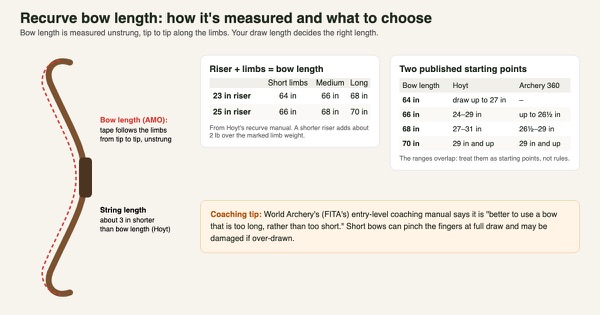
On a takedown, riser and limb length combine to set bow length. Hoyt's manual shows a 23-inch riser with short, medium or long limbs giving 64, 66 or 68 inches, and a 25-inch riser giving 66, 68 or 70 inches. A one-piece bow is one fixed length. Our recurve bow length guide explains how to choose a length for your draw.
Travel and transport
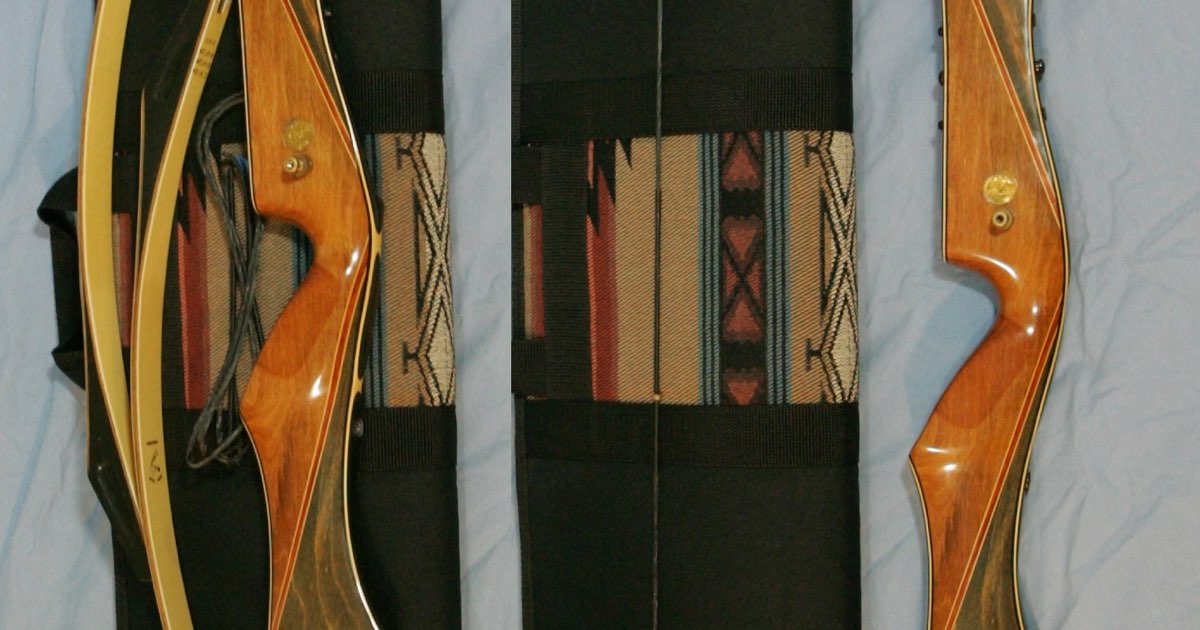
A takedown recurve comes apart, so it can travel in a much shorter case than a full-length one-piece bow. That's a real advantage if you fly, drive to tournaments or hunts, or have limited storage. Our Plano PillarLock review explains one hard-case option for bows.
Hunting with either type
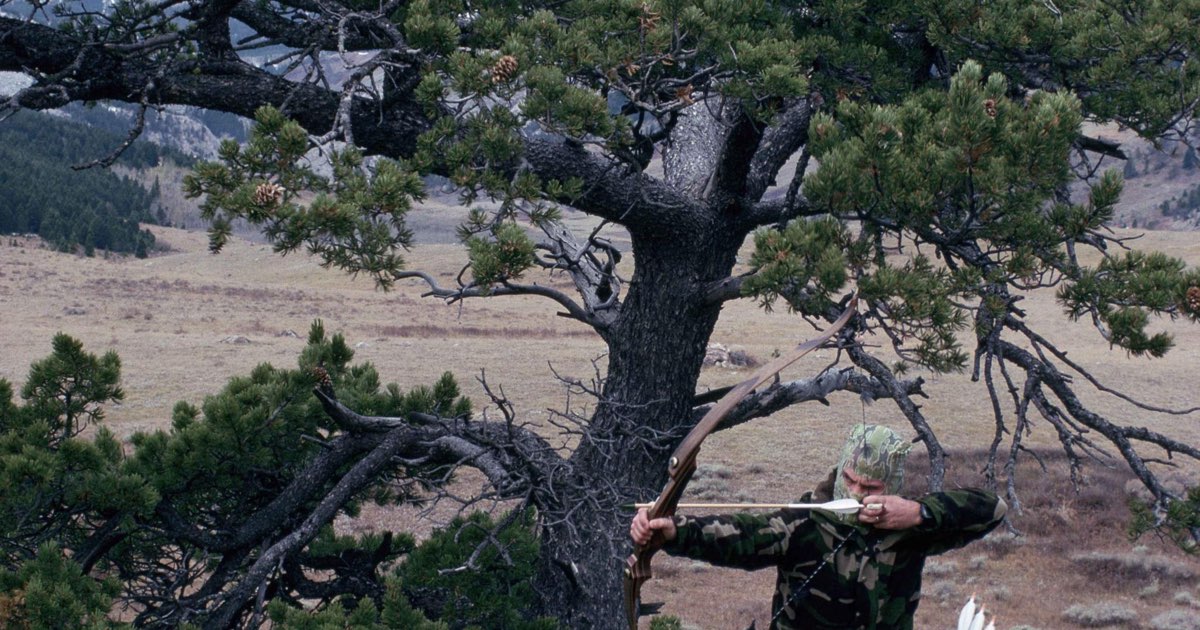
Both types are used for hunting. Lancaster Archery notes that shorter recurves, "in the 54–64-inch range, are specialized for hunting and recreation." Many traditional hunting recurves are one-piece bows, while takedowns offer the flexibility to change limbs and travel easily.
For hunting, the important rules are about draw weight and broadheads, not whether the bow comes apart. Check your state's minimum draw weight and broadhead rules; our draw weight for deer hunting guide explains them. Outdoor Life offers one caution for would-be traditional hunters choosing an ILF riser: "Don't pick an ILF riser simply because you think it'll give you a shortcut in learning how to shoot a traditional bow."
Target and Olympic-style archery
Olympic-style recurves are takedowns. Their risers accept sights, plungers, clickers and stabilisers, and archers change limbs as their strength and needs change. Barebow archers also commonly use takedown risers; our barebow guide explains the style, and our recurve tuning guide covers the adjustments a takedown riser allows.
Care and storage
The same basic care applies to both types. Hoyt's manual warns: "Never Expose Your Bow to Extreme Heat or Prolonged Moisture. Excessive heat, such as could be experienced on a sunny day inside of a closed vehicle, could cause limb failure. Prolonged storage in a hot, dry attic or damp basement could also be damaging and will void your warranty." It also says to "carefully inspect your bow before and during each shooting session."
For takedowns, also:
- Check the limbs are fully seated before stringing.
- Keep limb bolts and fittings clean and within the maker's limits.
- Store limbs together with the riser so parts don't get lost.
Whether to leave a recurve strung varies by maker and bow, so follow your manual. Our stringing guide explains safe stringing and unstringing.
Assembling a takedown safely
- Identify the limbs. Most limbs are marked top and bottom; fitting them the wrong way round can affect tiller and fit.
- Seat each limb fully in its pocket, listening for the click on detent systems, or tightening the bolt or knob as the maker describes.
- Check the limbs are straight and sitting evenly before stringing.
- String the bow with a stringer, never by stepping through or bending it by hand.
- Check the string sits in both limb grooves and that the brace height is in the maker's range; see our brace height guide.
- Sight down the string to check it runs down the centre of both limbs.
Reverse the process to take it down, always unstringing first.
Buying a second-hand recurve
Used recurves can be excellent value, but check:
- Limbs for cracks, twisting, lifting layers or damaged tips.
- Fittings for wear, and that limbs and riser are compatible.
- The string for fraying and the right length for the bow.
- The draw weight marking on the limbs, and what you'll actually pull at your draw length.
- The riser for cracks or damage around the pockets and grip.
If in doubt, have a shop look it over before you shoot it.
Common mistakes
- Buying limbs that don't fit the riser's fitting system.
- Buying a one-piece bow too heavy to learn on, with no way to lighten it.
- Choosing a length that's too short for your draw.
- Leaving a bow in a hot vehicle, which Hoyt warns can cause limb failure.
What affects the cost
We don't quote prices, but cost depends on:
- Riser material: wood, aluminium or carbon.
- Limb materials and construction.
- Fitting standard: ILF risers and limbs open up more choices.
- Craftsmanship: handmade one-piece bows can be costly.
- Accessories you plan to add.
Which should you choose?
- Choose a takedown if you're a beginner, expect to increase draw weight, want to try target or Olympic-style archery, travel with your bow, or want to change length or limbs later.
- Choose a one-piece if you want a simple traditional bow with nothing to assemble, have settled on a draw weight, and like the look and feel of a single-piece bow.
Our longbow vs recurve comparison and compound vs recurve comparison help if you're still deciding on bow type.
Takedown recurves
Advantages
- Swap limbs to change draw weight or length
- Packs into a shorter case for travel
- Many risers accept sights, plungers and stabilisers
Trade-offs
- Limb fittings must match; not all are interchangeable
- More hardware to check and maintain
- Some traditional archers prefer the simplicity of a one-piece
You can browse takedown recurves or takedown bow cases on Amazon.
Frequently asked questions
What is a takedown recurve?
A recurve that comes apart into a riser and two limbs, which attach with bolts, knobs or a fitting system.
Are takedown recurves as good as one-piece bows?
Both can shoot very well. Takedowns offer adjustability and portability; one-piece bows offer simplicity.
Is a takedown recurve good for hunting?
Yes, many hunters use them. Make sure the draw weight meets your state's minimum and practise with broadheads.
Can you leave a takedown recurve strung?
Follow your bow maker's guidance. Practice varies between bows.
How do you store a takedown recurve?
Cool and dry, away from hot vehicles, attics and damp basements, with limbs and riser kept together in a case.
Can I put ILF limbs on any takedown riser?
Only on an ILF riser. Archery 360 notes most ILF limbs fit other makers' ILF risers, but interchangeability isn't guaranteed.
Can a one-piece recurve change draw weight?
Not significantly. Its draw weight is fixed, though your actual weight changes with your draw length.
Do takedown limbs have a top and bottom?
Most do, and they're usually marked. Fit them as the maker intends so tiller and fit are correct.
Is a takedown or one-piece better for a beginner?
Most beginners are better served by a takedown, because limbs can be swapped for heavier ones as they get stronger.
What does ILF stand for?
International Limb Fitting, according to Archery 360: a widely used standard for attaching takedown limbs to a riser.
Related articles
 Guides
What Recurve Bow Length Do I Need? (Chart by Draw)
What recurve bow length do you need? How bow length is measured, draw-length charts from Hoyt and Archery 360, riser and limb combinations, and when length matters.
November 4, 2026 · 9 min read
 Reviews
Samick Sage Takedown Recurve Review: Still the Default First Bow?
Research-based Samick Sage review: the 62-inch takedown recurve's published specs, 25–60 lb limbs, who it suits, its limits and how it compares with rivals.
Updated May 21, 2025 · 5 min read
 Comparisons
Longbow vs Recurve Bow: Differences for Traditional Archers
Longbow vs recurve compared: limb shape, draw feel, hand shock, speed, length, accessories, competition rules, hunting and which traditional bow suits you.
Updated September 30, 2026 · 6 min read