
What Recurve Bow Length Do I Need? (Chart by Draw)
What recurve bow length do you need? How bow length is measured, draw-length charts from Hoyt and Archery 360, riser and limb combinations, and when length matters.

By Archery Insider Editorial Team
· 9 min read
In this article
Recurve bows come in a range of lengths, usually from the low 60s to 70 inches for target bows, and shorter for many hunting bows. Choosing the right length matters more than many beginners think. A bow that's too short for your draw can pinch your fingers, feel harsh and even be damaged; one that's well matched feels smooth and stable.
This guide explains how recurve length is measured, why your draw length is the deciding factor, two published length charts side by side, how riser and limbs combine on a takedown, what happens if a bow is too short, and how hunting and target lengths differ.
How recurve bow length is measured
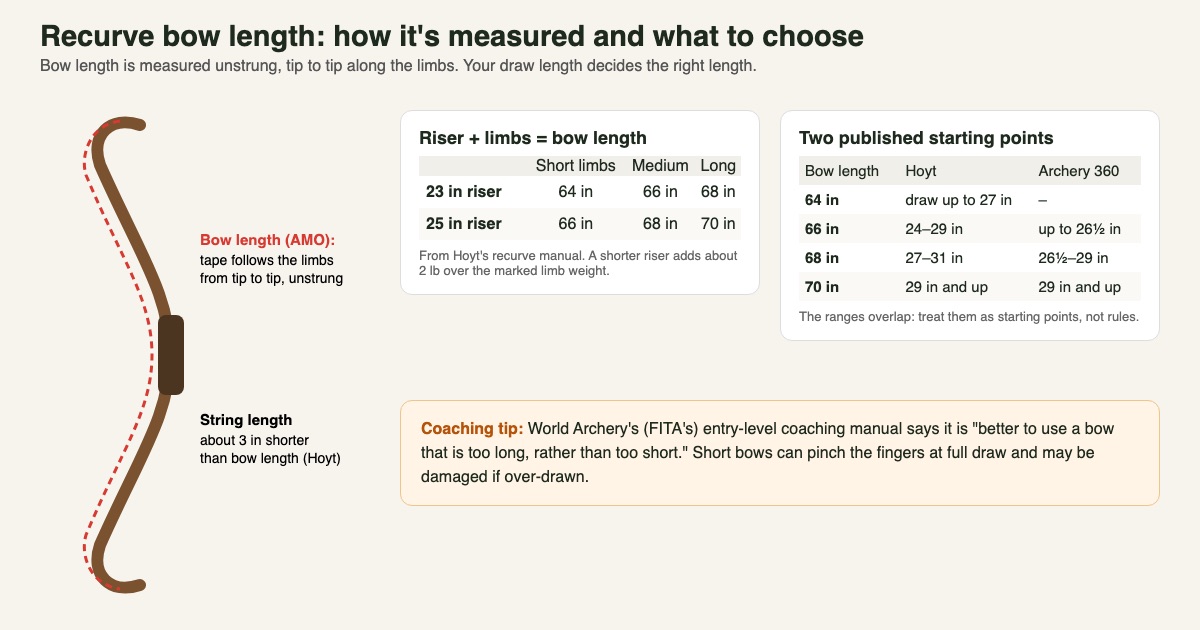
Hoyt's manual defines it: "Bow length is the distance from the tip of the top limb to the tip of the bottom limb of an unstrung bow with the tape following the recurve tips." This is often called the AMO length. World Archery's (formerly FITA's) entry-level coaching manual describes the same method: "The length of the Recurve bow is measured from tip to tip along the bow, when the bow is unstrung."
The string is shorter than the bow. Hoyt says "string length is approximately three inches shorter than the bow length," and the coaching manual agrees: "Recurve strings are usually three inches less than the bow's A.M.O. length." So a 68-inch bow typically takes a 65-inch string.
Measuring a bow yourself
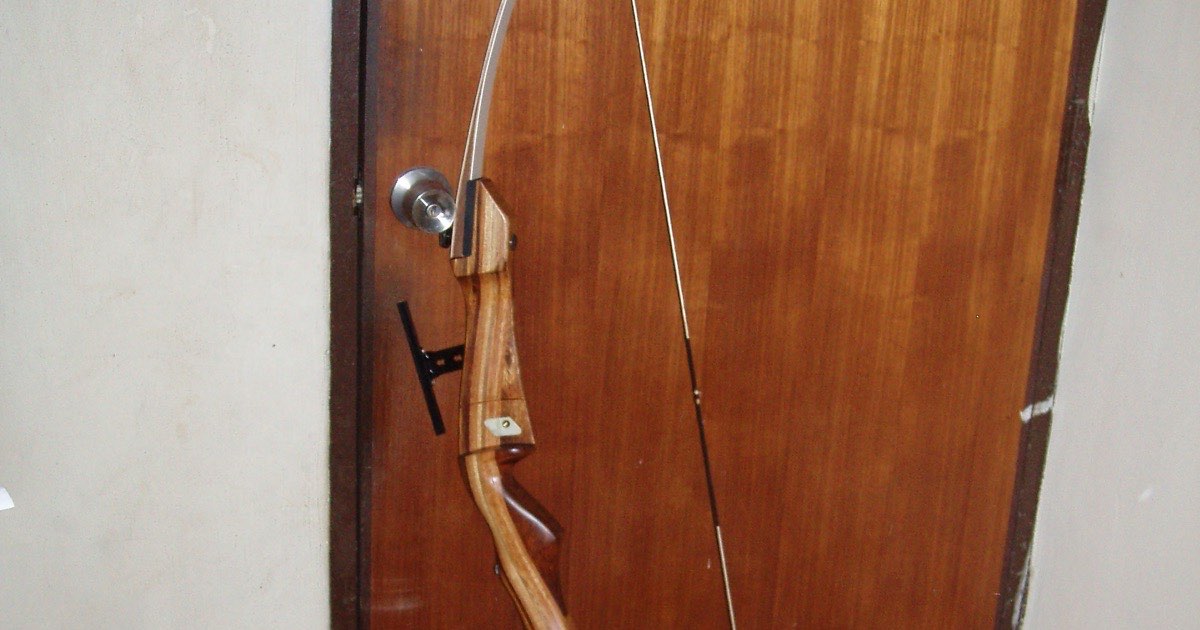
If a used bow isn't marked, you can measure it:
- Unstring the bow with a stringer.
- Use a flexible tape (a tailor's tape is ideal).
- Follow the limbs from the tip of the top limb, around the curve of the limbs and riser, to the tip of the bottom limb, as Hoyt describes.
- Note the measurement and compare it with the string length: the string should be about three inches shorter.
Measuring in a straight line between the tips gives a shorter, incorrect figure.
Bow length vs draw length
Your draw length (how far you pull the string) is the measurement that decides bow length. A longer draw bends the limbs further, so it needs a longer bow to keep the draw smooth and the string angle comfortable. Our draw length guide explains how to measure yours, and our draw weight vs draw length guide explains how the two interact.
Two published charts
| Bow length | Hoyt (draw length) | Archery 360 (draw length) |
|---|---|---|
| 64 in | Up to 27 in | Not listed |
| 66 in | 24–29 in | Up to 26½ in |
| 68 in | 27–31 in | 26½–29 in |
| 70 in | 29 in and up | 29 in and up |
Why the ranges overlap
The charts don't agree exactly, and that's normal. Hoyt's ranges overlap deliberately, so a 28-inch draw could suit a 66- or 68-inch bow. Archery 360's ranges are tighter. Limb design, the archer's style and personal preference all play a part. Treat both as starting points, and remember the coaching manual's advice to err on the long side.
Riser + limbs = bow length
On a takedown recurve, bow length depends on the riser and the limbs. Hoyt's manual gives this table:
| Riser | Short limbs | Medium limbs | Long limbs |
|---|---|---|---|
| 23 in | 64 in | 66 in | 68 in |
| 25 in | 66 in | 68 in | 70 in |
Archery 360's guide to ILF bows gives the same combinations for a 25-inch riser: short limbs make 66 inches, medium 68 and long 70.
Riser length changes draw weight too
Hoyt notes that a "short riser will result in an approximate 2 lb. increase over the marked limb weight." Its worked example: long limbs on a 25-inch riser make a 70-inch bow at 34 lb (at 28 inches); the same limbs on a 23-inch riser make a 68-inch bow at 36 lb. Limb weight is marked at a 28-inch draw, and Hoyt advises adding or subtracting "approximately two pounds for each inch your draw length is over or under the 28" standard." Our parts of a recurve bow explains risers and limbs.
What happens if your bow is too short
The coaching manual explains: "Short bows are difficult to pull at longer draw lengths, and the angle of the string at full draw may pinch the archer's fingers making it difficult to release properly. As well, shooting a bow that is too short may damage the bow."
Stacking explained
Stacking is a sharp rise in draw weight when a bow is drawn further than it's designed for. ImproveYourArchery.com describes it as "the exponential draw weight increase when a bow is drawn further than it's designed to," adding that "shorter bows for example stack earlier than longer bows." A stacking bow feels like hitting a wall near full draw, which makes a smooth, consistent release much harder. How soon a bow stacks depends on its design, so there's no universal figure.
Is a longer bow always better?
Not always. Lancaster Archery says longer recurves, "in the 66–72-inch range, are geared more for the competition shooter, giving them more stability and smoothness." But longer bows are harder to manoeuvre in a tree stand, blind or thick cover, and heavier to carry. The goal is a length that suits your draw and how you shoot, not the longest you can find.
Hunting and traditional lengths vs target lengths
Lancaster notes that "shorter recurve bows, in the 54–64-inch range, are specialized for hunting and recreation," while 66–72-inch bows suit target shooting. Many one-piece hunting recurves are in the shorter range, trading a little smoothness for manoeuvrability. Archery 360 notes that traditional recurves come in lengths "from 48 to 72 inches." If you hunt with a short recurve and have a long draw, check the maker's recommended maximum draw length. Our longbow vs recurve comparison covers traditional bows, and our takedown vs one-piece comparison explains the two construction types.
Does height matter?
Height only matters because it roughly predicts draw length. Lancaster suggests estimating draw length as "Draw Length (inches) = Wingspan (inches) / 2.5," then confirming it by measuring at full draw. Two people of the same height can have different draw lengths, so choose by draw length, not height.
Examples by draw length
These examples are read from the two charts above; they're starting points, not rules.
- 26-inch draw: a 66-inch bow fits both charts.
- 28-inch draw: Hoyt allows 66 or 68 inches; Archery 360 suggests 68 inches. Many archers choose 68.
- 30-inch draw: Hoyt allows 68 or 70 inches; Archery 360 suggests 70 inches.
Our Samick Sage review notes that popular beginner bow can feel short for draws over about 29 to 30 inches.
Youth and short-draw archers
Children and smaller adults with short draws suit shorter bows with light limbs. Choose by measured draw length and the maker's guidance; our guide to choosing a bow for a child covers youth sizing.
Try before you buy
If you can, shoot a couple of lengths before buying. Many archery shops and clubs have range bows in different lengths and draw weights. At full draw, a well-matched bow should feel smooth through the last inch or two, with no sudden build-up of weight, and the string shouldn't pinch your fingers at anchor. If a shop measures your draw length, ask which lengths they'd suggest for it.
Common sizing mistakes
- Choosing by height instead of measured draw length.
- Buying the shortest bow because it looks handy, then struggling with finger pinch or stacking.
- Measuring bow length in a straight line instead of along the limbs.
- Forgetting that limb weight changes with your draw length and riser length.
- Buying limbs that don't fit the riser's limb fitting.
Changing a takedown's length
One advantage of a takedown is that you can change its length by changing limbs (or the riser). Moving from medium to long limbs on the same riser adds about two inches, and usually changes draw weight too. Check that new limbs fit your riser's limb fitting, and note that a new length needs a new string about three inches shorter than the bow. Our stringing guide and brace height guide cover setting up a new string.
Choosing a longer recurve
Advantages
- Smoother draw and less finger pinch at longer draws
- More stable to aim; standard for target archery
- Less likely to stack within your draw length
Trade-offs
- Harder to manoeuvre in stands, blinds and cover
- Slightly heavier to carry
- Can feel unwieldy for short-draw archers
You can browse 68-inch takedown recurves or recurve limbs on Amazon.
Frequently asked questions
Does recurve bow length matter?
Yes. A bow too short for your draw can pinch your fingers, stack and even be damaged. Longer bows are generally smoother and more stable.
How is recurve bow length measured?
Unstrung, from tip to tip, with the tape following the limbs.
What length recurve for a 28-inch draw?
Hoyt's chart allows 66 or 68 inches; Archery 360 suggests 68 inches. Many archers choose 68.
Is a 62-inch recurve too short for me?
It depends on your draw length. Short bows suit shorter draws and hunting; for longer draws, check the maker's maximum draw length.
What is the best recurve length for hunting?
Lancaster puts hunting and recreational recurves in the 54–64-inch range, trading some smoothness for manoeuvrability.
Can I make my takedown longer or shorter?
Yes, by changing limbs or riser. You'll need a new string to match.
Does bow length affect draw weight?
On takedowns, riser length does: Hoyt says a shorter riser adds about 2 lb over the marked limb weight.
Why is my recurve string so much shorter than the bow?
Because bow length is measured along the curved limbs and the string runs straight between the tips. Hoyt says the string is about three inches shorter than the bow length.
Is a 70-inch recurve too long for a beginner?
Not if your draw length suits it. Archery 360 and Hoyt both suggest 70 inches for draws of about 29 inches and up. Shorter-draw beginners usually suit 66 or 68 inches.
Should I choose a 66 or 68-inch recurve?
If your draw length falls where the charts overlap (about 27 to 29 inches), either can work. World Archery's coaching manual suggests erring towards the longer bow, which usually gives a smoother draw and less finger pinch, while a 66-inch bow is a little handier to carry and manoeuvre.
Related articles
 Guides
How to Choose Your First Recurve Bow: A Beginner's Guide
How to choose a first recurve bow: takedown vs one-piece, draw weight, bow length for your draw length, riser types, eye dominance, and essential accessories.
Updated February 6, 2025 · 11 min read
 Training
Archery Draw Length: How to Measure It and Why It Matters
How to measure archery draw length with the wingspan method or at full draw, what the AMO standard means, and how it affects bow size, draw weight, and arrows.
Updated February 6, 2025 · 8 min read
 Guides
Parts of a Recurve Bow: Diagram and Terms
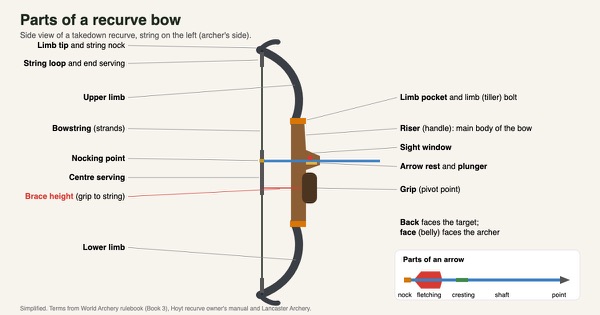
A labelled diagram of the parts of a recurve bow: riser, limbs, limb bolts, sight window, rest and plunger, plus the bowstring, measurements and arrow parts.
October 25, 2026 · 9 min read