
What Draw Weight Do You Need for Deer Hunting?
How much draw weight do you need for deer? Legal minimums, why arrow energy matters, compound vs traditional bows, elk, and choosing a weight you can shoot.
By Archery Insider Editorial Team
· 10 min read
In this article
Draw weight is the force, in pounds, needed to pull a bow to full draw. For deer hunting it matters for two reasons: some states set a legal minimum, and your bow has to send a broadhead with enough energy to pass through a deer's chest. But the right number is not "as heavy as possible". The best draw weight for hunting is one you can draw smoothly and quietly, hold steady, and shoot accurately when you are cold, sitting down and excited.
This guide explains the legal side, what really drives penetration, how compound and traditional bows differ, and how to choose and build up to a hunting draw weight.
The quick answer
| Situation | Typical guidance |
|---|---|
| Legal minimum | Check your state: some require 30 to 45 lb, many have none |
| Compound bow for whitetail | 40 lb or more is the common recommendation |
| Recurve or longbow for whitetail | Many hunters use 45 lb or more with heavier arrows |
| Elk-sized game | More energy needed; Easton's guide suggests 42 to 65 ft-lb |
| Youth or smaller adults | Use what can be drawn well within legal limits; keep shots short |
What draw weight actually is
On a recurve or longbow, draw weight keeps rising the farther you pull. It is marked on the limb at a standard draw length, usually 28 inches, so your real draw weight is higher if you draw longer and lower if you draw shorter.
On a compound bow, draw weight is the peak weight reached during the draw. The cams then "let off", so you hold only a fraction of the peak at full draw. Most compounds can be adjusted within a range set by the manufacturer by turning the limb bolts. Our reviews of the Bear Cruzer G3 and Diamond Infinite 305 show how wide that range can be on adjustable bows.
Your draw length affects both bow types. Get it measured before choosing a weight; our draw length guide explains how.
Legal minimums
Some states set a minimum draw weight for deer, and many do not. Two official examples:
- Minnesota requires a bow with "a pull no less than 30 pounds at or before full draw."
- Missouri sets no minimum, but its conservation department says "40 pounds or greater is recommended" for deer.
California's wildlife department publishes a summary of archery minimum draw weights by state, which shows how much the rules vary. Treat any summary as a starting point and confirm in your own state's current regulations.
Why energy matters more than the number
A broadhead kills by cutting. To do that, the arrow needs enough energy to drive the broadhead through hide, muscle and ribs, and ideally out the far side. Two measures describe this:
- Kinetic energy (KE), in foot-pounds: arrow weight in grains × speed in feet per second, squared, divided by about 450,000. Calculators use slightly different constants, such as 450,240 or 450,800; the difference is negligible.
- Momentum: arrow weight × speed. Heavier arrows carry more momentum at the same energy and many hunters believe they penetrate better.
Easton's kinetic energy guide, quoted widely by retailers and bowhunting sites, suggests:
| Game | Recommended KE |
|---|---|
| Small game | Under 25 ft-lb |
| Medium game (deer, antelope) | 25 to 41 ft-lb |
| Large game (elk, black bear, wild boar) | 42 to 65 ft-lb |
| Toughest game (Cape buffalo, grizzly) | Over 65 ft-lb |
Example calculations
These are worked examples using the formula above, not measurements of any particular bow. They show how arrow weight and speed combine.
| Arrow weight | Speed | Kinetic energy | Momentum (slug-ft/s) |
|---|---|---|---|
| 400 grains | 280 fps | 69.7 ft-lb | 0.50 |
| 400 grains | 250 fps | 55.5 ft-lb | 0.44 |
| 425 grains | 230 fps | 49.9 ft-lb | 0.43 |
| 450 grains | 200 fps | 40.0 ft-lb | 0.40 |
| 500 grains | 180 fps | 36.0 ft-lb | 0.40 |
| 450 grains | 170 fps | 28.9 ft-lb | 0.34 |
To estimate your own numbers, weigh a complete hunting arrow with its broadhead, and measure its speed with a chronograph at an archery shop. Advertised IBO speeds are measured under a standard test (70 lb, 30-inch draw, 350-grain arrow), so most hunting setups shoot slower.
Compound vs traditional bows
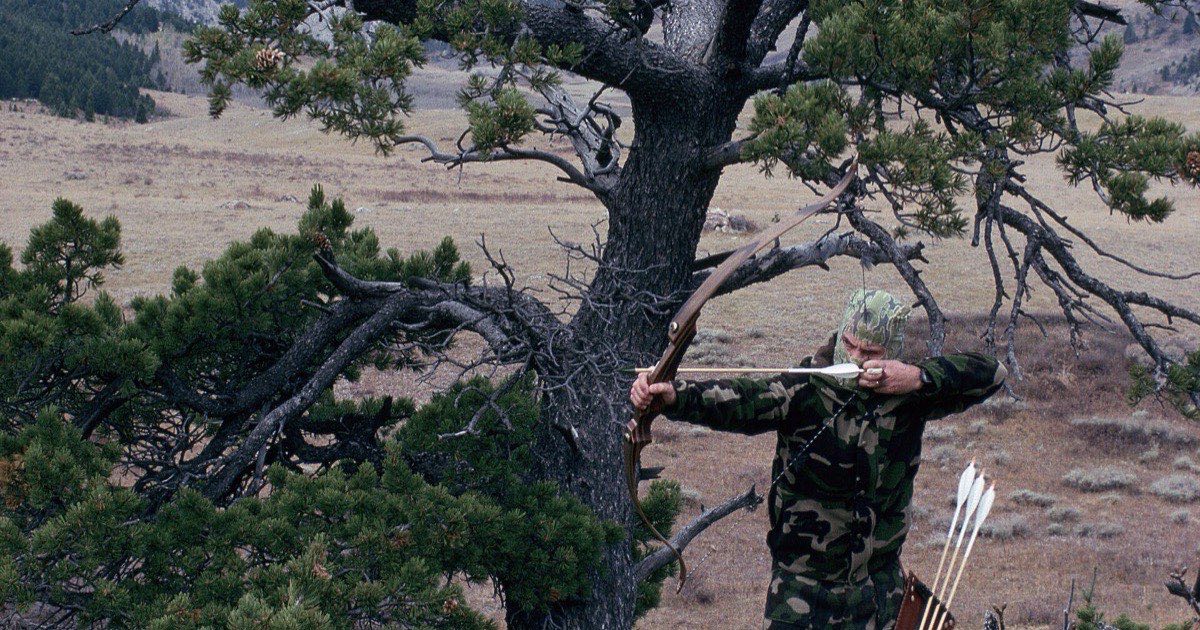
Compound bows store energy more efficiently and launch arrows faster than recurves or longbows at the same draw weight. That is why traditional bowhunters usually choose higher draw weights and heavier arrows, then keep their shots shorter.
| Compound bow | Recurve or longbow | |
|---|---|---|
| Arrow speed at the same draw weight | Higher | Lower |
| Holding weight at full draw | Low (let-off) | Full weight |
| Typical deer setup | 40 to 60 lb class bows, often turned down to suit the archer | Often 45 lb or more, heavier arrows |
| Adjustable | Usually, within a range | No, unless you change limbs on a takedown |
Our compound vs recurve comparison explains the differences in more detail.
What about elk?
Elk are much larger than deer, with thicker hide and heavier bones. Easton's guide moves elk into the 42 to 65 ft-lb category, and most elk hunters choose higher draw weights, heavier arrows and very durable broadheads. Check the rules where you hunt; some western states set separate minimums for elk.
Draw weight for women, youth and older hunters
Draw weight is personal, and plenty of successful deer hunters shoot lighter bows. If you are smaller, younger, older or recovering from injury:
- Check the legal minimum first, then choose the lowest weight that gives you comfortable control and adequate energy with your arrows.
- Shorter draw lengths reduce energy, because the limbs bend less. A heavier, well-built arrow with a sharp broadhead helps make the most of the energy you have.
- Keep shots closer. A lighter setup means a lower trajectory margin and less energy at distance.
- Choose cut-on-contact or fixed-blade broadheads that need less energy to penetrate, and make sure they are razor sharp.
- Be strict about shot angle. Broadside and quartering-away shots avoid heavy bone.
Many compound bows designed for smaller archers adjust over a wide range, so they can grow with the archer. Our guide to choosing a bow for a child covers youth sizing.
Measuring your draw weight
The number printed on a recurve limb is measured at a standard draw length, and a compound's labelled peak weight is a maximum setting, not necessarily how the bow is set now. To know your real draw weight:
- Use a bow scale. Hook it to the string at the nocking point and draw the bow to your full draw length, or ask a shop to do it.
- Read the peak for a compound, and the weight at your draw length for a recurve.
- Record the limb bolt setting on a compound so you can return to it.
- Re-check after changes to strings, cables or limb bolts.
How draw weight affects arrow speed
More draw weight generally means more arrow speed and energy with the same arrow, but the relationship is not one-to-one. Draw length, the bow's design and arrow weight all matter. A longer draw stores more energy; a lighter arrow leaves faster but carries less momentum; and an efficient compound turns more of its stored energy into arrow speed than a traditional bow. That is why measuring your actual setup with a chronograph tells you more than the draw weight number alone.
How to choose your hunting draw weight
- Start with your draw length. Get measured and fitted at an archery shop.
- Try the seated test. Sit in a chair, point the bow at a target and draw slowly. If you have to lift the bow above the target or jerk the string to get through the peak, it is too heavy.
- Try the cold test. Draw the bow on a cold morning without warming up. That is how your first shot at a deer will feel.
- Hold at full draw for 30 seconds. Deer often make you wait.
- Check your energy. Use the formula with your arrow weight and measured speed. For deer, aim to be comfortably inside or above Easton's medium-game range.
- Pick the lower weight if in doubt. You can turn a compound up later as you get stronger. A weight you can shoot well beats a heavier one you cannot.
Missouri's guidance puts it simply: the force required "is less than most people think," and accuracy matters more than maximum draw weight.
Common draw weight mistakes
- Buying for the future. A bow set heavier than you can handle now will hurt your form for months. Choose an adjustable bow and turn it up later.
- Testing only when fresh. Draw weight that feels fine in a warm shop can feel very different after hours on a cold stand.
- Raising the bow to draw. If you point the bow at the sky to get through the peak, the weight is too high and the movement will spook deer.
- Ignoring arrow weight. Changing draw weight without checking arrow spine can spoil arrow flight.
- Copying others. Your friend's 70-pound setup tells you nothing about what suits you.
Building up to a hunting weight
- Increase draw weight in small steps (a few pounds at a time) every couple of weeks.
- Shoot fewer arrows with good form rather than many tired ones.
- Practice drawing seated and from a stand.
- Use a resistance band or a light bow for extra form work; our practice plan has drills.
- Stop if you feel shoulder pain. Shooting more weight than you can control ("overbowing") strains the shoulder.
Higher draw weight
Advantages
- More arrow energy and speed
- Flatter trajectory, more forgiving of range errors
- Allows heavier arrows for big game
Trade-offs
- Harder to draw quietly and slowly
- Tiring, which hurts accuracy in long sits
- Raises risk of shoulder strain
You can browse bow scales or adjustable compound bows on Amazon. Check the adjustment range and draw length before buying.
Frequently asked questions
Is 40 lb enough to kill a deer?
With a sharp broadhead, a well-tuned arrow and a good broadside shot at sensible range, 40 lb is widely regarded as enough for deer, and it meets or exceeds many state minimums. Check your energy with the formula above.
Is 30 lb enough for deer?
It is the legal minimum in some states, such as Minnesota. At that weight, keep shots short, use a heavier arrow and a sharp, cut-on-contact broadhead, and only take broadside shots.
What draw weight do I need for elk?
More than for deer. Most elk hunters use higher draw weights and heavier arrows; Easton's guide puts elk-sized game at 42 to 65 ft-lb.
Can a woman or teenager hunt deer with a bow?
Yes. Many compounds adjust to lower weights. Pick a legal weight that can be drawn well, keep shots short and focus on placement.
How do I know my bow's actual draw weight?
Use a bow scale at your draw length, or ask an archery shop to measure it.
Can I lower the draw weight on my compound bow?
Usually, within the range set by the manufacturer, by turning the limb bolts out evenly on both limbs. Follow the manual, never exceed the maximum number of turns, and re-check your sight marks afterwards. A shop can do it for you.
Does more draw weight make me more accurate?
No. Accuracy comes from consistent form, and too much weight usually makes form worse. Choose a weight you can control.
Related articles
 Guides
Can You Hunt Deer With a Bow? A Beginner's Guide
Yes, you can hunt deer with a bow. Learn the legal basics, which bows work, how hard it is, effective range, gear, shot placement and a first-season plan.
October 6, 2026 · 13 min read
 Training
Archery Draw Length: How to Measure It and Why It Matters
How to measure archery draw length with the wingspan method or at full draw, what the AMO standard means, and how it affects bow size, draw weight, and arrows.
Updated February 6, 2025 · 8 min read
 Guides
How to Choose Arrows: Spine, Length, Weight and Spine Charts
How to choose arrows: what spine means, reading a spine chart, measuring arrow length, arrow weight and FOC, fletching, and bare-shaft tuning to confirm it.
Updated June 26, 2026 · 9 min read