
How Long Should Arrows Be? Arrow Length by Draw
How long should arrows be? How arrow length is measured, the full-draw marking method, clearance for compound, recurve and crossbow, and worked examples.

By Archery Insider Editorial Team
· 11 min read
In this article
"How long should my arrows be?" sounds as if it should have a one-number answer, but it doesn't. The right length depends on your draw length, your bow type, where your arrow rest sits, and how much margin you want. There is, though, a standard way to measure arrows and a simple, reliable way to find your own length.
This guide explains how arrow length is measured, how to find yours at full draw, how much clearance compound, recurve and crossbow shooters need, how length affects spine and weight, and why an arrow that's too short is dangerous. It ends with worked examples for common draw lengths.
The quick answer
Your arrows should be long enough that, at full draw, the end of the shaft is still safely in front of the arrow rest, with a margin to spare. For most compound shooters, that means cutting so the shaft ends around the middle of the shelf or flush with the front of the riser. For beginners and recurve archers, the FITA coaching manual recommends at least an inch more than your draw.
Measure arrow length the standard way, from the nock groove to the cut end, and always check it against your real full-draw position, not a chart.
How arrow length is measured
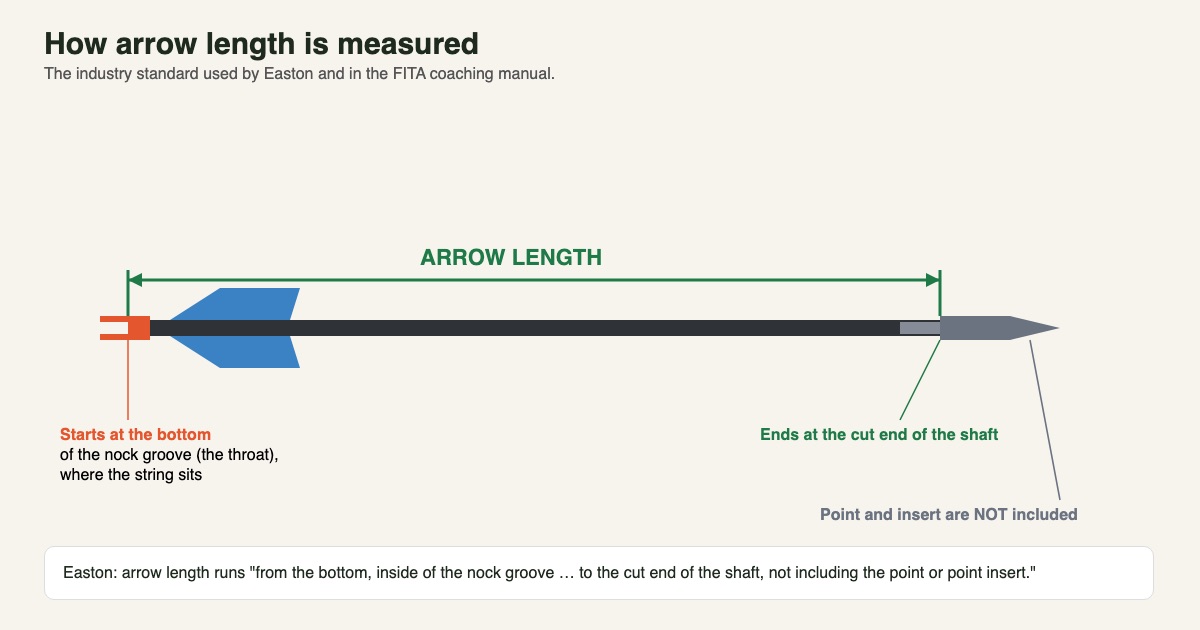
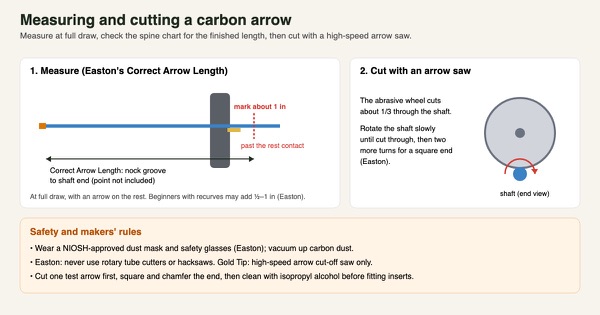
There's an industry definition, and it's worth knowing because arrow charts, cut lists and shop orders all use it. Easton puts it like this: "Correct arrow length is measured from the bottom, inside of the nock groove (deepest point where the string goes into the nock) to the cut end of the shaft, not including the point or point insert."
The FITA coaching manual uses the same definition: length is "measured, in inches, from the bottom of the slot in the nock to where the shaft is cut."
So arrow length:
- Includes the nock up to the bottom of its groove (the throat, where the string sits).
- Includes the whole shaft.
- Excludes the point and the insert. They sit in front of the cut end.
Arrow length is not the same as draw length
Draw length and arrow length are related but measured differently. Draw length, the figure used to set up a compound bow, is measured to the grip (the ATA standard measures to the pivot point plus 1¾ inches), not to the end of the arrow. Two archers with the same draw length can need different arrow lengths depending on rest position and bow type. Our guide to measuring your draw length explains the standard method, and draw weight vs draw length shows how the two interact.
The FITA manual adds a useful term, "actual draw length": "The arrow length needed by an archer, measured from the bottom of the slot in the nock to the back of the bow." The back of the bow is the side facing the target. Arrow length starts from that figure and adds whatever clearance you want.
Step by step: find your arrow length at full draw
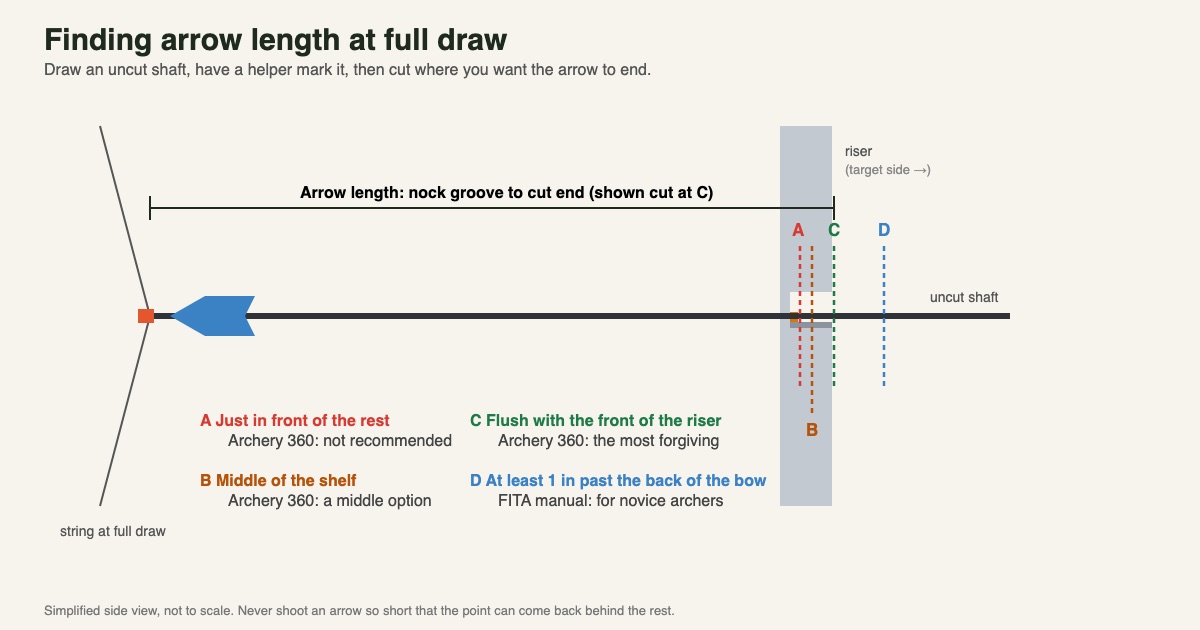
This method works for any vertical bow. Archery 360's version: "nock a full-length, uncut arrow and draw it back. Have a friend mark the shaft."
- Get an uncut shaft. Use a full-length arrow longer than you need. Ideally it should already have a nock fitted, so your measurement starts in the right place.
- Set up your bow as you'll shoot it, with your usual rest, release aid or tab, and anchor.
- Nock the arrow and draw to your normal anchor. Aim at a safe backstop and don't let down suddenly.
- Have a helper mark the shaft with a fine pen at the back of the bow (for recurves) or where the shaft crosses your chosen reference on the riser (for compounds).
- Let down slowly and carefully. Never dry-fire. Our dry-firing guide explains why.
- Add your clearance (see below) and mark the final cut line.
- Measure from the nock throat to the cut mark to get your arrow length in inches. Record it for future orders.
If you don't have a helper or an uncut shaft, a good archery shop can do this for you in a few minutes.
How much clearance? Compound vs recurve vs beginners
Compound bows
Compound rests sit well back in the riser, which gives you choices. Archery 360 describes three cut positions:
- Flush with the front of the riser. The most forgiving option, because the shaft stays well supported and clear of the rest even if your draw varies.
- The middle of the shelf. A common middle ground: a little shorter and lighter.
- Just in front of the rest. Not recommended. There's very little margin before the arrow could fall off the rest.
Archery 360 notes that for a 30-inch draw, arrows typically run from about 28.5 to 31 inches depending on rest placement. It's a good illustration of how much the cut choice matters. Hunters also need room for broadheads (see below). Our arrow rests explained covers how rest type and position affect this.
Recurve bows and beginners
The FITA coaching manual keeps it simple for novices: "To determine the arrow length for a novice archer, simply add at least 2.5 cm (1") to the draw length." Its illustration shows "the arrow point protrude 2.5 cm out of the bow."
The extra inch gives beginners margin, because their draw length often grows as their form improves. Many target recurve archers later cut closer to suit a clicker, which their coach will help set up. If you're buying a first set of arrows for a recurve, start with the FITA rule and don't cut short to save weight.
Crossbow bolts: use the manufacturer's length
Crossbows are different: arrow length isn't set by your draw at all. It's set by the crossbow's design, and the maker specifies a minimum (and often an exact) length. TenPoint states that "most Wicked Ridge, Horton Crossbow Innovations, and TenPoint crossbows were designed to shoot arrows with a 20-inch minimum length", and notes exceptions for some models.
Always follow your crossbow's manual for length, weight and nock type. Shooting the wrong bolts can damage the crossbow or cause injury. Our guide to crossbow bolts explains nocks, weights and lengths.
Arrow length, spine and weight
Length isn't only about clearance. It changes how stiff the arrow behaves (its dynamic spine) and how heavy it is.
Longer acts weaker; shorter acts stiffer. Easton's FAQ is direct: to make an arrow act stiffer, "Shorten the length of the arrow"; to make it act weaker, "Increase arrow length."
It can change your spine choice. Archery 360 gives a striking example: cutting from 30 inches to 28 inches moved one Easton chart recommendation from a 250 spine to a 340 spine. The same archer and bow needed a weaker shaft at the shorter length.
It changes weight. Archery 360's example found that cutting 2 inches off a 300-spine Easton Axis saved "just over 21 grains." That matters for speed, kinetic energy and arrow FOC, and for hunters choosing arrow weight for hunting.
That's why you should decide your length before choosing a spine. Easton's charts list arrow length across the top. Easton's hunting chart also tells you how to handle fractions: "If arrow length is 28.25" round down to 28" column. If arrow length is 28.5" round up to 29" column." Our guide to choosing arrows walks through reading a spine chart.
Hunting arrows and broadhead clearance
Fixed-blade broadheads are wider than field points. If a broadhead sits too far back, it can hit the rest, the riser or your hand at full draw. Hunters often leave their arrows a little longer than target arrows so the broadhead clears everything comfortably. When you test, draw with the broadhead fitted, check its position, and keep fingers well away from the blades. Our arrow weight for hunting guide covers broadhead weight.
Worked examples: 27, 28, 29 and 30-inch draws
These are examples of the method, not a standard chart. No manufacturer publishes a single arrow-length chart by draw length, because rest position and bow type change the answer. Your full-draw marking always wins.
| Example archer | Bow and setup | How length is found | Example result |
|---|---|---|---|
| 27 in draw, beginner | Recurve, novice | Actual draw length plus at least 1 in (FITA) | Measured actual draw plus 1 in or more |
| 28 in draw | Compound, target | Marked at full draw, cut flush with front of riser | Whatever the mark shows: never shorter |
| 29 in draw | Compound, hunting | Marked at full draw, extra length for broadhead clearance | Often a little longer than a target arrow |
| 30 in draw | Compound | Archery 360's example range | About 28.5 to 31 in, depending on rest placement |
The pattern: start from your real full-draw mark, add the clearance your bow and style need, and never go shorter.
Why too short is dangerous (and too long is fine)
The FITA manual puts it bluntly: "Arrows that are too long are satisfactory to shoot. Arrows that are too short are NOT safe."
An arrow that's too short can be drawn back past the rest. The point can fall inside the riser's window or behind the rest, where it can hit the bow hand or the riser when released. With broadheads, that risk is worse. That's why you leave a margin, and why you should check arrow length again whenever your draw length changes: after a new bow, a new release or improved form.
Too long is a smaller trade-off. A longer arrow is slightly heavier and acts slightly weaker, so you may need a stiffer spine. It's also safer while you're learning.
Before you cut
- Measure twice. Recheck your mark at full draw before cutting.
- Remember the reference points. Cut length runs from the nock throat; the insert and point add length in front.
- Check maximum cut rules. Easton notes that some shafts, such as the X10, X10 ProTour and ACE, "have a maximum recommendation for the amount that you may cut off the front of the arrow", and that "exceeding the max cut amount will expose carbon". Check before cutting barrelled or specialist shafts.
- Use the right tool. Carbon arrows need a high-speed arrow saw for a clean, square cut. Our guide to cutting carbon arrows shows how.
- Tune afterwards. A new length can change how arrows fly. Bare-shaft and walk-back tuning confirms the spine works.
If you're comparing materials as well as lengths, see carbon vs aluminium arrows. When you're ready, you can browse uncut carbon arrows or an arrow saw on Amazon.
Common arrow-length mistakes
- Using your draw length as your arrow length. They're measured differently, and the right arrow length depends on rest position.
- Measuring to the end of the point. The standard is the cut end of the shaft.
- Copying a friend's arrows. Their draw, anchor and rest aren't yours.
- Cutting before choosing spine. Length changes dynamic spine, so decide length first.
- Forgetting broadhead clearance when hunting.
- Not rechecking after changes to your draw length, release or bow.
Frequently asked questions
How long should arrows be for a 28-inch draw?
There's no single figure. Mark an uncut arrow at full draw, then add clearance: for a compound, cut around mid-shelf or flush with the front of the riser; for a beginner or recurve archer, add at least an inch to the actual draw length (FITA). Never cut shorter than your mark.
Does arrow length include the nock?
Partly. It's measured from the bottom of the nock groove, where the string sits, to the cut end of the shaft. The point and insert are not included (Easton).
How long should arrows be for a compound bow?
Long enough to end at least in front of the rest. Archery 360 suggests flush with the front of the riser for the most forgiveness, or mid-shelf. Cutting just in front of the rest isn't recommended.
How long should arrows be for a recurve bow?
For beginners, the FITA coaching manual says to add at least 1 inch (2.5 cm) to the draw length, so the point sticks out past the back of the bow. Experienced target archers may cut to suit a clicker.
Does arrow length affect accuracy?
Indirectly. Length changes how stiff the arrow acts and how heavy it is, which affects tuning and flight. A correctly spined arrow at a sensible length, tuned to your bow, is what makes for accuracy.
Can an arrow be too long?
It can be heavier and act weaker than ideal, but it's safe. FITA: "Arrows that are too long are satisfactory to shoot."
Is it safe to shoot arrows shorter than my draw length?
No. An arrow that can be drawn behind the rest can strike the riser or your hand. FITA: "Arrows that are too short are NOT safe."
How long are crossbow bolts?
That depends on the crossbow. Use the maker's specified length. TenPoint says most of its group's crossbows need arrows of at least 20 inches.
Related articles
 Guides
How to Choose Arrows: Spine, Length, Weight and Spine Charts
How to choose arrows: what spine means, reading a spine chart, measuring arrow length, arrow weight and FOC, fletching, and bare-shaft tuning to confirm it.
Updated June 26, 2026 · 9 min read
 Training
How to Cut Carbon Arrows Safely at Home
How to cut carbon arrows safely: measuring the right length, what Easton and Gold Tip say about tools, carbon dust safety, squaring the ends and spine changes.
October 25, 2026 · 8 min read
 Training
Archery Draw Length: How to Measure It and Why It Matters
How to measure archery draw length with the wingspan method or at full draw, what the AMO standard means, and how it affects bow size, draw weight, and arrows.
Updated February 6, 2025 · 8 min read