
Arrow Weight for Hunting: Grains per Pound Explained
Arrow weight for hunting explained: what grains per pound means, the 5 GPP minimum, a weight table by draw weight, light vs heavy arrows, and starting points.

By Archery Insider Editorial Team
· 10 min read
In this article
How heavy should a hunting arrow be? It's one of the most argued-about questions in bowhunting, with "heavy arrow" and "fast arrow" camps on either side. The useful way to think about it is in grains per pound: how much the arrow weighs compared with your bow's draw weight. There is a hard minimum for safety, and above that a range of sensible choices that trade speed against momentum.
This guide explains what grains per pound means, the minimum arrow weight, a weight table for common draw weights, the measured trade-off between light and heavy arrows, and commonly cited starting points for deer and elk.
What "grains per pound" means
Arrow weight is measured in grains (there are 7,000 grains in a pound). Grains per pound compares that weight with your draw weight:
GPP = total arrow weight (grains) ÷ peak draw weight (lb)
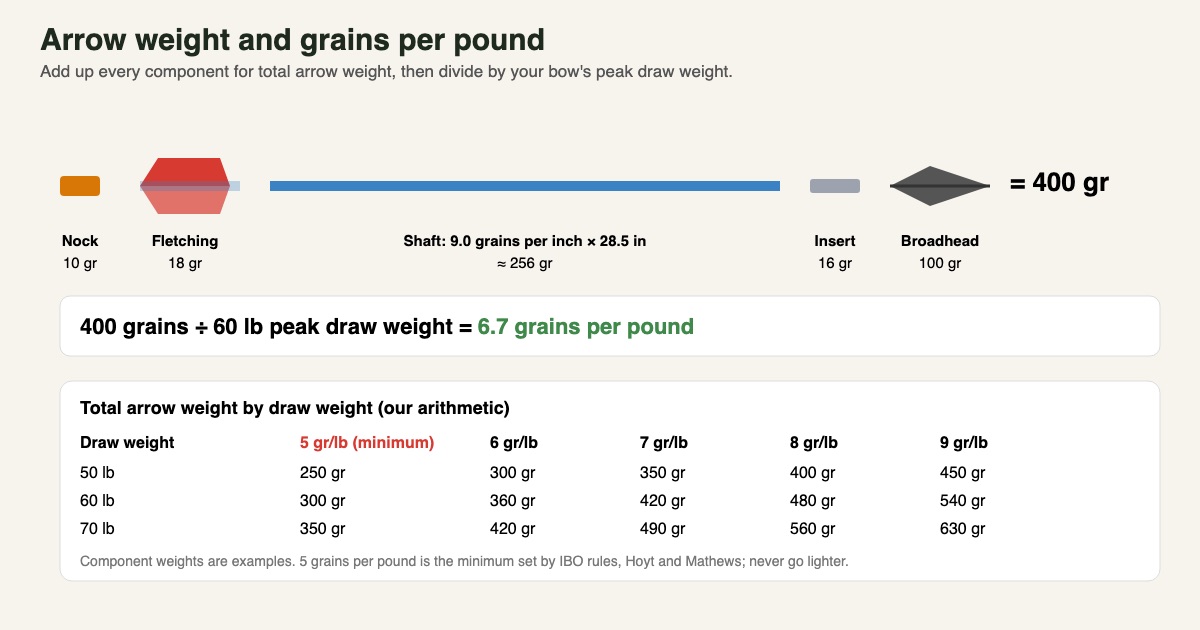
Our example in the diagram above: a 400-grain arrow from a 60 lb bow is 400 ÷ 60 = 6.7 GPP. The same arrow from a 70 lb bow would be about 5.7 GPP.
GPP is useful because it scales with the bow. A 400-grain arrow is light for a 70 lb bow and heavy for a 45 lb bow.
Total arrow weight: what counts
Total arrow weight includes everything that leaves the bow:
- Shaft: grains per inch (GPI, listed by the maker) × cut length.
- Insert (and any outsert or collar).
- Point or broadhead.
- Nock (and any nock bushing).
- Fletching (vanes or feathers) and any wrap.
Small parts add up. In our example, the nock, fletching and insert together weigh over 40 grains. The best way to know your real arrow weight is to weigh a finished arrow on a grain scale.
The minimum: 5 grains per pound
This is the most important number in the article:
- IBO rules: "Arrows must weigh at least five (5) grains per pound of the bow's maximum shooting weight." IBO also recommends that archers "do not exceed manufacturer's recommended limits on arrow weight and draw weight."
- Hoyt: "Never shoot an arrow weighing less than five grains for every pound of peak draw weight of your bow. For example: If your bow's peak draw weight is 70 pounds, do not shoot an arrow weighing less than 350 grains. Shooting an arrow below five grains per pound of peak draw weight could cause your bow to break and cause death or serious injury."
- Mathews: "Do not shoot an arrow that is less than 5 grains per pound of draw weight."
Why? A very light arrow doesn't absorb enough of the bow's energy, so the rest goes back into the bow, much like a dry fire. Our guide to dry firing a bow explains the damage this can cause. Check your own bow's manual and warranty terms too.
Note that the IBO figure is a competition rule and a safety floor, not a hunting recommendation. Most hunting arrows are well above it.
Arrow weight by draw weight
Our arithmetic, at different grains per pound:
| Draw weight | 5 GPP (minimum) | 6 GPP | 7 GPP | 8 GPP | 9 GPP |
|---|---|---|---|---|---|
| 40 lb | 200 gr | 240 gr | 280 gr | 320 gr | 360 gr |
| 50 lb | 250 gr | 300 gr | 350 gr | 400 gr | 450 gr |
| 60 lb | 300 gr | 360 gr | 420 gr | 480 gr | 540 gr |
| 65 lb | 325 gr | 390 gr | 455 gr | 520 gr | 585 gr |
| 70 lb | 350 gr | 420 gr | 490 gr | 560 gr | 630 gr |
This answers the common "how heavy should an arrow be for a 60 lb bow?" question in terms of GPP. Where you land within that range depends on the trade-offs below.
Light vs heavy: the speed and trajectory trade-off
Heavier arrows leave the bow slower, so they drop more over distance. Outdoor Life measured this with a chronograph: arrows of 440, 445.8 and 475.6 grains left the same bow at 274.3, 272.2 and 264.1 fps, "about 1 fps lost for every 3 grains added." Over the drop between 20 and 50 yards with the same sight setting, the 264 fps arrow dropped 35 inches, the 273 fps arrow 30 inches and the 282 fps arrow 26 inches.
goHUNT compared two arrows from a 70 lb, 30-inch bow: 498 grains at 285 fps and 420 grains at 310 fps. At 60 yards, the heavier arrow dropped 55 inches against 47.1 inches. Kinetic energy was almost identical (89.7 vs 89.5 ft-lb), but momentum was higher for the heavier arrow (.63 vs .58).
In practice:
- Lighter arrows shoot flatter, so a small error in judging distance matters less.
- Heavier arrows carry more momentum and, many hunters believe, penetrate more reliably, at the cost of more drop.
A worked example: a 60 lb bow
Our arithmetic, using Outdoor Life's measured rule of thumb of about 1 fps per 3 grains:
- At 6 GPP, a 60 lb bow shoots a 360-grain arrow.
- At 7 GPP, a 420-grain arrow, about 20 fps slower than the 360-grain arrow by that rule of thumb.
- At 8 GPP, a 480-grain arrow, roughly another 20 fps slower.
goHUNT's deer range of 410 to 460 grains falls between about 6.8 and 7.7 GPP for this bow. Your real speeds depend on draw length, cam design and arrow build, so measure with a chronograph.
Energy and momentum
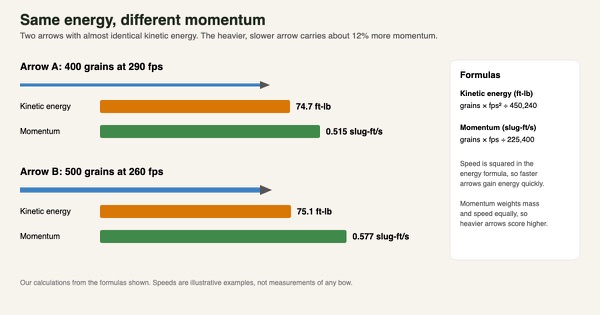
Kinetic energy and momentum depend on both weight and speed. The National Deer Association's worked examples show the trade-off: a 350-grain arrow at 320 fps carries 79.57 ft-lb and 0.497 slug-ft/s of momentum, while a 500-grain arrow at 260 fps carries 75.04 ft-lb but 0.577 slug-ft/s. Its conclusion: "the best results will likely come from a happy medium of weight and arrow speed." Our kinetic energy and momentum guide explains the formulas.
Arrow weight and shot distance
The extra drop of a heavier arrow matters most when you misjudge distance. Outdoor Life's test showed a 9-inch difference in drop between 20 and 50 yards between its slowest and fastest arrows. If you hunt from treestands where most shots are close and ranged in advance, that difference rarely matters. If you hunt open country with longer, unpredictable shots, a flatter-shooting arrow and a rangefinder become more important. Our guide to effective bow range for deer explains how to set sensible limits.
Youth and low-poundage bows
The same 5 GPP minimum applies to light bows. A 40 lb bow needs an arrow of at least 200 grains, and a 30 lb bow at least 150 grains. Youth arrows are often well above these figures. Always follow the bow maker's minimum, and check any legal minimum draw weight for hunting in your state; our guide to choosing a bow for a child covers youth setups.
Commonly cited starting points
Deer
goHUNT suggests, for deer and antelope, "a 410 to 460 grain arrow traveling at 285 to 315 FPS with a 10% to 15% front of center."
The National Deer Association passes on starting points from bowhunting writer Bill Bagley: "6 grains of arrow weight per pound of draw weight for bows in the 70-lb. range," "8 grains… 60-lb. range," and "10 grains… 50-lb. range." Notice that lighter bows get proportionally heavier arrows, helping them carry more momentum.
Elk and bigger game
For elk, goHUNT suggests "a 440 to 500 grain arrow traveling at a rate of 275 to 300 FPS with a front of center of 10% to 15%." Our draw weight guide also covers energy guidelines for larger game.
Traditional bows
Recurves and longbows shoot slower, so traditional hunters often use proportionally heavier arrows, in line with the Bagley starting points for lighter bows. Whatever your bow, stay above the maker's minimum and build for good arrow flight.
How to weigh arrows and build to a target weight
- Weigh a finished arrow on a grain scale.
- Divide by your peak draw weight to get GPP.
- To add weight: heavier broadheads or points, heavier inserts, outserts, or a heavier shaft.
- To reduce weight: lighter points or inserts, a lighter shaft, or lighter fletching (never below 5 GPP).
- Re-check spine after any change. More front weight makes arrows act weaker; see our arrow guide.
- Re-check your sight marks, because heavier arrows hit lower.
Broadhead weight
Broadheads are one of the easiest ways to change total weight. Moving from a 100-grain to a 125-grain head adds 25 grains at the front, raising both total weight and FOC. If you change broadhead weight, change your field points to match, re-check spine and confirm both hit together; our field points vs broadheads guide explains how.
Consistency across a set
For hunting accuracy, every arrow in your quiver should weigh as close to the same as possible. Weigh each finished arrow, set aside any that are noticeably different, and keep components (inserts, points, nocks and fletching) the same across the set. A heavy or light arrow will hit in a different place, especially at longer distances.
Arrow weight and FOC
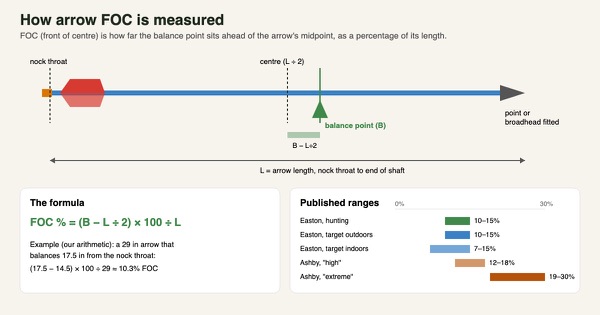
Adding weight at the front raises both total weight and front of center (FOC). Our FOC guide explains how to measure and adjust it. Many hunters add weight at the front rather than the back for this reason.
Crossbows are different
Crossbow bolts follow the crossbow maker's minimum bolt weight rather than a grains-per-pound rule. Our crossbow bolts guide covers bolt weight.
Arrow weight checklist
- Know your peak draw weight (check it on a bow scale).
- Work out the 5 GPP minimum and stay well above it.
- Choose a target range for your game and shot distances.
- Pick a shaft spine and weight from the maker's chart for that build.
- Build and weigh a test arrow, then calculate GPP.
- Tune and check sight marks before building the full set.
Common mistakes
- Going under 5 GPP to gain speed.
- Weighing the bare shaft instead of the finished arrow.
- Adding weight without checking spine.
- Forgetting sight marks after changing arrow weight.
- Choosing an arrow so heavy that it drops too much for your typical shot distances.
Heavier hunting arrows
Advantages
- More momentum from the same bow
- Fits goHUNT's heavier elk range
- Well above the 5 GPP safety minimum
Trade-offs
- Slower, with more drop at distance
- Range errors matter more
- May need stiffer shafts when weight is added at the front
You can browse arrow grain scales or carbon hunting arrows on Amazon.
Frequently asked questions
What is a good arrow weight for deer hunting?
goHUNT suggests 410 to 460 grains at 285 to 315 fps. In grains per pound, many hunters land between about 6 and 8.
How heavy should an arrow be for a 60 lb bow?
At least 300 grains (5 GPP). At 6 to 8 GPP, that's roughly 360 to 480 grains.
What does grains per pound mean?
Total arrow weight in grains divided by your bow's peak draw weight in pounds.
Is 5 grains per pound safe?
It is the minimum set by IBO rules, Hoyt and Mathews. Most hunters shoot heavier arrows.
Are heavier arrows more accurate?
Not automatically. They carry more momentum but drop more. Accuracy depends on tuning and form.
Does arrow weight affect spine?
Adding weight at the front makes an arrow act weaker, so check the spine chart after changes.
How do I weigh my arrows?
Use a grain scale and weigh a finished arrow, including broadhead or point, insert, nock and fletching.
Does draw length affect arrow weight choice?
Indirectly. A longer draw length usually means more speed and a longer, heavier shaft. GPP is based on draw weight, but check the spine chart using your actual arrow length.
Should I use heavier arrows with a lighter bow?
The starting points the National Deer Association passes on from Bill Bagley suggest more grains per pound for lighter bows (about 10 GPP around 50 lb) to help them carry momentum.
Related articles
 Guides
Arrow Kinetic Energy and Momentum Explained
How to calculate arrow kinetic energy and momentum, where the formula constants come from, worked examples, energy guidelines for game, and what they miss.
October 26, 2026 · 9 min read
 Guides
Arrow FOC Explained: Front of Center for Hunting Arrows
What arrow FOC (front of center) is, how to measure and calculate it, Easton's recommended ranges, how to raise or lower it, and the high-FOC debate.
October 27, 2026 · 9 min read
 Guides
How to Choose Arrows: Spine, Length, Weight and Spine Charts
How to choose arrows: what spine means, reading a spine chart, measuring arrow length, arrow weight and FOC, fletching, and bare-shaft tuning to confirm it.
Updated June 26, 2026 · 9 min read