
Arrow FOC Explained: Front of Center for Hunting Arrows
What arrow FOC (front of center) is, how to measure and calculate it, Easton's recommended ranges, how to raise or lower it, and the high-FOC debate.

By Archery Insider Editorial Team
· 9 min read
In this article
FOC, short for "front of center," describes how an arrow's weight is balanced. An arrow with more of its weight towards the point flies differently from one balanced near the middle. Bowhunters pay particular attention to FOC because it affects how stable an arrow is in flight, especially with broadheads, and because some research suggests very front-heavy arrows penetrate better.
This guide explains what FOC means, how to measure and calculate it, the ranges Easton recommends, how to change it, and what the "high FOC" and "extreme FOC" debate is about.
What FOC means
Every arrow has a balance point: the spot where it balances on a finger or knife edge. If the arrow weighed the same along its whole length, the balance point would be exactly in the middle. Because the point (or broadhead) and insert are heavy, the balance point is usually forward of the middle. FOC expresses how far forward, as a percentage of the arrow's length.
Easton puts it this way: "FOC describes the percentage of the arrow's total weight that is located in the front half of the arrow."
How to measure FOC
What you need
- A finished arrow, with the point or broadhead, insert, nock and fletching you will shoot.
- A knife edge or balance to find the balance point (a dedicated FOC tool, or a thin straight edge).
- A tape measure.
Easton's method
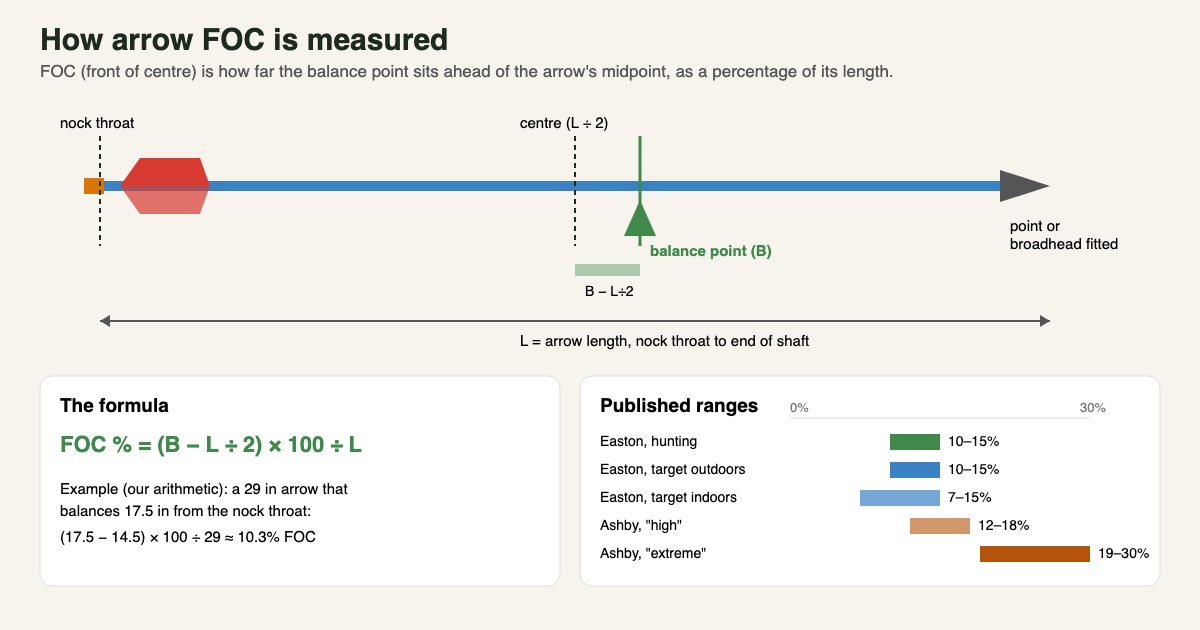
- Measure the arrow's length (L) from the throat of the nock (the bottom of the nock groove) to the end of the shaft.
- Divide by two to find the centre.
- Find the balance point. Easton: "Find the balance point… Mark the point, and measure from the throat of the nock."
- Subtract the centre from the balance-point distance.
- Multiply by 100 and divide by the arrow length.
The formula
Lancaster Archery writes it as:
FOC % = ((B − L/2) ÷ L) × 100
where B is the distance from the nock throat to the balance point and L is the arrow length. Ashby and his co-authors call this the "AMO-Standard" formula.
Worked example
Our arithmetic: take a 29-inch arrow that balances 17.5 inches from the nock throat.
- Half the length is 14.5 inches.
- 17.5 − 14.5 = 3.0 inches.
- 3.0 × 100 ÷ 29 ≈ 10.3% FOC.
That arrow sits at the lower end of Easton's hunting range.
Tips for accurate measurement
- Measure several arrows from the same set; small differences in components show up as different balance points.
- Use the same balance edge every time, and let the arrow settle before marking.
- Measure with the exact broadhead or field point you will shoot; a heavier head changes the result.
- Write the result down with the arrow's components, so you can compare builds.
How a heavier point changes FOC: an example
Our approximate arithmetic, treating the point's weight as sitting at the front end of the shaft: imagine the 29-inch arrow above weighs 420 grains with a 100-grain point and balances 17.5 inches from the nock throat.
- Its balance "moment" is 420 × 17.5 = 7,350.
- Swap to a 125-grain head: the arrow gains 25 grains at about 29 inches, adding 25 × 29 = 725, for a total of 8,075.
- The new total weight is 445 grains, so the new balance point is about 8,075 ÷ 445 ≈ 18.1 inches.
- FOC becomes (18.1 − 14.5) × 100 ÷ 29 ≈ 12.6%.
So 25 grains at the front moved this arrow from about 10% to about 12.5% FOC. Always confirm by measuring the real arrow.
What FOC does in flight
A front-heavy arrow tends to be more stable, because the heavy point leads and the fletching at the back steers more effectively. Easton describes the trade-off: "A high F.O.C. will fly with good stability, but will shed its trajectory quicker and nose-dive." A low-FOC arrow "will hold its trajectory better, but can fly erratically."
So FOC is a balance. Too little, and the arrow may not stabilise well, particularly with broadheads. Too much, and it drops faster at distance and can be harder to tune.
Recommended FOC ranges
| Use | Recommended FOC | Source |
|---|---|---|
| Hunting | 10–15% | Easton: for "setups requiring greater momentum, and optimal accuracy – especially for longer distance shots" |
| Target, indoors | 7–15% | Easton |
| Target, outdoors | 10–15% | Easton: will fly "with good stability, optimal momentum, and accurate trajectory from 0-90 meters" |
Easton's guidance also warns that excessive FOC (above about 20%) can make finger-release consistency "more critical" and reduces an arrow's dynamic spine (makes it act weaker).
How to raise or lower FOC
Heavier points or broadheads
The simplest way to raise FOC is to put more weight at the front. Lancaster gives examples: moving from a 100-grain point to a 125- or 150-grain broadhead adds front weight.
Heavier inserts and outserts
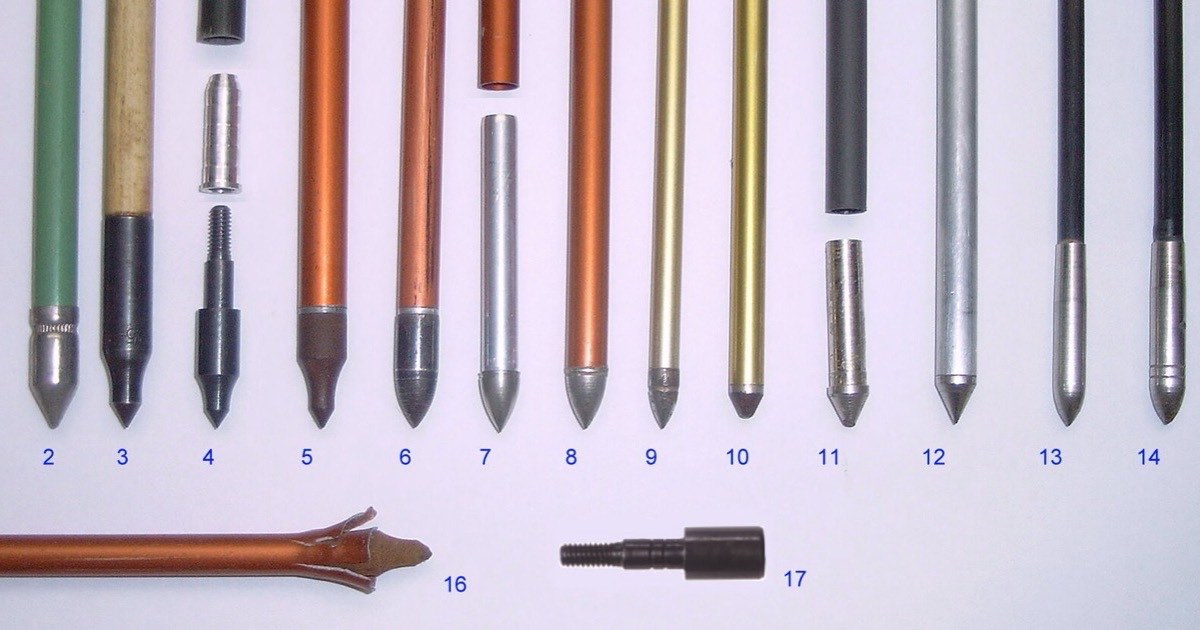
Inserts sit inside the front of the shaft. Lancaster notes that aluminium inserts weigh around 16 grains, while brass inserts can weigh up to 100 grains. Outserts and collars that fit over the shaft also add front weight.
Lighter rear components
Easton points out that the back of the arrow matters too: "a lighter arrow shaft with a 100 grain point/insert and light weight fletching will have considerably more positive FOC balance than a heavier shaft." Lighter vanes, smaller fletching or a lighter nock all move the balance point forward slightly.

Lowering FOC
Lighter points, lighter inserts or heavier fletching move the balance point back.
Re-check spine after any change
Adding weight at the front makes an arrow act weaker. Lancaster warns that extra front weight can call for a stiffer spine, and that it slows the arrow. Any time you change point, broadhead or insert weight, re-check your arrow's spine against the maker's chart and re-test flight. Our arrow guide explains spine, and our bare shaft and walk-back guide explains how to test.
High and extreme FOC: what Dr Ed Ashby's research reported
Much of the interest in high FOC comes from the work of Dr Ed Ashby, a bowhunter who tested arrow penetration on animals over many years. The Ashby Bowhunting Foundation says his testing began in 1981 in Zimbabwe and involved "hundreds of freshly culled animals."
An article by Ashby, Rob Hummel and Todd Smith, published by the Dallas Safari Club, groups FOC into categories:
| Category | FOC |
|---|---|
| Normal | Less than 12% |
| High | 12%–18% |
| Extreme (EFOC) | 19%–30% |
| Ultra-extreme | Above 30% |
The article reports "upwards of a 40 percent gain in tissue penetration" at the 19% threshold, and the Foundation says the gains are "first manifest when arrow FOC reaches 19%."
Three caveats matter:
- These are Ashby's own field-test results, not peer-reviewed studies, so treat the percentages as what his study reported.
- Ashby himself warns about tuning. The same article says: "One cannot just…keep adding heavier points…and expect perfect flight… The spine must be stiff enough to fly perfectly."
- Penetration depends on more than FOC: arrow weight, broadhead design, sharpness, shot angle and arrow flight all matter.
Trade-offs of high FOC
- Spine: more front weight makes arrows act weaker, so you may need stiffer shafts.
- Speed and trajectory: heavier fronts slow the arrow and, as Easton notes, make it drop faster at distance.
- Finger release: Easton says very high FOC makes finger-release consistency more critical.
- Tuning: heavier fronts can magnify tuning problems; see field points vs broadheads.
- Cost and complexity: heavy inserts, outserts and stiffer shafts add cost and need careful building.
FOC and broadhead flight
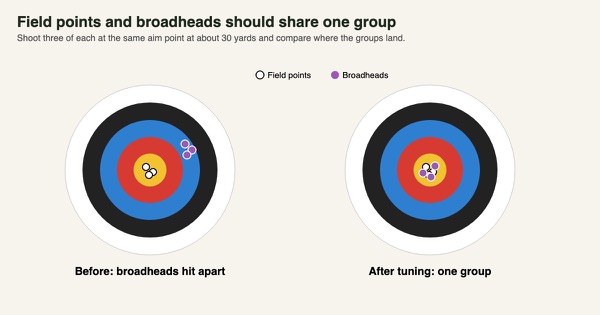
Broadheads have blades near the front of the arrow, which can catch air and steer it if the arrow isn't flying straight. Easton's point that a higher-FOC arrow "will fly with good stability" is one reason hunters pay attention to FOC. But FOC doesn't replace tuning. If broadheads and field points hit in different places, the cause is usually arrow flight, spine or rest position; our field points vs broadheads guide walks through the fixes.
FOC vs total arrow weight
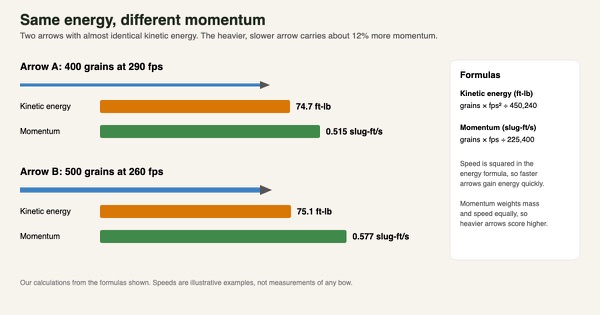
FOC describes where the weight sits; total arrow weight describes how much there is. Both matter. Adding a heavier point raises both. Our guide to arrow kinetic energy and momentum explains how arrow weight affects momentum, and our arrow weight guide covers grains per pound and minimum weights.
FOC for elk and bigger game
For larger animals with heavier bones, some hunters build heavier arrows with higher FOC, within the limits of good arrow flight. Easton's 10–15% hunting range is a sound starting point; going higher means building and tuning carefully.
A quick FOC build checklist
- Choose the right spine for your draw weight, arrow length and point weight from the maker's chart.
- Pick your head weight (field point and broadhead the same weight).
- Choose an insert: light aluminium for less front weight, or heavier brass or steel for more.
- Build one test arrow without glue and measure its FOC.
- Adjust point or insert weight to land where you want, re-checking spine.
- Tune and test with field points and broadheads before building the full set.
Common mistakes
- Measuring without the hunting head fitted. Measure the arrow exactly as you will shoot it.
- Chasing a number and forgetting to re-tune.
- Adding front weight without checking spine.
- Assuming more FOC always means more accuracy.
- Confusing FOC with total weight.
Building for higher FOC
Advantages
- More stable flight, especially with broadheads
- Ashby's studies reported penetration gains at very high FOC
- Easy to adjust with point and insert weight
Trade-offs
- Arrows act weaker and may need stiffer shafts
- More drop at longer distances
- Needs careful tuning and can cost more
You can browse FOC balance tools or brass arrow inserts on Amazon.
Frequently asked questions
What is a good FOC for a hunting arrow?
Easton recommends 10–15% for hunting setups.
How do you calculate arrow FOC?
Find the balance point, measure from the nock throat, subtract half the arrow's length, multiply by 100 and divide by the arrow's length.
Does FOC really matter for deer at 20–30 yards?
It affects stability and broadhead flight. A well-tuned arrow in the normal range works well at typical deer distances.
Is high FOC better for elk?
Many elk hunters use heavier, more front-loaded arrows. Ashby's studies reported penetration gains at very high FOC, but the arrow must still be tuned to fly well.
Does adding point weight weaken spine?
Yes. More front weight makes the arrow act weaker, so check the spine chart after any change.
What is extreme FOC?
In Ashby's categories, extreme FOC is 19% to 30%, and ultra-extreme is above 30%.
Is FOC the same as front-loading weight?
Front-loading weight raises FOC, but FOC is the measurement: where the balance point sits relative to the arrow's midpoint.
Does fletching affect FOC?
Yes, a little. Heavier fletching at the back moves the balance point backwards; lighter vanes move it forwards. Easton notes that lightweight fletching contributes to a more positive FOC.
Should I build arrows to a target FOC?
Use Easton's range as a guide, but build for good flight first. Choose the right spine, then adjust point and insert weight while keeping the arrow tuned.
Related articles
 Guides
Arrow Kinetic Energy and Momentum Explained
How to calculate arrow kinetic energy and momentum, where the formula constants come from, worked examples, energy guidelines for game, and what they miss.
October 26, 2026 · 9 min read
 Guides
How to Choose Arrows: Spine, Length, Weight and Spine Charts
How to choose arrows: what spine means, reading a spine chart, measuring arrow length, arrow weight and FOC, fletching, and bare-shaft tuning to confirm it.
Updated June 26, 2026 · 9 min read
 Training
Field Points vs Broadheads: Why Impact Changes
Why broadheads hit differently from field points, and how to fix it: paper tuning, spin-testing, micro-tuning the rest at 30 yards, FOC and re-sighting.
October 14, 2026 · 9 min read