
Crossbow Bolts Explained: Length, Weight, Nocks
Crossbow bolts explained: carbon vs aluminium, length, minimum weight, front-of-centre balance, nock types, lighted nocks, inspection and how to choose.
By Archery Insider Editorial Team
· 10 min read
In this article
Crossbow bolts look simple: a short shaft, a point, some vanes and a nock. But bolts are matched to the crossbow that shoots them in a way vertical-bow arrows are not. The wrong length, weight or nock type can spoil accuracy, damage the crossbow, or cause a dangerous release similar to a dry fire. American Hunter's crossbow bolt guide sums it up: "Following manufacturers' guidelines is best practice."
This guide explains each part of a bolt, how carbon and aluminium compare, why length, weight and nocks matter so much, what lighted nocks do, how to inspect bolts, and how to choose them safely.
The quick answer
| Question | Short answer |
|---|---|
| Carbon or aluminium? | Carbon is the most popular for consistency and durability; aluminium is economical |
| What length? | The length your crossbow maker specifies, typically 16 to 22 inches |
| What weight? | At or above the maker's minimum; heavier bolts are slower but carry more momentum |
| What point weight? | Usually 100 grains, which many bolts are designed around |
| Which nock? | Exactly the type your crossbow requires |
| Lighted nocks? | Helpful for tracking and recovery; check that they are legal where you hunt |
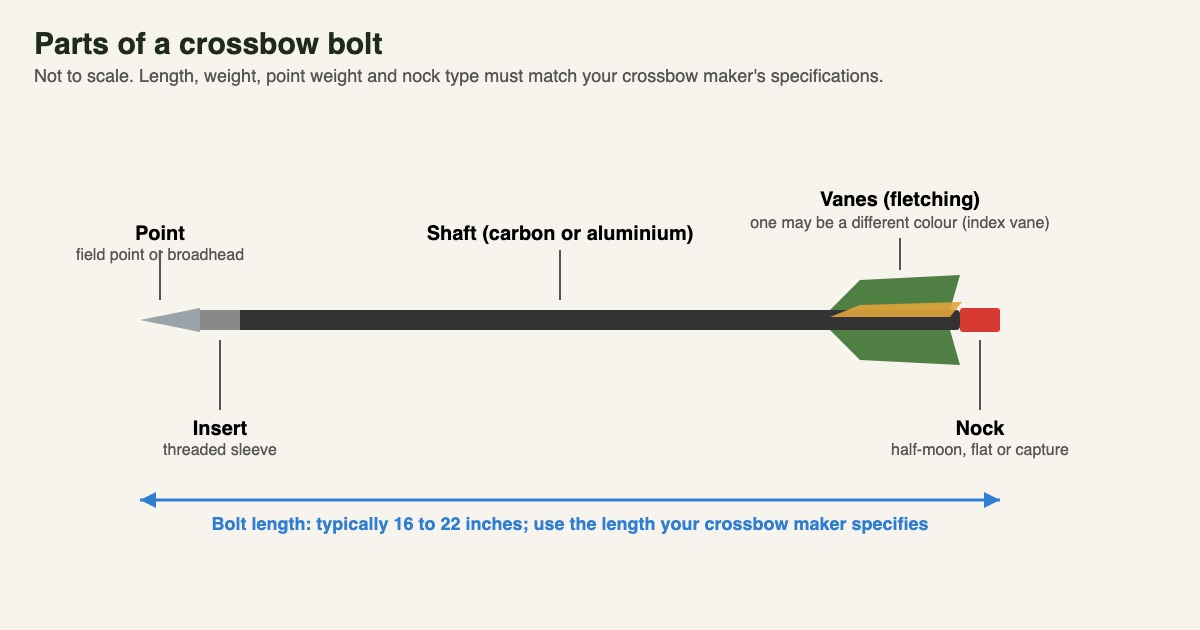
Parts of a bolt
- Point: a field point for practice or a broadhead for hunting, screwed into the insert.
- Insert: the threaded sleeve glued into the front of the shaft.
- Shaft: usually carbon or aluminium.
- Vanes: usually three, often with one in a different colour (the index vane).
- Nock: the rear end that sits against the string; half-moon, flat or capture.
Carbon vs aluminium
American Hunter's guide compares the materials:
| Material | Strengths | Weaknesses |
|---|---|---|
| Carbon | Offered in "a variety of weights and tolerances (i.e. straightness) unequalled by those made from aluminum"; either straight or broken, with no middle ground | Costs more; cracks can be hard to see |
| Aluminium | "An economical option" | Less variety and consistency; bends more easily |
| Hybrid (carbon core, aluminium jacket) | Combines a carbon core with an aluminium jacket for deep penetration on large game | Usually more expensive |
Most crossbow hunters today use carbon bolts. Our carbon vs aluminium arrow comparison covers the materials in more depth.
Bolt length
American Hunter notes that bolts typically run from 16 to 22 inches, with most measuring 20 to 22 inches. The right length is not a matter of preference; it depends on your crossbow's design, including its power stroke and where the bolt sits on the rail. Using a different length from the one specified can affect accuracy and safety. Always buy the length your crossbow maker recommends, and check how they measure it.
Bolt weight
Manufacturers set a minimum total bolt weight, including the point. TenPoint's figures are a clear example:
| TenPoint crossbows | Minimum finished bolt weight |
|---|---|
| Made in 2012 or later | 370 grains, including a 100-grain point |
| Made before 2012 | 420 grains, including a 100-grain point |
| Certain Wicked Ridge Ranger models | 350 grains, including a 100-grain point |
American Hunter is blunt about minimums: never go below them. A bolt that is too light does not absorb enough of the crossbow's energy, which stresses the crossbow and the shooter.
Above the minimum, there is a trade-off. American Hunter notes that heavier bolts increase kinetic energy and penetration, although they reduce velocity. Lighter bolts shoot flatter; heavier bolts carry more momentum and are often quieter. Our draw weight guide explains kinetic energy and momentum.
Point weight and FOC
Front of centre (FOC) describes how far forward a bolt's balance point sits. TenPoint designs its bolts around "a 100-grain field tip or broadhead weight" for ideal flight, and notes that 125- or 150-grain heads may need shoot-testing. Changing point weight changes FOC, trajectory and sometimes how the bolt flies, so test any change before hunting. Our crossbow broadhead guide covers broadhead weight in detail.
Nock types
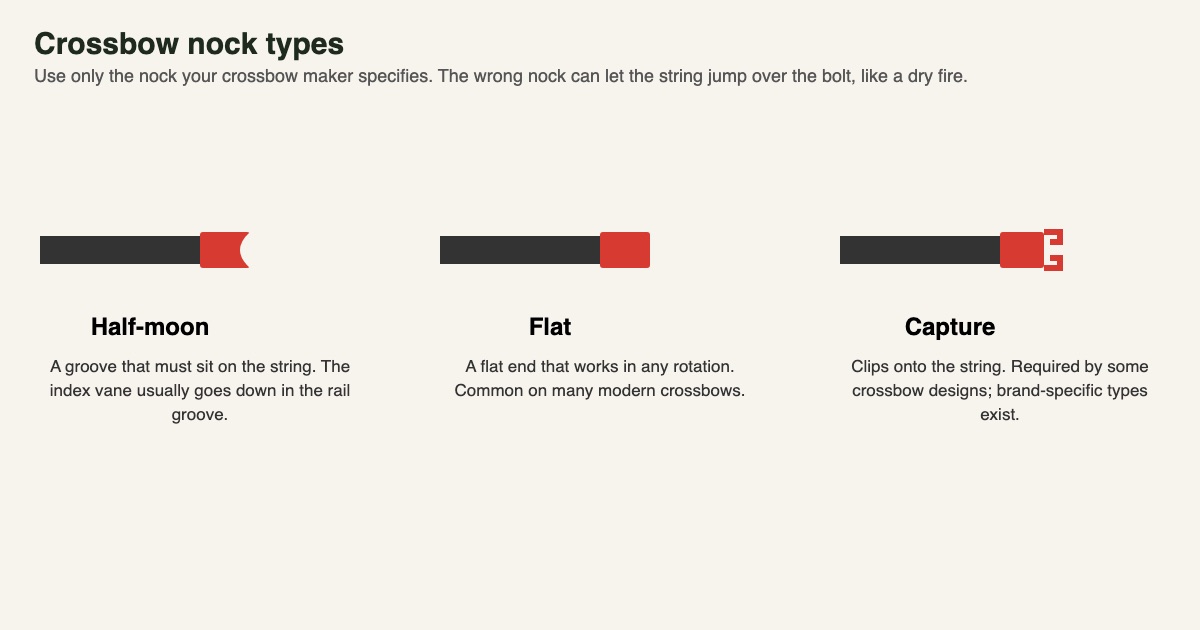
American Hunter warns that crossbows are designed to work with specific nocks, and "deviating from them can create calamitous consequences."
- Half-moon nocks have a groove that must sit on the string. The index vane usually goes down into the rail groove so the nock aligns correctly.
- Flat nocks have a flat end that works in any rotation.
- Capture nocks clip onto the string. Some crossbow makers require proprietary designs; American Hunter notes that TenPoint models mandate the company's Omni-Nock.
Using the wrong nock can let the string slip over or under the bolt instead of pushing it, which can act like a dry fire and damage the crossbow.
Lighted nocks
Lighted nocks switch on when the bolt is fired and glow so you can follow its flight and find it afterwards. American Hunter recommends them for recovery and safety. They also help you see where a bolt hit an animal. Check that lighted nocks are legal where you hunt, and that they meet your crossbow's nock requirements and the minimum bolt weight, since they can add weight.
Vanes
Crossbow bolts usually have three short vanes. With half-moon nocks, the odd-coloured index vane goes down into the rail's flight groove, so the other two vanes clear the rail. Check vanes for tears and loose edges; damaged vanes steer bolts badly.
Bolts for different hunting situations
- Whitetail deer: a carbon bolt at or a little above your crossbow's minimum weight, with a 100-grain broadhead, suits most setups.
- Larger game such as elk or black bear: many hunters move to heavier bolts for more momentum and penetration, staying within the manufacturer's recommendations and testing the change carefully.
- Turkeys: shots are close and the target small; accuracy matters most, and many hunters use bolts and heads designed for turkeys, where legal.
- Target practice: a separate set of practice bolts with field points of the same weight as your broadheads keeps your hunting bolts in good condition.
How many bolts do you need?
For hunting, carry enough to cover a follow-up shot plus a practice or decocking bolt, often three or four in a crossbow quiver. At home, a set of six to a dozen matched bolts lets you practise properly and still have a reserve when bolts are damaged or lost.
Inspecting bolts
Inspect every bolt before and after you shoot:
- Look for cracks, splinters and dents, especially near the nock and insert.
- Flex-check carbon bolts gently while listening for cracking sounds; retire any that creak or show damage.
- Check nocks for cracks and correct seating.
- Check vanes for tears and lifting edges.
- Check inserts and points are tight and straight; spin-test on a flat surface.
- Retire any bolt that hit something hard or that you are unsure about. A damaged carbon bolt can break when fired.
How bolts affect accuracy
Most accuracy problems blamed on a crossbow or scope are really bolt problems. Several things matter:
- Consistency within the set. Bolts that differ in weight, straightness or point weight will not group together, however good the crossbow. Weigh your bolts and keep matched sets.
- Straightness. Carbon bolts are sold in straightness tolerances; tighter tolerances generally group better at longer range, though at typical hunting distances the difference is small.
- Correct nocking. A bolt that is not fully seated against the string, or a half-moon nock that is not aligned, can fly erratically.
- Weight versus your scope. Multi-reticle scopes are calibrated for an assumed bolt speed. If your bolts are heavier or lighter than that assumption, the lower reticle lines may not match their marked distances; our crossbow scope guide explains how to check.
- Damage. A cracked or bent bolt can fly wildly and is unsafe.
Practice bolts and hunting bolts
Many hunters keep two sets. Practice bolts take the wear of target shooting: repeated impacts, pulling from tight targets and occasional misses into the ground. Hunting bolts are a matched set, checked carefully, fitted with fresh broadheads or blades, and shot only enough to confirm they group with your practice bolts. Mark the two sets differently, with nock colour or tape, so you never carry a worn practice bolt into the woods by mistake.
Replacing nocks, points and vanes
- Nocks crack or loosen over time. Replace them with the exact type and model your crossbow requires, pressed fully home.
- Points should be screwed in snugly with clean threads; a loose point can unscrew in flight or in a target.
- Inserts that are loose or crooked should be re-glued or replaced by someone who knows how, or the bolt retired.
- Vanes can be re-fletched with a fletching jig, keeping the index vane in the correct position for half-moon nocks. Our Bohning Tower Jig review covers a popular jig.
After any repair, check the bolt's total weight still meets your crossbow's minimum.
Storing and carrying bolts
- Use a quiver designed for your crossbow, with a cover over the broadheads.
- Store bolts dry and straight, away from heat sources, not loose in a bag where they bang together.
- Keep broadhead-tipped bolts separate from practice bolts, and handle them carefully.
- Never leave a bolt loaded in an uncocked crossbow, or carry a cocked and loaded crossbow while moving around.
Choosing crossbow bolts: a checklist
- The length your crossbow maker specifies
- At or above the minimum total weight, including the point
- The correct nock type
- Designed for your point weight, usually 100 grains
- Carbon for consistency and durability, unless you choose aluminium for cost
- Matched set: same weight, length and components
- Lighted nocks if you hunt and they are legal
Common mistakes
- Buying bolts by price without checking length, weight and nock against the manual.
- Mixing bolts of different weights or makes in one quiver.
- Using damaged bolts because they "still fly fine."
- Loading half-moon nocks wrong, with the index vane up.
- Shooting bolts lighter than the minimum to gain speed.
- Changing point weight without re-zeroing.
Carbon crossbow bolts
Advantages
- Consistent weight and straightness
- Durable; stay straight until they break
- Wide choice of weights
Trade-offs
- More expensive than aluminium
- Cracks can be hard to see, so inspection matters
Aluminium crossbow bolts
Advantages
- Economical
- Damage such as bends is usually visible
Trade-offs
- Bend more easily
- Less variety and consistency than carbon
You can browse carbon crossbow bolts or lighted nocks on Amazon. Check length, weight and nock type against your crossbow's manual first.
Frequently asked questions
What length crossbow bolt do I need?
The length your crossbow maker specifies. Bolts typically run 16 to 22 inches, with most 20 to 22 inches.
How heavy should a crossbow bolt be?
At or above your crossbow's minimum total weight, including the point. TenPoint, for example, requires 370 grains for its 2012-and-later models.
Can I use any nock on my crossbow?
No. Use only the nock type your crossbow maker specifies. The wrong nock can cause a dangerous, dry-fire-like release.
Are carbon crossbow bolts better than aluminium?
Carbon is the most popular choice for its consistency and durability. Aluminium is cheaper but bends more easily.
Are lighted nocks worth it?
They help you follow the bolt and recover it, and can show where you hit an animal. Check that they are legal where you hunt.
Why are my crossbow bolts not grouping?
Common causes are mismatched bolt weights, damaged bolts, an off-centre string, a loose scope or bolts that do not suit your scope's calibrated speed. Check each one, starting with the bolts themselves.
Can I shoot regular arrows from a crossbow?
No. Crossbows need bolts designed for them, with the correct length, weight and nock. Using arrows meant for vertical bows is unsafe.
Do heavier crossbow bolts penetrate better?
Generally they carry more momentum and penetrate well, but they fly slower and drop more over distance. Stay within your crossbow maker's recommendations and re-check your scope's reticle distances after changing bolt weight.
Related articles
 Training
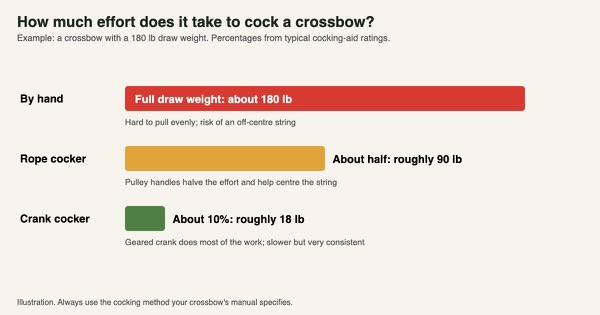
How to Cock a Crossbow Safely
How to cock a crossbow safely: by hand, with a rope cocker or a crank, centring the string, loading a bolt correctly, and safe ways to unload or decock.
October 13, 2026 · 9 min read
 Gear
GearCrossbow Broadheads: What's Different, How to Choose
Crossbow broadheads explained: why crossbow versions exist, fixed vs mechanical at crossbow speeds, broadhead and bolt weight, legal rules and safe handling.
October 9, 2026 · 9 min read
 Training
How to Sight In a Crossbow Scope, Step by Step
How to sight in a crossbow scope: safety, mounting, a 20-yard zero, multi-reticle and speed-dial scopes, broadhead checks and fixes for wandering groups.
October 6, 2026 · 9 min read