
How to Cut Carbon Arrows Safely at Home
How to cut carbon arrows safely: measuring the right length, what Easton and Gold Tip say about tools, carbon dust safety, squaring the ends and spine changes.

By Archery Insider Editorial Team
· 8 min read
In this article
Carbon arrows usually come longer than you need, so most archers who build their own arrows have to cut them to length. It's a straightforward job, but it is easy to get wrong: cut too short and the arrow is unsafe and wasted; cut with the wrong tool and you can splinter the carbon; cut without protection and you breathe in fine carbon dust.
This guide explains how to measure the right length, what arrow makers say about cutting tools, how to protect yourself, a step-by-step cutting method, and how cutting affects spine.
Before you cut: measure twice
Correct Arrow Length
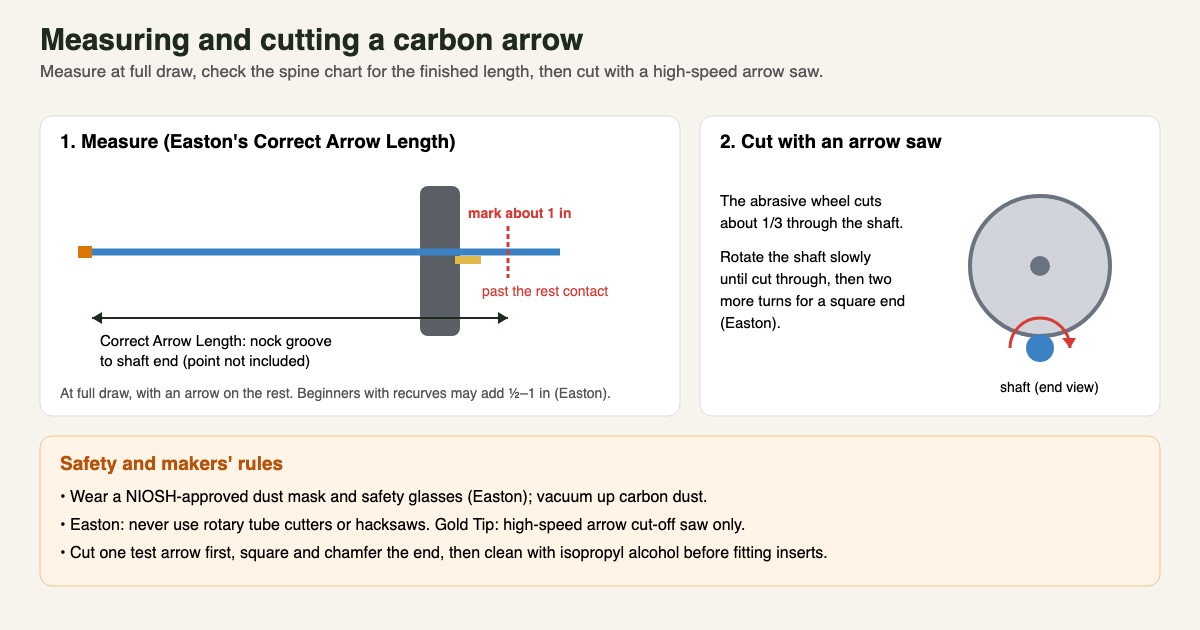
Easton defines Correct Arrow Length as the distance "from the bottom of the nock groove to the end of the shaft… The point is not included." For target arrows, and hunting arrows shot from bows with a cut-out sight window, Easton suggests marking the arrow "about 1" in front of the place where the arrow contacts the most forward position of the arrow rest" at full draw. It also notes that "beginners with recurve bows may want to add an extra 1⁄2"-1" to their arrow length."
Gold Tip gives a safety minimum for bows with an overdraw: "the arrow should always be cut to a minimum of one inch in front of the arrow rest at full draw."
To measure, have a helper mark an uncut shaft while you hold full draw with the arrow on the rest, pointed safely at a target. Never draw an arrow shorter than your draw length; the point could be pulled behind the rest. Our draw length guide explains how draw length relates to arrow length.
Shaft cut length is different
Easton notes that the shaft's cut length "is slightly shorter than your Correct Arrow Length," because the nock adds a little length at the back. Allow for this when marking.
Check the spine chart
Arrow length changes how stiff an arrow acts. Before cutting, check the maker's spine chart using your finished length and draw weight, so you don't end up with arrows that are too stiff or weak. Our arrow guide explains how to read a spine chart.
What arrow makers say about cutting tools
| Maker | What they say |
|---|---|
| Easton | "Never use rotary tube cutters, hack saws or other methods that can damage the shaft or leave a rough cut." |
| Gold Tip | "Cut carbon arrows using a high-speed arrow cut-off saw only. Use of any other type of saw may cause damage to the arrow." |
| Victory | Use "a high-speed arrow saw (≥5,000 RPM) with a diamond blade and a vacuum system. Always square ends before insert installation." |
Easton explains why: "Carbon shafts of all types must be cut carefully to prevent splintering of the carbon (graphite) fibers."
Can you cut carbon arrows without an arrow saw?
This is one of the most searched questions about arrow building, so here is the honest answer from the makers:
- Pipe or tube cutter: Easton says never use rotary tube cutters.
- Hacksaw: Easton says never use hack saws.
- Dremel or rotary tool: none of the arrow makers we checked approves this. Gold Tip says to use a high-speed arrow cut-off saw only.
- Angle grinder: not approved by the makers we checked, and a hazard in its own right.
If you don't own an arrow saw, the simplest option is to have a pro shop cut your arrows. Many shops do it quickly when you buy shafts, and some will cut shafts you bring in.
Carbon dust and safety
Carbon dust is not something to breathe in. A NASA hazard document on carbon structures explains that "the disrupted carbon fiber is easily airborne and widely distributed," and that "carbon fiber exposure can cause mechanical irritation and abrasion similar to that of glass fibers." It notes that fibres "can become a fine dust or fly during any handling operations" and can "cause irritation, particularly to eyes, skin, and lungs."
Practical precautions:
- Wear a NIOSH-approved dust mask and safety glasses, as Easton instructs.
- Use a saw with dust extraction or a shop vacuum; Victory recommends "a vacuum system."
- Work in a well-ventilated area, away from food and other people.
- Wear long sleeves or wash skin afterwards if dust irritates it.
- Clean up with a vacuum, not by blowing dust around.
- Keep fingers well clear of the wheel.
What you need
- A high-speed arrow saw with a length stop (and ideally dust extraction).
- A NIOSH-approved dust mask and safety glasses.
- A fine marker and a measuring tape or ruler.
- A squaring tool, and fine sandpaper if your shafts need a chamfer.
- 91% isopropyl alcohol and cotton buds or a cloth for cleaning.
- The maker's spine chart for your shafts.
Step by step: cutting with an arrow saw
Easton's method for carbon shafts:
- Mark the cut on the shaft, allowing for your Correct Arrow Length.
- Set the saw's stop so the cut falls on your mark. Many arrow saws have an adjustable length stop, so every shaft is cut to the same length.
- Set the depth. Easton says to set the tool "so the abrasive wheel only cuts about 1⁄3 through the diameter of the shaft."
- Cut while rotating. "While slowly rotating the shaft in the same direction as the cutoff wheel, gently push the shaft into the wheel and rotate the shaft until it is completely cut."
- Finish square. "Continue to slowly rotate the shaft two more revolutions to ensure a square cut."
- Repeat for each shaft, checking the length stop hasn't moved.
Squaring, deburring and chamfering
A square, clean end lets the insert sit straight, which matters for point and broadhead alignment. Victory says to "always square ends before insert installation." A squaring tool lightly faces the end of the shaft so it is exactly at right angles.
For shafts that use external components (outserts or collars), Easton recommends a small chamfer with "180- or 240-grit sandpaper… Three complete revolutions will produce a sufficient chamfer."
Clean the shaft before installing inserts
Cutting leaves fine dust inside and outside the shaft. Easton says to clean the shaft "in 91% isopropyl alcohol to remove the fine cutting dust. Let the shaft dry thoroughly before bonding." Then fit the insert with the adhesive the shaft maker recommends.
Does cutting an arrow change its spine?
Yes. A shorter arrow behaves stiffer. Archery 360 notes that shortening an arrow by a quarter of an inch stiffens its spine, which is why small trims are sometimes used as a tuning adjustment. For tapered or barrelled target shafts, Easton warns that where you cut matters too: cutting some of these shafts from the rear can give "an effectively stiffer arrow reaction, one that is disproportionate to cutting the same amount from the front." For those shafts, follow the maker's cutting instructions exactly.
Cutting can't be undone, so if you are using cutting to tune, trim small amounts at a time and test with bare shafts or walk-back tuning.
Test before you cut the whole dozen
Easton "recommends that you test-draw one arrow with all components installed (without adhesive) before cutting and finishing a complete set of arrows." Cut one shaft, fit the nock, insert and point without glue, and check:
- The length at full draw, with safe clearance past the rest.
- How it flies, ideally with paper or bare shaft testing.
- That it matches your intended spine.
Only then cut the rest.
Common mistakes
- Cutting before checking the spine chart for the finished length.
- Forgetting the nock when marking the shaft cut length.
- Cutting every shaft before testing one.
- Using a pipe cutter, hacksaw or rotary tool, which makers advise against.
- Skipping the mask and glasses.
- Not cleaning the shaft before gluing inserts.
- Cutting too short to chase speed, which risks an arrow drawn behind the rest.
Cutting your own carbon arrows
Advantages
- Arrows cut exactly to your draw and setup
- Lets you build and tune arrows yourself
- Saves trips to the shop once you own a saw
Trade-offs
- Needs an arrow saw and safety equipment
- Carbon dust must be controlled
- Mistakes can't be undone
You can browse arrow saws or arrow squaring tools on Amazon.
Frequently asked questions
Can you cut carbon arrows with a pipe cutter?
Easton says never use rotary tube cutters on carbon shafts. Use a high-speed arrow saw.
Can you cut carbon arrows with a Dremel?
None of the arrow makers we checked approves it. Gold Tip says to use a high-speed arrow cut-off saw only.
Which end of a carbon arrow do you cut?
Follow the shaft maker's instructions. Many archers trim at the point end, but some tapered or barrelled target shafts must be cut from a specific end, because it changes how stiff they act.
How much should I cut off my arrows?
Measure your Correct Arrow Length at full draw. Easton suggests about 1 inch past the rest contact point for many setups, with extra length for beginner recurve archers.
Does cutting an arrow make it stiffer?
Yes. Shorter arrows act stiffer, so check the spine chart for your finished length.
Is carbon fibre dust dangerous?
It can irritate the eyes, skin and lungs, according to a NASA hazard document. Wear a dust mask and safety glasses and use a vacuum.
Do I need to square arrow ends after cutting?
Yes. Victory says to square ends before installing inserts, so they sit straight.
Related articles
 Guides
How to Choose Arrows: Spine, Length, Weight and Spine Charts
How to choose arrows: what spine means, reading a spine chart, measuring arrow length, arrow weight and FOC, fletching, and bare-shaft tuning to confirm it.
Updated June 26, 2026 · 9 min read
 Comparisons
Carbon vs Aluminium Arrows: Which Should You Shoot?
Carbon vs aluminium arrows compared: weight, stiffness, durability, straightness, consistency, safety checks, cost and which suits target, hunting or youth.
Updated May 14, 2026 · 7 min read
 Training
Archery Draw Length: How to Measure It and Why It Matters
How to measure archery draw length with the wingspan method or at full draw, what the AMO standard means, and how it affects bow size, draw weight, and arrows.
Updated February 6, 2025 · 8 min read