
Arrow Kinetic Energy and Momentum Explained
How to calculate arrow kinetic energy and momentum, where the formula constants come from, worked examples, energy guidelines for game, and what they miss.

By Archery Insider Editorial Team
· 9 min read
In this article
Bowhunters talk a lot about kinetic energy and momentum, usually when debating heavy arrows against fast ones. Both numbers describe what an arrow brings to the target, both are easy to calculate, and both are often misunderstood. This guide explains what each one means, how to work them out, where the odd-looking constants in the formulas come from, and what the numbers can and can't tell you about penetration.
If you are choosing a draw weight for deer, our draw weight for deer hunting guide covers that question directly; this article goes deeper on the physics.
Kinetic energy vs momentum in one minute
Easton explains the difference this way: "Kinetic energy is simply the 'power potential' of the arrow at the target, based on its mass weight and speed. Momentum can be thought of as the ability to put that power to work, penetrating the target." It adds: "Light weight arrows at high velocity may have lots of kinetic energy, but generally, heavier arrows generally provide greater momentum, and this means deeper and more reliable penetration."
Deer & Deer Hunting makes a similar point: momentum "gives both mass and velocity equal bearing," while kinetic energy rewards speed much more heavily.
What you need to calculate them
- Arrow weight in grains. Weigh the complete arrow (shaft, insert, point or broadhead, nock and fletching) on a grain scale. Our arrow guide explains what makes up arrow weight.
- Arrow speed in feet per second. Easton notes that "arrow velocity is found by shooting through a chronograph." Use your own bow, at your draw length and draw weight, with the arrow you hunt with. Advertised bow speeds are measured under standard test conditions and are usually faster than real-world setups.
The arrow kinetic energy formula
KE (ft-lb) = arrow weight (grains) × velocity² (fps²) ÷ 450,240
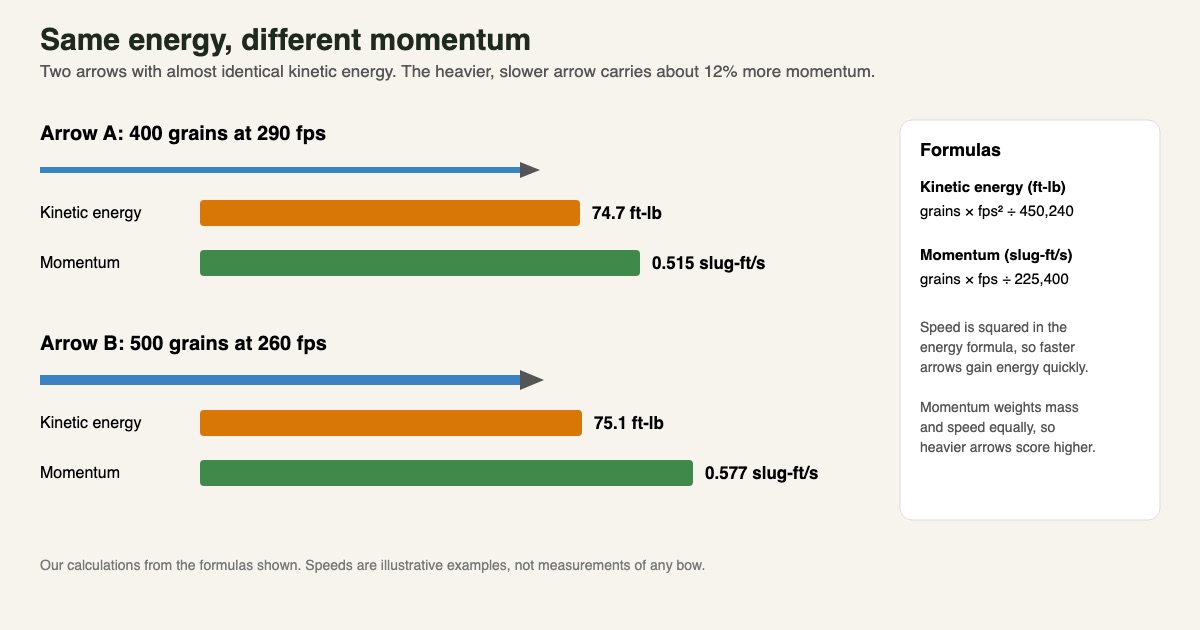
Easton's online calculator uses exactly this formula, and Deer & Deer Hunting gives the same: "Mass x Velocity-squared divided by 450,240." Its worked example is a 400-grain arrow at 290 fps, which comes to 74.72 ft-lb.
Where 450,240 comes from
The constant converts grains and feet per second into foot-pounds of energy. It comes from the physics formula KE = ½mv², with two conversions (this is our explanation, not a quote):
- There are 7,000 grains in a pound.
- Converting pounds of weight into mass uses the acceleration due to gravity, about 32.16 to 32.2 feet per second squared.
So the divisor is 2 × 7,000 × g. With g = 32.16 it is 450,240; with g = 32.2 it is 450,800. That is why some calculators use 450,800 and others 450,240. The difference is under 0.2%, far smaller than the error in most chronograph readings.
The arrow momentum formula
Momentum (slug-ft/s) = arrow weight (grains) × velocity (fps) ÷ 225,400
Deer & Deer Hunting gives the basic physics form: "p (momentum) = m (mass) x v (velocity)."
Where 225,400 comes from
Momentum uses the same conversions without the ½ and without squaring the speed: the divisor is 7,000 × g. With g = 32.2 that is 225,400; with standard gravity (32.174) it is about 225,218. Again, our explanation, and the difference is tiny.
Worked examples
These are our own calculations using the two formulas above. The speeds are illustrative inputs, not claims about any particular bow.
| Arrow weight | Speed | Kinetic energy (ft-lb) | Momentum (slug-ft/s) |
|---|---|---|---|
| 350 grains | 300 fps | 69.96 | 0.466 |
| 400 grains | 290 fps | 74.72 | 0.515 |
| 425 grains | 280 fps | 74.00 | 0.528 |
| 500 grains | 260 fps | 75.07 | 0.577 |
| 450 grains | 180 fps (traditional bow example) | 32.38 | 0.359 |
A step-by-step calculation
Take a 425-grain arrow at 280 fps:
- Square the speed: 280 × 280 = 78,400.
- Multiply by the arrow weight: 78,400 × 425 = 33,320,000.
- Divide by 450,240: 33,320,000 ÷ 450,240 ≈ 74.0 ft-lb of kinetic energy.
- For momentum, multiply weight by speed: 425 × 280 = 119,000.
- Divide by 225,400: 119,000 ÷ 225,400 ≈ 0.528 slug-ft/s.
How changes to your setup affect the numbers
Because of how the formulas work, some changes have bigger effects than others (simple arithmetic, assuming everything else stays the same):
- Speed affects energy more than weight does. Speed is squared, so 10% more speed gives about 21% more kinetic energy, but only 10% more momentum.
- Arrow weight affects both equally at a given speed. 10% more weight at the same speed gives 10% more energy and 10% more momentum. In reality, a heavier arrow leaves the same bow slower, which is why you need a chronograph to see the real result.
- More draw weight or draw length usually increases speed, which raises both numbers. Our draw weight vs draw length guide explains how the two interact.
- Distance reduces both, as the arrow slows downrange.
Same energy, different momentum
Look at the 400-grain arrow at 290 fps and the 500-grain arrow at 260 fps. Their kinetic energy is almost identical: 74.7 against 75.1 ft-lb. But the heavier arrow has a momentum of 0.577 against 0.515, about 12% more. The featured chart above shows the difference.
This is the heart of the light-and-fast versus heavy-and-slow debate. A lighter arrow from the same bow leaves faster, which flattens its trajectory and makes small range errors less costly. A heavier arrow leaves slower but carries more momentum, which Easton links to "deeper and more reliable penetration."
How much kinetic energy do you need?
The most widely quoted guideline is Easton's, reproduced by Deer & Deer Hunting:
| Game | Kinetic energy guideline |
|---|---|
| Small game | Up to 25 ft-lb |
| Medium game (deer, pronghorn, sheep) | 25–41 ft-lb |
| Large game (elk, black bear) | 42–65 ft-lb |
| Toughest game (grizzly, African game) | 66 ft-lb and up |
Treat these as broad guidelines. Many deer are taken cleanly with energies at the lower end when the shot is well placed and the broadhead is sharp. Legal requirements, where they exist, are usually set as minimum draw weights or broadhead sizes rather than energy; check your state's rules.
Traditional bows
Recurves and longbows usually shoot slower than compounds, so their kinetic energy figures look small by comparison. Our example of a 450-grain arrow at 180 fps works out at about 32 ft-lb, which falls inside the guideline band for deer-sized game. Traditional bowhunters typically rely on heavier arrows, razor-sharp broadheads and close, well-placed shots. Our first recurve guide and longbow vs recurve comparison cover traditional equipment.
Is there a momentum chart for deer and elk?
Not one with authority behind it. You will find momentum "thresholds" online, but we found no manufacturer, agency or research source that sets a standard momentum chart for different game. Use momentum to compare setups (for example, whether a heavier arrow gives you more momentum from your bow), not as a pass-or-fail number.
What kinetic energy and momentum don't tell you
Both numbers describe the arrow, not the whole shot. They leave out:
- Shot placement. A well-placed arrow with modest energy beats a poorly placed fast one; see our shot placement guide.
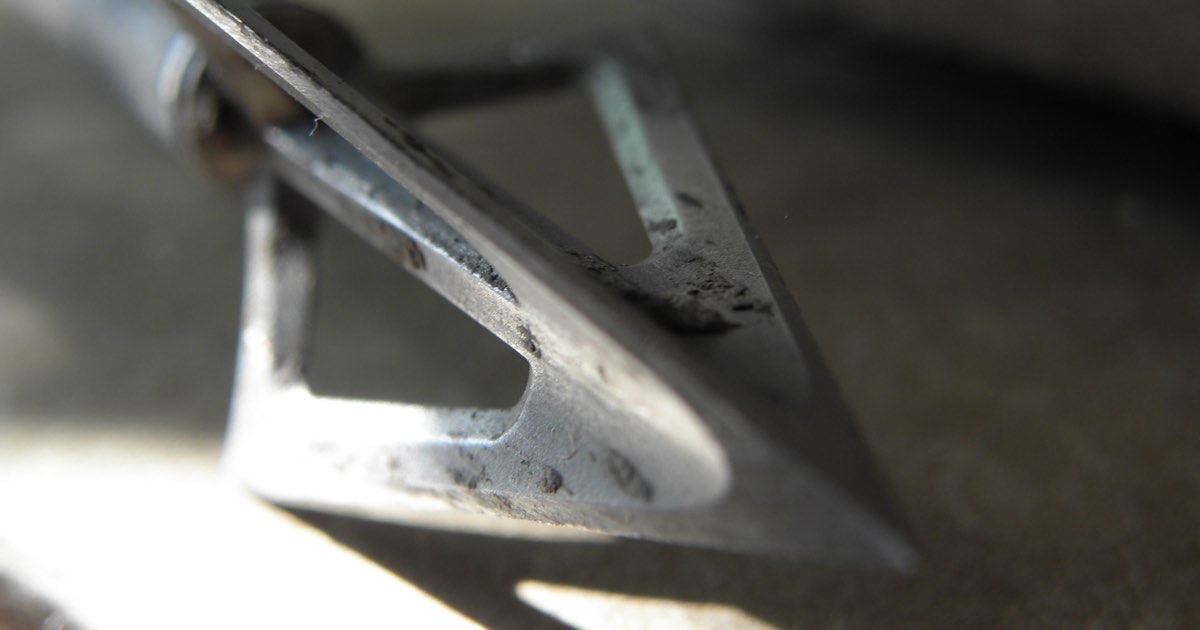
- Broadhead design and sharpness. Cutting diameter, blade angle and sharpness change how easily an arrow penetrates. Our fixed vs mechanical broadheads comparison covers the trade-offs.
- Arrow flight. A poorly tuned arrow wastes energy as it flexes and wobbles; see field points vs broadheads.
- Arrow construction. Shaft diameter, weight distribution (front of centre) and durability all matter.
- Distance. Arrows slow down as they fly, so energy and momentum at the target are lower than at the bow. That's one reason our effective range guide recommends realistic shot distances.
Don't go below the minimum arrow weight
Chasing kinetic energy with very light, fast arrows has a hard limit. Bow makers set minimum arrow weights, commonly 5 grains per pound of draw weight; Elite and Hoyt both give this figure, and Bear and Elite warn that underweight arrows have the same effect as dry firing. Our guide to dry firing a bow explains why. A 60 lb bow, for example, needs an arrow of at least 300 grains under that rule.
Measuring your real setup
- Weigh a finished arrow with the broadhead you hunt with.
- Shoot it through a chronograph at your normal draw length and weight. Shoot several arrows and average the readings.
- Calculate kinetic energy and momentum with the formulas above, or use a calculator.
- Repeat after any change to arrows, broadheads, draw weight or draw length.

If you shoot a crossbow, the same formulas apply to bolts; our crossbow bolts guide covers bolt weight.
Common mistakes
- Using the bow's advertised speed instead of measuring your own setup.
- Weighing the bare shaft instead of the finished arrow.
- Chasing energy with very light arrows, which can be unsafe if they fall below the bow maker's minimum arrow weight.
- Treating online momentum thresholds as rules.
- Forgetting that shot placement and broadhead choice matter more than a few foot-pounds.
Using kinetic energy and momentum
Advantages
- Simple, repeatable way to compare arrow setups
- Shows the trade-off between arrow weight and speed
- Helps check you meet commonly used guidelines
Trade-offs
- Ignores shot placement and broadhead design
- Needs a chronograph for accurate speed
- No standard momentum targets exist
You can browse archery chronographs or arrow grain scales on Amazon.
Frequently asked questions
How do you calculate arrow kinetic energy?
Multiply arrow weight in grains by speed in feet per second squared, then divide by 450,240. The result is in foot-pounds.
How do you calculate arrow momentum?
Multiply arrow weight in grains by speed in feet per second, then divide by 225,400. The result is in slug-feet per second.
Is kinetic energy or momentum more important for penetration?
Easton says heavier arrows "generally provide greater momentum," meaning "deeper and more reliable penetration." But broadhead design, arrow flight and shot placement matter as much.
How much kinetic energy do you need for deer?
Easton's widely published guideline puts deer-sized game at 25 to 41 ft-lb.
How much kinetic energy do you need for elk?
The same guideline puts elk and black bear at 42 to 65 ft-lb.
Why do calculators give slightly different answers?
They use slightly different values for gravity (450,240 vs 450,800 for energy). The difference is under 0.2%.
Does arrow speed drop downrange?
Yes. Arrows slow as they fly, so energy and momentum at the target are lower than at the bow.
Is a heavier arrow always better for hunting?
Not always. Heavier arrows carry more momentum but fly slower and drop more, so range errors matter more. Choose a weight that suits your bow, distance and game, above the maker's minimum.
Do I need a chronograph?
For accurate numbers, yes. Advertised bow speeds come from standard test setups and are usually faster than a real hunting arrow from your bow.
Related articles
 Guides
What Draw Weight Do You Need for Deer Hunting?
How much draw weight do you need for deer? Legal minimums, why arrow energy matters, compound vs traditional bows, elk, and choosing a weight you can shoot.
October 5, 2026 · 10 min read
 Guides
How Far Can You Shoot a Deer With a Bow?
Effective bow range for deer: what bowhunter education says, why long shots wound more, arrow flight times, jumping the string, and how to find your limit.
October 7, 2026 · 9 min read
 Comparisons
Fixed-Blade vs Mechanical Broadheads: Pros, Cons and Rules
Fixed-blade vs mechanical broadheads compared: flight, tuning, cutting diameter, energy needs, durability, hybrid designs, regulations and which suits your bow.
Updated October 9, 2026 · 6 min read