
Where to Shoot a Deer With a Bow: Shot Placement
Bow shot placement for deer: where the heart and lungs sit, how to aim broadside, quartering away and from a tree stand, which shots to pass on, and why.
By Archery Insider Editorial Team
· 10 min read

In this article
An arrow kills differently from a bullet. It does not rely on shock; it kills by cutting blood vessels and organs, so the deer loses blood and oxygen quickly. That makes shot placement the single most important skill in bowhunting. Put a sharp broadhead through both lungs and a deer usually goes only a short distance. Miss the vitals and you risk a long track or a lost animal.
This guide explains where a deer's vital organs sit, how to aim at each angle, how a tree stand changes your aim point, and which shots a responsible bowhunter passes on.
The vital zone
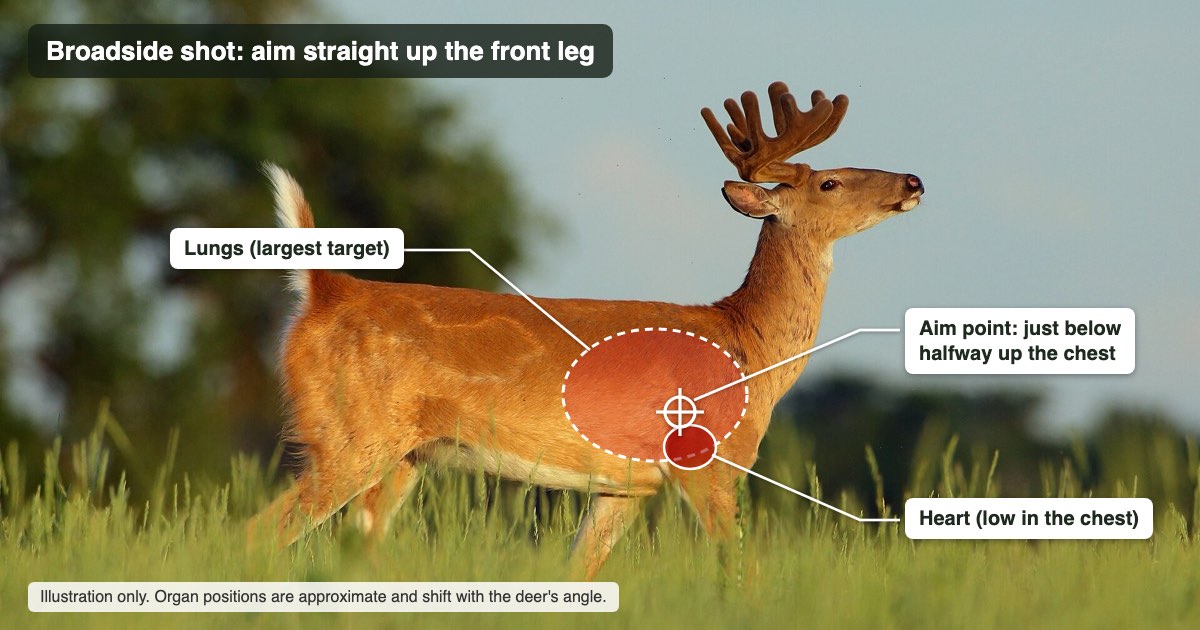
A deer's heart and lungs sit in the front of the chest, protected by the ribs and partly covered by the shoulder.
- The lungs are the biggest target. They fill most of the chest cavity behind the shoulder. A double-lung hit is the most reliable bow kill.
- The heart sits low in the chest, between and slightly behind the front legs.
- The liver sits just behind the lungs. Liver hits are fatal but slower, which affects how long you wait before tracking.
Bowhunter magazine points out why both lungs matter: a deer's lungs are separated by a membrane, so "one lung can remain fully functional, even if the other collapses." A shot that only clips one lung can leave a deer able to travel a long way.
Shot angles, one by one
| Angle | Take it? | Where to aim |
|---|---|---|
| Broadside | Yes, the best shot | Straight up the front leg, about halfway up the chest or slightly lower |
| Quartering away | Yes, very good | Farther back; aim so the arrow exits near the opposite front leg |
| Slight quartering away | Yes | Just behind the near shoulder, angled toward the far shoulder |
| Quartering toward | No | Shoulder bones shield the vitals |
| Facing you (frontal) | No | Very small target; deer is likely to see you draw |
| Facing away (rear) | No | No clean path to the vitals |
| Running or alert and tense | No | Wait for a calm, standing deer |
Broadside
The broadside shot gives the biggest window into both lungs. Follow the back edge of the front leg up the deer and aim just below halfway up the chest. Pick a precise spot, such as a hair tuft or a shadow line, rather than "the deer".
Quartering away
The deer's rear end is angled toward you and its head away, so it is less likely to see you draw. The bowhunter education course says the aiming spot "will be farther back than with the broadside shot," and that "the opposite front leg is a good reference point." Imagine the arrow's path through the body and aim so it exits around the far front leg. The more sharply the deer quarters away, the farther back you aim on the near side.
Quartering toward
The deer's chest is angled toward you. The official course says this angle "offers a poor shot opportunity and should not be taken," because "heavy shoulder bones shield the majority of vital organs," and the deer is likely to spot your movement. Bowhunter magazine adds that most bowhunters should pass on this shot beyond about 15 yards unless they are highly confident. Our advice: wait. Deer often turn broadside within seconds.
Reading the deer before you shoot
Where you aim matters, but so does when. A deer's body language tells you whether the shot is likely to go as planned.
- Relaxed: head down feeding, tail swishing gently, ears moving casually, slow steady walk. This is the deer you want to shoot.
- Alert: head up, ears locked forward, staring, neck stretched, stamping a front foot, or bobbing its head. An alert deer is tense, more likely to react to the sound of the shot, and may bolt. Wait for it to relax.
- Walking: a walking deer can move a few inches between release and impact. Wait for it to stop, or stop it with a soft bleat only when you are at full draw.
- Looking at you: a deer that looks your way may catch the movement of your draw. Wait until its head is down, turned away or behind cover.
Patience at this stage prevents more bad hits than any equipment upgrade.
Shooting from a tree stand
Height changes the arrow's path through the deer. Bowhunter magazine's advice is to "visualize the path of the arrow through the deer" and "aim at a point that will cause the arrow to pass through the center of the body cavity," which means aiming "slightly higher than you would from ground level." Picture where the arrow should come out, low on the far side, and work back to the entry point.
Avoid steep, straight-down shots. It is tempting when a deer walks under your stand, but the same article calls it "one of the worst in bowhunting," likely to "produce a fatally hit but unrecovered deer," because it often hits only one lung and leaves a poor blood trail. The author would "rather see a bowhunter take a 40-yard shot at a broadside deer than a straight-down shot." Wait for the deer to walk 10 to 15 yards out and present an angle.
Distance and timing
Bowhunter education notes the average hunter's maximum effective range is about 30 yards, and explains that wounding rates rise with distance because the vitals are harder to hit, brush can deflect the arrow, and the deer has more time to move. Our effective range guide explains how to find your own limit.
Timing matters too:
- Draw when the deer cannot see you: head behind a tree, head down feeding, or looking away.
- Shoot a relaxed deer. A deer that is alert, stamping or staring is tense and more likely to react to the shot.
- Stop a walking deer with a soft mouth bleat only if you are already at full draw and ready to shoot.
From the ground versus from a stand
On the ground, you see the deer from roughly its own level, so the vital zone looks like the classic textbook picture: a broadside chest with the heart low and the lungs above. The arrow travels nearly level through the body, and an exit hole on the far side is likely to be at a similar height to the entry.
From a stand, you see more of the deer's back and less of its side, and the arrow travels downward through the body. The closer the deer, the steeper the angle and the smaller the window into both lungs. That is why many tree-stand hunters prefer shots at 15 to 25 yards rather than directly below, and why they aim slightly higher on the near side.
Crossbows and shot placement
A crossbow does not change the anatomy. The same aim points, angles and shots to pass on apply. Crossbows can make hunters overconfident about distance because they are so accurate on the range, but deer still move and bolts still drop. Keep to your tested maximum distance, and confirm your broadheads hit with your field points. Our crossbow scope guide explains how to check that.
How broadheads affect the result
Shot placement and broadhead choice work together. A razor-sharp broadhead through both lungs is lethal, whatever its design. Where broadhead choice matters more is on marginal angles and bone:
- Fixed blades are strong and penetrate well, which helps if you clip the shoulder.
- Mechanicals cut a wider hole, which can help blood trails on a good double-lung hit, but use some energy opening.
- Sharpness matters more than type. Dull blades push tissue aside rather than cutting it.
Our fixed-blade vs mechanical comparison covers the trade-offs.
Choosing the exact spot
"Aim small, miss small" is old advice for a reason. Instead of looking at the whole deer, pick a tiny spot on the hair where you want the arrow to go. On 3D targets and in practice, train yourself to find that spot quickly. Our aiming guide covers how to hold steady and aim with a sight, gaps or instinct.
A five-second checklist before you release
Run through this every time, until it becomes automatic:
- Angle: is the deer broadside or quartering away?
- Distance: is it inside your tested maximum, and do you know the range?
- Path: is the line to the vitals clear of branches, twigs and grass?
- Behaviour: is the deer relaxed and standing still, or about to move?
- Spot: have you picked a precise spot, straight up the front leg?
If any answer is no, wait. Holding at full draw a little longer, or letting the bow down and waiting for the next chance, is always better than a doubtful shot.
After the shot
Watch the deer as long as you can, listen, and mark the exact spot where it was standing and where you last saw it. Note how it reacted. Then wait before following up; the right waiting time depends on where you think you hit. Never push a deer you suspect is hit too far back.
Common shot placement mistakes
- Aiming at the whole deer. Without a specific spot, arrows wander toward the middle of the body, which is behind the vitals.
- Aiming too far back out of fear of the shoulder, hitting the liver or stomach.
- Aiming too high from a stand, missing over the back or hitting only one lung.
- Shooting quartering-toward deer because they are close.
- Rushing the shot as a deer walks past, instead of waiting or stopping it at full draw.
- Dropping the bow arm to watch the arrow, which pulls the shot low.
Practice that improves shot placement
- Shoot 3D deer targets from different angles and heights, not just round paper faces.
- Practice from your stand height and while seated.
- Shoot one arrow at a time, cold, at the start of each session.
- Put a vital-zone sticker on a 3D target and move it to match each angle.
- Confirm your broadheads fly with your field points; see our broadhead comparison.
Waiting for the perfect angle
Advantages
- Much higher chance of a quick, clean kill
- Shorter, easier tracking
- Fewer wounded and lost deer
Trade-offs
- Some deer walk away without offering a shot
- Requires patience and staying still at full draw
You can browse 3D deer targets on Amazon to practise realistic angles. Check that the target is rated for broadheads if you plan to shoot them.
Frequently asked questions
Where is the best place to shoot a deer with a bow?
The heart and lungs, just behind the front shoulder. On a broadside deer, aim straight up the front leg, about halfway up the chest or slightly lower.
Should I aim behind the shoulder or at the shoulder?
Aim up the back of the front leg rather than well behind it. The shoulder blade angles forward, so the area straight up the leg is a clear window into the lungs.
Can you shoot a quartering-toward deer with a bow?
Official bowhunter education advises against it because shoulder bones protect the vitals. Wait for the deer to turn.
Where should I aim from a tree stand?
Slightly higher than from the ground, so the arrow passes through the centre of the chest and exits low on the far side. Avoid shooting straight down.
What is the vital area of a deer?
The heart and lungs, plus the major blood vessels around them. The lungs are the largest part of that target.
What happens if I hit the liver?
A liver hit is fatal but slower than a heart or lung hit. Give the deer several hours before following up, and follow quietly. Pushing a liver-hit deer too soon often leads to a much longer track.
Is the heart or the lungs a better target?
Aim for the lungs, which are the larger target. A shot straight up the front leg, just below halfway, passes through both lungs and often clips the top of the heart.
How big is a deer's vital area?
It varies with the size of the deer and the angle, which is why bowhunters practise on targets roughly the size of a dinner plate and aim at a small spot within it rather than the whole chest. The heart-lung area is largest on a broadside deer and shrinks on steep or quartering angles.
Related articles
 Guides
Can You Hunt Deer With a Bow? A Beginner's Guide
Yes, you can hunt deer with a bow. Learn the legal basics, which bows work, how hard it is, effective range, gear, shot placement and a first-season plan.
October 6, 2026 · 13 min read
 Comparisons
Fixed-Blade vs Mechanical Broadheads: Pros, Cons and Rules
Fixed-blade vs mechanical broadheads compared: flight, tuning, cutting diameter, energy needs, durability, hybrid designs, regulations and which suits your bow.
Updated February 13, 2026 · 6 min read
 Guides
What Draw Weight Do You Need for Deer Hunting?
How much draw weight do you need for deer? Legal minimums, why arrow energy matters, compound vs traditional bows, elk, and choosing a weight you can shoot.
October 5, 2026 · 10 min read