
Field Points vs Broadheads: Why Impact Changes
Why broadheads hit differently from field points, and how to fix it: paper tuning, spin-testing, micro-tuning the rest at 30 yards, FOC and re-sighting.

By Archery Insider Editorial Team
· 9 min read
In this article
You spend the summer shooting tight groups with field points, then screw on broadheads before the season and suddenly the arrows land a few inches away, sometimes more. It is one of the most common frustrations in bowhunting, and it matters: a broadhead that hits four inches off at 30 yards can turn a perfect aim into a wounded deer.
The good news is that the cause is usually fixable. This guide explains why broadheads and field points often hit in different places, how to diagnose the problem, and the order of fixes that brings them back together.
The quick answer
| Symptom | Likely cause | First fix |
|---|---|---|
| All broadheads hit in one direction away from field points | Arrow not leaving the bow straight | Paper tune, then micro-tune the rest |
| One or two broadheads fly off on their own | Bent blade, crooked insert or ferrule | Spin-test; replace or fix the head or arrow |
| Broadheads drop low at distance | Heavier or longer head, less speed | Check weight; re-sight if groups are tight |
| Broadheads wander in wind | Fixed blades steering | Better tune, more fletching, or a mechanical head |
| Crossbow broadheads hit apart | Head alignment, bolt damage | Spin-test; re-zero with broadheads |
Why broadheads fly differently
Bowhunter's broadhead-tuning article sums it up: "Broadheads don't resemble the shape of a fieldpoint; they have bladed 'wings' that catch air unevenly and veer off course." They are also "typically longer in shape as well, which will alter the arrow's front of center compared to a fieldpoint-tipped shaft."
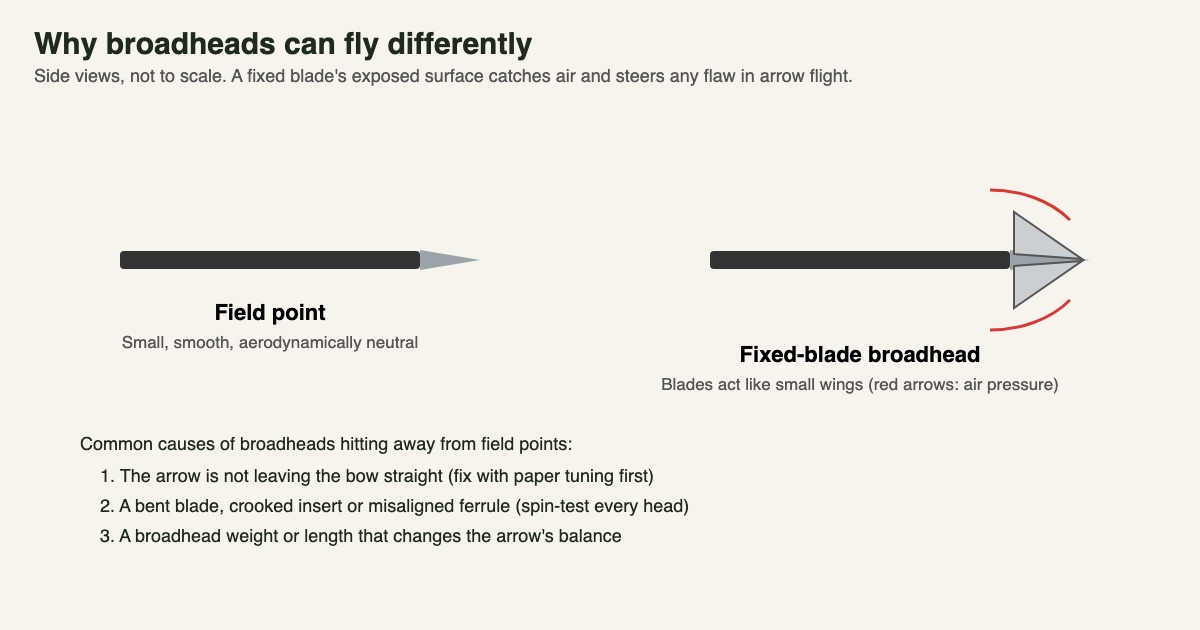
Think of it this way: a field point lets a slightly crooked arrow straighten out quickly. A broadhead's blades act like a small rudder at the front, so if the arrow leaves the bow at an angle, the broadhead steers it further off course. Mechanical broadheads reduce the exposed blade area, but as Bowhunter notes, they only "eliminate some of this bladed surface area, but not all of it."
Step 1: Check the arrows and heads
Before touching the bow, rule out the simple causes:
- Spin-test every broadhead-tipped arrow. Spin it on its point on a hard surface or in a spin tester. A wobble means a bent blade, a crooked ferrule or a misaligned insert.
- Check nocks and fletching for damage and correct alignment.
- Match weights. Use broadheads the same weight as your field points, and check total arrow weights.
- Number your arrows so you can spot one that always flies differently.
Step 2: Tune the bow itself
Bowhunter starts with bow tuning: correct draw length, cams synchronised (on dual-cam and hybrid bows), and the rest set at centre shot. If the bow itself is out of specification, no amount of rest moving will fix broadhead flight.
Step 3: Paper tune
Paper tuning shows whether the arrow leaves the bow straight. Bowhunter suggests paper tuning with un-fletched shafts, using electrical tape to replicate the weight of the vanes, shooting from "four or five feet away" initially and then "10 feet to ensure the pattern remains unchanged." Lancaster Archery's paper tuning guide gives the standard corrections: for nock-high tears, move the nocking point down or the rest up; for left and right tears, move the rest.
Our paper tuning guide explains how to read each tear and the order of fixes.
Step 4: Micro-tune at distance
Once paper shows good flight, move to the target:
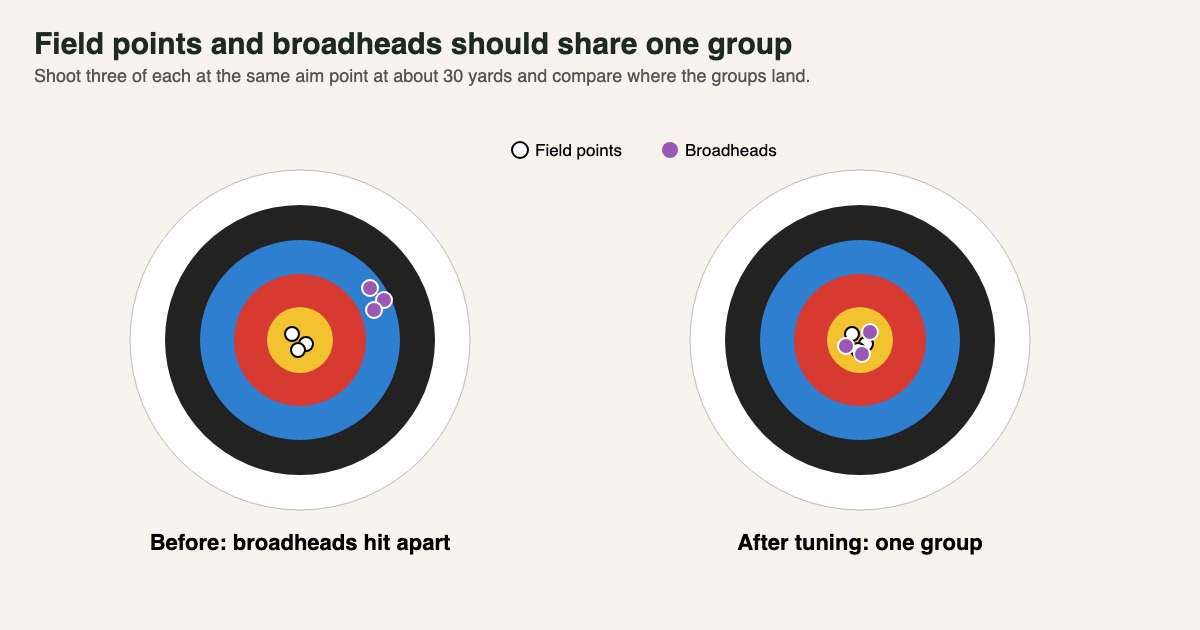
- At 30 yards, shoot three field points and three broadheads at the same aim point, as Bowhunter suggests.
- Compare the groups. If the broadheads land apart from the field points, make "one small increment (1⁄64 or 1⁄32-inch)" rest adjustment.
- Re-shoot both groups after every adjustment.
- Repeat until the groups merge.
- Extend to 40 to 50 yards and repeat to confirm.
Once both groups land together, re-sight the bow with field points if needed; your broadheads will follow.
A broadhead tuning session, step by step
A practical way to run a session on a calm day:
- Warm up with field points until your form is settled.
- Shoot three field points at a fresh aim point at 30 yards.
- Shoot three broadheads at the same aim point, ideally into a broadhead-rated target or a separate layer.
- Note the difference in direction and size, and photograph or sketch it.
- Make one small change, usually a tiny rest move, and record it.
- Repeat until the two groups overlap.
- Step back to 40 yards and confirm.
- Finish by re-checking your sight with field points, and mark your final rest position with a pen.
Rest your arms between groups. Tired form opens groups and makes the comparison meaningless.
Spine and point weight
Arrow spine, how stiff the shaft is, has a big effect on broadhead flight. An arrow that is too stiff or too weak for your bow may fly acceptably with field points but steer badly with broadheads. Adding point weight makes an arrow behave as if it is weaker; reducing it makes it behave stiffer. If you cannot get broadheads to group with field points despite careful rest adjustments, check your arrow against the manufacturer's spine chart for your draw weight, draw length and point weight. Our arrow guide explains spine charts.
Why this matters for ethical hunting
A few inches of difference may not sound like much, but the vital zone of a deer is not large, and errors grow with distance. A broadhead that drifts four inches at 30 yards can move a perfect lung shot into the shoulder or the liver. Tuning broadheads is part of taking responsibility for every shot; see our shot placement guide for where those inches matter.
When to simply re-sight
If your broadheads group tightly together but in a slightly different place from your field points, and the difference is small, many hunters simply sight in with broadheads for hunting. That works, but it can hide a tuning problem that gets worse at longer range or in wind. Tuning until both groups merge is the more reliable fix.
Fixed blade vs mechanical
- Fixed blades are the most sensitive to tuning, because their blades are always exposed. When they group with field points, it is a good sign your bow is well tuned.
- Mechanical broadheads usually fly closer to field points, because their blades are folded in flight. They still need checking.
- Practice heads made to match a broadhead's flight are useful, but always confirm with the actual heads you will hunt with.
Our fixed-blade vs mechanical comparison covers the trade-offs.
Front of centre (FOC)
FOC describes how far forward of the middle an arrow's balance point is. A broadhead that is longer or heavier than your field point moves the balance forward or changes how the arrow behaves. Some arrow builders aim for a modest FOC for stable broadhead flight. If you change broadhead weight, re-test your arrow spine and tune; a heavier head makes an arrow act weaker in spine.
Traditional bows
Recurve and longbow hunters face the same problem, but tune differently. Without an adjustable rest or sight, the main adjustments are arrow spine, point weight, brace height, and strike plate or shelf material. Many traditional archers bare-shaft tune first, then compare broadheads with field points at hunting distances and adjust point weight or spine until they group together. Feather fletching and heavier fixed-blade heads are common choices because they stabilise well off the shelf.
Crossbows
Crossbows have the same issue. Scheels recommends sighting in "with field points first, then confirm with broadheads matching hunting specifications." Because crossbows are less tunable than vertical bows, the usual fixes are spin-testing bolts and heads, replacing damaged bolts, and re-zeroing the scope with broadheads if needed. Our crossbow broadhead guide has more.
Fletching and stability
Larger or more helical fletching steers the arrow more strongly and can help stabilise broadheads. If you have tuned carefully and fixed blades still wander, especially in wind, a fletching change or a smaller broadhead can help. Our feathers vs vanes comparison explains fletching options.
Common mistakes
- Skipping the spin test and blaming the bow for one crooked head.
- Moving the rest a lot in one go instead of tiny increments.
- Tuning only at 20 yards, where small errors do not show.
- Changing several things at once, so you never know what fixed it.
- Hunting with practice-dulled heads. Replace blades or heads after tuning.
- Ignoring wind while tuning; shoot comparison groups on calm days.
Tuning until broadheads match field points
Advantages
- Confident accuracy at hunting distances
- Reveals hidden tuning problems
- Lets you practise with field points year-round
Trade-offs
- Takes time and patience
- Uses up broadheads and target life
- May need a pro shop for cam timing
You can browse arrow spin testers or broadhead practice targets on Amazon.
Frequently asked questions
Why do my broadheads hit lower than field points?
Usually because the broadhead is heavier or longer, or the arrow is losing speed or flying slightly nose-down. Check weights, paper tune, and compare groups at 30 yards.
Should broadheads hit with field points?
Ideally, yes. A well-tuned bow and arrow should group broadheads and field points together at hunting distances.
How far should I tune broadheads?
Start at 30 yards, then confirm at 40 to 50 yards, as Bowhunter suggests. Longer distances reveal small errors.
Do mechanical broadheads fly like field points?
They usually fly closer to field points than fixed blades, but they still need checking.
Can I just sight in with broadheads?
You can, if broadheads group tightly, but it can hide tuning problems. Tuning until both groups merge is more reliable.
How many broadheads should I shoot when tuning?
Three of each type is a good starting comparison. Use a dedicated set for tuning, and finish by checking each of your hunting heads at least once before replacing blades or using fresh heads.
Do I need to tune broadheads every season?
Check them every season and after any equipment change. If nothing has changed and your broadheads still group with field points, a quick confirmation session is enough.
Can a different rest help broadhead flight?
Sometimes. A rest that gives the fletching clean clearance, such as a well-set drop-away, removes one source of erratic flight. Fix tuning basics first, though; a new rest will not cure a crooked arrow or a mismatched spine.
Related articles
 Training
Paper Tuning a Bow: How to Read Tears and Fix Them
How to paper tune a bow: what it shows, frame setup, reading nock-high, low, left and right tears, the order of fixes, and when to see a pro shop.
October 8, 2026 · 10 min read
 Comparisons
Fixed-Blade vs Mechanical Broadheads: Pros, Cons and Rules
Fixed-blade vs mechanical broadheads compared: flight, tuning, cutting diameter, energy needs, durability, hybrid designs, regulations and which suits your bow.
Updated October 9, 2026 · 6 min read
 Gear
GearCrossbow Broadheads: What's Different, How to Choose
Crossbow broadheads explained: why crossbow versions exist, fixed vs mechanical at crossbow speeds, broadhead and bolt weight, legal rules and safe handling.
October 9, 2026 · 9 min read