
What Age Can Kids Start Archery? A Parent's Guide
What age can kids start archery? The age rules of USA Archery, NASP, 4-H and Scouting, signs a child is ready, what under-8s can do, and safe first equipment.

By Archery Insider Editorial Team
· 9 min read
In this article
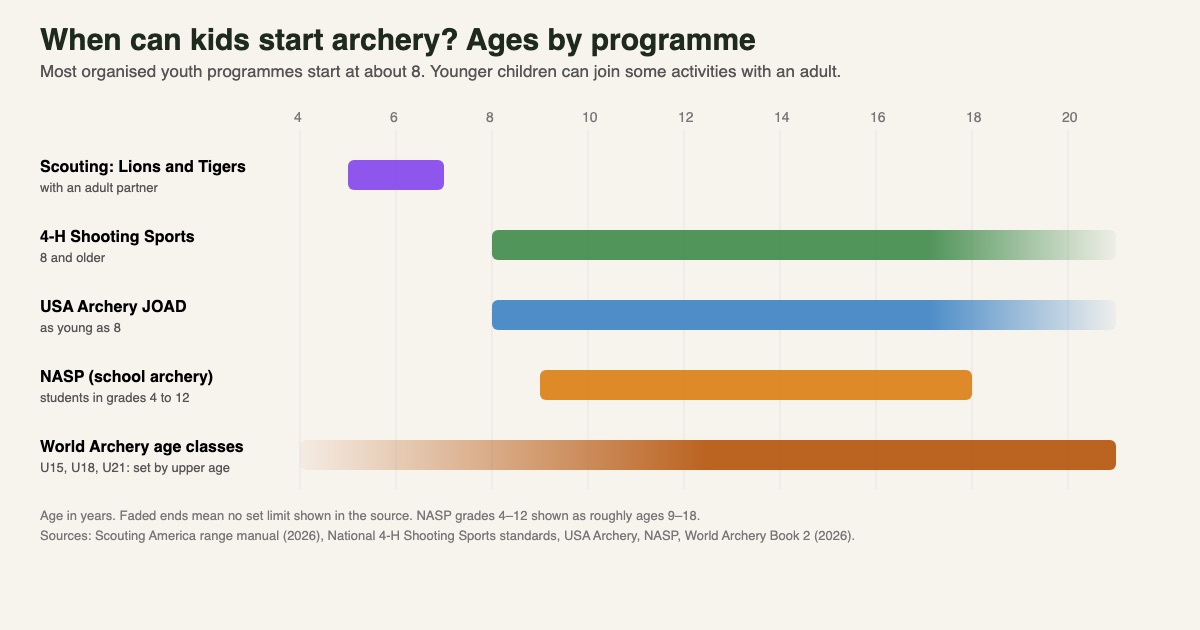
"How old does my child need to be to start archery?" is one of the first questions parents ask. The short answer is that most organised youth programmes in the US start at about 8, but there's no single legal minimum, and some activities welcome younger children with an adult alongside. What matters more than a birthday is whether your child is ready: able to listen, follow safety rules and draw a light bow.
This guide sets out the actual age rules of the main youth programmes, the signs a child is ready, what younger children can do, safe first equipment and how to find lessons. For choosing a bow, see our guide to choosing a bow for a child.
The short answer: about 8, but readiness matters more
Several of the biggest US youth programmes set 8 as their starting age, which is why you'll often see that number. Archery 360, the Archery Trade Association's consumer site, puts it this way: "USA Archery recommends 8 as the minimum age for most kids to pick up a bow." But that's a recommendation, not a law. Some children are ready a little earlier, others later, and younger children can enjoy supervised taster sessions or toy bows.
Age rules by programme
| Programme | Who can take part | Notes |
|---|---|---|
| USA Archery JOAD | "Youth as young as 8 years old" | Awards progress by skill, not age |
| NASP (schools) | "Students in grades 4-12" | Uses one universal-fit bow |
| 4-H Shooting Sports | "8 years of age or older (as of Jan. 1 of the current year)" | 4-H Clovers aged 5–7 not eligible |
| Scouting America | Lion and Tiger Cubs with adult partners; older Scouts in programme activities | Run at council level, not pack or den level |
| World Archery competition | Classes include U15, U18 and U21 | U15 runs up to the year of the 14th birthday |
USA Archery JOAD and Explore Archery
USA Archery says its Junior Olympic Archery Development programme "is for youth as young as 8 years old." Its achievement awards are "not structured by age; each archer starts at the beginning and progresses through the program at their own pace," across "barebow, basic compound, fixed pins, recurve and compound." Clubs run JOAD sessions across the country.
NASP (school archery)
The National Archery in the Schools Program is for "students in grades 4-12." NASP says students in these grades "are best able to use the universal-fit NASP equipment and adhere to all NASP safety features." It uses a single bow: "a 'Genesis' compound which has no let-off and is adjustable from 11-20 pounds in draw weight at any draw length."
4-H Shooting Sports
The National 4-H Shooting Sports standards say programmes "are open to all youth 8 years of age or older (as of Jan. 1 of the current year)," and are clear that "4-H Clovers (age 5-7) are not eligible for any aspect of 4-H shooting sports programs as these are not age appropriate activities." Instructors must be "a minimum of 21 years of age."
Scouting America
Scouting America's 2026 range manual says "Lion and Tiger Cubs and their adult partners may participate in archery activities. The adult partners must be included in all archery activities." It notes that youth of this age "have very short attention spans (20 to 30 minutes maximum), and tire easily." Archery is "prohibited at the pack level or den level" and happens at council-run ranges, with rangemasters "at least 18 years old."
Competitive age classes
For older children who compete, World Archery's 2026 rules list classes including U15, U18 and U21, with the "Under 15 Class when the competition takes place up to and in the year of the athlete's 14th birthday." USA Archery adopted U15 as an official age class from 2024, and also runs U13 events, such as U13 recurve at "30m, 122cm." Our coverage of the 2025 World Youth Championships shows youth archery at the top level.
Signs a child is ready
Use these as a guide rather than a strict test:
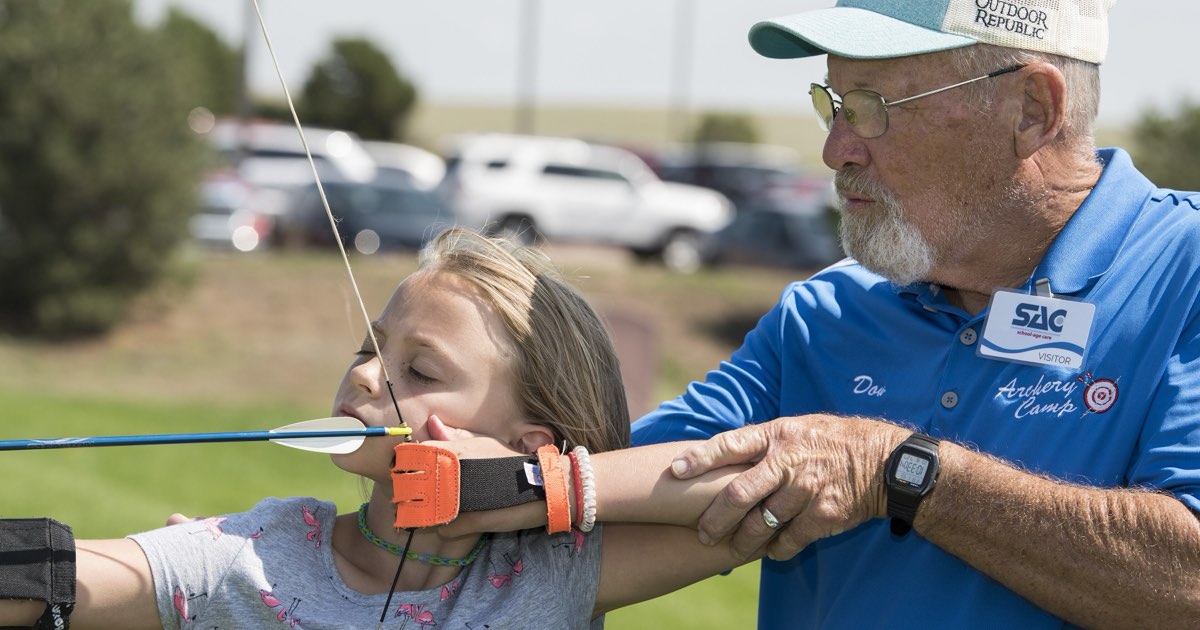
- Listens and follows instructions from an adult who isn't a parent.
- Follows safety rules reliably, even when excited: waiting on the line, never pointing a bow at people, only collecting arrows when told.
- Understands whistle commands or similar signals; our range safety guide explains them.
- Can concentrate for a short session. Scouting America notes young Cubs manage 20 to 30 minutes at most.
- Can draw a light bow smoothly, without straining or lifting it towards the sky.
- Wants to do it. Enthusiasm keeps children safe and attentive.
Under 8? What younger children can do
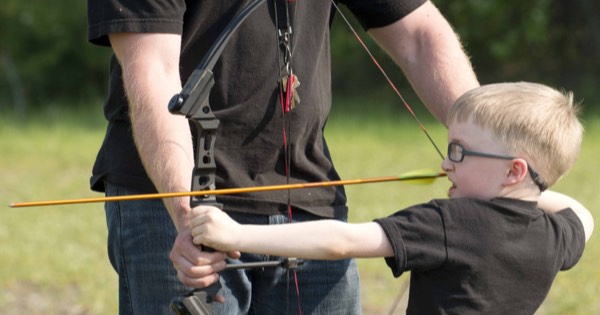
- Toy bows. Archery 360 notes that "toy bows let toddlers and preschoolers feel like they're shooting alongside the family." Our kids bow and arrow sets guide explains toy sets and their safety rules.
- Scouting with an adult partner. Lion and Tiger Cubs can try archery at council-run events with a parent or adult partner.
- Family taster sessions. Some clubs and ranges run family or "come and try" sessions. Archery 360 suggests that "if your child is young or particularly shy, offer encouragement by taking the introductory lesson with them."
- Watching and helping. Helping set up targets and keeping score builds interest and understanding of range rules.
What a first lesson usually involves
A first lesson for a child usually covers:
- A safety briefing: the shooting line, whistle or voice commands, and when it's safe to collect arrows.
- Equipment fitting: a light bow, an arm guard, and checking which eye is dominant.
- The basic shot: stance, nocking an arrow, drawing, anchoring and releasing, often at a large target close by.
- Short ends of a few arrows, with plenty of rest and encouragement.
- Collecting arrows together under the instructor's direction.
Expect lots of praise and little focus on scores at this stage.
A simple path into the sport
- Try a taster session at a club, range, school programme or Scouting event.
- Join a regular programme such as JOAD, 4-H or a school NASP team.
- Get your own equipment once your child is committed, fitted by a shop or coach.
- Try a fun competition, such as a club shoot or a 3D course.
- Keep it fun. Children who enjoy archery keep shooting; pressure drives many away.
Equipment for a first-time child archer
Children need light, properly sized equipment:
- A light draw weight. NASP's Genesis bow is adjustable from 11 to 20 lb (Genesis lists its Original model as 10 to 20 lb), and Genesis also makes a Mini "adjustable from 6-12 pounds." Scouting America recommends Cub Scouts use a "light-draw-weight (15- to 20-pound), 54-inch, take-down, recurve bow."
- A bow that fits. Archery 360 notes that "an archery shop technician will measure your child's draw length and draw weight to match them with a bow." Universal-draw-length bows like the Genesis fit a wide range of children.
- Matched arrows long enough for the child's draw.
- An arm guard and finger protection; see our arm guard and finger tab guide.
- A proper target and backstop.
Our guide to choosing a bow for a child and beginner equipment list cover equipment in detail.
Safety and supervision
Archery has a good safety record when rules are followed. Archery 360, citing the Archery Trade Association, reported "archery's 2017 injury rate as .057 injuries per 1,000 participants." That record depends on supervision and rules:
- Qualified supervision. Programmes set minimum ages for instructors and rangemasters (21 for 4-H instructors, 18 for Scouting rangemasters).
- Short sessions for younger children, who tire quickly.
- Clear range rules, taught from day one.
- Safe equipment: light bows, matched arrows and proper targets.
- Never dry fire a bow; our dry firing guide explains why.
Supporting your child at home
If your child wants to practise between lessons, set up somewhere safe and legal with a proper target, a backstop and clear space behind; our backyard range guide explains how. Supervise every session, keep sessions short, and use the same range rules your child learns at the club. Our practice plan has simple drills that suit young archers.
Where to find lessons
- USA Archery clubs running JOAD or Explore Archery sessions.
- Schools taking part in NASP.
- 4-H clubs with shooting sports programmes.
- Scouting councils running range events.
- Archery shops and ranges, many of which offer beginner lessons and fitting.
Once your child has the basics, our guide to shooting a recurve bow and 3D archery guide show where the sport can go next.
Starting archery around age 8
Advantages
- Matches the starting age of most US youth programmes
- Children can usually follow range rules and draw a light bow
- Programmes provide equipment, coaching and supervision
Trade-offs
- Some keen younger children may have to wait
- Children grow quickly, so equipment needs changing
- Needs regular adult time for practice and transport
You can browse youth recurve bows or youth arm guards on Amazon.
Frequently asked questions
What is the minimum age for archery?
There's no single legal minimum. USA Archery's JOAD and 4-H start at 8; NASP starts at grade 4; Scouting lets younger Cubs take part with an adult partner.
Is 5 too young for archery?
For most organised programmes, yes; 4-H, for example, doesn't allow its 5- to 7-year-old Clovers to take part. Toy bows and Scouting activities with an adult partner are options for younger children.
What is the best age to start archery?
Many programmes start at 8, but the best age is when a child is ready to listen, follow safety rules and draw a light bow.
Is there an age limit for Olympic archery?
We couldn't find a minimum age in World Archery's rulebooks. Its age classes (U15, U18, U21) are defined by upper age. Olympic eligibility rules should be checked with World Archery directly.
Can a 6-year-old use a real bow?
With very light equipment, close adult supervision and a suitable activity (such as a Scouting event with an adult partner), some can. Most programmes start later.
How old do you have to be to buy a bow?
We didn't find a single national rule. Check the shop's policy and your state's laws.
Do girls and boys start archery at the same age?
Yes. The programme age rules above apply to all children, and many clubs run mixed youth sessions.
How long should a child's first archery session be?
Short. Scouting America notes that young Cubs have attention spans of 20 to 30 minutes at most and tire easily. End the session while your child is still enjoying it.
Related articles
 Guides
How to Choose a Bow for a Child: Sizing, Draw Weight and Safety
How to choose a bow for a child: when to start, recurve vs youth compound, draw weight and bow length by size, matched arrows, safety gear and where to learn.
November 19, 2025 · 9 min read
 Gear
Kids Bow and Arrow Sets: Toy vs Real Youth Bows
Kids bow and arrow sets explained: toy sets vs real youth bows, US toy safety rules, eye safety, makers' age ranges and draw weights, and what to look for.
October 30, 2026 · 10 min read
 Guides
Archery Range Safety Rules and Whistle Commands Explained
Archery range safety explained: whistle commands, shooting and waiting lines, collecting arrows safely, equipment checks, and what the Fast call means.
Updated April 10, 2026 · 10 min read