
Archery Practice Plan: 10 Drills and a Weekly Routine
A structured archery practice plan: arrows per session, warm-ups, 10 proven drills from blank bale to pressure games, weekly routines and a practice log.
By Archery Insider Editorial Team
· 7 min read

In this article
Shooting arrows is not the same as practising. Archers who improve fastest are not the ones who shoot the most arrows; they are the ones who shoot every arrow for a reason. A structured session with a warm-up, a focused drill and a scored round will do more in an hour than an afternoon of shooting at whatever looks interesting.
This guide gives you ten drills that coaches use, explains what each one is for, and puts them together into weekly routines for beginners, improving archers and bowhunters.
Principles of good practice
- One focus per session. Pick one step of your shot, such as anchor or follow-through, and make it the theme.
- Start close. New archers do best at 5 to 10 metres, moving back only when arrows group consistently. Moving back too soon trains bad habits because you start fighting for score.
- Stop when form fails. Fatigue shows up as a collapsing anchor, a dropping bow arm or a rushed release. Shooting tired practises those faults.
- Measure. Score at least part of every session at a fixed distance so you can see real progress over weeks.
- Rest between ends. Walk to collect, review, then start the next end fresh.
How many arrows?
| Level | Typical session | Sessions per week |
|---|---|---|
| Complete beginner | 20 to 40 arrows | 2 to 3 |
| After a few months | 40 to 70 arrows | 3 to 4 |
| Competitive club archer | 70 to 150 arrows | 4 to 6 |
These figures are illustrative. Build volume gradually, and reduce it if your shoulders, fingers or form suffer. Elite archers shoot several hundred arrows a day, but only after years of conditioning.

Warm-up (10 minutes)
- Mobility: arm circles, shoulder rolls, gentle neck turns.
- Resistance band: draw a stretch band to your anchor ten times, using the same back-muscle movement as your shot.
- Easy arrows: shoot six to twelve arrows at a blank bale at close range, concentrating on feel rather than placement.
Never warm up by drawing and releasing a bow without an arrow. Dry-firing can break the bow.
The 10 drills
1. Blank bale
What: shoot at a target with no face, from 2 to 5 metres, often with eyes closed at anchor. Why: removes aiming from the shot so you can feel your stance, anchor, back tension and release. How: one arrow at a time, slowly. Ask after each shot whether it felt like your best shots.
2. Form-focus end
What: an end of six arrows at a face, thinking only about one step. Why: grooves a specific part of the shot under normal shooting conditions. How: choose the step before the end ("follow-through: bow arm stays up until the arrow lands") and judge each arrow on that step alone, not on score.
3. Hold and let down
What: draw to anchor, aim for five to ten seconds, then let down without shooting. Why: builds holding strength and teaches that aiming does not have to end in a shot, which protects against target panic. How: five to ten repetitions, with rest. Stop if you shake.
4. Grouping drill
What: shoot every arrow at the same spot, ignoring where the group lands on the face. Why: consistency comes before accuracy. A tight group in the wrong place is fixed with a sight adjustment; a spread group is a form problem. How: shoot six arrows at a small aiming mark, then measure or photograph the group. Track group size over time.
5. Distance ladder
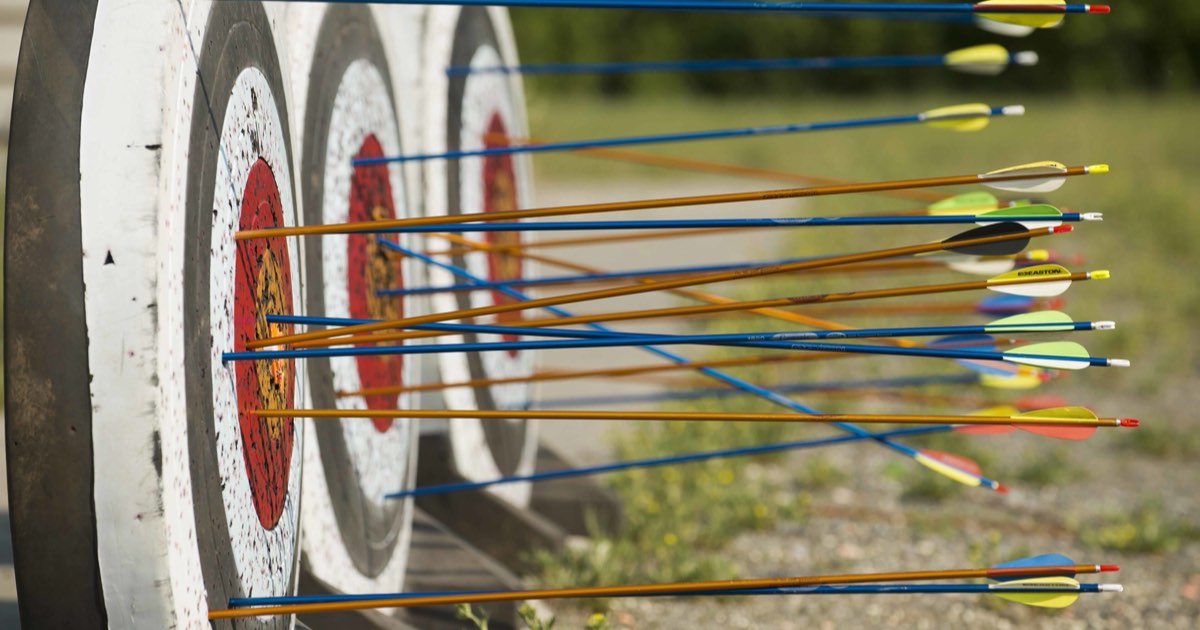
What: shoot an end at increasing distances, for example 10, 15, 20, 25 and 30 metres, then come back in. Why: builds sight marks and exposes form faults that only show at distance. How: record sight marks and group size at each distance.
6. Alternating blank bale and target
What: one arrow at the blank bale, one at the target, repeated. Why: carries the relaxed feeling of blank-bale shooting into aimed shots. Recommended by Archery 360 as a target panic tool, and useful for everyone.
7. Timed ends
What: shoot three arrows in 90 seconds or six in 180 seconds. Why: these are World Archery's competition time limits (30 seconds per arrow). Practising with a clock removes the shock of timing at your first competition. How: use a phone timer. Arrows shot after the buzzer count as misses.
8. One-arrow pressure game
What: shoot a single arrow; it must score above a set value, for example a 9. If it does not, start the count again. Why: simulates competition pressure and shoot-offs. How: aim for a run of five successful arrows. Play against a friend for added pressure.
9. Video review
What: film your shot from behind and from the side. Why: what you feel and what you do are often different. Video shows collapsing, dropping the bow arm and anchor changes clearly. How: film one end each session, compare with a good-shot clip, and focus the next session on the biggest difference.
10. Scored round
What: a standard round at a fixed distance, for example 30 arrows at 18 metres on a 40 cm face. Why: the only reliable measure of progress. How: score properly, as described in our scoring guide, and log the total and the number of 10s.
Weekly routines
Beginner (first three months)
| Day | Session | Arrows |
|---|---|---|
| Session 1 | Warm-up, blank bale (15), form-focus ends at 10 m | 30 to 40 |
| Session 2 | Warm-up, grouping drill at 10 m, short scored round | 30 to 40 |
| Session 3 (optional) | Warm-up, hold-and-let-down, form-focus ends | 20 to 30 |
Improving archer
| Day | Session | Arrows |
|---|---|---|
| Monday | Blank bale, form-focus ends, video review | 50 to 60 |
| Wednesday | Distance ladder, grouping drill | 60 to 70 |
| Friday | Timed ends, one-arrow pressure game | 50 to 60 |
| Weekend | Warm-up and a full scored round | 60 to 80 |
Bowhunter in the build-up to the season
| Day | Session | Arrows |
|---|---|---|
| Daily | One cold first shot at a random distance, from hunting clothes and position | 1 to 3 |
| Twice a week | Distance ladder at hunting distances; shots from kneeling, sitting and elevated positions | 30 to 40 |
| Once a week | Broadhead flight check into a broadhead-rated target | 6 to 12 |

Keep a practice log
A log turns practice into progress. Record, for each session:
| Date | Distance and face | Arrows shot | Focus | Score or group size | Notes |
|---|---|---|---|---|---|
| 4 Oct | 18 m, 40 cm | 45 | Follow-through | 30 arrows: 241 | Bow arm dropped late in the session; stop earlier when tired |
Over a month, patterns appear: the time of day you shoot best, the distance where your form breaks down, the drill that improves your score.
Off the range
- Strength and conditioning. Exercises for the back, shoulders and core support a stable draw. Resistance bands mimic the draw closely.
- Mental rehearsal. Run through your shot routine in your head, step by step. Many coaches recommend this daily.
- Equipment maintenance. Check strings, arrows and fletching weekly so equipment never becomes the variable.
Plateaus
Every archer hits a plateau. When scores stop improving:
- Go back to the blank bale for a week.
- Film your shot and compare it with an earlier video.
- Check your equipment: arrow spine, string wear, draw weight. Our arrow selection guide explains how to check spine.
- Book a coaching session. A fresh pair of eyes often spots in minutes what you have missed for months.
Frequently asked questions
How often should I practise archery?
Two or three sessions a week is a good start for beginners. Short, frequent sessions improve consistency faster than one long session.
How many arrows should a beginner shoot?
Around 20 to 40 well-executed arrows per session to start, building gradually. Stop when your form starts to break down.
Should I practise at long distance?
Only once your groups are consistent at shorter distances. Moving back too soon trains you to fight for score rather than repeat good form.
Is it worth practising without a coach?
Yes, with a plan like the one above and regular video review. Combine it with occasional coaching sessions to check that what you are practising is correct.
Sources
- Blank Bale Training (discussion of methods) – ArcheryTalk
- Quick Tips for Beating Target Panic – Archery 360
- Ultimate Beginners Guide to Archery – Archery 360
- World Archery Rule Change Reduces Shooting Time for Individual Rounds – USA Archery
- Archery Drills & Bow Training Exercises – Legend Archery
Related articles
 Training
Archery Form: 11 Steps to a Consistent Shot
Archery form step by step: stance, hook and grip, set-up, draw, anchor, transfer, aiming, release and follow-through, plus common faults and fixes.
Updated March 21, 2025 · 10 min read
 Training
Target Panic in Archery: Symptoms, Causes and How to Fix It
Target panic explained: symptoms like freezing off target and snap shooting, what causes it, a self-test, and a step-by-step recovery plan for any bow.
February 19, 2025 · 8 min read
 Guides
How Archery Scoring Works: Target Faces, Rings and Match Rules
How archery scoring works: ring values and colours, target face sizes, line cutters, X counts, the recurve set system, compound matches and shoot-offs.
Updated September 14, 2026 · 8 min read