
What Is 3D Archery? Rules, Scoring and How to Start
What 3D archery is, how a 3D shoot works, how ASA, IBO and World Archery score 3D targets, known vs unknown distance, equipment, and how to get started.

By Archery Insider Editorial Team
· 9 min read
In this article
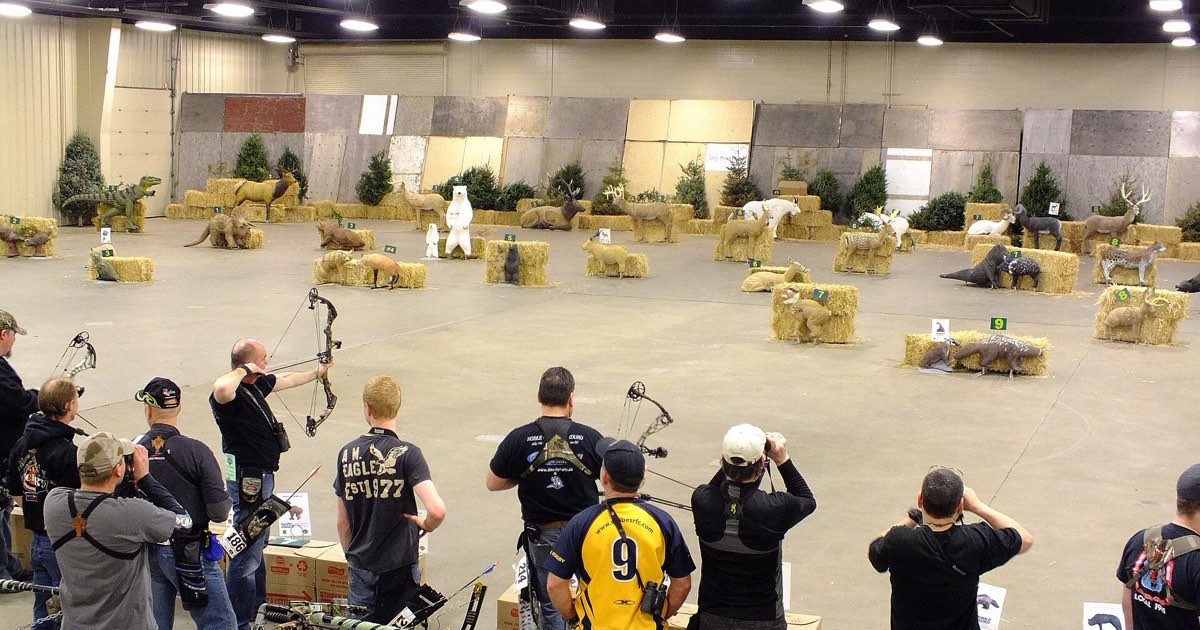
3D archery is the closest thing to hunting that you can do on a range. Instead of round paper faces, you shoot at life-size foam animals placed at different distances along a course, often in woodland. It is hugely popular with bowhunters looking for off-season practice, and it is a competitive sport with its own national and world championships.
This guide explains what 3D archery is, how a shoot works, how the main organisations score it, the difference between known and unknown distance, what equipment you need, and how to get started.
What is 3D archery?
Archery 360 describes it as "a game played by walking a preset course — usually in the woods — and shooting at three-dimensional, foam animal targets at varying distances." Each target has scoring rings moulded or marked over the animal's vital area. You walk the course with a small group, shoot from marked stakes or pegs, then walk to the target to score.
There are two broad versions. In the known game, distances are known; Archery 360 notes that "rangefinders are allowed." In the unknown game, "it's up to the archer to guess the distance." Judging distance is a big part of the challenge, and of the appeal for hunters.
How a 3D shoot works
- Register and choose your class (based on equipment, age and sometimes arrow speed).
- Join a group of archers who will shoot and score together.
- Walk the course. Each target has one or more stakes or pegs marking where each class shoots from.
- Shoot your arrow or arrows from your stake.
- Walk to the target and score together, agreeing each arrow's value.
- Move to the next target until the course is complete; totals decide the placings.
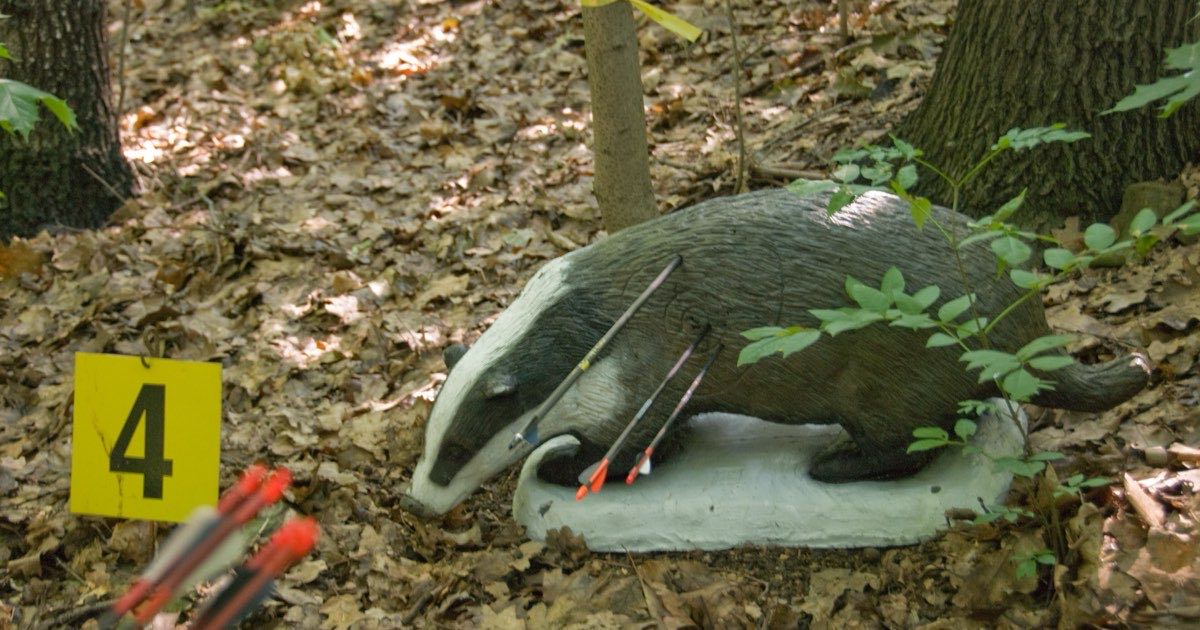
Courses typically have 20 or more targets. World Archery's 3D round, for example, "consists of 24 targets."
3D archery scoring explained
Each organisation uses different ring values. The rings sit over the animal's vital area.
ASA scoring
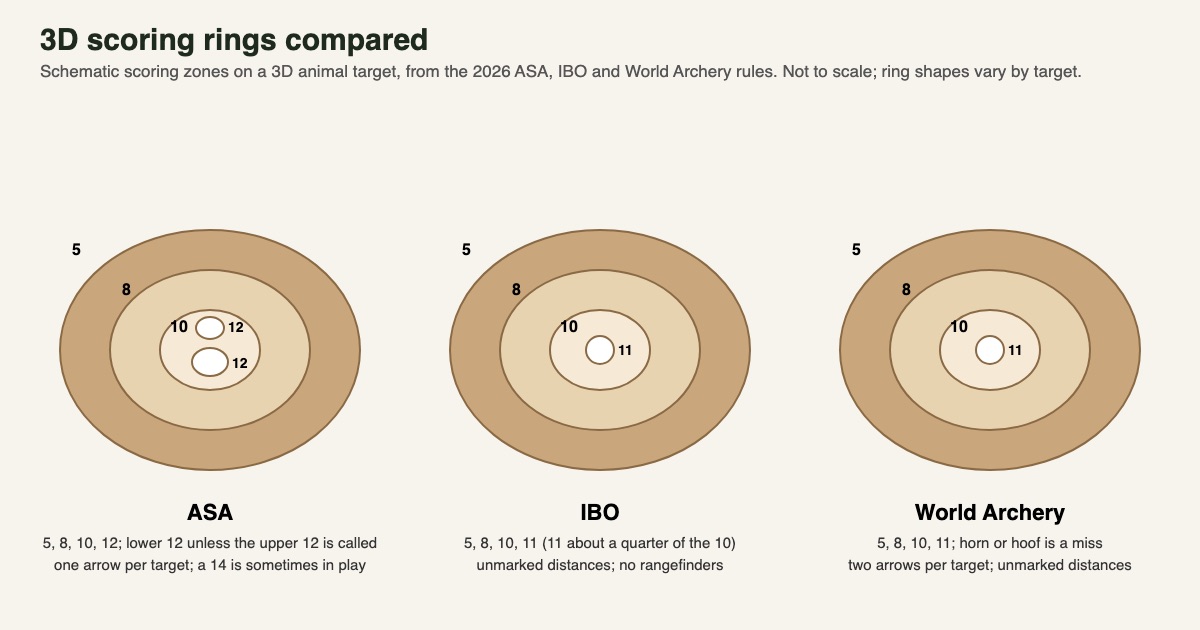
The Archery Shooters Association's 2026 rules say: "Arrows in the corresponding area of the target will be scored with point values of 5, 8, 10, or 12." ASA targets have two 12 rings: "Each target has two (2) 12-rings. At each target the lower 12-ring will be in play initially for all shooters and a shooter may elect to have the upper 12-ring scored by announcing their intention to shoot for it." Archery 360 adds that a 14 ring "isn't always in play, but when it is you must call it to earn the extra points." ASA shooters shoot "only one arrow, per shooter, per target."
IBO scoring
The International Bowhunting Organization's rules list: "11 points: 11 ring or 'X' ring centered inside the 10 ring; 10 points: 10 ring or heart; 8 points: Vital; 5 points: Body; 0 points: Miss." The 11 ring is "approximately twenty five percent (25%) of the size of the 10 ring," and "an arrow shaft touching the line of a greater scoring area shall be given the higher score."
World Archery 3D scoring
World Archery uses scoring zones of 11, 10, 8 and 5, with "11 points for the small circle in the centre of the 10-ring" and "five points for the remaining body colour zone." In 3D, "two arrows per target will be shot in all rounds." Some details differ from US rules: "A hit in the horn or the hoof… counts as a miss," "an arrow ricochet will score a miss," and if archers "cannot agree on the value of the arrow, the arrow will be scored a five."
Comparison table
| ASA | IBO | World Archery | |
|---|---|---|---|
| Ring values | 5, 8, 10, 12 (upper 12 by call); 14 sometimes in play | 5, 8, 10, 11 | 5, 8, 10, 11 |
| Arrows per target | One | Check the event's rules | Two |
| Distances | Known and unknown classes | Unmarked distances | All unmarked |
| Rangefinders | In known classes; spectators can't have them on unknown ranges | Prohibited | Distances are unmarked; check the current rules |
| Maximum distance | Varies by class (e.g. 40 yd for some young adult classes) | By stake colour (Blue about 50 yd down to Neon Pink about 20 yd) | Compound 5–45 m; Barebow and Longbow 5–30 m |
Rules are updated every year, so treat this as a summary of the 2026 rulebooks and check the current rules for any event.
Known vs unknown distance
Known distance means the yardage is marked or you are allowed a rangefinder. The challenge is pure shooting. Unknown distance means you must judge it yourself. IBO's rules say "targets shall be set at unmarked distances," and that "rangefinders and other devices that may be used to calculate yardage to the target are prohibited." World Archery says "a 3D round consists of all unmarked targets." ASA designates each class as known or unknown, and notes that "on any range conducting unknown competition spectators may not have range finders."
For bowhunters, unknown-distance 3D is excellent practice for estimating range. If you use a rangefinder when hunting, our rangefinder guide explains how they work.
Classes and divisions
Each organisation sorts archers into classes, so you compete against people with similar equipment, age and experience.
- ASA classes carry both a maximum yardage and an arrow speed limit. For example, the 2026 class table lists "Young Adult Open Male 40 [yds] 280 [fps] Known" and "Eagle Open Boys Ages 9 – 11 25 230 Known."
- IBO uses coloured stakes for different classes, with approximate maximum distances from Blue (about 50 yards) to Neon Pink (about 20 yards).
- World Archery 3D divisions are Compound, Barebow, Longbow and Traditional. Compounds shoot from red pegs at 5 to 45 metres; barebow and longbow from blue pegs at 5 to 30 metres. Olympic-style recurve is not a 3D division.
3D vs field archery
Field archery is also shot on a walking course, but at paper faces rather than animals. World Archery's Field Round "consists of 24 targets where athletes shoot 3 arrows per target," on faces of 20, 40, 60 and 80 cm, and a field round "may be all marked or all unmarked or a combination." 3D uses animal targets, two arrows per target in World Archery events, and unmarked distances. Our coverage of the 2026 World Field Championships shows the field side of the sport.
What equipment do you need?
Almost any bow can be shot at 3D, but your class determines what's allowed:
- Compound classes cover everything from hunting setups with pins to target bows with scopes and long stabilisers.
- Barebow, traditional and longbow classes limit sights and accessories; our barebow guide and longbow vs recurve comparison explain the styles.
- Arrows: ASA classes have arrow speed limits, so check your setup if you shoot a fast compound.
- Binoculars help you see the rings at distance (check whether they are allowed for your class).
- A rangefinder only where the rules allow it.
- A hip or back quiver, comfortable shoes and water for a long course.
Our beginner equipment list covers the basics, and our sight comparison explains pin options.
How to get started
- Find a local club or 3D shoot. Many clubs run informal shoots open to newcomers.
- Start in a fun or novice class and shoot from the shorter stakes.
- Practise judging distance by guessing yardage on walks, then checking with a rangefinder.
- Practise from awkward positions: uphill, downhill, kneeling and through gaps.
- Learn the scoring and etiquette before your first event: stay behind the shooter, keep quiet while others shoot, and score honestly.
- Check the rules for the organisation you shoot with.
Tips for judging distance
Unknown-distance 3D is as much about judging yardage as shooting. A few common approaches:
- Practise constantly. Guess the distance to objects on walks, then check with a rangefinder. Your guesses improve quickly with feedback.
- Break it into chunks. Picture a distance you know well, such as 10 or 20 yards, and count how many fit between you and the target.
- Use the target's size. 3D animals are roughly life-size, so you can learn how big a deer target looks at 20, 30 and 40 yards. World Archery notes that 3D target sizes "are not standardised," so don't rely on this alone.
- Watch the terrain. Uphill, downhill, dark woods and open fields can all make targets look nearer or further than they are.
- Commit to a number. Hesitating between two distances usually leads to a poor shot.
3D etiquette
- Stand behind the shooter and stay quiet while they shoot.
- Don't discuss distances on unknown courses; it's against the spirit, and often the rules.
- Score together at the target before anyone pulls arrows, and agree each value.
- Look for lost arrows briefly, then let the group behind you through if you need more time.
- Keep the course moving, and be patient with newcomers.
3D targets and real animals
3D targets are realistic, but scoring rings are a scoring system rather than an anatomy lesson. The rings sit over the vital area, which builds the habit of aiming at a small spot behind the shoulder. If you hunt, also learn real shot placement, including angles; our shot placement guide explains where to aim on a real deer. Practising on 3D targets at awkward angles, from kneeling or sitting positions, and at unknown distances is about as close as you can get to a real shot.
World-level 3D
World Archery runs a World 3D Championships. Our coverage of the 2026 World Archery 3D Championships and the 2024 event at Mokrice shows the top level of the sport.
3D archery
Advantages
- Realistic practice for bowhunters
- Open to almost any bow style
- Social: you walk and score in a group
Trade-offs
- Different scoring systems between organisations
- Courses take time and often involve walking
- Class rules (speed limits, rangefinders) need checking
You can browse 3D archery targets or archery binoculars on Amazon.
Frequently asked questions
How is 3D archery scored?
It depends on the organisation. ASA uses 5, 8, 10 and 12 (with an upper 12 by call and sometimes a 14); IBO and World Archery use 5, 8, 10 and 11.
How far are 3D archery targets?
It varies by class. IBO stakes run from about 20 to about 50 yards; World Archery compounds shoot from 5 to 45 metres, barebow and longbow from 5 to 30 metres.
Can you use a rangefinder in 3D archery?
Only in known-distance classes or events that allow it. IBO prohibits rangefinders, and World Archery 3D uses unmarked distances.
Can you shoot 3D with a recurve or longbow?
Yes. Traditional, barebow and longbow classes exist in the main organisations.
What is the difference between ASA and IBO?
They are separate US organisations with different scoring (ASA's 12 and 14 rings vs IBO's 11) and different class rules.
How many arrows do you shoot per target in 3D?
One per target in ASA; two per target in World Archery 3D.
What is the difference between 3D and field archery?
3D uses foam animal targets; field archery uses round paper faces on a walking course with three arrows per target in World Archery events.
Do I need a special bow for 3D archery?
No. Many archers shoot 3D with the same bow they hunt with. Choose a class that matches your equipment, and check any arrow speed or accessory limits in that class.
Related articles
 Guides
How Archery Scoring Works: Target Faces, Rings and Match Rules
How archery scoring works: ring values and colours, target face sizes, line cutters, X counts, the recurve set system, compound matches and shoot-offs.
Updated September 14, 2026 · 8 min read
 News
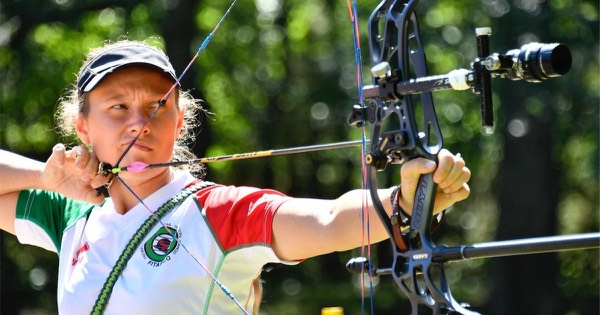
2026 World Archery 3D Championships: Yankton Results
Yankton 2026 World 3D Championships results: David Jackson's third barebow title, wins for Jevsnik and Ama-Cormerais, and France top of the medal table.
October 5, 2026 · 4 min read
 Gear
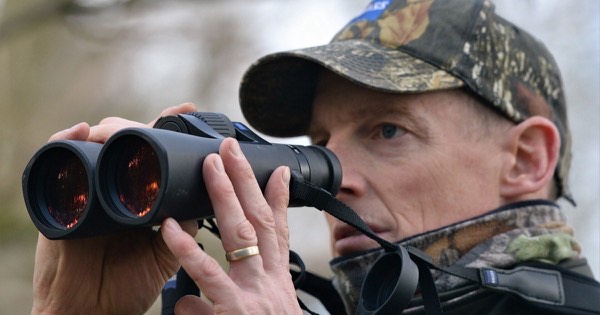
How to Choose a Rangefinder for Bowhunting
How to choose a bowhunting rangefinder: angle compensation, bow modes, scan and target priority, display, magnification, bow-mounted units and field use.
October 11, 2026 · 9 min read