
Kids Bow and Arrow Sets: Toy vs Real Youth Bows
Kids bow and arrow sets explained: toy sets vs real youth bows, US toy safety rules, eye safety, makers' age ranges and draw weights, and what to look for.

By Archery Insider Editorial Team
· 10 min read

In this article
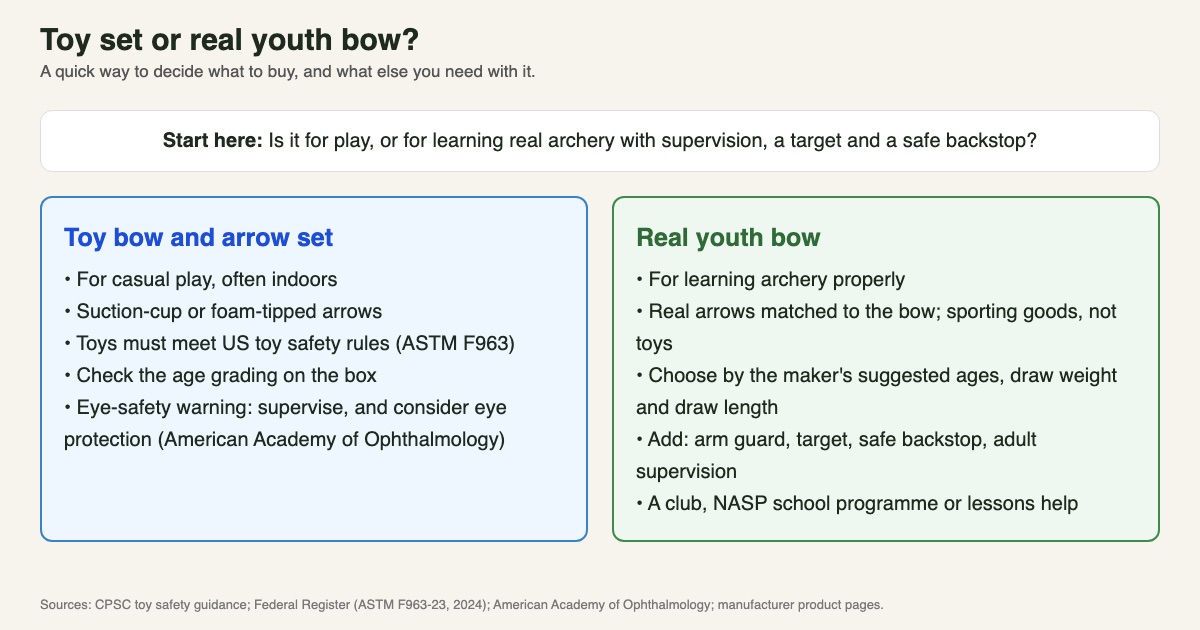
"Kids bow and arrow set" covers two very different things. One is a toy: a plastic bow with suction-cup or foam arrows for play in the garden or living room. The other is a real youth bow: a small, light archery bow that shoots real arrows into a target and teaches the sport properly. Both can make great gifts, but they need different expectations, different safety precautions and different extras.
This guide explains the difference, what US toy safety rules cover, the eye-safety warning about projectile toys, the age ranges and draw weights manufacturers give for real youth bows, what to look for, and how to keep kids safe. For detailed sizing, see our guide to choosing a bow for a child.
Toy bow and arrow sets
Toy sets are designed for play rather than archery. Most use suction-cup or foam-tipped arrows and a soft, low-powered bow, and many come with a stick-on target.
What US toy safety rules cover
The Consumer Product Safety Commission (CPSC) defines a children's toy as "any object designed, manufactured, or marketed as a plaything for children under 14 years of age." Testing and certification rules apply to products "designed or intended primarily for children 12 years of age or younger."
In January 2024 the CPSC allowed "ASTM F963-23, to become the mandatory toy standard," effective 20 April 2024. The CPSC's guidance also says that "certain toys that can fire projectiles must meet certain performance requirements, such as ensuring the projectiles are not small parts or that they cannot exert excessive force when impacting a surface." Small parts are restricted for young children, with warning labels required on some toys.
The CPSC itself doesn't "certify" toys. Manufacturers and importers are responsible for testing and certifying that their toys meet the rules. When buying, choose established sellers, check the age grading on the box and follow it.
Eye safety
The American Academy of Ophthalmology is blunt about projectile toys in general: "They are unsafe and you should think about buying something else." It warns that "even if arrows are foam and plastic, the impact at close range can cause serious eye damage," and advises: "If you do buy them for your children, supervise them while they play." It adds that "everyone, even adults, should wear eye protection to block flying objects from entering their eyes." This guidance dates from 2020 but remains sensible.
Who toy sets suit
Toy sets suit young children who want to play at archery, indoors or in the garden, with an adult nearby. They don't teach real archery form, and they aren't designed to send real arrows into a target.
Real youth bows and starter sets
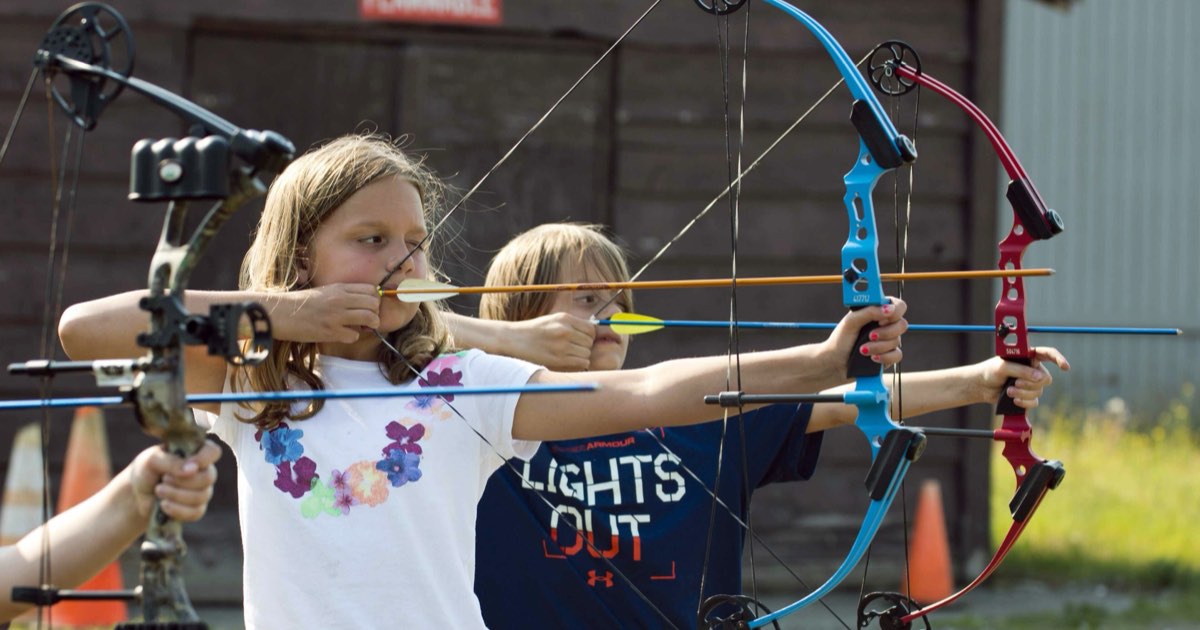
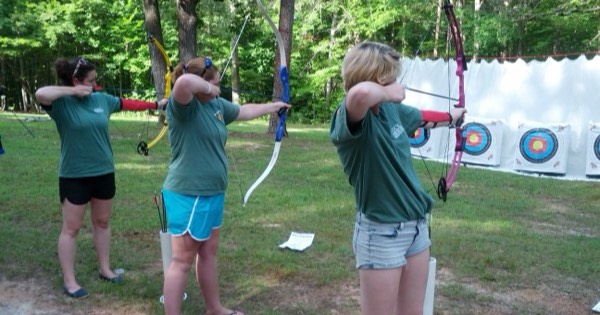
A real youth bow is a scaled-down archery bow: light draw weight, short draw length and real arrows. It is sporting equipment, generally treated as sporting goods rather than a toy. That means the toy rules above don't define how safe it is to use. Safe use depends on the right setup, supervision and a proper shooting area.
Manufacturer age guidance
Manufacturers give suggested age ranges with their youth bows. Bear Archery's product pages are a useful example:
| Bear model | Suggested ages | Draw weight | Draw length |
|---|---|---|---|
| Valiant | Four to seven | Up to 16.5 lb | Up to 18 in |
| Apprentice | Four to seven | Up to 13.5 lb | Up to 24 in |
| Spark (compound) | Five to ten | Up to 10 lb | Up to 25 in |
| Brave (compound) | Eight to twelve | 25 lb peak | Up to 19.5 in |
| Flash | Eleven to fourteen | Up to 18 lb | Up to 24 in |
| Raider | Kids moving into their early teens | 29 lb peak | Up to 26 in |
Bear describes the Raider as a "transition bow… for kids moving from childhood into their early teens." These are the maker's figures; check the current product page before buying, as models change.
Genesis bows, used in school archery programmes, are another example. Genesis lists its Mini as "adjustable from 6-12 pounds," the Original as "adjustable from 10-20 pounds" and the Gen-X as "adjustable from 25-40 pounds." It says "the Genesis Original (10-20 lb model) is the only bow that is allowed" in NASP, the National Archery in the Schools Program. Genesis says which model suits a child "depends on the size and stature of the archer," rather than giving ages.
For older children who are growing quickly, an adjustable compound can last for years; our Bear Cruzer G3 review explains one grow-with-you option.
What's in a starter set, and what's missing
Bear's youth sets ship with items such as "two Safetyglass arrows," finger rollers and an arrow rest, with some including a sight and the Raider a four-arrow quiver. What starter sets usually don't include:
- A proper target and backstop.
- An arm guard (and sometimes finger protection).
- Extra arrows, which get lost or broken quickly.
- A safe place to shoot.
What to look for in a youth bow
- Suggested age and size: use the maker's guidance, but fit the child, not the birthday.
- Draw weight: light enough for the child to draw smoothly and hold without straining.
- Draw length: the bow's range should cover the child's draw length; our child bow guide explains how to measure it.
- Matched arrows: arrows that are long enough and suitable for the bow's draw weight.
- Right or left hand: match the child's dominant hand and eye.
- Finger protection and an arm guard: see our arm guard and finger tab guide.
When to move from a toy to a real bow
There's no fixed age, but signs a child may be ready for a real youth bow include:
- They keep asking to do archery, long after the novelty of a toy set has worn off.
- They follow safety rules reliably, even when excited.
- They can listen to instructions and wait their turn on a shooting line.
- They're big and strong enough to draw the smallest youth bows smoothly.
- There's somewhere safe to shoot and an adult available every time.
A beginner session at a club or range is a good way to find out before buying.
How long will a youth bow last?
Children grow quickly, so a bow that fits today may be too small in a year or two. Bear's line-up, for example, steps from models suggested for ages four to seven up to bows for the early teens. Ways to get more use from a bow:
- Choose adjustable models with wide draw-length and draw-weight ranges.
- Buy for now, not for growth. A bow that's too big or heavy now teaches bad habits.
- Consider takedown recurves, where limbs can be swapped for heavier ones as the child grows.
- Pass bows down to younger siblings, or trade in at a shop.
What affects the cost
We don't quote prices, but the main factors are:
- Toy vs real bow: toy sets are usually much cheaper.
- Adjustability: wide-range compounds cost more but last longer.
- What's included: arrows, sight, quiver, rest and target.
- Arrow quality: better arrows last longer and fly more consistently.
- Extras you'll need anyway: a target, arm guard and spare arrows.
Common buying mistakes
- Buying a bow that's too heavy "to grow into."
- Skipping the target and backstop, leaving nowhere safe to shoot.
- Buying a real bow for a child who won't be supervised.
- Ignoring draw length, so arrows are too short or the bow doesn't fit.
- Forgetting spare arrows, which disappear quickly.
- Treating a toy set as a training tool or a real bow as a toy.
Arrows for youth bows
Arrows matter as much as the bow. They need to be long enough for the child's draw length, so the point always stays in front of the rest at full draw, and suitable for the bow's light draw weight. Arrows that come with youth sets are made to suit those bows; when buying replacements, match the length and type, or ask an archery shop. Never let a child shoot arrows that are too short for them. Our arrow guide explains length and spine.
Safety and supervision
Real youth bows shoot real arrows, so treat them as real archery equipment:
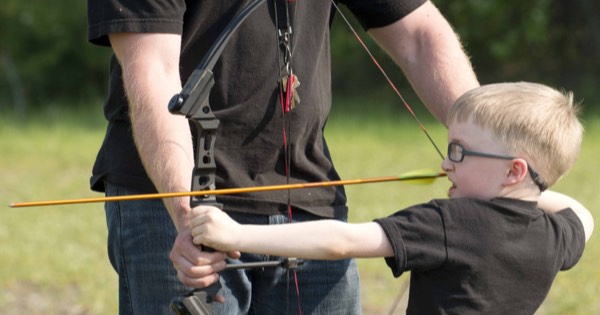
- Always supervise children shooting real bows.
- Shoot only at a proper target with a safe backstop and clear space behind; see our backyard range guide.
- Teach range rules from day one: never point a bow at a person, only nock an arrow on the shooting line, and only retrieve arrows when everyone has finished. Our range safety guide explains the whistle commands clubs use.
- Never dry fire a bow (release the string without an arrow); our dry firing guide explains why.
- Store bows and arrows out of reach when not in use.
For toy sets, follow the age grading, supervise, and consider eye protection, as the AAO advises.
Targets for kids' sets
- Toy sets: most suction-cup arrows need a smooth surface or the target supplied with the set.
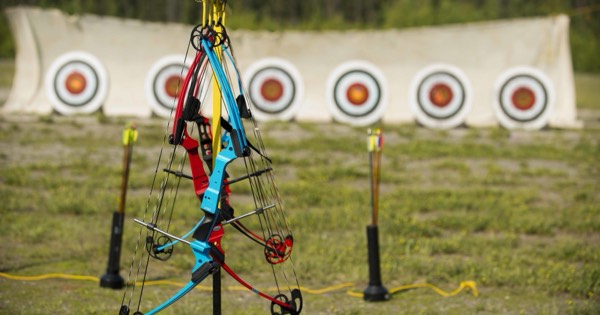
- Real youth bows: use a foam block or bag target designed for the arrows and draw weight, with a backstop behind. Our target review compares two popular backyard targets, and our guide on leaving targets outside covers weather.
Gift checklist
- Play or learning? Choose a toy set for play, a real youth bow for learning archery.
- Age and size: check the maker's suggested ages and the child's draw length.
- Supervision: will an adult be there every time a real bow is used?
- Somewhere safe to shoot: a club, range or safe backyard setup.
- Extras: target, arm guard, spare arrows and eye protection for toy sets.
- Lessons: a beginner session or club membership makes a great addition.
Where kids can learn
Many children start archery at school through NASP, which uses Genesis bows, or at local clubs, Scouts and youth programmes. Lessons teach safety and good habits from the start; our practice plan offers simple drills, and our archery exercises guide includes USA Archery's advice that under-11s do strength holds with a stretch band.
Real youth bows vs toy sets
Advantages
- Real youth bows teach proper archery skills
- Toy sets are simple, cheap fun for young children
- Both can spark a lifelong interest
Trade-offs
- Real bows need a target, backstop and supervision
- Toy projectiles still carry eye-injury risk
- Children outgrow small bows quickly
You can browse youth archery bow sets or suction-cup toy sets on Amazon.
Frequently asked questions
What age is a kids bow and arrow set for?
Toy sets carry an age grading on the box. Real youth bows have maker-suggested ages; Bear's smallest models are suggested for ages four to seven.
Are toy bow and arrow sets safe?
Toys must meet the US toy standard, but the American Academy of Ophthalmology warns that projectile toys can still injure eyes. Supervise and consider eye protection.
What's the difference between a toy bow and a youth bow?
A toy is designed for play, usually with suction-cup or foam arrows. A youth bow is real archery equipment that shoots real arrows into a target.
What draw weight should a child's bow have?
Light enough to draw and hold without strain. Our child bow guide explains how to choose.
Do kids need an arm guard?
With real youth bows, yes; it protects the forearm from the string.
Can you use a kids' bow in the backyard?
Only with a proper target, a safe backstop, clear space and supervision, and where local rules allow it.
Are suction-cup arrows safe for toddlers?
Follow the age grading on the box and supervise closely. The AAO warns that even soft projectiles can damage eyes at close range.
Is a compound or recurve better for a child?
Both work. Light recurves are simple and teach good form; adjustable youth compounds can grow with the child. Our child bow guide compares them.
Related articles
 Guides
How to Choose a Bow for a Child: Sizing, Draw Weight and Safety
How to choose a bow for a child: when to start, recurve vs youth compound, draw weight and bow length by size, matched arrows, safety gear and where to learn.
November 19, 2025 · 9 min read
 Reviews
Bear Cruzer G3 Review: The Grow-With-You Compound Bow Explained
Research-based Bear Cruzer G3 review: 14–30 in draw, up to 70 lb, 75% let-off. Published specs, who it suits, and how it compares with the Diamond Infinite 305.
Updated July 10, 2025 · 4 min read
 Guides
How to Set Up a Safe Backyard Archery Range
How to set up a safe backyard archery range: legal checks, safe buffer distances, backstops and netting, choosing a target, layout and house rules.
April 8, 2026 · 8 min read