
IBO Speed vs Real Arrow Speed: What to Expect
What IBO and ATA bow speed ratings mean, why your arrows are slower, rules of thumb for estimating real speed, chronographs, and why speed isn't everything.

By Archery Insider Editorial Team
· 9 min read
In this article
Every compound bow's spec sheet lists a speed, usually somewhere in the 300s, labelled "IBO" or "ATA." Then you shoot the bow through a chronograph and get a number that is often 50 or 60 feet per second lower. That isn't a fault or a trick: it's because the rating is measured under a standard setup that few hunters actually use.
This guide explains what IBO and ATA speed ratings mean, why your arrows are slower, how to estimate your real speed, how to measure it, and why speed isn't the only thing that matters.
What IBO speed is
There is no single official document online that sets out how manufacturers test bows for IBO speed, and published definitions don't all agree. The most consistently reported version is Sunrise Archery's: "IBO Speed Rating = 70#s – 30 inch draw – 350 grain arrow." Sunrise adds: "Most archers will never actually get this performance out of their bow, but it serves as a reference point."
Grand View Outdoors describes IBO speed as "measured with a 30-inch draw length and an arrow weighing 5 grains per pound of draw weight; otherwise, exactly equivalent to ATA." Five grains per pound at 70 lb is 350 grains, so the two descriptions match.
ATA speed
The ATA (Archery Trade Association) speed standard uses the same headline numbers with stricter conditions. Archery 360 describes it as "70-pound draw weight (+/- .2 pounds), 30-inch draw length, and 350-grain arrow." Grand View adds that for ATA testing "the bowstring is bare — no peep sight or silencers."
Brands label differently
Bow makers don't all use the same label. On the pages we checked in October 2026, Hoyt's Carbon RX-10 is listed at "342 FPS (ATA)," while Mathews lists its ARC 30 with an "IBO Rating: Up to 348 FPS." When comparing bows, note which rating is used. Our 2026 compound launches article covers these bows.
IBO speed limits in competition
The International Bowhunting Organization's competition rules set speed limits for some classes, including 300 fps for Pro and Semi-Pro classes and 260 fps for Youth Hunter, with "a 3% variance for chronograph accuracy." These limits apply to IBO competitions; they are not how manufacturer ratings are produced.
Why your bow is slower than its rating
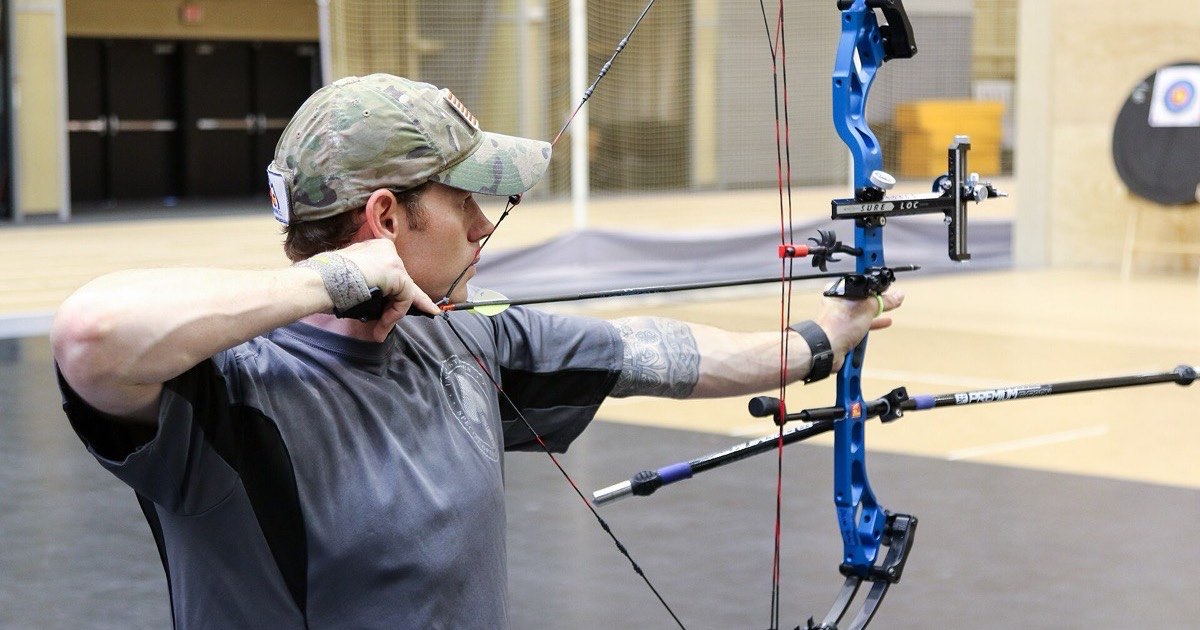
Most hunters shoot less draw weight, a shorter draw and a heavier arrow than the rating setup, and add accessories to the string. Each takes speed away.
Grand View walks through an example. Starting from a rating, a 29-inch draw brings the bow to "325 to 330 fps"; adding silencers and a peep, "315 to 320 fps"; 60 lb, "300 to 310 fps"; and a 400-grain arrow, "likely in the 280- to 290-fps range." Archery 360 says hunting setups typically shoot "270 to 285 fps," against advertised speeds of "350 fps or higher."
Rules of thumb for estimating your speed
Outdoor Life measured the effect of each change in a chronograph test. These are results from one test, so treat them as approximate:
| Change | Measured effect (Outdoor Life) |
|---|---|
| Draw weight | About 2.25 fps per pound ("I increased draw weight by 4.9 pounds and speed by 11.5 fps") |
| Draw length | 8.8 to 10.3 fps per inch, depending on where in the module's range |
| Arrow weight | "About 1 fps lost for every 3 grains added" |
String accessories (peep, D-loop, silencers, speed nocks) also cost a little speed, by amounts that vary.
Worked example: from spec sheet to your speed
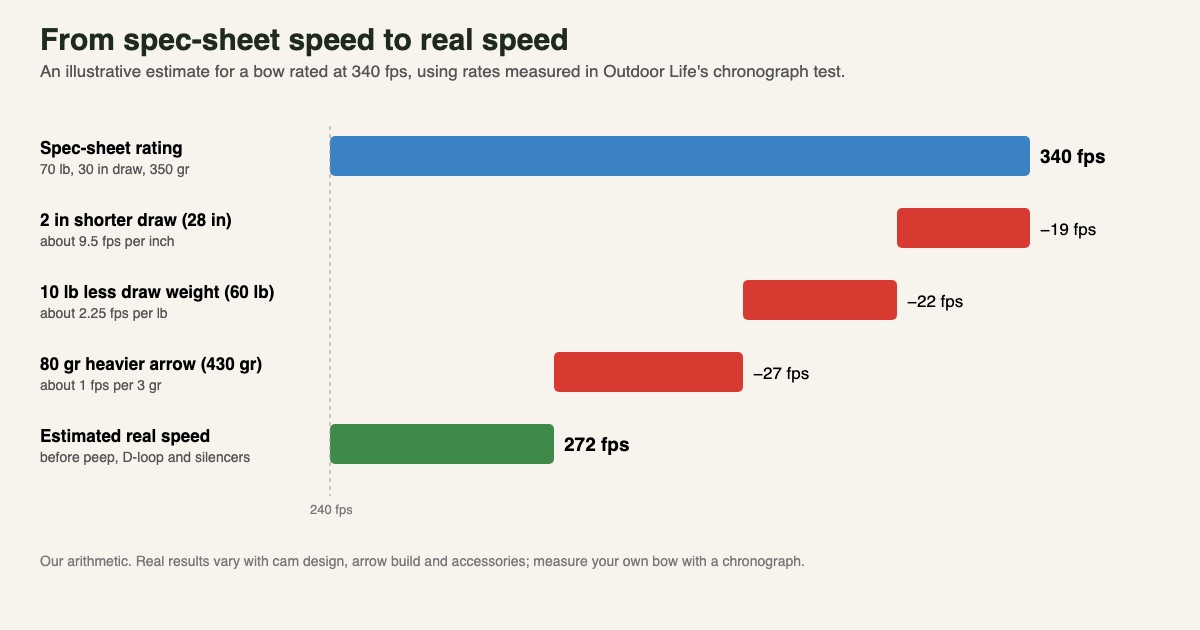
The featured chart above shows our illustrative estimate for a bow rated at 340 fps, using the Outdoor Life rates:
- Rating: 340 fps at 70 lb, 30 inches and 350 grains.
- 2 inches shorter draw (28 in): about 9.5 fps per inch, minus about 19 fps.
- 10 lb less (60 lb): about 2.25 fps per pound, minus about 22 fps.
- 80 grains heavier arrow (430 gr): about 1 fps per 3 grains, minus about 27 fps.
- Estimate: about 272 fps, before string accessories.
Sunrise Archery gives a similar example: a bow rated at 330 fps IBO, shot at 60 lb, 28 inches and with a 400-grain arrow, gives roughly 275 fps.
Where most speed is lost
For most hunters, three settings account for nearly all the gap between the rating and real speed:
- Draw length. Few archers have a 30-inch draw. Every inch shorter costs roughly 9 to 10 fps by Outdoor Life's measurements, so a 27-inch draw starts close to 30 fps behind the rating.
- Draw weight. Many hunters shoot 60 to 65 lb rather than 70 for comfort and control, losing roughly 11 to 22 fps.
- Arrow weight. Typical hunting arrows of 400 to 450 grains weigh 50 to 100 grains more than the rating arrow, costing roughly 17 to 33 fps.
Our draw length guide explains why draw length should be set for fit, not speed.
Measuring real speed with a chronograph
A chronograph measures arrow speed as it passes through two sensors. To get a reliable reading:
- Set up safely, with a large target behind the chronograph and the chronograph a short distance in front of you, as its maker recommends.
- Use your hunting arrow, with the broadhead or matching field point.
- Shoot through the middle of the sensors, level, without hitting the unit.
- Shoot several arrows and average the readings.
- Record the result with your draw weight, draw length and arrow weight.
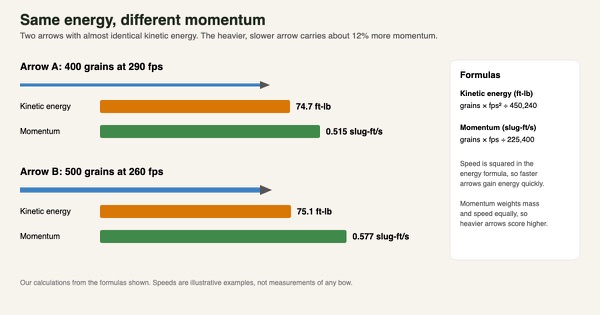
Sunrise notes that a chronograph reading is "initial velocity within a foot or two of the chronograph." That's the number to use in energy and momentum calculations; see our kinetic energy and momentum guide.
Speed loss downrange
Arrows slow down as they fly. Sunrise says: "Your arrow will lose additional speed and Kinetic Energy as it travels down range." Outdoor Life measured how much more slower arrows drop: with a 20-yard sight setting, the drop to 50 yards was 35 inches for a 264 fps arrow, 30 inches at 273 fps and 26 inches at 282 fps. It concluded that "arrow speed can provide a noticeably flatter trajectory once you get about a 10 fps or more increase."
Why speed isn't everything
Faster arrows shoot flatter, which helps when you misjudge distance. But speed comes at a cost:
- Lighter arrows carry less momentum; see our arrow weight guide.
- Higher draw weights can be harder to draw smoothly, especially when cold or seated.
- Fast, aggressive cams are often described as harsher to draw and less forgiving.
- Broadhead flight can be harder to tune at very high speeds; see field points vs broadheads.
- Arrow balance matters too; our FOC guide explains why.
Accuracy and shot placement matter more than a few extra feet per second.
Choosing a bow when speed matters
If you want a faster setup, these approaches keep the trade-offs sensible:
- Compare like with like: IBO with IBO, ATA with ATA, and similar brace heights and axle-to-axle lengths. Our brace height guide explains how brace height relates to speed.
- Shoot before you buy. A bow that is a few fps slower but smoother to draw and quieter may suit you better.
- Keep a sensible arrow weight, well above 5 grains per pound.
- Set draw length for fit, never longer to gain speed.
- Measure the result with a chronograph once the bow is set up.
A note on crossbow speeds
Crossbows are rated differently, usually with the maker's recommended bolt, and IBO's competition rules cap crossbow bolts at 350 fps. Don't compare crossbow and vertical-bow speeds directly; our crossbow vs compound comparison explains the differences.
What speed do you need for deer or elk?
There's no magic number. State hunting rules, where they exist, set things like minimum draw weight or broadhead size, not arrow speed. A well-placed, sharp broadhead from a properly tuned arrow is what matters. goHUNT, for example, suggests deer arrows of 410–460 grains at 285–315 fps and elk arrows of 440–500 grains at 275–300 fps, ranges that many well-set-up hunting bows reach. Our draw weight vs draw length guide explains how those two settings drive speed.
Common mistakes
- Comparing an IBO rating with an ATA rating as if they were the same.
- Expecting the spec-sheet speed from a hunting setup.
- Using the rating in energy calculations instead of a chronograph reading.
- Chasing speed with arrows under 5 grains per pound, which is below manufacturers' minimum.
- Choosing draw weight for speed rather than for what you can shoot well.
Speed ratings on spec sheets
Advantages
- A standard way to compare bows
- Shows the relative efficiency of cam systems
- Useful as a starting point for estimates
Trade-offs
- Few hunters shoot the test setup
- Labels (IBO vs ATA) differ between brands
- Says nothing about forgiveness, noise or feel
You can browse archery chronographs or arrow speed chronographs on Amazon.
Frequently asked questions
What does IBO speed mean?
A standard speed rating, commonly described as measured at 70 lb, a 30-inch draw and a 350-grain arrow.
How is IBO speed measured?
By shooting a bow set to the standard draw weight and length with a standard arrow through a chronograph. Exact test details vary and aren't published in one official document.
Is ATA speed the same as IBO?
They use the same headline numbers, but ATA testing is reported to have tighter tolerances and a bare string. Brands label their ratings differently.
How much speed do I lose per inch of draw length?
Outdoor Life measured 8.8 to 10.3 fps per inch in its test.
How can I calculate arrow speed without a chronograph?
Start from the rating and subtract using rules of thumb (about 2.25 fps per pound, about 9–10 fps per inch, about 1 fps per 3 grains). It's only an estimate.
What arrow speed do I need for deer?
No legal or official minimum exists. Accuracy, arrow weight and broadhead choice matter more.
Does a peep or D-loop slow the bow?
Yes, slightly. Grand View's example shows string accessories costing several fps.
Why are hunting bows so much slower than their ratings?
Hunters usually shoot shorter draws, lower draw weights and heavier arrows than the rating setup, and add peeps, D-loops and silencers.
Do arrows slow down after leaving the bow?
Yes. Sunrise Archery notes that arrows lose speed and energy downrange, and Outdoor Life measured slower arrows dropping more by 50 yards.
Is a faster bow more accurate?
Not by itself. A faster arrow shoots flatter, which helps when you misjudge distance, but accuracy depends on form, tuning and how well you can draw and hold the bow.
Related articles
 Guides
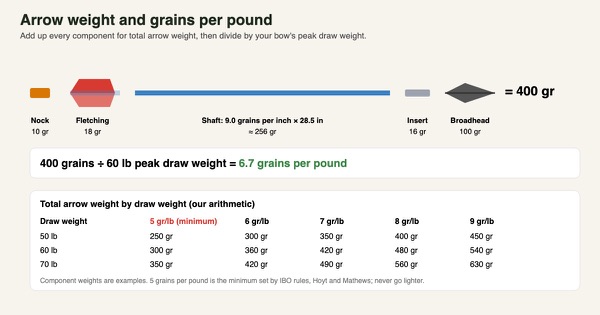
Arrow Weight for Hunting: Grains per Pound Explained
Arrow weight for hunting explained: what grains per pound means, the 5 GPP minimum, a weight table by draw weight, light vs heavy arrows, and starting points.
October 27, 2026 · 10 min read
 Guides
Arrow Kinetic Energy and Momentum Explained
How to calculate arrow kinetic energy and momentum, where the formula constants come from, worked examples, energy guidelines for game, and what they miss.
October 26, 2026 · 9 min read
 Guides
Draw Weight vs Draw Length Explained
Draw weight vs draw length explained: what each means, how they are measured (ATA standard), how they interact on recurves and compounds, and how to set both.
October 15, 2026 · 10 min read