
Archery Exercises: Muscles Used, Workouts and Calories
Is archery good exercise? Calories burned, the muscles archery works, archery exercises like SPT holds and band draws, a sample routine, and injury tips.

By Archery Insider Editorial Team
· 9 min read
In this article
Archery looks calm, but drawing and holding a bow dozens of times a session is real physical work, especially for the back and shoulders. Getting stronger helps you hold steadier, shoot longer sessions and move up in draw weight safely. And yes, archery counts as exercise.
This guide covers how much energy archery uses, which muscles it works, archery-specific exercises, general strength work, a sample weekly routine, advice for young archers, and how to look after your shoulders and elbows.
Does archery count as exercise?
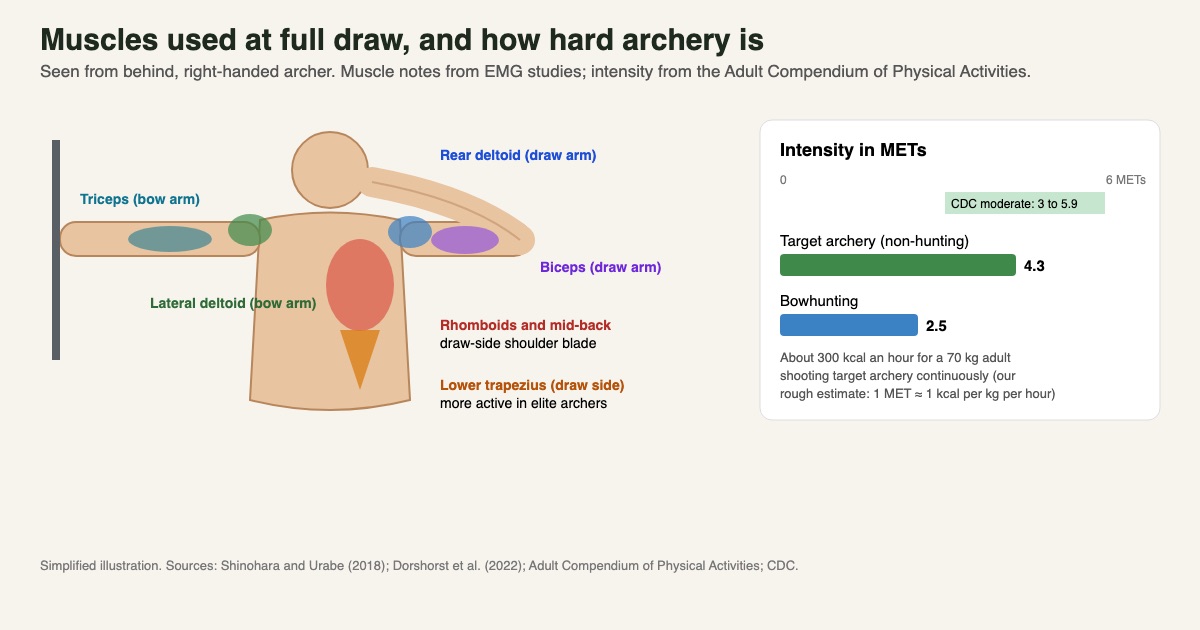
Yes. Exercise scientists rate activities in METs (metabolic equivalents), where 1 MET is your energy use at rest. The Adult Compendium of Physical Activities lists "Archery (non-hunting)" at 4.3 METs and "Hunting, bow and arrow or crossbow" at 2.5 METs. The CDC says "physical activity that burns 3 to 5.9 METs is moderate intensity," so target archery counts as moderate activity.
How many calories does archery burn?
The Compendium uses the conversion "1 MET = 1 kcal/kg/hr." Our arithmetic: a 70 kg person shooting target archery at 4.3 METs uses roughly 4.3 × 70 ≈ 300 kcal per hour. This is a gross estimate that includes the energy you'd use at rest, and the Compendium notes that standard METs do "not correct the MET levels for age, body mass, and sex." Real sessions also include standing, waiting and walking to the target, so treat it as a ballpark figure.
The CDC recommends that adults get "150 minutes of moderate-intensity physical activity a week" and "at least 2 days of muscle-strengthening activity each week." Archery can contribute to the first, and the exercises below help with the second.
What muscles does archery work?
Archery uses the two arms differently. The bow arm pushes and holds the bow steady; the draw arm pulls the string and holds it at anchor.

Two studies using electromyography (EMG), which measures muscle activity:
- Shinohara and Urabe (2018) compared elite, pre-elite and beginner archers. Elite archers showed significantly more activity in the lower trapezius and less in the biceps and triceps. The authors concluded that "the lower trapezius muscle of the draw arm is actively involved in scapular fixation during shooting." In other words, skilled archers hold with their back, not their arms.
- Dorshorst and colleagues (2022) found higher biceps activity in the draw arm, and higher lateral deltoid and triceps activity in the bow arm.
Together, these support what coaches teach: a good shot uses the muscles around the shoulder blades on the draw side, with the bow arm stable and strong.
Why strength and endurance help archers
- Steadier holding. Stronger, less tired muscles shake less at full draw.
- Longer sessions without form breaking down.
- Safer progression to higher draw weights; see our draw weight vs draw length guide.
- Better posture and shoulder control, which supports good form; see our 11 steps of archery form.
Walking adds up
A day on a 3D or field course involves a lot of walking between targets, often over hills and rough ground, on top of the shooting itself. Our 3D archery guide explains how a course works. For hunters, scouting, hanging stands and long walks to and from the stand add plenty of activity too.
Archery-specific exercises
SPT holds (specific physical training)
USA Archery describes the SPT drill: "The archer will brace the bow for 10 to 30 seconds. The archer will rest for 40-60 seconds and repeat." Key rules:
- Never dry fire. USA Archery says "not to dry fire the bow during this drill." Our dry firing guide explains why.
- Use an arrow and a target if you hold a real bow. Archery 360 says: "if you do SPT with a bow, stand in front of a target with an arrow loaded."
- Compound archers: USA Archery says not to repeatedly let down or draw without an arrow.
- Young archers: "For archers under the age of 11, we recommend doing this with just a stretch band."
Archery 360 gives a version that holds for a "minimum of 15 seconds and a maximum of 30 seconds. You then rest double what you held."
Band draws
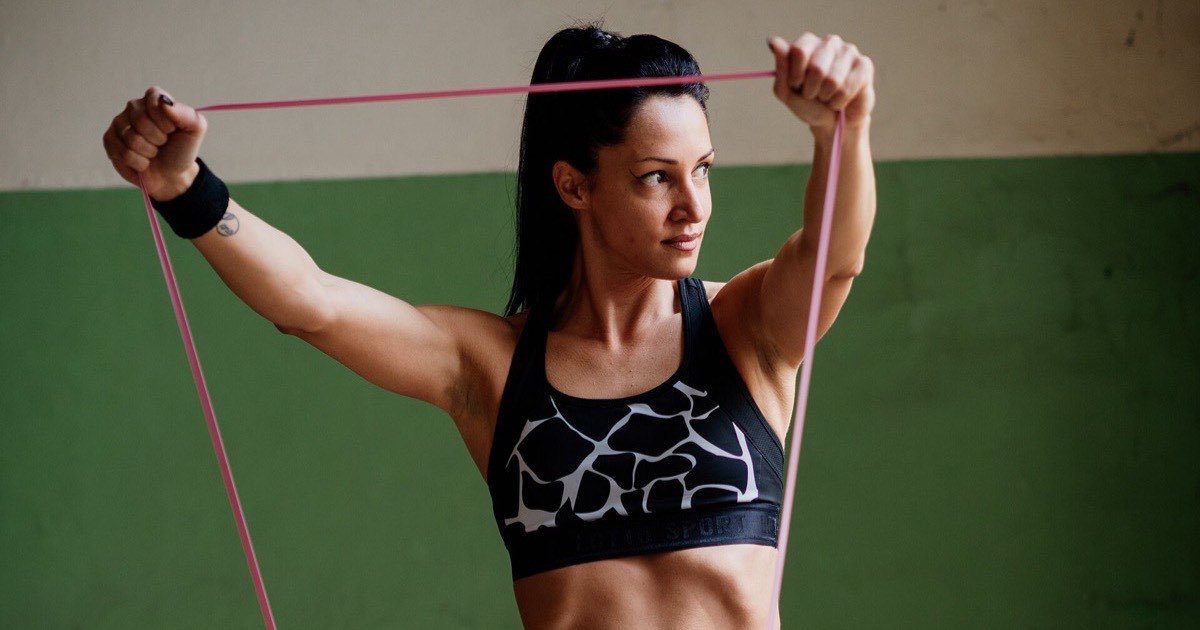
A resistance band or bow trainer lets you rehearse the draw and hold without a bow or arrow. Hold the band in your bow hand, draw it to your anchor with good form, hold for a few seconds, and return slowly. It's ideal at home and for warming up.
Band pull-aparts and rear-shoulder work
General band exercises that pull the shoulder blades together, such as pull-aparts and rear-delt flyes, train the upper-back muscles that archers rely on. Keep the movement slow and controlled.
Bow-arm holding
The bow arm has to stay still while the draw arm works. A simple drill is to hold your bow (or a band anchored at bow-arm height) at shooting position, with the shoulder low and the arm extended but not locked, for 10 to 20 seconds at a time. Focus on keeping the bow shoulder down rather than shrugging it up, a common fault when archers tire.
General strength and core
Archery 360's living-room routine includes:
- Plank: hold "1 minute or as long as possible," rest 60 seconds, then repeat once or twice.
- Romanian deadlift: 8 to 12 repetitions, for the back of the legs and lower back that support your stance.
A strong core and legs keep your stance stable, especially over long sessions or on uneven ground when hunting.
A sample weekly routine
This is an example, not a prescription. Adjust it to your fitness and goals, and get advice if you have any health concerns.
| Day | Session |
|---|---|
| Monday | Shooting practice, then 3–5 SPT holds |
| Tuesday | Strength: band pull-aparts, rear-delt flyes, plank, Romanian deadlifts |
| Wednesday | Rest or a walk |
| Thursday | Shooting practice, then band draws |
| Friday | Strength: as Tuesday |
| Saturday | Longer shooting session or a 3D course |
| Sunday | Rest |
This includes the CDC's recommended two strength days. Our practice plan covers the shooting side in more detail.
Progressing your draw weight
If you want to shoot a heavier bow, go slowly:
- Shoot your current weight well for full sessions without your form breaking down.
- Add SPT holds and strength work for several weeks.
- Increase in small steps, such as a couple of pounds on a compound's limb bolts or the next limb weight on a takedown recurve.
- Watch for warning signs: shaking, lifting the bow skyward to draw it, a shrinking anchor, or soreness that lasts into the next day.
- Step back down if form suffers. There's no prize for a draw weight you can't control.
Common training mistakes
- Doing too much too soon, in shooting volume or strength work.
- Training only the draw arm and neglecting the bow arm, core and legs.
- Holding at full draw until shaking in every set, rather than stopping while form is good.
- Dry firing during holds, which can damage the bow.
- Skipping rest days, which muscles and tendons need to adapt.
- Ignoring pain instead of getting it checked.
Training for bowhunting
Hunting asks for a slightly different kind of fitness from target archery. You may have to draw slowly and quietly from a seated position, hold at full draw while an animal steps clear, and shoot after a long walk or climb. Useful additions to your routine:
- Seated draws and holds with a band, or with your bow, an arrow and a target.
- Longer holds of up to 20 or 30 seconds, within USA Archery's SPT range.
- Shooting when your heart rate is up, after a short brisk walk.
- Leg and core work for climbing, carrying a pack and staying stable on uneven ground.
Our elk setup guide covers practice for steep country, and our late-season guide covers drawing in the cold.
Exercises for young archers
Children and teenagers benefit from the same principles, with lighter loads. USA Archery recommends that archers under 11 do SPT-style holds "with just a stretch band." Keep sessions short and fun, focus on good form, and avoid heavy draw weights. Our guide to choosing a bow for a child covers suitable draw weights.
Shoulder and elbow pain: prevention
Shoulder problems are common among archers. In a 2024 survey of 396 archers, 57.3% reported an archery injury, with "drawing shoulder (28.2%) and neck/back injuries (19.9%)" the most common. A study of 200 European Youth Championship archers found that "43.5% of participants experienced shoulder pain during training."
To reduce your risk:
- Choose a draw weight you can handle. Struggling to draw is a common cause of strain.
- Use good form, drawing with the back rather than lifting the bow skyward.
- Warm up before shooting.
- Increase volume and draw weight gradually.
- Build shoulder and upper-back strength away from the range.
- Rest when you're sore or tired.
If you have pain that persists, worsens or affects daily life, stop shooting and see a doctor, physiotherapist or sports-medicine specialist. We don't give treatment advice here.
Warm-up and cool-down
Before shooting, spend a few minutes moving: arm circles, gentle band draws and a few light draws with a band or a lighter bow. After a session, gently stretch the shoulders, chest and forearms. Warm muscles are less likely to strain, especially in cold weather; see our late-season guide.
Training off the range
Advantages
- Steadier holding and longer sessions
- Supports safe progression in draw weight
- Many exercises need only a band
Trade-offs
- Takes extra time each week
- Poor technique in exercises can cause strain
- Not a substitute for coaching or medical advice
You can browse archery band trainers or resistance band sets on Amazon.
Frequently asked questions
Does archery count as exercise?
Yes. The Adult Compendium of Physical Activities rates target archery at 4.3 METs, which the CDC classes as moderate intensity.
How many calories does archery burn?
Roughly 300 kcal per hour for a 70 kg adult shooting continuously, based on the Compendium's MET value. Real sessions vary.
What muscles does archery work?
Mainly the draw-side back and shoulder muscles, including the lower trapezius, plus the bow-arm deltoid and triceps and the draw-arm biceps.
Can archery cause shoulder pain?
It can. Surveys of archers find shoulder problems are common. Use a manageable draw weight, good form and gradual progression, and see a professional for persistent pain.
How can I increase my draw weight safely?
Build strength with SPT holds, band work and general upper-back exercises, and increase draw weight gradually.
What exercises help archery at home?
Band draws, SPT holds with a band, band pull-aparts, planks and Romanian deadlifts.
Is archery good exercise for kids?
Yes, with light draw weights and short sessions. USA Archery recommends bands rather than bows for SPT holds under age 11.
Should I stretch before shooting?
Many archers prefer an active warm-up (arm circles, light band draws and a few easy draws) before shooting, and gentle stretching afterwards. If you have a specific condition, ask a physiotherapist what suits you.
How often should I do archery exercises?
Two short strength sessions a week, as the CDC recommends for adults, plus a few SPT holds after shooting practice, is a sensible start.
Related articles
 Training
Archery Practice Plan: 10 Drills and a Weekly Routine
A structured archery practice plan: arrows per session, warm-ups, 10 proven drills from blank bale to pressure games, weekly routines and a practice log.
March 20, 2025 · 7 min read
 Training
Archery Form: 11 Steps to a Consistent Shot
Archery form step by step: stance, hook and grip, set-up, draw, anchor, transfer, aiming, release and follow-through, plus common faults and fixes.
Updated March 21, 2025 · 10 min read
 Training
How to Shoot a Recurve Bow: A Beginner's Guide
How to shoot a recurve bow as a beginner: safety, draw weight, split-finger vs three-under hooks, anchors, the shot step by step, with or without sights.
October 29, 2026 · 11 min read