
How Long Do Bow Strings Last? When to Replace Them
How long do bow strings last? What Hoyt, Bear and string makers recommend, how storage affects strings, signs of wear, and when to replace string and cables.

By Archery Insider Editorial Team
· 10 min read
In this article
A bowstring is a wear part. Every shot loads it, every hot day in a truck cooks it a little, and the serving that protects it slowly wears through. The honest answer to "how long do bow strings last?" is that manufacturers recommend replacing them every one to two years, sooner if they show wear, and that how you store and look after a string matters as much as how often you shoot.
This guide sets out what bow makers and string makers actually say, how long strings last in storage, the signs that a string or cable needs replacing, and how to make yours last longer.
The quick answer
Most guidance falls between one and two years for compound strings and cables in regular use. Archers who shoot a lot, target archers who shoot hundreds of arrows a week, and bows stored in poor conditions sit at the short end. Lightly used hunting bows stored well sit at the longer end. Whatever the age, a string with visible damage should be replaced straight away, and every string should be inspected before each shooting session.
What manufacturers and string makers recommend
| Source | What they say |
|---|---|
| Hoyt | Change strings and cables "when wear is evident or every two years under normal use conditions" |
| Bear Archery | "Strongly recommends replacing the bowstring and cable annually"; "Replace frayed or worn bowstrings and cables immediately" |
| Elite Archery | "Replace all frayed bowstrings"; heat "may cause component failure" |
| 60X Custom Strings | "Once a year on target bows"; "Every two years on hunting bows" |
| A string maker quoted by Grand View Outdoors | "Change out strings every two to three years," regardless of visible wear |
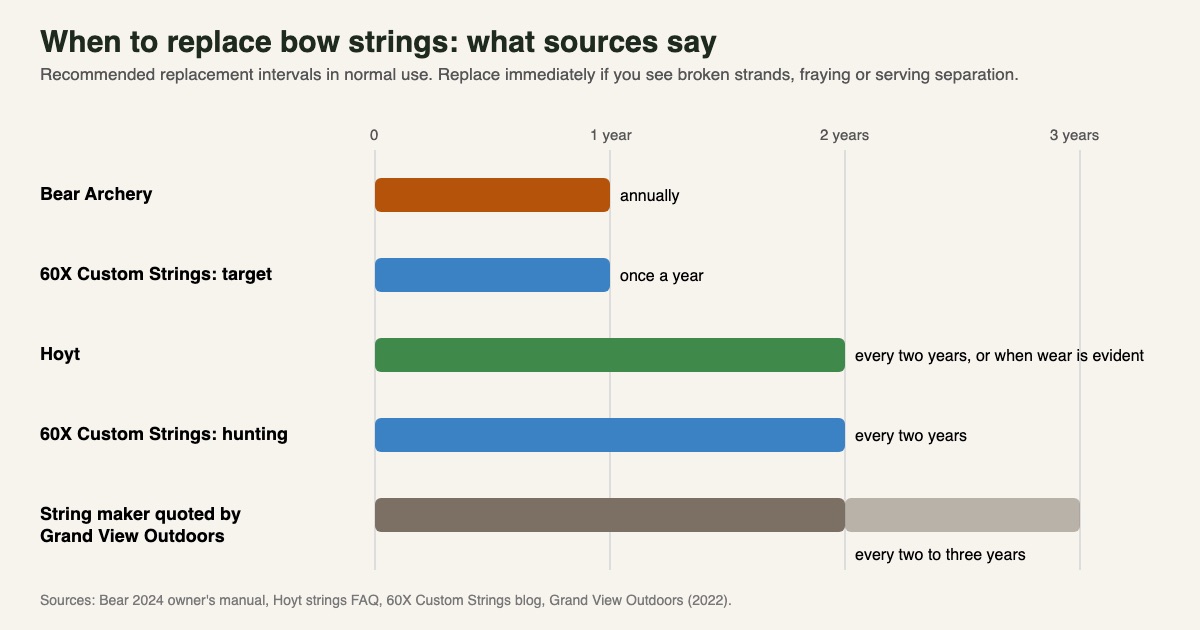
The differences are real, so treat the range as guidance rather than a fixed date. Bear's annual recommendation is the most conservative. Hoyt's two years applies "under normal use conditions." 60X adds a useful rule of thumb from a string maker's point of view: "a lifetime of 2,000 – 2,500 shots is typical."
Note that string and cable warranties are usually short or excluded. Bear's warranty excludes "cables, strings, bearings, string suppressors," and Elite's warranty "does not cover strings, cables." These are expected to wear out.
Why strings wear out
Modern bowstrings are made from high-strength synthetic fibres, but they still degrade:
- Shots: every shot loads and unloads the fibres. BCY Fibers, a major string-material maker, says string life "depends on many factors but primarily the number of shots and the condition of the equipment."
- Heat and sunlight: bow makers warn that excessive heat can cause component failure, and string makers advise storing bows out of direct sunlight.
- Dirt and grit: abrasive particles work into the string and cut fibres from the inside.
- Dry string: without wax, fibres rub against each other and fray.
- Damage: a dry fire, an arrow nock cutting the serving, or contact with sharp broadheads can damage strands instantly.
Stretch versus creep
BCY explains an important difference: "Creep is non recoverable elongation, unlike stretch - which is recoverable elongation." Stretch springs back. Creep is permanent lengthening of the string over time, and BCY notes that "it can cause the bow to go out of tune and the peep to rotate." Modern low-creep materials reduce this, but no string lasts forever.
How long do bow strings last in storage?
This is the most searched question about bowstrings, and the answer depends almost entirely on the storage conditions.
60X says "the string on a properly stored bow should last two to three years," but warns that with poor storage that time "could be cut in half, or if conditions are really poor the string may be ruined in a matter of weeks."
What counts as good storage:
- Keep it cool. Bear's manual says: "Avoid exposing your bow to temperatures over 125 degrees… Do not leave your bow in your vehicle on a hot sunny day or store in a hot attic." Elite warns that "excessive heat, such as a sunny day inside a closed vehicle, may cause component failure."
- Avoid big temperature swings. A string maker quoted by Grand View Outdoors warns about storage swinging from "100-plus degrees during the summer down to minus 30 degrees in the winter."
- Keep it waxed. 60X recommends keeping strings "fully waxed while in storage."
- Use a case, ideally "a dedicated case," and keep the bow "out of direct sunlight," per 60X.
- Keep it dry. Store the bow somewhere dry, and dry it off before casing it after a wet day.
For long storage, Bear also notes: "You can relax the limbs if storing for more than a year." Check your own bow's manual before backing out limb bolts, as instructions vary.
A string that has sat unused for years should be inspected carefully, and if in doubt, replaced before shooting.
Compound strings and cables vs recurve and longbow strings
Compound bows
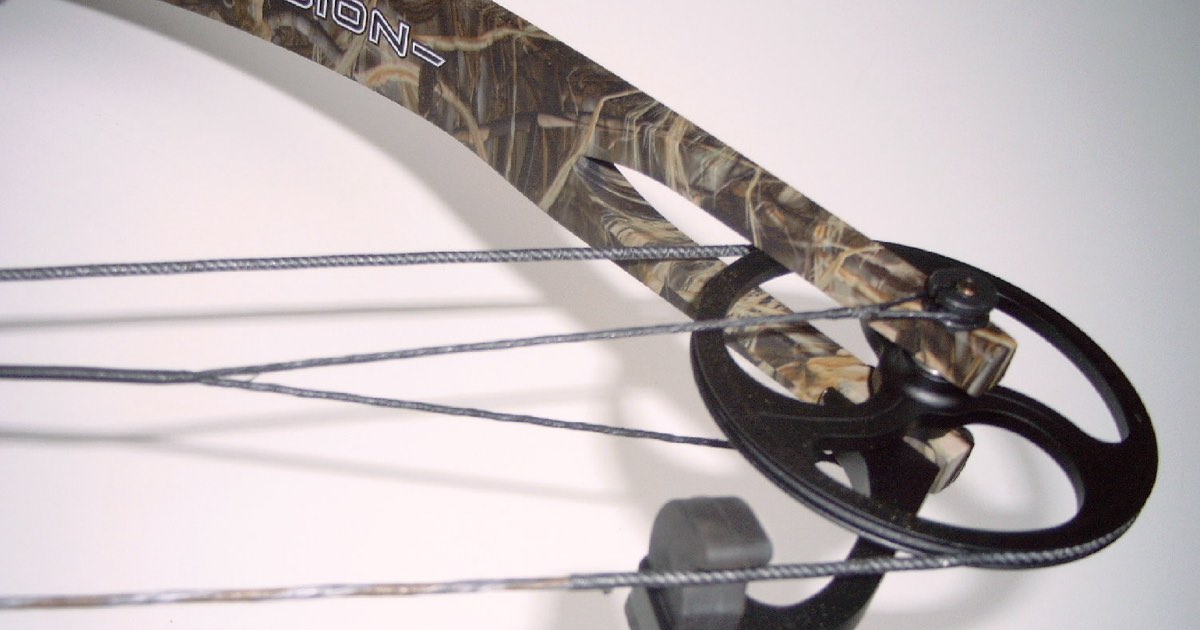
A compound bow has a string plus one or more cables (sometimes called buss and control cables) that connect the cams. They work as a set. Hoyt and Bear both refer to replacing the string and cables. Changing them on most compounds requires a bow press, because the limbs stay under tension. Hoyt notes that "string and cable lengths are normally listed on the limb sticker," which helps when ordering replacements.
Recurve and longbow strings
Recurve and longbow strings are simpler: one string, which you can fit yourself with a bow stringer. Our recurve stringing guide explains how to do it safely. Materials vary. BCY describes its B55 as "100% polyester similar to Dacron… primarily used for recurves, but also used on older compounds, crossbows and traditional bows," while modern low-stretch materials such as its 452X are described as "No creep." Always check that your bow's limbs are rated for the string material you choose.
Because traditional strings are cheap and easy to change, many archers keep a spare that has been shot in and tuned, so a broken string does not end a session.
Signs it's time to replace a string or cables
What you can see
- Fuzz and fraying: a string that looks hairy has damaged fibres. Lancaster Archery puts it bluntly: "If you see individual strands sticking out, that's a damaged bowstring, and it has to be replaced."
- Broken strands: replace immediately.
- Serving separation: gaps or loose serving, especially where the arrow nocks. Lancaster says "any separation in the serving in the nocking area must be addressed ASAP."
- Worn end loops or end serving where the string wraps around the cam or limb tip.
- Dry, faded or discoloured strings. MeatEater lists strings that look "dry, frayed, faded, separated, or otherwise damaged" as warning signs.
What you can feel or measure
- Peep rotation: a peep that no longer sits square at full draw can mean the string is creeping. See our kisser button and peep sight guide.
- Cam timing changes or a draw stop that hits differently.
- Lost poundage or speed. The Mathews FAQ lists "string and cable stretch" among the causes of poundage loss.
- Accuracy that drifts without a change in your form.
What is serving, and can it be redone?
Serving is a tight wrap of thread over the string at points of wear: the centre serving, where the arrow nock, D-loop and release sit, and the end servings around the loops at each end. BCY lists different serving materials for different jobs, such as nylon end serving that is "the traditional end serving for recurves and longbows," and braided materials suitable for end or centre serving.
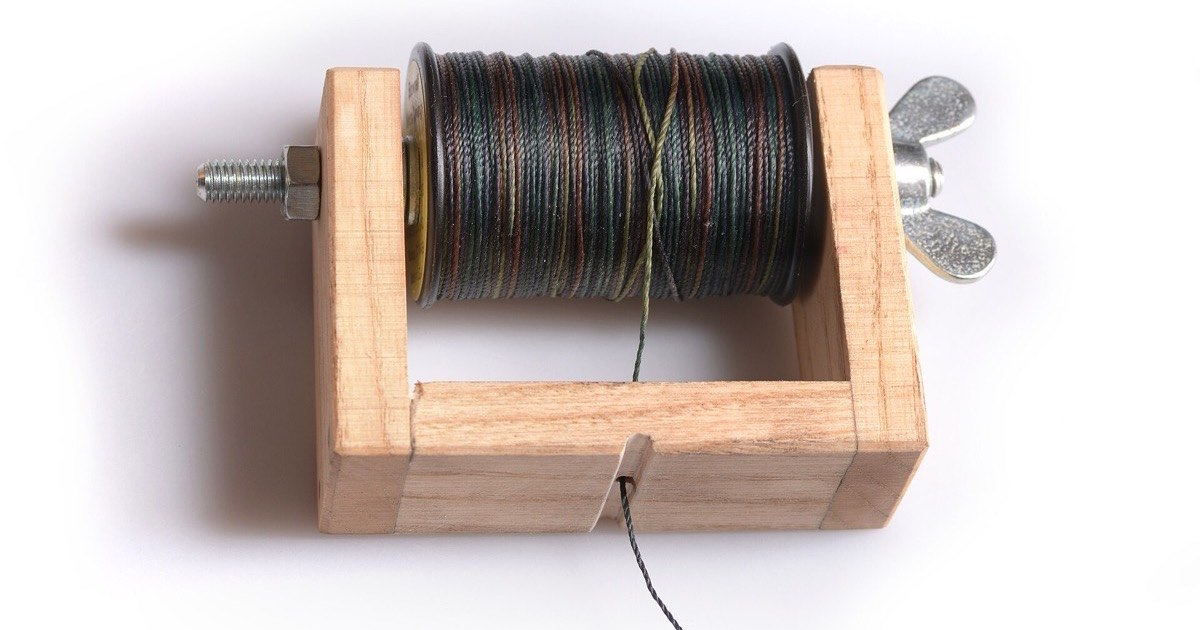
Worn serving can often be re-served by a pro shop or a skilled archer, using a tool like the one in our featured photo. But if the string fibres underneath are damaged, or the string is old, replacing the whole string is the safer option.
Should strings and cables be replaced together?
On a compound bow, yes, as a general rule. Hoyt and Bear both refer to the string and cables together. A new string paired with old, stretched cables can leave the cams out of time and the bow hard to tune.
A new set also needs to settle. Elite recommends cycling the bow "100-125 times to settle the string and cables," adding that adjustments "may need to be repeated after cycling and an additional 150-200 shots." After new strings, a shop will normally check the cam timing, draw length, draw weight and peep position, and you should re-check your sight marks. Our paper tuning guide explains how to confirm arrow flight afterwards.
MeatEater's advice to replace strings "at least a month before you plan to hunt" is sensible: it gives time for the new set to settle and for you to re-sight.
What affects the cost
We don't quote prices, because they change and vary widely, but these are the main cost factors:
- Stock vs custom strings: factory-replacement sets vs custom-built sets in your choice of colours and materials.
- String and cables vs string only. A full compound set costs more than a single recurve string.
- Labour and press time at a pro shop.
- Tuning afterwards: timing, peep, rest and sight adjustments.
- Serving extras: a new D-loop, peep installation or speed nocks.
Can you replace a bowstring yourself?
On a recurve or longbow, yes, with a bow stringer and a little practice. On a compound, replacing strings and cables requires a bow press and the knowledge to set timing and draw length correctly. Most archers have it done at a pro shop. Never try to remove a compound string without a proper press.
How to make bow strings last longer
- Wax regularly. Keep the strand sections waxed and supple; our bowstring wax guide explains how.
- Inspect before every session for fuzz, broken strands and serving gaps.
- Keep the bow out of heat: no hot cars, attics or direct sun.
- Store it in a case and keep it dry.
- Never dry fire. Firing without an arrow can damage strings, cables, cams and limbs.
- Check arrow nocks for cracks, which can cut serving or cause a dry fire.
- Keep broadheads away from the string when handling and in the quiver.
Crossbow strings have their own guidance; see our crossbow maintenance checklist.
Replacing strings on schedule
Advantages
- Consistent tune, peep alignment and accuracy
- Lower risk of a string failure on a hunt
- A chance for a shop to check the whole bow
Trade-offs
- Cost of strings, labour and re-tuning
- New strings need settling and re-sighting
You can browse bowstring wax or serving thread on Amazon.
Frequently asked questions
How long do bow strings last if not used?
It depends on storage. 60X says a properly stored string should last two to three years, but heat, sun and damp can ruin one much sooner. Inspect an old string before shooting.
How often should compound bow strings and cables be replaced?
Hoyt says when wear is evident or every two years under normal use; Bear recommends annually. Replace immediately if damaged.
How long do recurve bow strings last?
The same signs apply: fraying, broken strands and worn serving. Recurve strings are easy to change, so many archers keep a shot-in spare.
What is bow string serving?
A tight wrap of thread that protects the string where the arrow nocks and at the end loops. Worn serving can often be re-served by a shop.
Can I replace my own bow string?
On a recurve or longbow, yes, with a stringer. A compound needs a bow press and correct tuning, so most archers use a pro shop.
Should I replace a new bow's factory strings?
Manufacturers say to replace strings when worn or damaged, or on their recommended schedule. There is no need to replace a new bow's strings unless they show problems.
Related articles
 Training
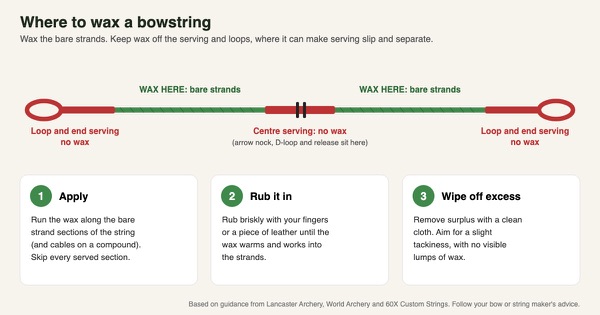
Bowstring Wax: Why, How Often and Does It Go Bad?
How to wax a bowstring, how often makers recommend it, why you should keep wax off the serving, what string wax is made of, and whether bowstring wax goes bad.
October 19, 2026 · 9 min read
 Training
How to String and Unstring a Recurve Bow Safely
How to string and unstring a recurve bow with a stringer, why step-through stringing twists limbs, post-stringing checks, brace height and string care.
Updated February 1, 2025 · 8 min read
 Gear
Kisser Button and Peep Sight: What They Do, Where They Go
Kisser buttons and peep sights explained: what each does, where they go, how to install and tie in a peep, fixing peep rotation, and kisser vs nose button.
October 9, 2026 · 8 min read