
How Archery Scoring Works: Target Faces, Rings and Match Rules
How archery scoring works: ring values and colours, target face sizes, line cutters, X counts, the recurve set system, compound matches and shoot-offs.

By Archery Insider Editorial Team
· · 8 min read

In this article
Archery scoring looks simple: hit the middle, get ten points. In practice there are a few rules that every archer needs to know before their first club shoot, from which ring a touching arrow counts in, to how a match is won when two archers finish level.
This guide covers the standard World Archery target face, the face sizes and distances used in competition, how to score an end properly, and how Olympic-style matches are decided for recurve and compound archers.
Anatomy of a target face
The World Archery (WA) target face is the one you see at the Olympics and at almost every club in the world. It is divided into five coloured bands, each split into two scoring rings.
| Colour | Rings | Score |
|---|---|---|
| Gold (yellow) | Inner and outer | 10 and 9 |
| Red | Inner and outer | 8 and 7 |
| Blue | Inner and outer | 6 and 5 |
| Black | Inner and outer | 4 and 3 |
| White | Inner and outer | 2 and 1 |
| Outside the white | Miss (scored M, zero) |
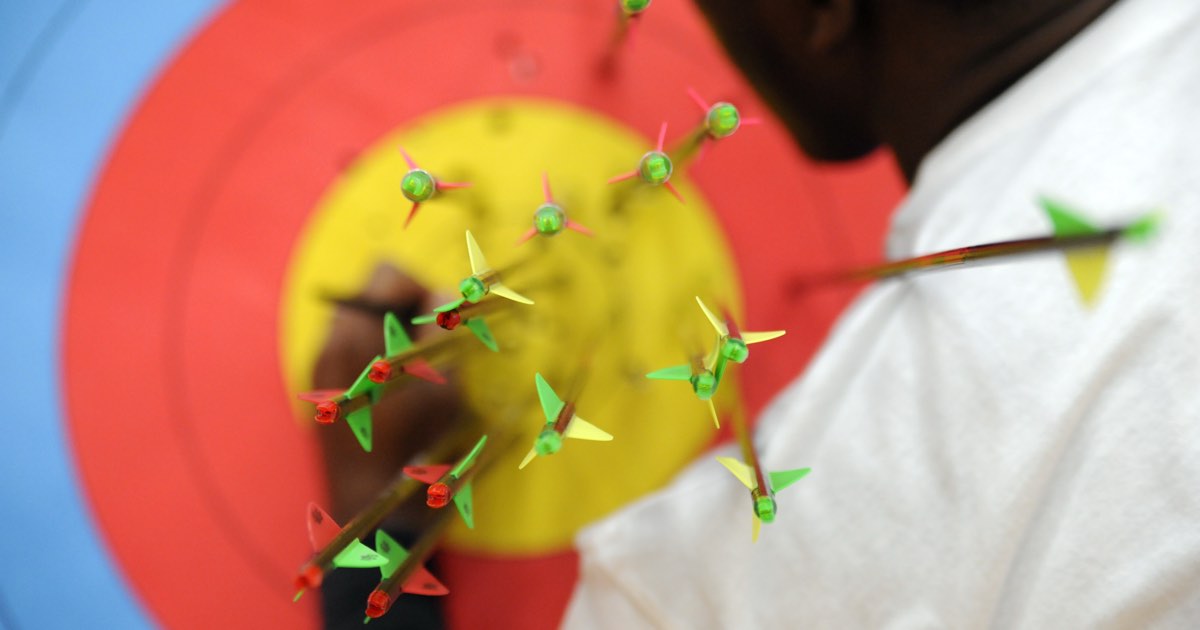
Inside the 10 ring is a smaller X ring. An X is worth 10 points, but competitions count Xs separately and use the count to separate archers on the same score.
How big are the rings?
Every ring on a WA face has the same width: one-twentieth of the face diameter. The 10 ring's diameter is one-tenth of the face, and the X ring is half of that.
| Face | Ring width | 10 ring diameter | X ring diameter |
|---|---|---|---|
| 122 cm | 6.1 cm | 12.2 cm | 6.1 cm |
| 80 cm | 4 cm | 8 cm | 4 cm |
| 60 cm | 3 cm | 6 cm | 3 cm |
| 40 cm | 2 cm | 4 cm | 2 cm |
Face sizes and distances
Different disciplines shoot different faces at different distances so that the challenge is comparable.
| Event | Distance | Face |
|---|---|---|
| Recurve (Olympic) outdoor | 70 m | 122 cm |
| Barebow outdoor | 50 m | 122 cm |
| Compound outdoor | 50 m | 80 cm reduced face (rings 5 to 10 only) |
| Indoor, all bow styles | 18 m | 40 cm, or a three-spot face |
| Shorter outdoor rounds and youth | 30 m and 50 m | 80 cm |
The compound outdoor face removes the white and black rings entirely, because compound archers rarely score below a 5 at 50 metres. Indoor competitions often use a vertical three-spot face: three small faces showing only rings 6 to 10, one for each arrow of the end, so that tight groups do not destroy arrows by hitting each other. On indoor faces, compound archers score only the smaller inner ring as a 10.
Line cutters, bouncers and pass-throughs
These rules decide most scoring disagreements.
- Line cutters. If the arrow shaft touches the line between two rings, it scores the higher value. The line itself belongs to the higher ring.
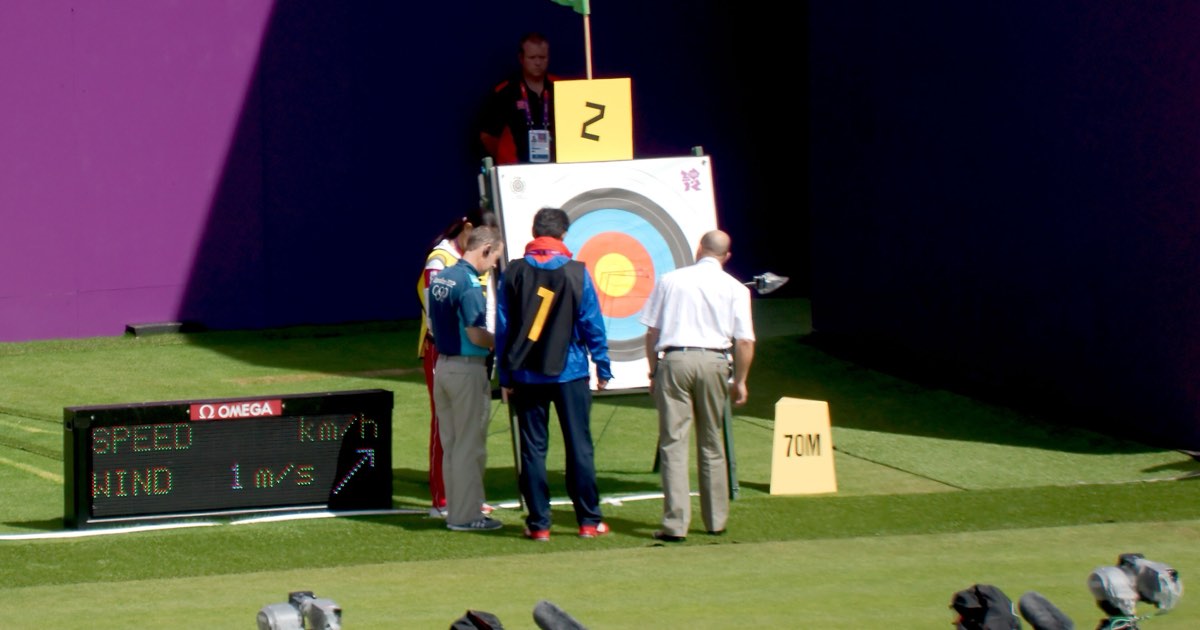
- Who decides. If archers on a target disagree, nobody touches the arrow. A judge is called and makes the decision before any arrow is pulled.
- Bouncers. An arrow that hits the target and bounces out can still score if the judge can identify its new, unmarked hole in the face. At competitions, archers signal a bounce-out and a judge resolves it before arrows are pulled.
- Pass-throughs. An arrow that passes completely through the target is scored from its hole in the face, again under a judge's ruling.
- Arrows in other arrows. An arrow embedded in the nock of another arrow, known as a Robin Hood, scores the same as the arrow it hit.
- Wrong target or extra arrows. Arrows shot at the wrong target score as misses, and shooting more arrows than allowed costs your highest-scoring arrow in that end.
How to score an end
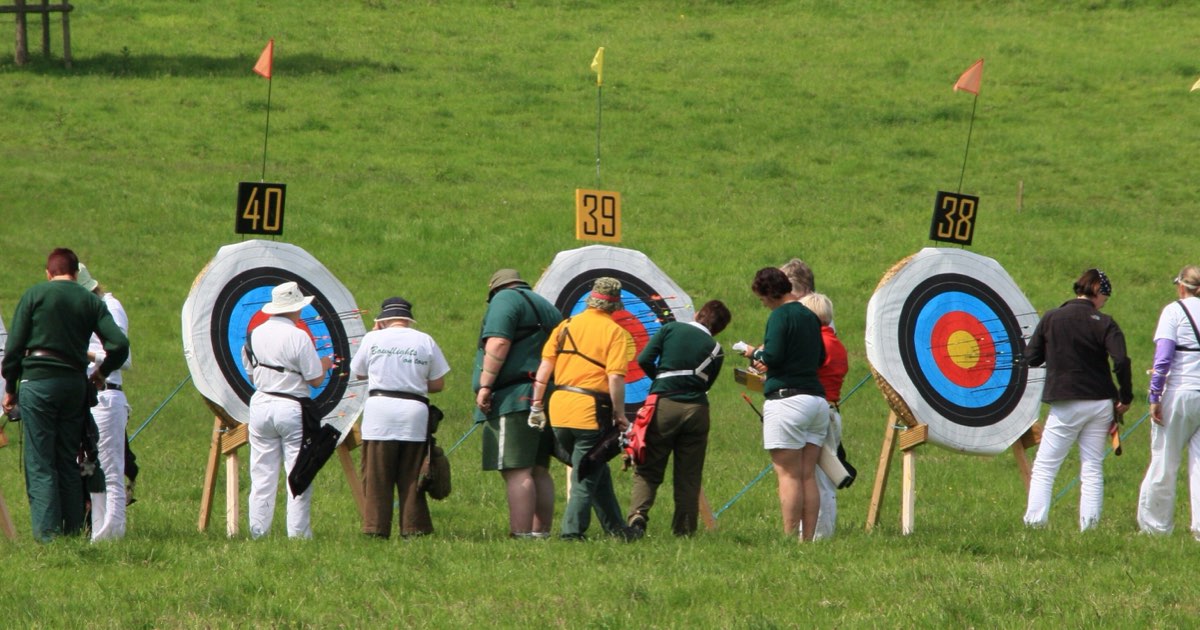
At club shoots, one archer on each target acts as scorer and another checks. The procedure is the same everywhere.
- Walk to the target together after three whistles, and stop a step in front of the face.
- Each archer calls their own arrows, highest first. For example: "ten, nine, seven".
- The scorer writes them down in order, highest to lowest, on the scorecard.
- The checker and the archer confirm the scores before any arrow is touched.
- Mark the holes if your club uses re-used faces, so they are not counted again.
- Pull the arrows, standing to the side, and walk back.
A scorecard shows each end as a row of arrow values, an end total, a running total, and columns for the number of 10s and Xs. Write misses as M, never as a blank.
Common rounds and maximum scores
| Round | Arrows | Maximum |
|---|---|---|
| WA 70 m ranking round (recurve) | 72 arrows in 12 ends of 6 | 720 |
| WA 50 m compound ranking round | 72 arrows in 12 ends of 6 | 720 |
| WA 18 m indoor round | 60 arrows in 20 ends of 3 | 600 |
| Recurve match (set system) | Up to 5 sets of 3 arrows | First to 6 set points |
| Compound match | 5 ends of 3 arrows | 150 |
The 72-arrow ranking round takes about two hours, and its result decides each archer's seeding for the matches that follow.
Time limits
At competitions, each end is timed. Since January 2022 World Archery has allowed 30 seconds per arrow in qualification and individual matches, so 90 seconds for a three-arrow end and 180 seconds for a six-arrow end. Arrows shot after the time runs out score as misses, starting with the highest.
Recurve matches: the set system
Olympic recurve matches use sets to keep every match close.
- Each set is three arrows per archer.
- The archer with the higher set total wins 2 set points. A tied set gives 1 point each.
- The first archer to 6 set points wins the match, so a match lasts at most five sets.
- If it reaches 5–5, there is a shoot-off: one arrow each, and the arrow closest to the centre wins.
The set system means a bad arrow only costs you one set, not the whole match. It also explains how an archer can lose a match while scoring more points overall.
Compound matches: cumulative scoring
Compound matches simply add up the score over 15 arrows, in five ends of three, for a maximum of 150. Because elite compound archers rarely drop more than a few points, finals are often decided by one or two points, or by a shoot-off if the totals are level. Several world records in recent seasons have been perfect 150s.
Our explainer on compound vs recurve bows covers why the two disciplines are scored differently.
Shoot-offs
When a match is tied, each archer shoots one arrow. The higher score wins. If both score the same, the arrow closest to the centre wins, measured by a judge if necessary. At the top level, shoot-offs are often decided by a few millimetres.
Field and 3D scoring
Other disciplines use different faces:
- World Archery field archery uses black-and-yellow faces. The two yellow rings score 6 and 5, and the four black rings score 4, 3, 2 and 1.
- World Archery 3D uses life-size foam animals with four scoring zones worth 11, 10, 8 and 5.
National organisations such as the NFAA in the United States use their own faces and scoring for field and 3D rounds. Check the rules for the event you are entering.
Scoring etiquette and common mistakes
Good scoring habits keep shoots friendly and save arguments.
- Do not touch the face or arrows until every arrow on the target has been scored and checked. Touching an arrow before scoring can forfeit the higher value.
- Do not lean on the target while scores are being called; it can move arrows.
- Call clearly and in order. "Ten, nine, nine" is easy to check. "Two nines and a ten" is not.
- Check the arithmetic at the end of every end, not at the end of the round.
- Agree on doubtful arrows calmly. If you cannot agree, call a judge or the club's field captain rather than guessing.
- Mark holes on re-used faces with a pen or patches so old holes are not counted as new ones.
- Sign the scorecard at competitions. An unsigned card can be rejected.
The most common beginner mistake is scoring a line cutter down. If the shaft touches the line, the higher value is yours.
Frequently asked questions
Does an X count as more than a 10?
No. An X is worth 10 points. It is counted separately and used to break ties, and to separate archers on identical scores in qualification.
If my arrow touches the line, which score do I get?
The higher one. The dividing line belongs to the higher-scoring ring.
What is a good score for a beginner?
It depends entirely on distance, face size and bow type. Track your own scores on the same round over time, which is a far better measure of progress than comparing with others. Our practice plan suggests how.
Why do recurve and compound use different match formats?
Compound archers score so consistently that cumulative scoring rewards their precision, while the set system keeps recurve matches close and unpredictable. Both formats end in a shoot-off when level.
Related articles
 Guides
Archery Range Safety Rules and Whistle Commands Explained
Archery range safety explained: whistle commands, shooting and waiting lines, collecting arrows safely, equipment checks, and what the Fast call means.
Updated April 10, 2026 · 10 min read
 Training
Archery Practice Plan: 10 Drills and a Weekly Routine
A structured archery practice plan: arrows per session, warm-ups, 10 proven drills from blank bale to pressure games, weekly routines and a practice log.
March 20, 2025 · 7 min read
 Comparisons
Compound vs Recurve Bow: Key Differences Explained
Compound vs recurve bow compared: how each works, let-off and holding weight, aiming systems, competition formats, maintenance, hunting, and which suits you.
February 6, 2025 · 8 min read