
How to Choose a Rangefinder for Bowhunting
How to choose a bowhunting rangefinder: angle compensation, bow modes, scan and target priority, display, magnification, bow-mounted units and field use.

By Archery Insider Editorial Team
· 9 min read
In this article
Misjudged distance is one of the most common reasons bowhunters miss or wound deer. A bow sight is set for exact yardages, and arrows drop steeply, so a few yards of error can move the arrow out of the vitals. A laser rangefinder removes the guesswork. Bowhunter magazine puts it plainly: "the only ethical situation is to know the exact range" before you shoot.
This guide explains which rangefinder features matter for bowhunting, why angle compensation is the big one, how bow-mounted units work, and how to use a rangefinder in the field. It is a buyer's guide to features, not a ranked list: we have not tested these devices, so we explain how to choose rather than which model to buy.
The quick answer
| Feature | Why it matters | What to look for |
|---|---|---|
| Angle compensation | Uphill and downhill shots play shorter than the line-of-sight distance | A bow or archery mode giving true horizontal distance |
| Display | Dawn and dusk readability | Clear, adjustable brightness; works against dark backgrounds |
| Speed and scan | Moving deer | Fast readings and a continuous scan mode |
| Target priority | Ranging through brush and branches | First-target or distant-target modes |
| Magnification | Picking out the deer | 5x to 7x is typical |
| Size and weight | Carried all day, used one-handed | Compact and light; a lanyard or holster |
| Precision | Pin selection at longer range | Readings to the yard or tenth of a yard |
| Weather resistance | Rain and cold | Water-resistant body |
Angle compensation: the feature that matters most
Gravity pulls an arrow down over the horizontal distance to the target, not the straight-line distance. When you shoot downhill from a tree stand, or uphill on a slope, the line-of-sight distance your eye sees is longer than the horizontal distance your sight pins are set for. Bowhunter's review highlights angle range compensation so "you'll know the true shot distance no matter how steep the terrain."
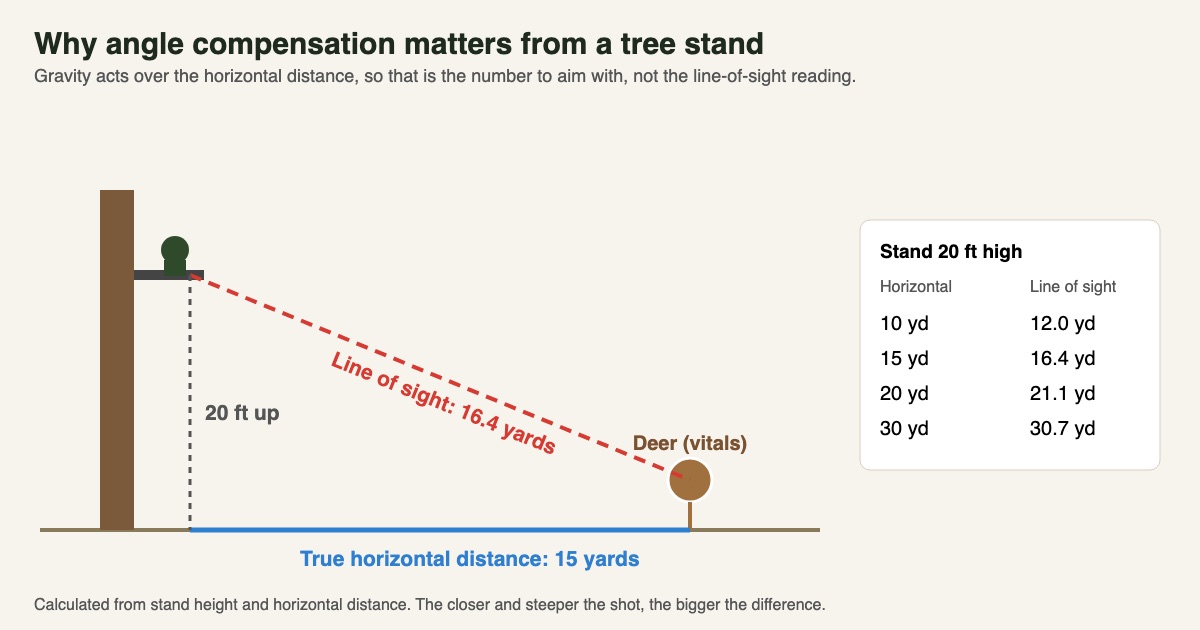
The difference is biggest on close, steep shots, exactly the ones bowhunters take from tree stands. These figures are simple calculations for a stand 20 feet high:
| Horizontal distance | Line-of-sight distance | Difference |
|---|---|---|
| 10 yards | 12.0 yards | 2.0 yards |
| 15 yards | 16.4 yards | 1.4 yards |
| 20 yards | 21.1 yards | 1.1 yards |
| 30 yards | 30.7 yards | 0.7 yards |
On the ground, on flat terrain, the two distances are almost identical. In mountains, or from a tall stand, angle compensation matters much more. Remember too that steep downward shots shrink the vital window. Bowhunter's shot placement article warns that straight-down shots are among "the worst in bowhunting." See our shot placement guide.
Bow modes and ballistic modes
Many rangefinders have a dedicated bow or archery mode that shows the angle-compensated distance. Some go further and let you enter details such as arrow speed, so the unit can suggest an aim distance or show whether your arrow will clear branches. These features can help, but only if you set them up carefully and check them against real shots.
Display and low-light performance
Deer move most around dawn and dusk. Bowhunter notes rangefinders should give "quick and accurate distance readings" with displays that work in low light. Things to check:
- Display type. Some displays are black, others illuminated in red or another colour. Black displays can be hard to read against dark timber; illuminated displays can be easier in poor light. Brightness adjustment helps.
- Optical clarity. Clear, bright glass makes it easier to pick out a deer against cover.
- Reticle. A simple aiming point that does not hide a small target.
Speed, scan mode and target priority
- Ranging speed. A quick reading means less time with the rangefinder up and more time ready to shoot.
- Scan mode. Bowhunter describes scan mode as allowing "continuous distance monitoring as animals move." Hold the button and sweep across the deer's path.
- Target priority. In timber, the laser may hit a branch in front of the deer. First-target modes report the nearest object; distant-target modes ignore close clutter and report the farther object. Knowing which mode you are in avoids wrong readings.
Magnification and range
Bowhunter's review notes most models offer 5x to 7x magnification. More magnification can make a distant deer clearer but can also make the image shakier in the hand. For bowhunting, maximum range is rarely the limiting factor. Advertised maximum distances are usually measured on reflective targets, and readings on a deer are shorter, but even modest rangefinders reach far beyond bow range. Prioritise angle compensation, display and speed over a big maximum-range number.
Precision
Most rangefinders read to the nearest yard; some, as Bowhunter notes, give "distance readings in one-tenth-yard increments." For most whitetail hunting inside 30 yards, whole yards are enough. Tenth-of-a-yard precision matters more for long shots in open country and for target archers.
Size, weight and handling
You will carry the rangefinder all day and often use it with one hand while holding your bow. Look for:
- A compact, light body. Bowhunter cites a 5.3-ounce model as an example of a lightweight design.
- One-hand operation with buttons you can find by feel, even with gloves on.
- A lanyard, harness pocket or holster so it is always within reach and quiet to retrieve.
- Water resistance for wet days.
Carrying it quietly
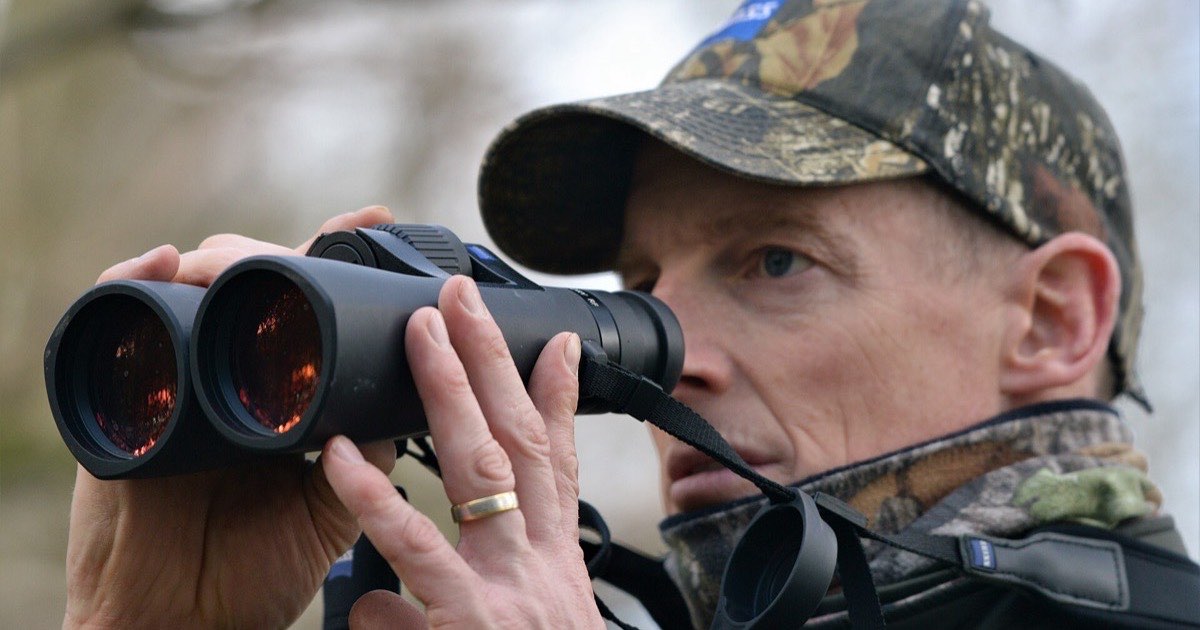
How you carry a rangefinder affects whether you use it. A lanyard around the neck is simple but can swing and clack against the bow. A chest harness with a dedicated rangefinder pocket keeps it quiet, protected and instantly reachable, and many hunters carry binoculars in the same harness. A belt holster works for ground hunters. Whatever you choose, practise retrieving and using the rangefinder with minimal movement, ideally with your bow in the other hand.
Bow-mounted rangefinders
A bow-mounted rangefinder attaches to the bow and lets you range without picking up a separate device. Petersen's Hunting explains the appeal: "Knowing exact shot distance without having to move is the ideal scenario." Some units run in scan mode, so you can activate them before game arrives and focus on drawing when a deer comes close.
Things to weigh up:
- Extra weight and bulk on the bow, which changes balance and handling.
- Practice. Petersen's suggests installing the unit before the season, because "pushing the button will become the first step in your shot routine."
- Legality. Some states restrict electronic devices or lighted accessories attached to bows. Check your regulations before hunting with a bow-mounted rangefinder.
Some rangefinders are built into bow sights and adjust the aiming point automatically. The same considerations apply: weight, battery life, practice and legality.
Using a rangefinder in the stand
- Range landmarks as soon as you settle in. Trees, rocks, trail crossings and shooting lanes at different distances. Then you know the range before a deer appears.
- Note your maximum. Mark a landmark at your personal maximum distance; our effective range guide explains how to find it.
- Range the deer only if you have time. If a deer is close and moving, rely on your landmarks rather than lifting the rangefinder.
- Use bow mode from stands and on slopes.
- Choose the right pin. Our single-pin vs multi-pin guide explains how pins relate to distance.
- Practise ranging and shooting together at 3D targets, including from height.
Rangefinders for crossbow hunters
Crossbow scopes have reticle lines for set distances, usually 20, 30, 40 yards and beyond, so exact range matters just as much. The same features apply: angle compensation from stands, a readable display and fast ranging. Because crossbows are often shot from a rest in a blind or stand, many crossbow hunters range landmarks and mark their reticle distances on a card. Our crossbow scope guide explains how to confirm where each reticle line really hits.
Common rangefinder mistakes
- Ranging the brush, not the deer. Check you are in the right target-priority mode and that the reading makes sense.
- Forgetting bow mode. Using the line-of-sight number from a tall stand can send the arrow high on close shots.
- Too much movement. Lifting a rangefinder with a deer at 15 yards can end the encounter. Range landmarks in advance.
- A dead battery on opening day. Cold drains batteries faster; carry a spare.
- Trusting it blindly. Check it against a tape measure, and confirm that your sight marks match real distances.
- Leaving it in a pack. If it takes ten seconds and a zip to reach, you will not use it when it counts.
Training your eye as well
A rangefinder is a tool, not a replacement for judging distance. Batteries fail, deer appear suddenly, and there is not always time to range. Practise estimating distances on walks and at 3D shoots, then check yourself with the rangefinder. Learn what 10, 20 and 30 yards look like in open fields, in timber and from a tree stand, because distances look different in each. Many experienced bowhunters combine the two: they range landmarks, then judge the deer's distance against those known points. 3D archery, with its unmarked distances, is excellent practice; see our 2026 World 3D Championships report for how competitive archers handle unknown ranges.
Checking your rangefinder
- Compare with a tape measure at known distances before the season.
- Check bow mode on a slope against a measured horizontal distance.
- Replace the battery before the season and carry a spare.
- Keep the lenses clean with a lens cloth.
Buyer's checklist
- Angle-compensated bow or archery mode
- Display readable at dawn and dusk
- Scan mode and clear target priority settings
- Comfortable magnification, typically 5x to 7x
- Compact, one-hand operation; easy to carry quietly
- Weather resistance
- Easy-to-find battery type
- For bow-mounted units: weight, mounting and legal status where you hunt
Handheld rangefinder
Advantages
- Works for ranging landmarks and game
- Doesn't add weight to the bow
- Useful for scouting and other hunting
Trade-offs
- Movement to lift and use it near deer
- Another item to carry and reach for
Bow-mounted rangefinder
Advantages
- Range without extra movement
- Scan mode can run while you wait
Trade-offs
- Adds weight and changes balance
- Battery-dependent on the bow
- May be restricted in some states
You can browse bowhunting rangefinders or rangefinder harnesses on Amazon. Check that the model has a bow or angle-compensated mode.
Frequently asked questions
Do I need a rangefinder for bowhunting?
It is one of the most useful tools a bowhunter can carry. Bowhunter education notes that misses and wounding rise with distance, and knowing the exact range removes a major source of error.
What is angle compensation on a rangefinder?
A mode that calculates the horizontal distance to the target, which is what your bow sight is set for, instead of the longer line-of-sight distance on uphill or downhill shots.
Is a golf rangefinder good for bowhunting?
Some work, but many lack angle compensation for steep shots and have displays designed for bright conditions. A hunting rangefinder with a bow mode is a better fit.
Are bow-mounted rangefinders legal?
It depends on the state. Some restrict electronic devices or lighted accessories on bows. Check your regulations.
How far can a bowhunting rangefinder read?
Usually well beyond any sensible bow shot. Advertised ranges are measured on reflective targets, and readings on deer are shorter, but still far more than you need.
Should I range the deer or landmarks?
Both, when possible. Range landmarks as soon as you set up, so you can judge a deer's distance instantly. Range the deer itself only if it is calm and you have time without being seen.
Related articles
 Guides
How Far Can You Shoot a Deer With a Bow?
Effective bow range for deer: what bowhunter education says, why long shots wound more, arrow flight times, jumping the string, and how to find your limit.
October 7, 2026 · 9 min read
 Guides
Where to Shoot a Deer With a Bow: Shot Placement
Bow shot placement for deer: where the heart and lungs sit, how to aim broadside, quartering away and from a tree stand, which shots to pass on, and why.
October 6, 2026 · 10 min read
 Comparisons
Single-Pin vs Multi-Pin Bow Sights: Which Should You Choose?
Single-pin vs multi-pin bow sights compared: fixed pins vs sliders, speed in the field, long-range precision, low light, gap shooting, hybrids and scopes.
February 25, 2026 · 5 min read