
Crossbow Accessories: What You Actually Need
Crossbow accessories ranked: what a new crossbow needs before the first shot, what to add before you hunt, which upgrades are optional, and how to check fit.

By Archery Insider Editorial Team
· 9 min read
In this article
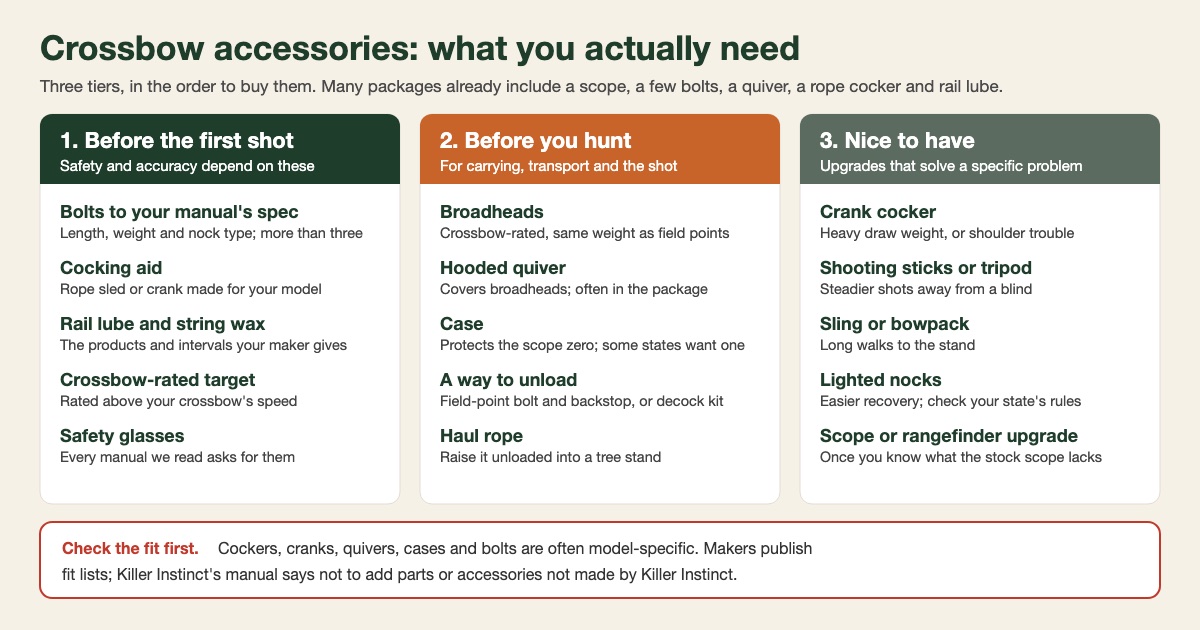
The crossbow accessories you actually need are few: bolts that match your manual, a cocking aid made for your model, the rail lube and string wax your maker specifies, and a target rated for crossbows. Before you hunt, add broadheads, a hooded quiver, a case and a safe way to unload. Everything else, from crank cockers to slings and tripods, is an upgrade that solves a particular problem.
Most crossbows are sold as a package, so you may already own half of that list. This guide sorts the rest into what to buy first, what can wait, and what to skip, and explains why each category exists. We haven't tested any of these products; the facts come from makers' manuals and product pages, and the product names are examples, not a ranking.
Crossbow accessories by priority
| Accessory | Priority | Why it exists | Check before buying |
|---|---|---|---|
| Bolts | Before the first shot | Too light or the wrong nock can cause a dry fire | Length, total weight, nock type in your manual |
| Cocking aid | Before the first shot | Halves the effort or more and centres the string | Listed as compatible with your exact model |
| Rail lube and string wax | Before the first shot | Reduces string and serving wear | The product and interval your maker gives |
| Crossbow-rated target | Before the first shot | Stops bolts safely at crossbow speeds | Speed rating and point type (field point or broadhead) |
| Safety glasses | Before the first shot | Every manual we read asks for them | Fit over prescription glasses if needed |
| Broadheads | Before you hunt | Hunting requires a cutting head | Weight matches your field points; legal in your state |
| Hooded quiver | Before you hunt | Covers broadheads in transport | Mounts to your crossbow's bracket |
| Case | Before you hunt | Protects limbs and scope zero | Internal length and width when uncocked |
| Crank cocker | Nice to have | Easier cocking; some let you decock | Fits your stock and triggerbox |
| Shooting sticks, sling, bowpack | Nice to have | Steadier shots, easier carrying | Height range; attachment points |
What a crossbow package usually includes
"Crossbow package" and "crossbow kit" usually mean the crossbow plus the basics to start shooting. Killer Instinct's Boss 405 page lists a typical "Pro Package": a Lumix 4x32 scope, rope cocker, string suppressors, a three-bolt quiver, three 370-grain Hypr Lite bolts with field tips, and a stick of rail lube. Its 2026 decocking models ship with two bolts rather than three.
That's enough to sight in, but not enough to practise and hunt. Three bolts disappear fast once one is damaged, and a package never includes a target, broadheads or a case. Our guide to choosing crossbow bolts explains how to buy more that match.
The essentials: before the first shot
Bolts that match your manual
Bolts are an accessory only in the sense that you buy more of them. Ravin's R-series manual says lighter arrows "can cause a dry fire", and that a damaged nock can do the same. Killer Instinct's 2026 manual names the nocks to use ("Half moon or KI V-Track nocks"), and Excalibur lists the field-point weights its bolts are built around. If your package came with three, buy a matching set of six or more so practice doesn't eat into the bolts you hunt with.
A cocking aid made for your crossbow
A cocking aid pulls both sides of the string evenly, which centres it, and cuts the effort. TenPoint says its Rope Sled reduces "the cocking effort by 50%", and that its built-in ACUdraw crank reduces draw weight "to about 5-pounds when operated manually". The catch is fit. TenPoint's sled "fits/works on all TenPoint and Horton crossbows with Functionally Superior Bullpup (FSB) stocks" and most Wicked Ridge models, except the Nitro X. Killer Instinct's DSC crank fits "Killer Instinct crossbows only" and lists the older models it doesn't fit. If your package included a rope cocker, keep using it; see our cocking guide for technique.
You can browse crossbow rope cockers or TenPoint ACUrope listings on Amazon, and check the model list on each listing before you order.
Rail lube and string wax
These do different jobs, and makers disagree on where each goes. TenPoint sells a Flight Rail and Trigger Lube that it says "will not gum-up in cold weather", plus a string wax that "lubricates and rejuvenates bow strings and cables". Excalibur tells owners to wax the centre serving "approximately every 30-40 shots", not to apply wax directly to the rail, and to use its rail lube there instead. Killer Instinct's NEO manual uses rail lube on the rail, string and cables "after every 5 to 10 shots". Buy what your maker names. Our crossbow maintenance checklist covers how to apply both.
Browse crossbow rail lube and string wax on Amazon if your maker's product isn't stocked locally.
A target rated for crossbows
The NBEF bowhunter course says to "only use targets or backstops that have been approved for crossbow use", and notes that not all targets take broadheads. Excalibur's manual says to use "a target designed to be used with high performance crossbows". Check the speed rating against your crossbow's rated speed and buy a broadhead-rated target or a separate broadhead block for final checks.
Safety glasses
They're cheap and easy to forget. Excalibur's manual says to wear them "when assembling, servicing, cocking, loading, or shooting your crossbow", because of injuries that could result from issues such as broken limbs. Keep a pair in the case so they travel with the crossbow.
Before you hunt
Broadheads
You'll need broadheads that suit crossbow speeds and match your field-point weight, plus one or two for confirming they hit with your field points. The NBEF course recommends sighting in with broadheads identical to the ones you'll hunt with. Our crossbow broadheads guide covers weight, fixed vs mechanical, and tuning.
A hooded quiver
Most packages include one. Barnett's manual says to "ALWAYS protect broadheads with a quiver when storing, transporting or not in use", and Killer Instinct's says the same. If you buy a replacement, make sure it fits your crossbow's bracket.
A case
A case protects the limbs, cams and scope zero in a truck bed, and in some places the law asks for one. New York's DEC says that on lands inhabited by deer or bear, in or on a vehicle using artificial lights, a crossbow may not be possessed "unless it is unstrung or taken down or securely fastened in a case or locked in the trunk". TenPoint's case pages warn that "Many states and provinces have unique casing requirements" for crossbows in vehicles. Rules checked on 9 October 2026; this isn't legal advice and regulations change, so confirm with your state wildlife agency (in New York, the DEC) before you travel.
Fit matters here too. TenPoint's hard case lists exactly which crossbow models fit, holds a fully assembled crossbow with the scope on, and is described as staying under the 50 lb airline limit when fully packed. A soft case is lighter and cheaper to store. You can browse crossbow cases on Amazon; check the internal dimensions against your crossbow's uncocked width.
A safe way to unload
Unless your crossbow has a decocking triggerbox or crank, you unload by shooting a bolt into a safe backstop. Carry one field-point bolt for the purpose, and only use a special discharge bolt if your maker approves it. Some newer crossbows build the answer in: Killer Instinct's 2026 DC models decock with the supplied sled and a button on the triggerbox, and Excalibur says its recurve crossbows can be decocked with the rope cocking aid. Even then, follow the manual's steps exactly.
Nice to have: crossbow upgrades
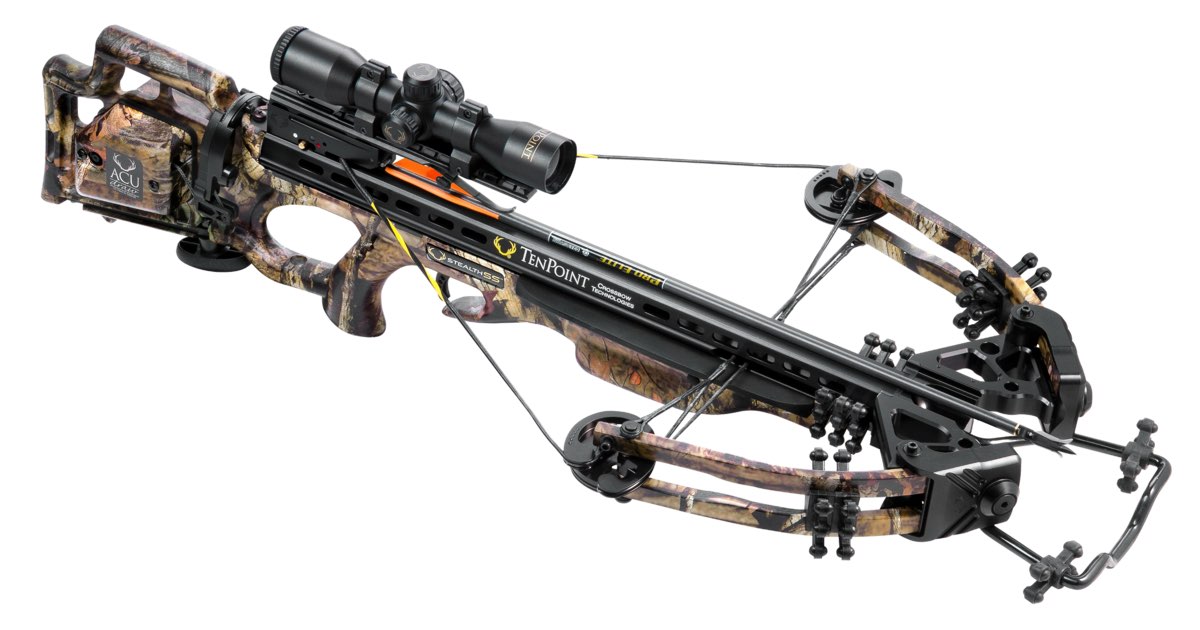
A crank cocker is the upgrade most worth considering if a rope cocker leaves you straining, or if you'd like to let the string down without a shot on a crossbow that allows it. Check that it fits your stock and triggerbox; Killer Instinct's crank pages list compatible models one by one.
Shooting sticks or a tripod steady a heavy crossbow when you're not shooting from a blind window. Our shooting sticks guide compares monopods, bipods and tripods.
A sling or bowpack helps on long walks. Killer Instinct sells a single-point sling with a quick-detach mount, and TenPoint's Wicked Ridge Ambush Bowpack is a rigid-frame pack that carries the crossbow with waist and sternum straps. Browse Wicked Ridge Ambush Bowpack listings on Amazon; check its fit list against your model.
Lighted nocks make bolts easier to find after the shot, but they add weight at the back of the bolt, so re-check your zero and your state's hunting rules before you use them.
A scope or rangefinder upgrade makes sense once you know what your package scope lacks, such as illumination or a speed dial.
What to skip, or check first
- "Universal" cockers and quivers with no model list. TenPoint and Killer Instinct both publish fit lists because shapes differ.
- Modifications. Killer Instinct's manual says not to alter, add or substitute parts or accessories "not made by KI Crossbows".
- Lubricants your maker doesn't name. A wax on the rail or a gel that stiffens in the cold can do more harm than good.
- A pile of extras before you've shot. Practise first, then buy for the problem you actually have.
Frequently asked questions
What accessories do I need for a crossbow?
At minimum: bolts that match your manual, a cocking aid made for your model, the rail lube and string wax your maker specifies, a crossbow-rated target and safety glasses. Before hunting, add broadheads, a hooded quiver, a case and a plan for unloading. Many packages already include the scope, quiver, rope cocker and lube.
Are crossbow accessories universal?
Often not. Cocking sleds, cranks, quivers and hard cases are shaped for particular stocks and rails. TenPoint lists which crossbows its sled and cases fit, and Killer Instinct lists models its crank doesn't fit. Bolts are model-specific too, because weight and nock type affect safety. Always check the maker's fit list.
What's the most useful crossbow upgrade?
For most owners, a crank cocker. It makes cocking easier and more consistent, and on some crossbows it can also let the string down without a shot. If cocking is already easy, shooting sticks or a tripod will probably help your accuracy more than a new scope.
What comes in a crossbow kit or package?
Usually the crossbow, a scope, two or three bolts with field points, a quiver, a rope cocker and rail lube. Killer Instinct's Boss 405 package, for example, adds string suppressors. A package rarely includes a target, broadheads or a case, so budget for those separately.
Related articles
 Training
How to Use a Crossbow: A Beginner's Guide
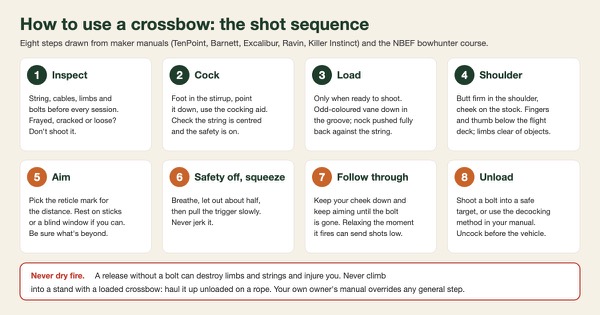
How to use a crossbow safely: inspect, cock, load, aim, squeeze and unload, with the rules every maker manual agrees on, plus practice and hunting basics.
November 19, 2026 · 11 min read
 Gear
Choosing a Crossbow for Hunting: What to Look For
What to look for in a crossbow for hunting: legal minimums, rated speed and energy, width, weight, cocking and de-cocking, safety features and examples.
November 23, 2026 · 9 min read
 Reviews
Killer Instinct Crossbows Review: The Lineup Explained
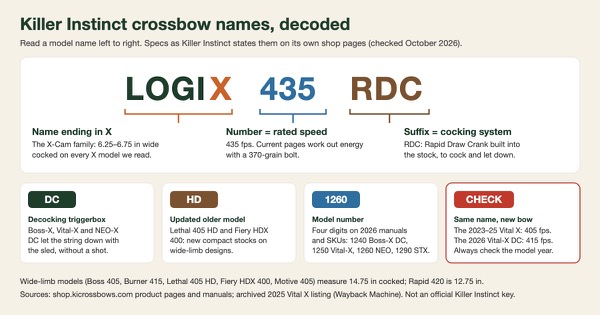
Killer Instinct crossbows explained: the 2026 line-up from STX and NEO-X to LogiX 435 and Lethal 405 HD, what the names mean, decocking and who each suits.
November 18, 2026 · 12 min read