
Choosing a Crossbow for Hunting: What to Look For
What to look for in a crossbow for hunting: legal minimums, rated speed and energy, width, weight, cocking and de-cocking, safety features and examples.

By Archery Insider Editorial Team
· 9 min read
In this article
A good crossbow for hunting does five things: meets your state's equipment rules, often a minimum draw weight and a working safety; delivers enough energy with a maker-approved arrow; is narrow and light enough for where you hunt; can be cocked and de-cocked safely by you; and keeps fingers out of the string's path. Speed ratings sell crossbows; those five things kill deer cleanly and keep you whole.
This is a checklist, not a ranking; we haven't shot the crossbows named.
Legal requirements come first
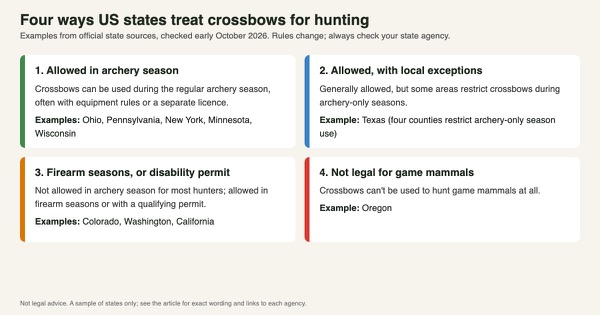
Whether you can hunt with a crossbow, and in which season, varies by state; our guide to crossbow hunting laws covers that. Here the question is which crossbow you can legally buy.
| State (source) | Minimum draw weight | Arrow or bolt | Broadhead |
|---|---|---|---|
| Washington (WAC 220-414-100) | 125 lb; also unlawful with "a trigger safety that does not work properly" | At least 350 grains | "sharp broadhead", at least "seven-eighths of an inch cutting diameter" |
| New York (DEC Q&A, fall 2025) | "a minimum peak draw weight of 100 pounds" and "a working trigger safety" | No minimum limb width or length | Not stated |
| Oklahoma (Wildlife Department) | "Minimum of 100 pounds draw weight and equipped with safety devices" | Not stated | Points "not less than 7/8 inches wide" |
| Texas (Parks and Wildlife, 2026–27) | "There is no minimum draw requirement" | Not stated | Required for game animals |
Rules checked on 7 October 2026; this isn't legal advice and regulations change, so confirm with your agency. A crossbow sold as a 100 lb or 115 lb model may be legal in one state and not the next, so check your state's number first.
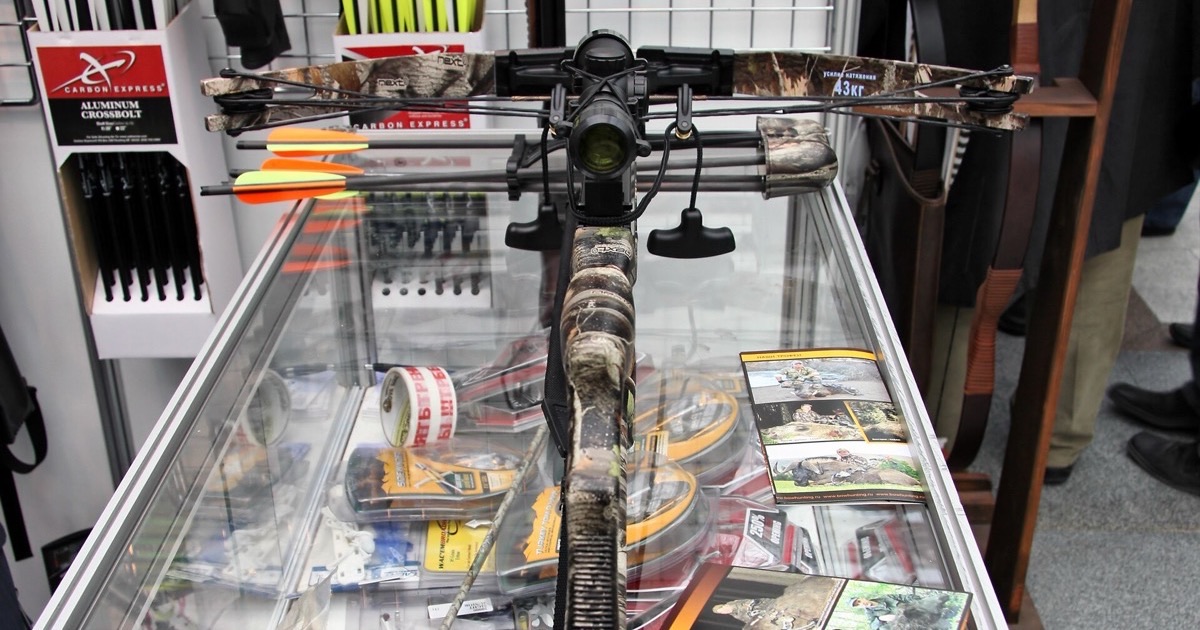
What to look for in a crossbow for hunting
| Criterion | What to look for | Why it matters |
|---|---|---|
| Legal fit | Draw weight at or above your state's minimum; working safety | The law, and the floor for energy |
| Speed and energy | The fps figure with its arrow weight, and the ft-lb figure | Energy drives penetration; speed alone is marketing |
| Width when cocked | Narrow for stands and blinds | A 9 in crossbow fits where a 15 in one won't |
| Mass weight | Bare weight plus scope, quiver and arrows | You carry and hold all of it |
| Cocking and de-cocking | Rope, crank, or a crank that also de-cocks | Whether you can use it alone and unload it quietly |
| Safety features | Anti-dry-fire, finger guards, tested trigger safety | Every maker's manual leads with these |
| Noise | String stops, dampeners | Deer react to the shot |
Rated speed and energy
A speed figure means nothing without its arrow weight, and the better makers publish both. Wicked Ridge lists the Fury 410 at "410 fps" with a 370-grain arrow for 138 ft-lb, or "400 fps / 142 fp ke" with a 410-grain arrow. TenPoint lists the TX Ultra 26.5 at "410 fps / 153 fp ke" with a 410-grain arrow and "390 fps / 149 fp ke" with a 440-grain one. The heavier arrow is slower but carries more energy and momentum.
All of those sit far above Easton's widely quoted 25 to 41 ft-lb guideline for deer-sized game, as does the budget model in our CenterPoint Sniper Elite 385 review, rated at 385 fps and about 131.5 ft-lb. On a current hunting crossbow, energy isn't the worry; accuracy and range estimation are.
Width, length and weight
Compound crossbows narrow when cocked because the limbs fold inward; reverse-draw designs go further. The Fury 410 is 15 in wide uncocked, 9 in cocked and 29 in long. The TX Ultra 26.5 is 10.75 in uncocked, 7 in cocked and 26.5 in long. The CenterPoint we reviewed is 14.75 in cocked and 33.75 in long. Excalibur's recurve-limbed Mag MAX is 32 in long; its page doesn't list a width, and recurve limbs don't fold, so they run wider.
Excalibur lists the Mag MAX at 6 lb bare and 7.9 lb with accessories; Wicked Ridge lists the Fury 410 at 7.5 lb and TenPoint the TX Ultra at 7.9 lb. With scope, quiver and arrows most reach 9 to 12 lb, which is why so many hunters shoot from a rest or a blind window.
Cocking and de-cocking
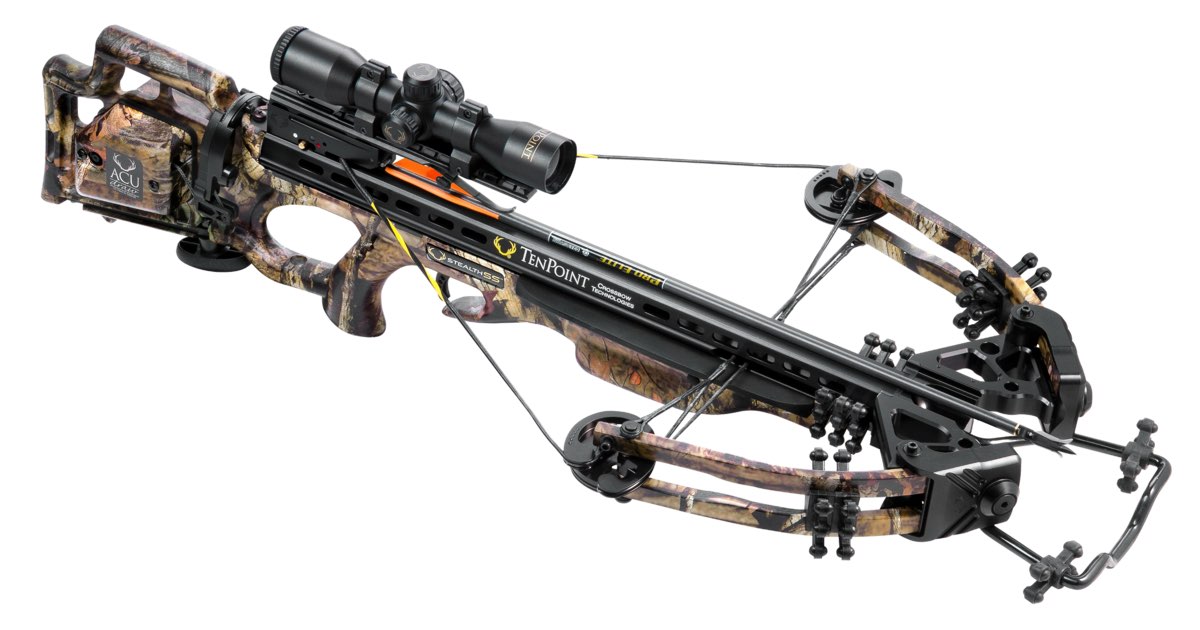
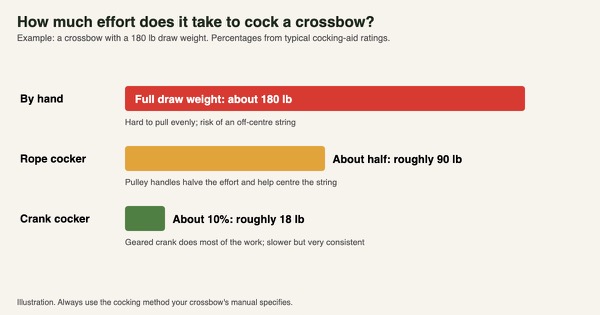
A rope cocker halves the effort (TenPoint says rope-style devices "reduce the draw weight by 50%", so a 175 lb crossbow needs about 88 lb of pull) and keeps the string centred; the Mag MAX ships with one. A crank, such as the ACUslide MAXX on the TX Ultra, cuts the effort far more. A crank that de-cocks, such as the ACUdraw De-Cock on the Fury 410, lets the string down at the end of the day instead of shooting an arrow into a target.
The manuals are firm. Barnett: "Under no circumstances should you attempt to use your rope cocking device to de-cock your crossbow", nor de-cock it by hand, and "Never attempt to cock a crossbow while in an elevated tree stand." Ravin: "Do not attempt to cock or uncock your Ravin Crossbow by hand." TenPoint says its narrow designs "are too narrow to cock manually." If you hunt alone or with limited strength, the cocking system decides whether you can use the crossbow at all.
Safety features
- Anti-dry-fire. TenPoint's "Dry-Fire-Inhibitor", Barnett's "automatic anti-dry fire safety mechanism" and Ravin's equivalent do the same job; Excalibur says "CeaseFire Technology ensures your crossbow will not fire unless an arrow is loaded". Every manual still says never dry-fire.
- Finger guards. Ravin: "keep fingers out of the bowstring path and below the finger guard at all times." Barnett: "Should the string strike your fingers, they may be amputated."
- A trigger safety you can test. TenPoint's manual describes checking that the safety knob bounces back when pushed toward SAFE, and warns: "Never rely upon a mechanical device for safety." Washington and New York require a working safety by law.
- Arrow minimums. Ravin: "Do not use arrows lighter than 400 grains (including tip)." Barnett warns against arrows "less than 380 grains". Use the nock type and length the maker specifies; our crossbow bolts guide covers length, weight and nocks.
- Storage and transport. TenPoint: "Do not leave your crossbow cocked for extended periods of time", and "Some jurisdictions require that a crossbow be encased during transport."
Noise
Crossbows are louder than vertical bows; dampeners (Excalibur's "R.E.D.S. Suppressors") and string stops (the TX Ultra) tame the shot but don't make it quiet, so keep shots close.
What comes in the package
| Package (maker's listing) | Scope | Arrows | Cocking device |
|---|---|---|---|
| Excalibur Mag MAX | Dead Zone, 1 in rings | 3 Quill 16.5 in arrows, 3 field points, 4-arrow quiver | CeaseFire rope aid |
| Wicked Ridge Fury 410 De-Cock | RangeMaster Pro | 3 Match 400 carbon arrows, quiver; "pre-sighted at 20-yards" | ACUdraw De-Cock crank |
| TenPoint TX Ultra 26.5 | RangeMaster 100 | 3 ACU-X 20 carbon arrows, quiver, bow hanger | ACUslide MAXX crank |
| CenterPoint Sniper Elite 385 (our review) | 4x32 multi-reticle | 3 × 20 in carbon arrows, quiver, rail lube | Rope cocker |
Whatever the box says, confirm the zero yourself; our guide to sighting in a crossbow scope covers a 20-yard zero and the multi-reticle and speed-dial scopes these packages use. Budget for a target rated for your crossbow's speed, a case if your state requires one, and broadheads.
Examples to consider
Three designs at different prices, on the makers' figures; they illustrate the criteria and aren't picks.
- Wicked Ridge Fury 410 De-Cock (TenPoint). A reverse-draw compound: 200 lb draw weight, 15.5 in power stroke, 410 fps and 138 ft-lb with a 370-grain arrow, 9 in wide cocked, 7.5 lb, with the ACUdraw De-Cock crank and a "Dry-Fire-Prohibitor" trigger. See Wicked Ridge Fury 410 listings on Amazon.
- Excalibur Mag MAX. A recurve crossbow: 350 fps, 175 lb draw effort, 32 in long, 6 lb bare, CeaseFire anti-dry-fire and a rope cocking aid. Recurve limbs are simpler, with no cams or cables, but wider and heavier to pull. See Excalibur Mag MAX listings on Amazon.
- CenterPoint Sniper Elite 385. A budget compound package rated at 385 fps and about 131.5 ft-lb, with a 185 lb draw, anti-dry-fire, auto safety and a rope cocker; see our CenterPoint Sniper Elite 385 review. See CenterPoint Sniper Elite 385 listings on Amazon.
A crank-cocked compound crossbow package for deer
Advantages
- Narrow when cocked, so it fits stands and blinds
- A crank makes a 175–200 lb draw usable for almost anyone
- De-cocking cranks let you unload without firing
Trade-offs
- Heavier and dearer than rope-cocked packages
- Cams, cables and crank mechanisms add maintenance
- Still loud, still slow to reload
Before you buy: a checklist
- Read your state's current crossbow equipment rules.
- Decide where you'll hunt from. A blind or stand favours a narrow, short crossbow.
- Shoulder the crossbow with the scope fitted; if you can't hold it steady, plan on a rest.
- Cock it in the shop with the device it comes with, and ask how it de-cocks.
- Confirm the arrow specification: length, minimum weight and nock type.
Frequently asked questions
What crossbow should I buy for deer hunting?
One that meets your state's minimum draw weight and safety rules, publishes an energy figure with its arrow weight, fits where you hunt, and that you can cock and de-cock on your own. Width, weight, cocking and safety features are the differences that matter.
How fast does a crossbow need to be for deer?
Less than the adverts suggest. Easton's widely quoted guideline puts deer-sized game at 25 to 41 ft-lb, and current hunting crossbows produce three to four times that. Spend the money on the scope or the cocking system instead.
Is a crossbow legal in archery season?
In many states yes, in some no, and in a few only with a disability permit. Washington, for example, allows crossbows in modern firearm and muzzleloader seasons rather than archery season. Check your own state's digest every year.
Do I need a crank cocker?
Not always, but it's worth it if the draw weight is heavy for you, you hunt alone, or you want to de-cock without firing. A rope cocker halves the effort, TenPoint says, so a 175 lb crossbow still needs roughly 88 lb of pull.
Related articles
 Guides
Are Crossbows Legal for Hunting? How State Rules Differ
Are crossbows legal for hunting? How US states differ on crossbows in archery season, examples from official sources, why some restrict them, and how to check.
November 1, 2026 · 12 min read
 Comparisons
Crossbow vs Compound Bow: Which Is Better for You?
Crossbow vs compound bow compared: how each works, speed and energy, weight, holding and follow-up shots, accuracy, learning curve, hunting rules and costs.
August 12, 2026 · 5 min read
 Training
How to Cock a Crossbow Safely
How to cock a crossbow safely: by hand, with a rope cocker or a crank, centring the string, loading a bolt correctly, and safe ways to unload or decock.
October 13, 2026 · 9 min read