
Crossbow Broadheads: What's Different, How to Choose
Crossbow broadheads explained: why crossbow versions exist, fixed vs mechanical at crossbow speeds, broadhead and bolt weight, legal rules and safe handling.

By Archery Insider Editorial Team
· 9 min read
In this article
A broadhead is a broadhead, right? Mostly. The threads that screw into a crossbow bolt are the same as those on an arrow for a vertical bow, so almost any broadhead will physically fit. But crossbows push bolts off the rail with a short, violent power stroke and often at higher speeds than compound bows. That puts extra stress on blades, ferrules and especially on the retention systems that keep mechanical blades closed in flight. That is why many broadhead makers sell crossbow-specific versions, and why your crossbow maker's weight requirements matter.
This guide explains what is different about crossbow broadheads, how fixed and mechanical heads compare at crossbow speeds, how to choose weight, what the law usually requires, and how to tune, practise and handle broadheads safely.
The quick answer
| Question | Short answer |
|---|---|
| Can I use regular broadheads on a crossbow? | They fit, but crossbow versions are built for the extra stress; follow the crossbow maker's advice |
| What weight? | 100 grains is the most common; check your crossbow and bolt maker's recommendation |
| Fixed or mechanical? | Either, if legal; mechanicals must be rated for crossbow speeds |
| Do I need to re-sight with broadheads? | Confirm with broadheads; re-zero if they hit apart from field points |
| Are they legal? | Check your state; many require at least two cutting edges and a minimum cutting diameter |
Why crossbow broadheads are different
Speed and acceleration
A crossbow stores a lot of energy in short, stiff limbs and releases it over a short distance along the rail. The bolt goes from standstill to full speed almost instantly. That sudden acceleration tries to push mechanical blades open and loads the joint between the broadhead and the bolt.
Blade retention on mechanicals
Mechanical broadheads keep their blades closed in flight with a clip, collar, rubber band or friction detent, then open them on impact. On a crossbow, a retention system designed for a slower vertical bow can let the blades open early, which ruins accuracy and can make the bolt veer. Crossbow versions use stiffer clips or collars that hold the blades shut until impact. The stronger retention does not stop the blades opening when they hit an animal.
Ferrule and blade strength
Crossbow bolts hit hard. Many crossbow heads use thicker blades and stronger ferrules to survive impact without bending.
Weight and balance
Crossbow bolts are designed around a specific point weight to give the right front-of-centre (FOC) balance. TenPoint says it uses "a 100-grain field tip or broadhead weight when designing these arrows for ideal flight."
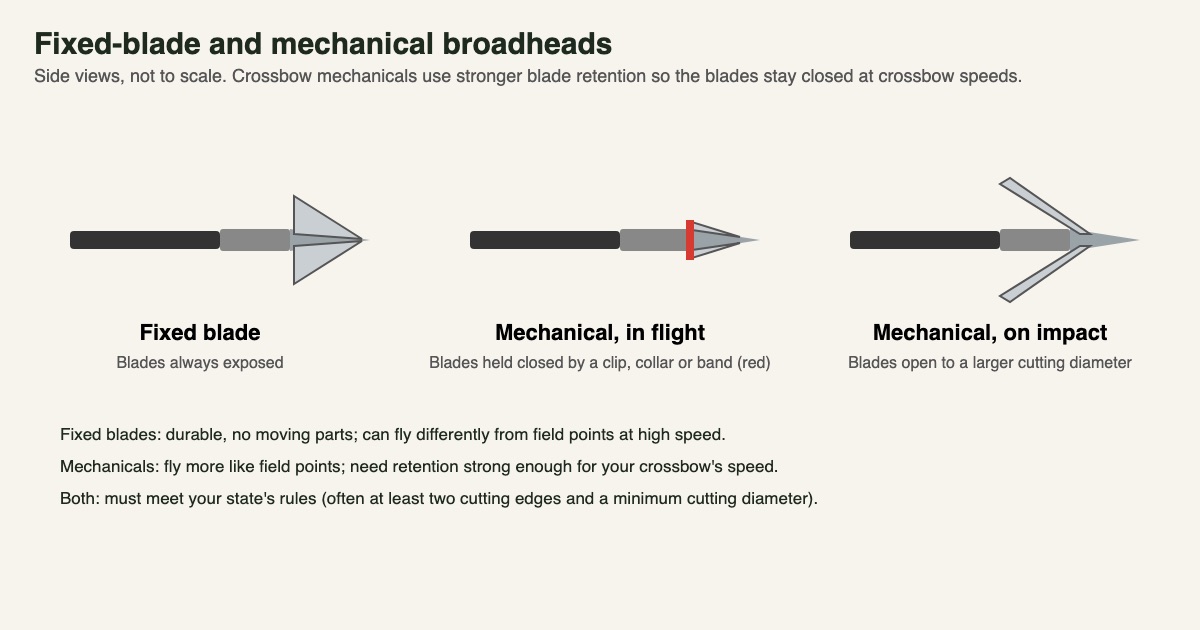
Fixed blade vs mechanical on a crossbow
| Fixed blade | Mechanical (crossbow-rated) | |
|---|---|---|
| Moving parts | None | Blades, retention clip or collar |
| Flight | Can be affected by wind and planing, especially if the bolt is not perfectly tuned | Usually flies close to field points |
| Cutting diameter | Smaller | Larger once open |
| Durability | Very durable; many can be resharpened | Blades and clips may need replacing after a shot |
| Penetration | Usually excellent, even on bone | Can lose some energy as blades open |
| Practice | Use practice heads or the hunting heads themselves | Practice heads that match flight are common |
| Legal concerns | Rarely restricted | Some places restrict expandable heads; check rules |
Our fixed-blade vs mechanical comparison goes deeper into the general trade-offs. On crossbows the main extra question is simply: is this mechanical rated for crossbow speeds?
Choosing broadhead weight
Follow your crossbow and bolt maker
Manufacturers specify both a recommended point weight and a minimum total bolt weight. TenPoint's guidance is a good example:
| Item | TenPoint guidance |
|---|---|
| Recommended broadhead weight | 100 grains, which its bolts are designed around |
| Heavier heads | 125 or 150 grains possible, but "shoot-testing these broadheads on our arrows may be necessary" |
| Minimum finished bolt weight, crossbows made 2012 or later | At least 370 grains, including a 100-grain point |
| Minimum finished bolt weight, crossbows made before 2012 | At least 420 grains, including a 100-grain point |
| Exception | Some Wicked Ridge Ranger models allow at least 350 grains |
Other brands set their own numbers, so check your manual. Manufacturers set minimums because a bolt that is too light does not absorb enough of the crossbow's energy, which can damage the crossbow and put the shooter at risk.
100 or 125 grains?
A heavier point moves the balance forward and adds a little momentum, but it also changes the trajectory and may need a different bolt spine. If your bolts are designed for 100 grains, stay with 100 unless you are prepared to test the change thoroughly, as TenPoint advises.
Cut-on-contact or chisel tip?
- Cut-on-contact heads have a blade edge right at the tip. They start cutting the moment they touch hide.
- Chisel or trocar tips have a pointed, faceted tip in front of the blades. They are strong when they hit bone.
Both kill well with good shot placement. The bigger factors are sharpness, flight and where you put the bolt. Our shot placement guide covers where to aim.
What the law usually requires
Broadhead rules are set by each state or province and apply to crossbows as well as vertical bows. As an example, Minnesota requires broadheads with at least two metal cutting edges, a barbless design and a cutting diameter of at least 7/8 inch, and sets conditions for expandable heads. Other common rules:
- A minimum cutting diameter for fixed heads, and sometimes a measurement rule for mechanicals.
- Barbless designs.
- Restrictions on mechanical heads in some places or for some species.
- Separate rules for crossbow use, including who may use one and when.
Always check your state's current regulations before buying.
Tuning and practice
- Sight in with field points of the same weight as your broadheads; see our crossbow scope guide.
- Spin-test each broadhead-tipped bolt on a flat surface or in a spin tester. A wobble means a misaligned insert, a bent bolt or a crooked head.
- Shoot broadheads into a broadhead-rated target at 20 and 30 yards. Scheels recommends testing "with field points first, then confirm with broadheads matching hunting specifications."
- Compare groups. If broadheads hit apart from field points, check alignment, then re-zero with broadheads if needed.
- Swap in fresh blades or new heads for hunting; practice dulls edges.
- Mark matched bolts so you know which ones fly best.
The rest of the bolt matters too
A broadhead only flies as well as the bolt behind it. Before blaming the head, check the parts it is attached to:
- Inserts. The insert is the threaded sleeve glued into the front of the bolt. If it is not square to the shaft, every broadhead will wobble. Spin-testing reveals this quickly.
- Straightness and spine. Bent or damaged bolts never group well with broadheads. Inspect bolts after every session and retire any with cracks, dents or splinters, especially carbon bolts.
- Nocks. Use the nock type your crossbow maker specifies, such as half-moon, flat or capture nocks, and orient half-moon nocks correctly. The wrong nock can cause a dangerous dry-fire-like release.
- Fletching. Damaged or loose vanes steer the bolt badly. Larger broadheads need enough fletching to stabilise them.
- Matching. Weigh your bolts and keep matched sets together. Small weight differences show up as vertical spread at longer range.
Common mistakes
- Using vertical-bow mechanicals on a fast crossbow without checking that they are rated for crossbow speeds.
- Changing point weight without testing. A switch from 100 to 125 grains changes where bolts hit and may change how they fly.
- Hunting with the heads you practised with. Practice dulls blades and can loosen ferrules; hunt with fresh, sharp heads that you have test-flown.
- Skipping the broadhead check. Field points alone do not prove your hunting setup is accurate.
- Ignoring the minimum bolt weight. Light bolts with light heads may shoot fast but can damage the crossbow.
- Carrying broadheads loose. Use a covered quiver; sharp heads cause many hunting injuries.
Choosing crossbow broadheads: a checklist
- Is it rated for crossbow speeds (for mechanicals) or built strongly enough (for fixed)?
- Does it match the point weight your crossbow and bolts are designed for?
- Does the finished bolt meet the minimum total weight in your manual?
- Is it legal in your state for the species and season?
- Does it fly with your field points in your crossbow?
- Can you get replacement blades or practice heads?
Caring for broadheads
- Store them in a dry, covered case to stop rust and protect edges.
- Inspect after every shot: bent blades, chipped edges or loose ferrules mean replacement.
- Resharpen fixed blades that are designed for it, or replace the blades.
- Check tightness before each hunt; vibration can loosen heads.
Crossbow-specific mechanical broadheads
Advantages
- Stronger retention keeps blades closed at crossbow speeds
- Usually fly very close to field points
- Large cutting diameter on impact
Trade-offs
- More parts that can fail or need replacing
- Not legal everywhere
- Can lose some penetration on heavy bone
Fixed-blade broadheads on a crossbow
Advantages
- No moving parts, very durable
- Excellent penetration
- Legal almost everywhere
Trade-offs
- More sensitive to bolt tuning and wind
- Smaller cutting diameter
- May need re-zeroing compared with field points
You can browse crossbow broadheads and broadhead-rated targets on Amazon. Check the grain weight, crossbow rating and your state's rules first.
Frequently asked questions
Can you use compound broadheads on a crossbow?
They usually fit, but mechanical heads made for vertical bows may open in flight at crossbow speeds. Use heads rated for crossbows or follow your crossbow maker's recommendations.
What grain broadhead is best for a crossbow?
100 grains is the most common, and TenPoint designs its bolts around that weight. Heavier heads may need shoot-testing and a different bolt.
Are mechanical broadheads good for crossbows?
Crossbow-rated mechanicals are widely used. They need stronger blade retention than vertical-bow versions, and they must be legal where you hunt.
Do broadheads hit differently from field points on a crossbow?
They can, especially fixed blades. Confirm broadhead groups before the season and re-zero if needed.
What is the minimum bolt weight for my crossbow?
It depends on the model. TenPoint, for example, requires at least 370 grains for its 2012-and-later crossbows and 420 grains for older models, including the point. Check your manual.
How often should I replace crossbow broadhead blades?
Replace or resharpen blades whenever they are dull, chipped or bent, after any shot into an animal, and before the season if you practised with them. Mechanical blades and retention clips should be replaced after a hit.
Related articles
 Training
How to Sight In a Crossbow Scope, Step by Step
How to sight in a crossbow scope: safety, mounting, a 20-yard zero, multi-reticle and speed-dial scopes, broadhead checks and fixes for wandering groups.
October 6, 2026 · 9 min read
 Comparisons
Fixed-Blade vs Mechanical Broadheads: Pros, Cons and Rules
Fixed-blade vs mechanical broadheads compared: flight, tuning, cutting diameter, energy needs, durability, hybrid designs, regulations and which suits your bow.
Updated October 9, 2026 · 6 min read
 Comparisons
Crossbow vs Compound Bow: Which Is Better for You?
Crossbow vs compound bow compared: how each works, speed and energy, weight, holding and follow-up shots, accuracy, learning curve, hunting rules and costs.
August 12, 2026 · 5 min read