
Crossbow Shooting Sticks and Rests
Crossbow tripod, bipod, monopod or blind rest? How each one steadies a heavy crossbow, what it costs you in weight, and how to keep limbs and fingers clear.
By Archery Insider Editorial Team
· · 5 min read

In this article
A crossbow tripod, bipod, monopod or blind rest takes the crossbow's weight off your arms while you wait for a shot. A monopod is the lightest, a tripod gives the most support, and a fixed blind rest needs no legs. Whichever you choose, it must hold the fore-end, never the limbs, rail, string or cables.
Why a rest helps with a crossbow
A cocked crossbow needs no effort to hold at full draw, but it is heavy and often front-heavy. Brad Fenson writes in Crossbow Magazine that "A front-heavy crossbow can be challenging to hold steady if not using shooting sticks or a rest." His practice advice is to "Shoot with a bipod and with sticks and then off the bench", so you learn how each position feels before the season.
Alice Jones Webb, writing on Excalibur's blog, says holding a crossbow on target for minutes "can get tiring real fast", and that "A solid rest or shooting sticks can help lighten that load and help me hold steady."
That's the honest case: less fatigue while you wait. A rest won't fix a poor trigger squeeze or an unzeroed scope. Our guide to sighting in a crossbow scope covers zeroing from a solid rest first.
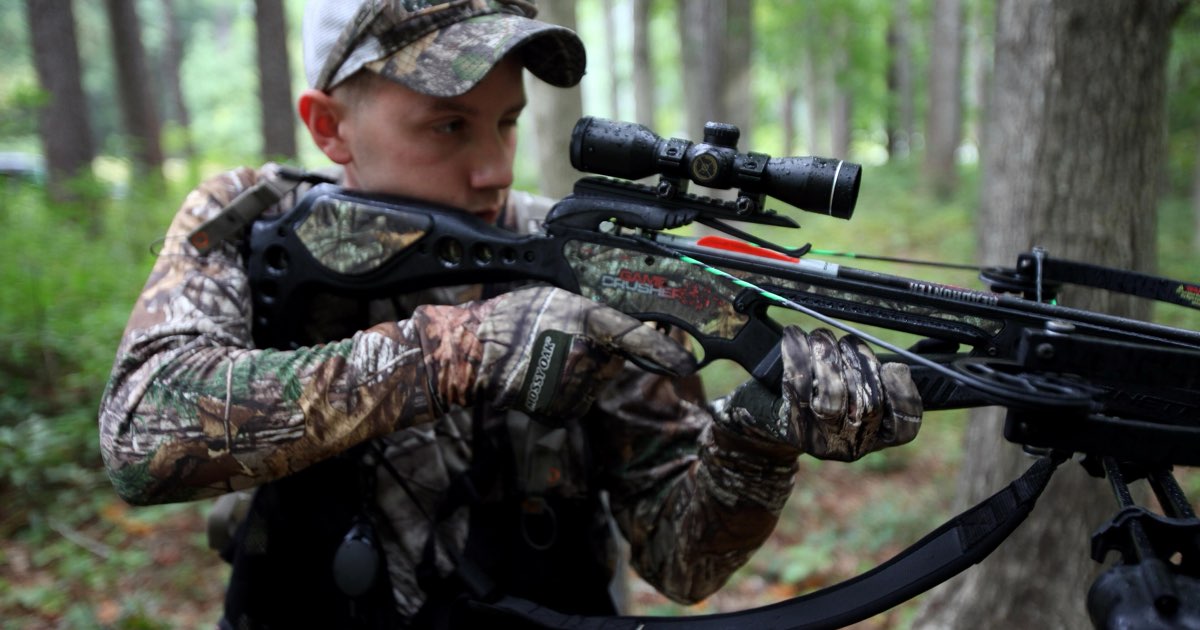
Monopods, bipods, tripods and blind rests
TenPoint's own accessory range shows the main options: when we checked, it listed the SteddyEddy Crossbow Monopod System, the Axis Tripod and Axis XL Carbon Tripod, and the DeadRest Carbon Stability System. Other brands make rests that fix to a blind: Fourth Arrow says its Final Rest system can "pivot between windows in stationary blinds".
| Rest | Weight to carry | Suits | Watch for |
|---|---|---|---|
| Monopod | Lightest | Moving between spots | You still balance side to side |
| Bipod or two-leg sticks | Light to moderate | Kneeling or sitting on the ground | Uneven ground |
| Tripod (often with a cradle) | Heaviest | Long waits in a blind | Bulk and set-up noise |
| Fixed blind or stand rest | Left in place | Hunting the same spot | Limbs near walls, windows and rails |
Tree-stand hunters often use a fixed rest or the stand's shooting rail instead of legs. Our tree stand vs ground blind comparison covers the wider trade-offs.
Keep limbs, cables and fingers clear of the rest
This matters most. The limbs and cables move fast at the shot, and the string travels along the top of the rail. Anything in that space, including the rest, gets hit.
- Limbs and cables: TenPoint's 2019 manual says: "Make certain your crossbow limbs are unobstructed when shooting," warning that limbs hitting "a tree, branches or a ground blind" could cause serious injury. Ravin's R26/R29 manual says not to fire "if branches or other obstructions block its limbs' release path." Barnett's manual bans foreign objects, hunting accessories included, "on, in and/or near the arrow/flight track, the string and/or the cables."
- Fingers: TenPoint warns that when shooting from a bench rest, "your fore-grip hand is particularly vulnerable to misplacement," and tells you to keep fingers and thumb "below the surface of the arrow flight deck." Ravin's manual says don't let your fore-grip hand "rotate into the bowstring path," and warns bench-rest shooters against resting a finger on the trigger with the safety off.
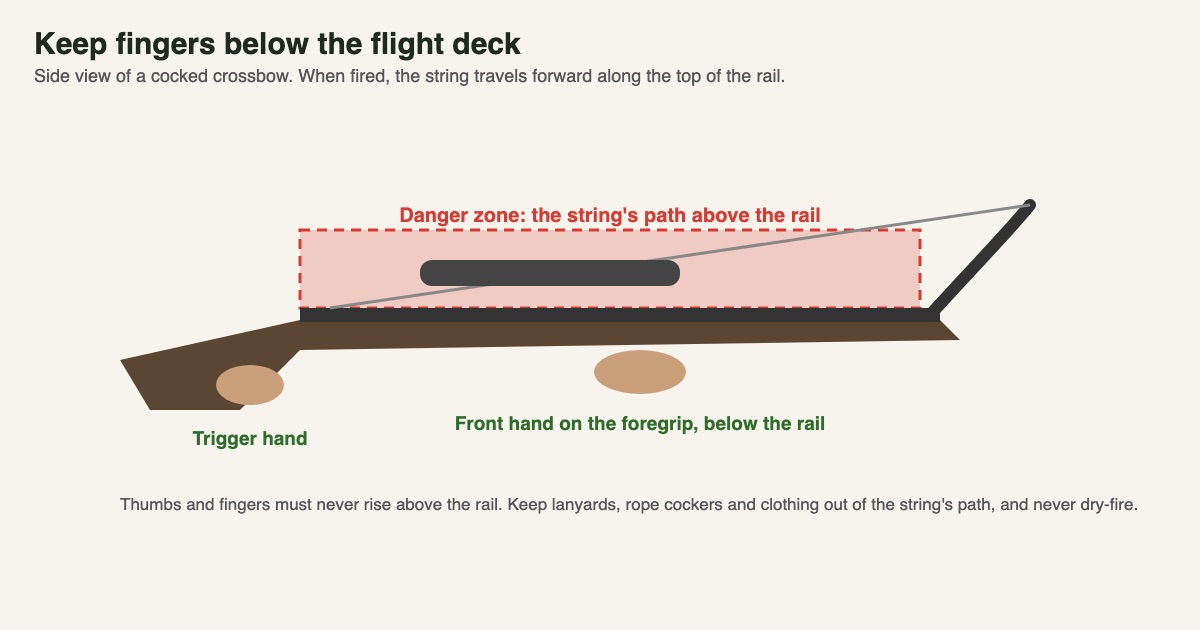
So set the rest under the fore-end, behind the limbs, and check from above that nothing sits beside the limbs or under the cables. Then rest your hand flat under the fore-grip, not wrapped around the rest's cradle.
Practise from the rest you'll hunt with
Your hold and balance change between a bench, a bipod and a tripod, so practise from the support you'll hunt with, as Fenson suggests. Practise setting up quietly, too: a tripod that clatters open can cost you a shot.
For examples to consider, you can browse crossbow shooting sticks and tripods on Amazon or look at crossbow monopods and bipods. Check the height range suits your sitting or kneeling position. Still choosing a weapon? Our crossbow vs compound bow comparison may help.
Frequently asked questions
Do I need a crossbow tripod?
No, but many hunters find one helpful. Crossbow Magazine notes a front-heavy crossbow is hard to hold steady without sticks or a rest. A tripod suits long waits in a blind; a monopod or bipod suits hunters who move. Practise from whichever rest you choose before you hunt with it.
Can I rest my crossbow on a tree stand rail or blind window?
Many hunters do, but check the limbs first. TenPoint warns that limbs hitting obstructions such as branches or a ground blind can cause serious injury, and Ravin says not to fire if anything blocks the limbs' path. Keep your fingers below the flight deck and away from the string.
Related articles
 Training
How to Sight In a Crossbow Scope, Step by Step
How to sight in a crossbow scope: safety, mounting, a 20-yard zero, multi-reticle and speed-dial scopes, broadhead checks and fixes for wandering groups.
October 6, 2026 · 9 min read
 Comparisons
Crossbow vs Compound Bow: Which Is Better for You?
Crossbow vs compound bow compared: how each works, speed and energy, weight, holding and follow-up shots, accuracy, learning curve, hunting rules and costs.
August 12, 2026 · 5 min read
 Guides
How Does a Crossbow Work? Recurve, Compound, Reverse
How does a crossbow work? The parts, how the latch and trigger release the string, what the power stroke is, and how recurve, compound and reverse-draw differ.
Updated October 6, 2026 · 5 min read