
Crossbow Maintenance: A Complete Checklist
A crossbow maintenance checklist: pre-shoot inspection, waxing string and cables, rail lube, checking bolts and screws, storage and string replacement.

By Archery Insider Editorial Team
· 9 min read
In this article
A modern crossbow stores a lot of energy in a short, stiff set of limbs, and every shot puts that energy through the string, cables, rail and trigger. A few minutes of regular maintenance keeps it accurate, extends the life of the string and cables, and, most importantly, catches problems before they become dangerous.
This guide gives you a practical crossbow maintenance routine: what to check before every session, what to do every few weeks of shooting, what to do at the start and end of each season, and when to hand the crossbow to a professional.
Why crossbow maintenance matters
Crossbow strings travel along a rail under high tension, so they wear faster than most vertical bow strings, especially at the centre serving, which rubs the rail on every shot. Loose screws let the scope move and spoil accuracy. A frayed string or cracked limb can fail suddenly. NRA Family warns that firing without an arrow, called dry firing, "will almost surely destroy the crossbow and can be very dangerous to the shooter," and a damaged crossbow can fail in a similar way.
Always check your owner's manual first. Manufacturers differ in which waxes, lubricants and schedules they recommend, and following them may also matter for your warranty.
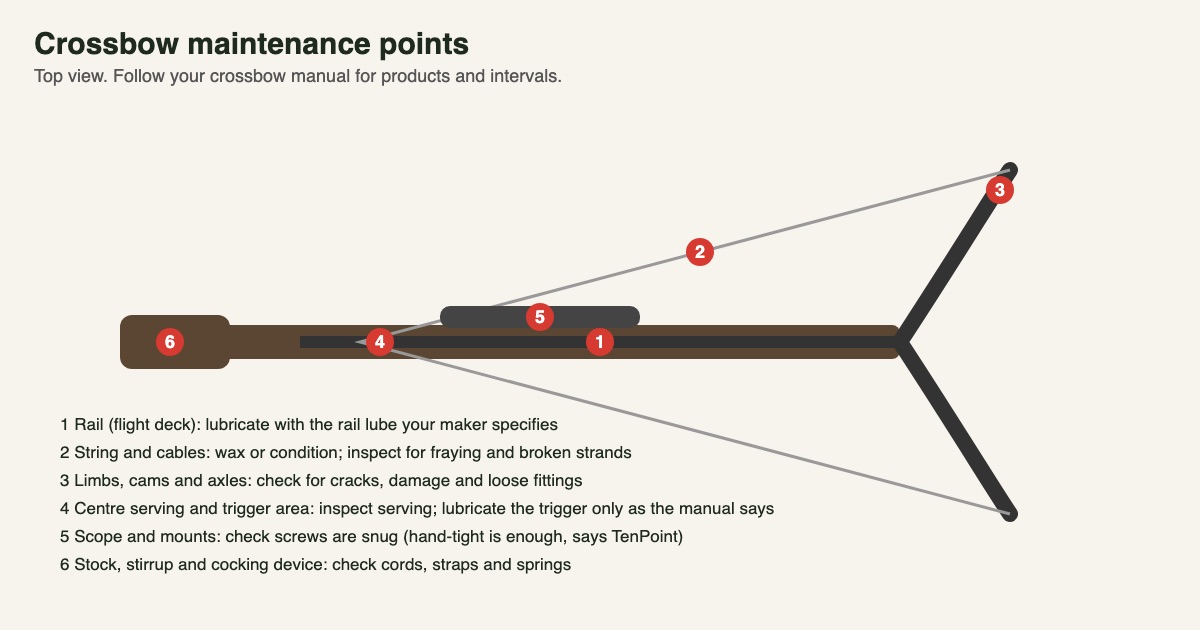
The six areas to check
Our diagram above shows the six areas to focus on:
- Rail (flight deck): where the string and bolt slide.
- String and cables: the load-carrying parts that wear.
- Limbs: the energy-storing parts.
- Serving and trigger: the centre serving that contacts the rail and the trigger mechanism that holds the string.
- Scope and mounts: for accuracy.
- Cocking device: rope cocker, crank or built-in system.
A basic maintenance kit
You do not need much to look after a crossbow. A simple kit covers almost everything an owner should do at home:
- String wax or conditioner of the type your manufacturer recommends.
- Rail lube, if your manufacturer specifies it.
- Allen keys and screwdrivers that fit your crossbow's fasteners, so you do not round off heads.
- A soft cloth for wiping down the rail, limbs and stock.
- A lens cloth or brush for the scope.
- A light rust-protective oil for exposed metal parts.
- A decocking bolt or the decocking method your manual specifies.
- A small torch to inspect the string, cables and limbs closely.
Keep the kit in your crossbow case so it travels with the bow.
Before every session
TenPoint advises that you "inspect your crossbow equipment for worn, loose, damaged or missing parts" and check the "cables and crossbow string for signs of fraying or broken strands." It adds: "Do not use the crossbow until these parts have been replaced." A quick check takes a couple of minutes:
- String and cables: look for fuzz, fraying, broken strands, or separation of the serving.
- Limbs: look and feel for cracks, splinters or chips, especially near the limb pockets and tips.
- Cams or wheels (compound and reverse-draw models): check they are straight, with the string and cables sitting in their grooves.
- Screws and bolts: check nothing is loose, especially on the scope mount, stirrup and limb pockets.
- Rail: look for grooves, burrs or debris.
- Safety and trigger: with the crossbow uncocked, check the safety moves freely and positively.
- Bolts: check each bolt for cracks, damaged nocks and loose inserts; our bolt guide explains the flex test.
If anything looks wrong, do not shoot. Take it to a dealer or contact the manufacturer.
Regular maintenance (every few weeks of shooting)
Wax the string and cables
String wax or conditioner keeps the fibres supple, reduces abrasion and repels moisture. TenPoint's checklist advises: "Apply a string conditioner or wax to the string and cables to prevent wear." Rub a small amount into the string and cables (not the serving, unless the manufacturer says so), then work it in with your fingers until it warms and soaks in. Wipe off any excess. How often depends on how much you shoot and the conditions; a string that looks dry or fuzzy needs wax.
Lubricate the rail, if your manufacturer recommends it
Many crossbow makers recommend a specific rail lube to reduce friction and wear on the centre serving. Others use a different approach, so check the manual. If yours calls for rail lube, apply a thin film along the rail where the string slides, then wipe away excess. Do not use household oils or products the manufacturer has not approved.
Check the serving
The centre serving rubs on the rail with every shot. Look for wear, flattening or separation. A worn serving should be replaced by a dealer before it wears through to the string.
Tighten fasteners
TenPoint says: "Check the tightness of all screws, nuts, and bolts on your crossbow. Hand-tight is all that is needed." Over-tightening can strip threads or crack parts, so use the correct tool and stop when snug. Pay particular attention to the scope rings and mount, which loosen with the vibration of each shot.
Lubricate moving parts
TenPoint's checklist also advises: "Apply lubricating oil to all moving parts that need it." On most crossbows this means the trigger's external moving parts, the cocking mechanism and the stirrup hinge if it has one. Follow your manual for which parts and which lubricant, and never lubricate inside the trigger box unless the manual instructs it.
Cocking device care
Our cocking guide explains each type. TenPoint's checklist advises you to make sure all parts are "in top operating shape, paying special attention to cords, straps, and springs."
- Rope cockers: check the rope for fraying and the hooks for wear.
- Crank cockers: check the strap or cord for fraying, the handle for play and the mechanism for smooth operation.
- Built-in cockers: follow the manual and have a dealer service them if they become stiff or noisy.
A failed cocking device can let the string snap forward or injure your hands, so replace worn parts immediately.
Scope and accuracy
- Check the scope mount and rings are tight before each session.
- Clean lenses with a lens cloth or brush, not your shirt.
- After any knock or fall, check the zero before hunting; our scope sight-in guide explains how.
- If your groups suddenly open up, check for loose screws and string wear before adjusting the scope.
Start-of-season checklist
- Full inspection of string, cables, serving, limbs, cams and rail.
- Wax the string and cables; lube the rail if specified.
- Check and tighten every screw, nut and bolt.
- Inspect and replace damaged bolts, nocks and inserts.
- Check the cocking device and its cords or straps.
- Re-check your zero at your common hunting distances.
- Check your broadheads are sharp and fly with your field points; our crossbow broadhead guide covers tuning.
- Check the string's age and consider replacement.
After hunting in rain or snow
Wet weather is hard on any bow. When you get home:
- Uncock the crossbow safely and unload it.
- Wipe it dry, including the rail, trigger area, limbs and cams.
- Let it air dry out of its case; a closed, damp case encourages rust and mould.
- Re-wax the string and cables, because water can wash wax out.
- Check metal parts for early rust and treat them with a light protective oil.
- Dry your bolts and broadheads, and check the broadheads for rust on the blades.
End-of-season and storage
- Clean and dry the crossbow, especially after rain or snow.
- Protect metal parts from rust: TenPoint's checklist advises: "Apply some rust-protective oil to the parts on the crossbow that might be susceptible to rust from moisture."
- Wax the string and cables before storage.
- Store it uncocked, in a case, somewhere dry and away from extreme heat. Never leave a crossbow cocked for longer than necessary.
- Keep it away from children and unauthorised users.
- Do not store it in a hot vehicle for long periods, which can damage strings and finishes.
When to replace the string and cables
TenPoint states: "We recommend changing the string and cables on your crossbow every two years," and "Always replace both the string and the cables when having them changed." Replace sooner if you see:
- Broken or frayed strands.
- Serving worn through or separating.
- The string stretching so the crossbow loses speed or changes impact point.
- Damage from a dry fire or a cut.
Replacing string and cables on many modern crossbows needs a crossbow press and specialist knowledge, so have it done by a dealer unless the manufacturer says otherwise.
Keep a simple maintenance log
A note in your phone or case is enough. Record the date you bought or last restrung the crossbow, when you last waxed the string, roughly how many shots it has taken, and any parts you have replaced. This makes it easy to follow a two-year string schedule, spot changes in accuracy, and give a dealer useful information if something goes wrong.
Problems and fixes
| Problem | Likely cause | Fix |
|---|---|---|
| Groups suddenly opening | Loose scope or mount; worn string | Tighten mounts; inspect the string |
| Fuzzy, dry string | Needs wax | Wax and work it in |
| Serving worn at the centre | Normal wear on the rail | Have the serving replaced |
| Noisy shot or vibration | Loose parts or dry string | Check fasteners and wax |
| Stiff cocking | Dirty or worn cocking device | Clean, inspect and service |
| Cracked limb or frayed cable | Damage or age | Stop shooting; see a dealer |
Common mistakes
- Dry firing: always use an arrow, a decocking bolt or the manual's decocking method.
- Over-tightening screws and stripping threads.
- Using the wrong lubricant on the rail or string.
- Waxing the serving when the manufacturer advises against it.
- Ignoring a small fray until it fails.
- Storing the crossbow cocked or in a hot vehicle.
Regular crossbow maintenance
Advantages
- Catches dangerous damage before it fails
- Keeps the zero and accuracy consistent
- Extends string, cable and serving life
Trade-offs
- Takes a few minutes before every session
- String and cable replacement usually needs a dealer
You can browse crossbow string wax and rail lube or crossbow maintenance kits on Amazon.
Frequently asked questions
How often should I wax my crossbow string?
Whenever it looks dry or fuzzy, and as your manufacturer recommends. Frequent shooters wax more often.
Should I lubricate the crossbow rail?
Only if your manufacturer recommends it, and only with the product they specify.
How often should I replace my crossbow string?
TenPoint recommends every two years, replacing the string and cables together, or sooner if damaged.
Can I replace a crossbow string myself?
Many crossbows need a press and specialist knowledge. Have a dealer do it unless your manual says otherwise.
Is it bad to leave a crossbow cocked?
Yes. Leaving it cocked puts the string, cables and limbs under constant stress and is a safety risk. Uncock it as soon as you are done.
What should I do if I dry fire my crossbow?
Stop using it immediately. Do not cock it again until a dealer or the manufacturer has inspected the string, cables, limbs and cams for damage.
Why is my crossbow suddenly shooting in a different place?
Check for a loose scope or mount, a worn or stretched string, or damaged bolts before you touch the scope adjustments.
Related articles
 Training
How to Cock a Crossbow Safely
How to cock a crossbow safely: by hand, with a rope cocker or a crank, centring the string, loading a bolt correctly, and safe ways to unload or decock.
October 13, 2026 · 9 min read
 Gear
Crossbow Bolts Explained: Length, Weight, Nocks
Crossbow bolts explained: carbon vs aluminium, length, minimum weight, front-of-centre balance, nock types, lighted nocks, inspection and how to choose.
October 13, 2026 · 10 min read
 Training
How to Sight In a Crossbow Scope, Step by Step
How to sight in a crossbow scope: safety, mounting, a 20-yard zero, multi-reticle and speed-dial scopes, broadhead checks and fixes for wandering groups.
October 6, 2026 · 9 min read