
How to Use a Crossbow: A Beginner's Guide
How to use a crossbow safely: inspect, cock, load, aim, squeeze and unload, with the rules every maker manual agrees on, plus practice and hunting basics.

By Archery Insider Editorial Team
· 11 min read
In this article
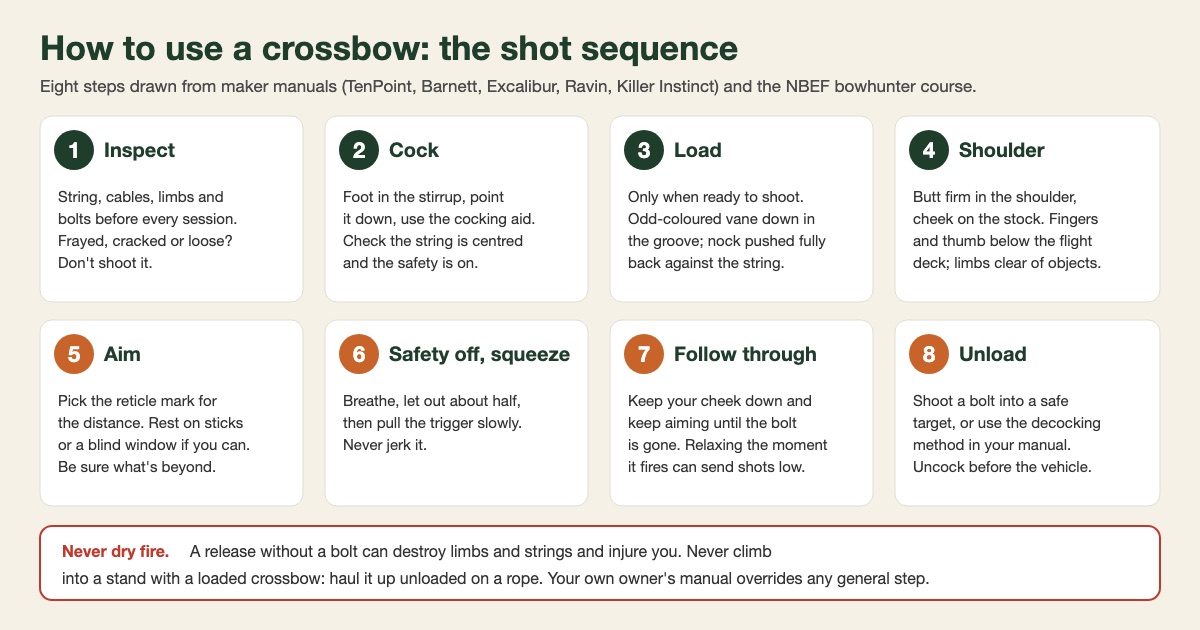
Learning how to use a crossbow comes down to one sequence: inspect it, cock it with the string centred, load a bolt only when you're ready to shoot, keep your fingers and thumbs below the flight deck, aim with the safety on, then take the safety off and squeeze the trigger slowly. When you're done, unload it by shooting into a safe target or by the decocking method your manual gives.
None of that is hard, and TenPoint's own beginner article says as much. What makes a crossbow different from a gun or a vertical bow is a string that snaps across the top of the stock with enough force to take off a thumb, and a set of limbs that can be wrecked by a single dry fire. This guide walks through each step using what the makers' manuals and the national bowhunter education course actually say.
Before your first shot
Every maker treats a crossbow like a firearm. Killer Instinct's 2026 manual opens with "A crossbow is a deadly weapon!" and lists the familiar firearm rules: point it in a safe direction, treat it as loaded, keep your finger off the trigger until ready, keep your body out of the string's path, and know your target and what's beyond it. The same manual says crossbows "should only be used by those that have completed a hunter's safety course or trained by a qualified professional."
That's good advice even if your state doesn't require a course for target shooting. The free NBEF study guide at bowhunter-ed.com has a whole crossbow unit, and an archery shop can walk you through your model's cocking device in ten minutes.
You'll also need:
- Safety glasses. TenPoint, Barnett, Excalibur, Ravin and Killer Instinct all tell you to wear them when cocking, loading and shooting.
- The bolts your manual specifies. Ravin's R-series manual, for example, says "Do not use arrows lighter than 400 grains (including tip)", because lighter ones can cause a dry fire. Our crossbow bolts guide explains length, weight and nocks.
- A crossbow-rated target with a safe backstop and nothing beyond it you don't intend to hit.
- The cocking aid that came with your crossbow, or one your maker lists as compatible.
The safety rules every manual agrees on
We read five current or recent owner's manuals plus the NBEF course. The wording differs; the rules don't.
| Rule | What the sources say |
|---|---|
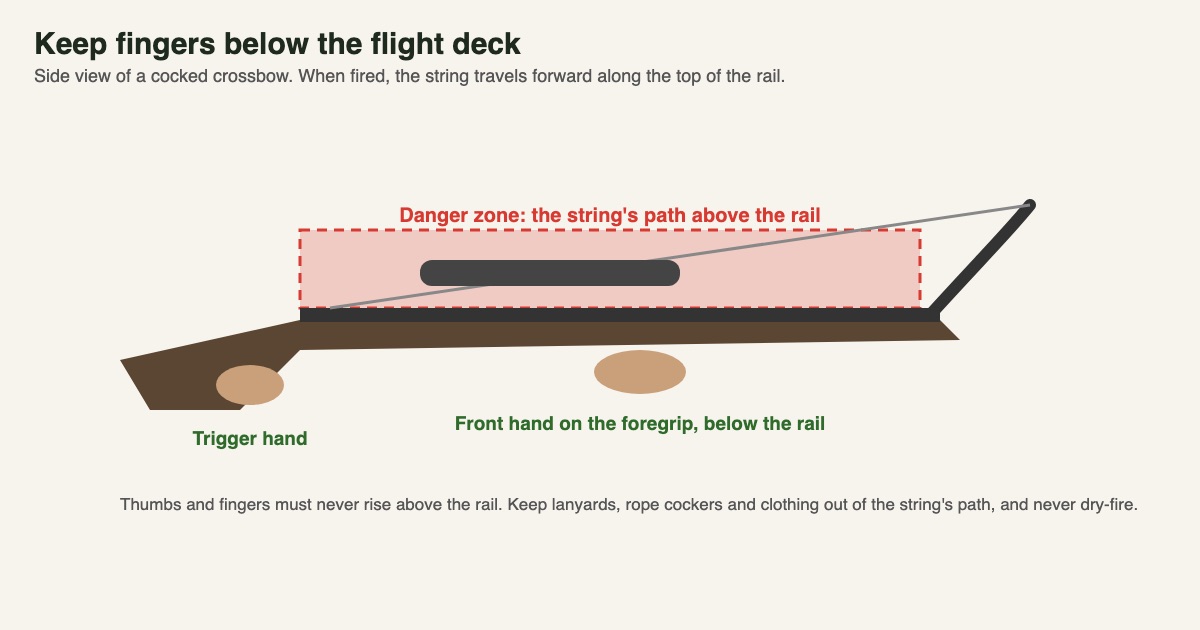
| Fingers below the deck | Excalibur: "Be sure that your fingers and thumb are below the crossbows deck before every shot." Ravin: "Keep your fingers below the finger guard at all times." |
| Never dry fire | Barnett: dry firing "will result in catastrophic crossbow damage". Excalibur: it "will damage your crossbow and void the warranty." |
| Seat the bolt fully | TenPoint: make sure "the arrow is fully seated in furthest back position to reduce possibility of dry-fire." |
| Inspect every session | TenPoint: check for "worn, loose, damaged or missing parts" and fraying before each session. Killer Instinct: examine after every shot. |
| Limbs clear | NBEF: make sure "there are no obstacles near the ends of the limbs." Killer Instinct: never fire if branches or blind walls may contact the limbs. |
| No loaded crossbow in a tree | Excalibur: "Never climb a tree stand with a cocked and loaded crossbow." Barnett: never cock "while in an elevated tree stand". |
| Don't leave it cocked | TenPoint: "Do not leave your crossbow cocked for extended periods of time." |
How to use a crossbow, step by step
1. Inspect the crossbow and bolts
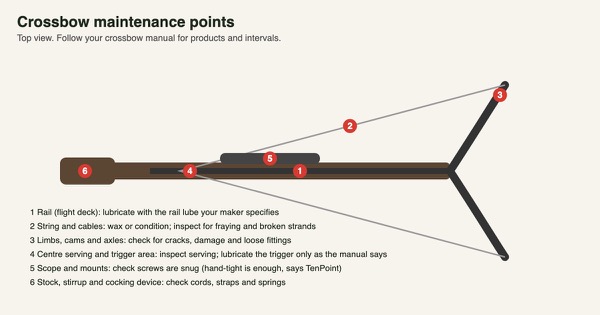
Look at the string and cables for fraying or broken strands, the limbs for cracks or chips, and every screw for looseness. Check each bolt for cracks and a sound nock. TenPoint's rule is simple: if parts are damaged or missing, "Do not use the crossbow." Our crossbow maintenance checklist shows what to look for.
2. Cock it with the string centred
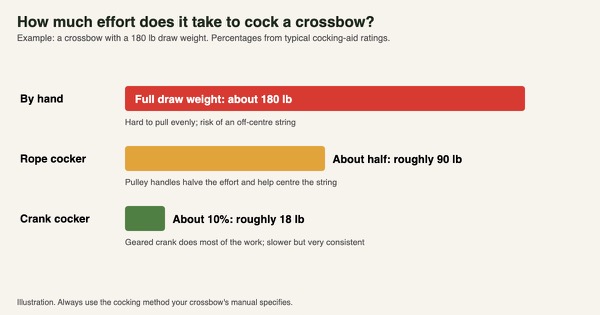
Point the crossbow at the ground in a safe direction, put your foot fully in the stirrup and use the cocking aid. TenPoint warns that its narrow and reverse-draw models are too narrow to cock by hand, and that "if your crossbow's draw weight is simply too heavy for you", you should use a cocking assist. The NBEF course suggests marking the serving just outside the rail so you can see at a glance whether the string is centred. Check the safety has engaged. Our crossbow cocking guide covers rope cockers, cranks and centring in detail.
3. Load the bolt only when you're ready to shoot
The NBEF course describes the load: put the "odd-colored feather down into the track" and move the bolt back against the string under the retention spring, with the nock properly aligned. TenPoint suggests holding the bolt near its point as you slide it in, so your hand stays clear of the string's path. Push it fully back. A bolt that isn't seated is one of the ways a crossbow can dry fire with a bolt on the rail.
4. Shoulder it with your hands in the right place
Bring the butt firmly into your shoulder and rest your cheek on the stock. NBEF points out that forearms have grooves or guides for your fingers and thumb, and says "Be sure to use them". Before you ever cock the crossbow, it suggests shouldering it several times to learn your cheek position, the safety's on and off movements and where your fingers go. Then check the limb tips are clear of tree trunks, branches and blind walls.
5. Aim
Pick the reticle mark for the distance and settle it on the target. TenPoint notes that crossbow scopes are built for bow-like distances: "The reticle itself might resemble a rifle scope, but are not designed for shooting at extreme distances." A rest helps a lot. NBEF says a crossbow "may be fired while resting on an object" for greater accuracy, which is what shooting sticks or a blind window are for.
6. Safety off, breathe and squeeze
Only now move the safety to fire. TenPoint describes letting out around half your breath, then beginning to pull the trigger slowly, and says: "You should ALWAYS pull the trigger slowly, never jerky." NBEF's version: "Take a deep breath; let half of it out. Squeeze the trigger."
7. Follow through
Keep your cheek down and keep aiming after the trigger breaks. NBEF explains why: "If you relax as soon as the trigger releases the latch, the arrow will strike low on the target or not reach it at all." TenPoint says to keep looking through the scope for a couple of seconds after the bolt has gone.
8. Unload when you're finished
If you've finished without shooting the last bolt, you need to unload safely (see the next section). Never put a cocked crossbow away.
Unloading and decocking safely
This is where models differ most, so it's where the manual matters most. The NBEF course gives the general rule: "The recommended method of uncocking a crossbow is to shoot an arrow from the cocked crossbow into a safe backstop." It adds that you shouldn't use a cocking device or a special unloading bolt to uncock unless your manufacturer recommends it.
| Crossbow | What its manual says about decocking |
|---|---|
| Barnett (universal manual) | Never use the rope cocking device to de-cock and never de-cock by hand; it puts you "at immediate risk of personal injury" |
| Excalibur recurve models | Can be decocked "without shooting an arrow" using the rope cocking aid, following the manual's steps exactly |
| Killer Instinct DC models (2026) | Decock with the supplied sled and the triggerbox's decocking button |
| Crossbows with a decocking crank | Follow the crank's own let-down procedure |
Killer Instinct's beginner guide puts the common case plainly: for most crossbows, "the only safe way to de-cock your bow is to shoot it into a target or use a de-cocking arrow." So carry a field-point bolt you're happy to shoot into a bank of soil or a discharge target at the end of every hunt.
Practice and sighting in
Before you hunt, sight in from a rest. Our step-by-step sight-in guide covers zeroing the top reticle and checking the lower marks. The NBEF course adds a hunting rule: you "must shoot and sight-in your crossbow using broadheads and arrow shafts identical to those you will be using for hunting", because broadheads may hit somewhere different from field points.
Then practise the way you'll hunt. Killer Instinct suggests trying "both elevated and seated positions in varying light conditions" from a stable rest, and notes that many beginners keep shots under 40 yards, because drop, wind and animal movement become harder to predict further out. A rangefinder helps you learn what 20, 30 and 40 yards look like.
| Practice session | Why it helps |
|---|---|
| From a bench or sticks at 20 yards | Confirms zero and builds a smooth trigger squeeze |
| Seated, at the height of your stand or blind | Matches the angle and position you'll hunt from |
| At unknown distances, then ranged | Trains your eye for picking the right reticle mark |
| Cocking and loading with gloves on | Makes the safe routine automatic on a cold morning |
| Low light, near sunset | Shows how the scope and reticle look when deer move |
Carrying, tree stands and vehicles
On foot. Barnett says "NEVER attempt to transport, carry and/or stalk with a loaded crossbow." Killer Instinct's 2026 manual agrees and adds that "It is acceptable to carry a cocked but unloaded crossbow." Keep broadheads in a hooded quiver.
In a tree stand. The NBEF course says to cock the crossbow at the base of the tree without loading a bolt, tie it to your haul line "so that the haul line is away from the trigger", climb up wearing your harness, then pull it up and load it. Never lean over to cock it in the stand. Our tree stand safety guide covers harnesses and haul lines.
In a vehicle. State law can be stricter than the manuals. New York's DEC says: "A crossbow may not be possessed in or on a motor vehicle unless it is un-cocked." Minnesota's statute says a person "may not transport an archery bow in a motor vehicle unless the bow is not armed with a bolt or arrow." Other states have their own wording, and TenPoint's manual notes that "Some jurisdictions require that a crossbow be encased during transport."
Rules checked on 9 October 2026; this isn't legal advice and regulations change, so confirm with your state wildlife agency (in New York, the DEC; in Minnesota, the DNR and the statute above) before you travel or hunt.
Common beginner mistakes
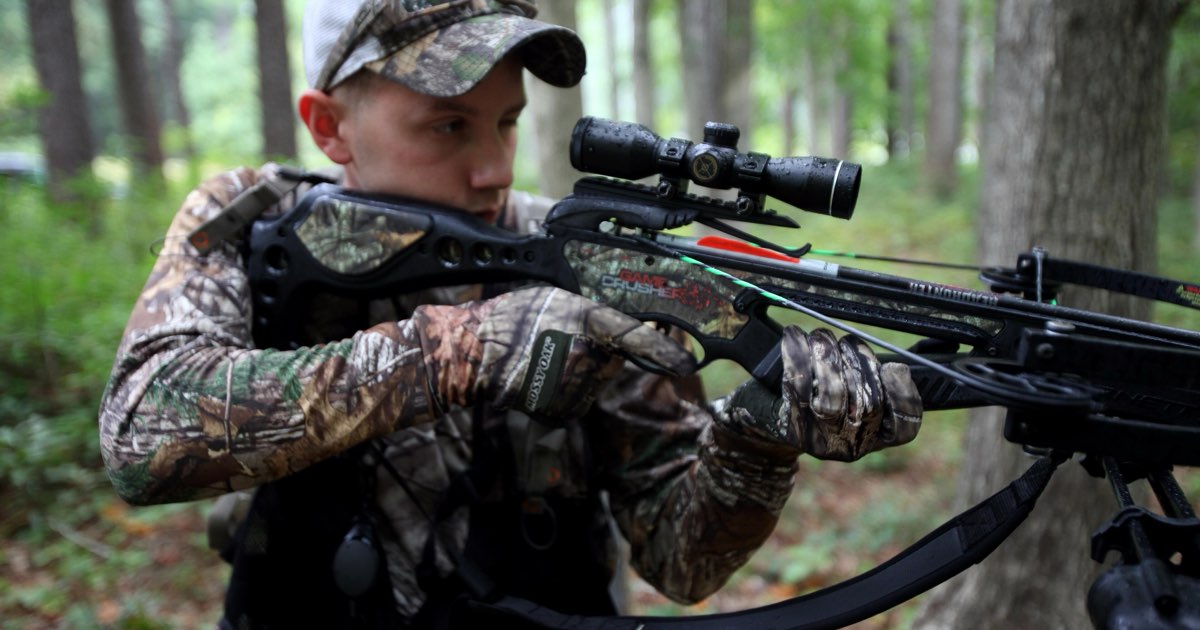
- A thumb creeping up over the deck, often when the shooter grips the fore-end like a rifle.
- Dry firing to "unload". It can wreck the limbs and string, and Barnett says a dry-fired crossbow must be inspected by a qualified service representative.
- Cocking unevenly, leaving the string off-centre and sending bolts left or right.
- Bolts that don't match the manual in weight, length or nock.
- Jerking the trigger or lifting your head to watch the bolt.
- Climbing or driving with a loaded crossbow, or leaving it cocked overnight.
Frequently asked questions
How do you use a crossbow for the first time?
Read the owner's manual, then practise shouldering and the safety with it uncocked. Cock it with the cocking aid, load one bolt with the odd vane down, rest it on sticks or a bench, aim at a crossbow-rated target about 20 yards away, take the safety off and squeeze slowly. Keep aiming until the bolt lands.
What happens if you dry fire a crossbow?
The stored energy goes into the limbs, string and cables instead of a bolt, which can break them and throw parts at you. TenPoint says a dry-fired crossbow must be inspected by an authorised dealer or the maker before it's re-cocked or shot. Stop using it and get it checked.
Is a crossbow easier to use than a regular bow?
In some ways. TenPoint notes the latch holds the string for you, so you don't have to hold a heavy draw while you aim, and the stock shoulders like a rifle. But you still need a cocking aid, careful hand placement and the same practice at judging distance as any bowhunter.
How far should a beginner shoot a crossbow?
Start at 20 yards from a rest. Killer Instinct says many beginning hunters keep shots under 40 yards, because bolt drop, wind drift and animal movement get harder to predict further out. Only stretch your distance once your groups are consistently tight at every range you practise.
Can you leave a crossbow cocked?
Not for long. TenPoint says not to leave it cocked "for extended periods of time", and the NBEF course tells you to check your manual for recommended times. Some states, such as New York, also require crossbows in vehicles to be uncocked.
Related articles
 Training
How to Cock a Crossbow Safely
How to cock a crossbow safely: by hand, with a rope cocker or a crank, centring the string, loading a bolt correctly, and safe ways to unload or decock.
October 13, 2026 · 9 min read
 Training
How to Sight In a Crossbow Scope, Step by Step
How to sight in a crossbow scope: safety, mounting, a 20-yard zero, multi-reticle and speed-dial scopes, broadhead checks and fixes for wandering groups.
October 6, 2026 · 9 min read
 Gear
Crossbow Maintenance: A Complete Checklist
A crossbow maintenance checklist: pre-shoot inspection, waxing string and cables, rail lube, checking bolts and screws, storage and string replacement.
October 16, 2026 · 9 min read