
How to Cock a Crossbow Safely
How to cock a crossbow safely: by hand, with a rope cocker or a crank, centring the string, loading a bolt correctly, and safe ways to unload or decock.

By Archery Insider Editorial Team
· 9 min read
In this article
Cocking a crossbow means pulling the string back until it locks into the trigger mechanism, ready to shoot. It sounds simple, and it is, but it is also the moment many crossbow injuries and accuracy problems begin. Modern crossbows store a lot of energy, the string is under high tension, and a string that is pulled back unevenly will send bolts off line.
This guide covers the three main ways to cock a crossbow, how to centre the string, how to load a bolt correctly, and the safe ways to unload a crossbow when you have not shot it. Always read your crossbow's manual first: its instructions override any general advice.
The quick answer
| Method | Effort | Speed | Consistency | Best for |
|---|---|---|---|---|
| By hand | Full draw weight | Fast | Hard to keep the string centred | Light, low-draw-weight crossbows only, if the manual allows |
| Rope cocker | About half the draw weight | Fast | Good; handles help centre the string | Most hunters; light and inexpensive |
| Crank (built-in or detachable) | About 10% of the draw weight | Slower | Excellent | High-draw-weight crossbows, smaller or older shooters, anyone with shoulder problems |
Know the parts
- Stirrup: the loop at the front where you put your foot to hold the crossbow while cocking.
- Rail or flight deck: the top of the stock where the bolt sits and the string travels.
- Latch and trigger box: where the string locks when cocked.
- Safety: a switch that blocks the trigger. Many crossbows set it automatically when cocked; check yours.
- Anti-dry-fire mechanism: a feature on many crossbows that prevents the trigger releasing without a bolt in place. Do not rely on it.
Safety rules before you start
NRA Family's crossbow guide boils safety down to a few core habits:
- Point it in a safe direction. "Always keep the crossbow pointed in a safe direction," including while cocking and loading.
- Finger off the trigger, hands below the deck. "Always keep your finger off the trigger, your hands and fingers under the flightdeck and out of the 'danger triangle.'"
- Keep it unloaded until you are ready to shoot.
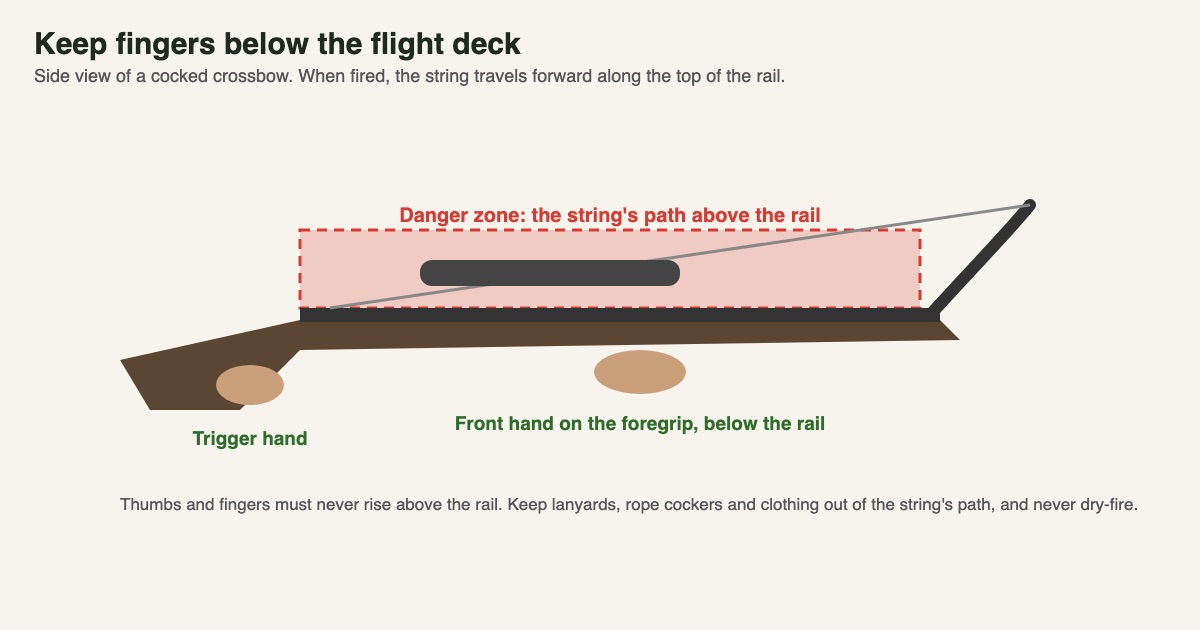
Also keep the rope cocker, slings, lanyards and loose clothing well clear of the string's path, and never cock a crossbow that has damaged strings, cables or limbs.
Method 1: Cocking by hand
Some lower-draw-weight crossbows can be cocked by hand. Check your manual first; many modern hunting crossbows are too heavy to cock by hand safely and consistently.
- Point the crossbow at the ground in a safe direction, finger off the trigger.
- Put your foot in the stirrup.
- Grip the string with both hands, evenly, close to the rail on each side.
- Pull straight up, smoothly, keeping your back straight and using your legs.
- Pull the string evenly into the latch until it clicks, and check it is centred.
- Check the safety is on.
The problem with hand cocking is consistency. It is easy to pull one side slightly further, leaving the string off-centre, which pushes bolts left or right.
Method 2: Using a rope cocker
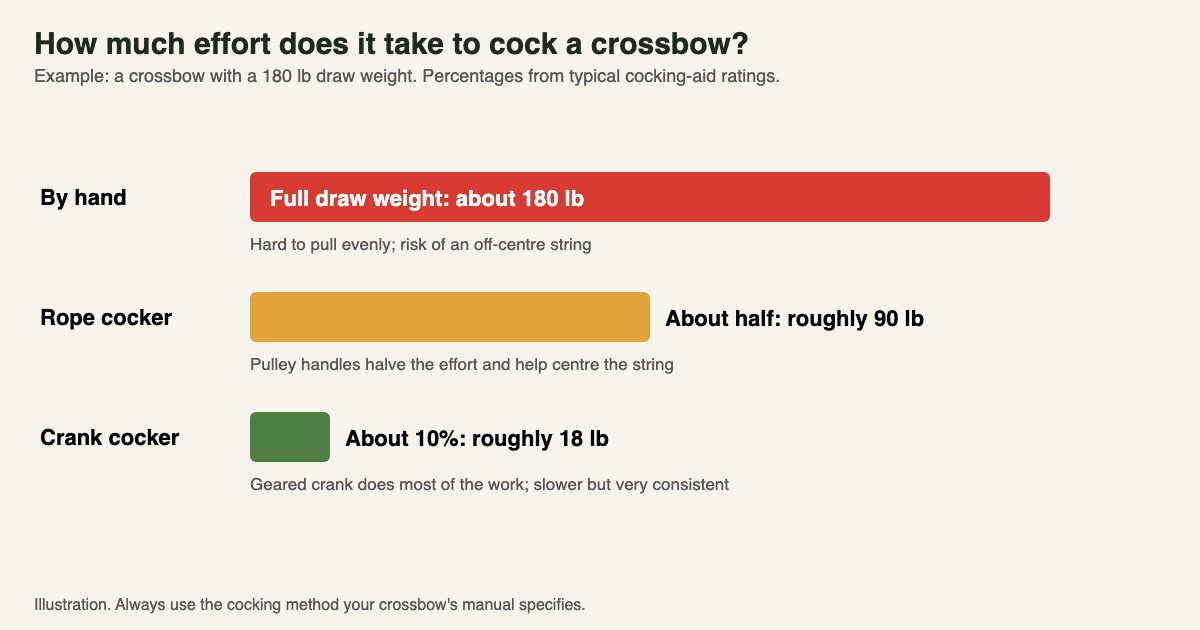
A rope cocker is a cord with hooks and two handles, running over a pulley at the stock. Deer & Deer Hunting describes it as the most basic, cost-effective option, and both standalone and stock-integrated versions reduce the effort by about 50 percent.
- Point the crossbow down in a safe direction, finger off the trigger.
- Place the cord over the back of the stock (or extend the integrated rope).
- Attach the hooks to the string on each side of the rail, as the instructions show.
- Put your foot in the stirrup.
- Pull both handles up evenly and smoothly until the string locks.
- Remove the hooks, check the string is centred, and check the safety.
Because both handles pull equally, rope cockers help set "a perfectly centred string", as many makers advertise. Stock-integrated rope cockers retract into the stock, which stops the cords tangling and speeds things up.
Method 3: Using a crank
Deer & Deer Hunting describes the crank cocker as "a separate crank handle that, when inserted into the device and turned, pulls the string up," reducing the effort by about 90 percent through an internal gear system. It also produces the most consistent string position, which can improve accuracy. Cranks make crossbows accessible to "people of all ages, strengths, and physical abilities."
- Point the crossbow in a safe direction, finger off the trigger.
- Attach or engage the crank system as the manual describes.
- Turn the handle steadily until the string locks into the latch.
- Disengage the crank and check the safety.
Cranks are slower than rope cockers and add weight, but for high-draw-weight crossbows, or for shooters with shoulder or back problems, they are often the best choice. NRA Family notes that with a crank device, "you must read the owner's manual for the proper cocking technique."
Why a centred string matters
If the string locks slightly to one side, it pushes the bolt off-centre as it fires. The result is bolts that hit left or right of where you aim, and groups that are larger than they should be. Many strings have a centre mark; check it lines up with the rail after cocking. Rope cockers and cranks make centring much easier than cocking by hand.
Loading a bolt
Only load when you are ready to shoot, with the crossbow pointed in a safe direction.
- Check the bolt for cracks, damaged vanes or a loose point. American Hunter's crossbow bolt guide stresses following the manufacturer's guidelines on bolts and nocks.
- Orient the nock and vanes. With half-moon nocks, the groove must sit correctly on the string, and the odd-coloured index vane usually goes down into the rail groove. Use only the nock type your crossbow maker specifies.
- Slide the bolt back until it sits fully against the string. A bolt that is not seated can cause a dangerous, dry-fire-like release.
- Keep the safety on until you are ready to shoot.
Our crossbow bolts guide explains nock types and bolt specifications in detail.
Unloading or decocking safely
If you finish hunting without shooting, you must unload the crossbow safely. NRA Family describes several approaches:
- Shoot a practice bolt into a safe target or a dedicated discharge target.
- Use a decocking bolt, a special bolt designed to be fired into the ground or a target to release the string safely.
- Use the crank's decocking procedure, if your crossbow has a decocking crank, following the manual exactly.
- Decock by hand only if the manual allows it, with help and with "all hands and body parts" kept "out of the danger triangle."
Choosing a cocking device
- Check compatibility. Cocking devices are designed for specific stock and string shapes. Use the one your crossbow maker recommends, or one listed as compatible.
- Match it to your strength and your crossbow's draw weight. If a rope cocker still leaves you straining, a crank is a better choice.
- Think about how you hunt. Rope cockers are light and fast for hunters who walk a long way; cranks suit blind and stand hunters who value consistency and the option to decock.
- Consider integrated systems. Built-in rope or crank systems cannot be left at home or lost in the woods.
- Practise at home until you can cock smoothly, quietly and in the dark, with gloves on.
Cocking in the field
- Cock on the ground, not in a tree stand. Many hunters cock on the ground and raise the crossbow unloaded with a haul line, then load in the stand. Follow your manual and our tree stand safety guide.
- Practise in the dark and with gloves on, so you can do it without fumbling on a cold morning.
- Carry the cocking device where you can reach it quietly.
- Keep track of whether the crossbow is cocked. Uncock it before travelling, crossing obstacles or getting into a vehicle.
Common mistakes
- Pulling unevenly, leaving the string off-centre.
- Thumbs above the rail while handling a cocked crossbow.
- Loading a bolt the wrong way round or with the wrong nock.
- Dry-firing to "unload".
- Leaving it cocked for long periods; follow your manual on how long a crossbow can be left cocked.
- Using the wrong bolts, too light or with the wrong nocks, for your crossbow.
Rope cocker
Advantages
- Cuts effort by about half
- Light, cheap and fast
- Helps centre the string
Trade-offs
- Still takes real effort on heavy crossbows
- Cords can tangle (unless integrated)
- Usually cannot be used to decock
Crank cocker
Advantages
- Cuts effort by about 90 percent
- Very consistent string position
- Often allows safe decocking
Trade-offs
- Slower to cock
- Adds weight and cost
- Another mechanism to maintain
You can browse rope cockers, crank cockers or decocking bolts on Amazon. Check compatibility with your crossbow model first.
Frequently asked questions
How do you cock a crossbow by hand?
Foot in the stirrup, crossbow pointed down, grip the string evenly on both sides and pull straight up into the latch. Only do this if your manual allows it, and check the string is centred.
How much does a rope cocker reduce draw weight?
About 50 percent. A 180 lb crossbow needs roughly 90 lb of pull with a rope cocker.
Is a crank cocker worth it?
For heavy crossbows, or for shooters with limited strength or shoulder problems, yes. Cranks reduce the effort by about 90 percent and give very consistent string position.
How do you uncock a crossbow without shooting?
Shoot a practice or decocking bolt into a safe target, or use the crank's decocking procedure if your crossbow has one. Never dry-fire.
Can I leave my crossbow cocked overnight?
Follow your manual. Many makers advise against leaving a crossbow cocked for long periods, and you should never transport a loaded crossbow.
Why do my bolts hit left or right after cocking?
The most common cause is an off-centre string. Use a rope cocker or crank to pull evenly, and check the string's centre mark lines up with the rail before loading.
Related articles
 Training
How to Sight In a Crossbow Scope, Step by Step
How to sight in a crossbow scope: safety, mounting, a 20-yard zero, multi-reticle and speed-dial scopes, broadhead checks and fixes for wandering groups.
October 6, 2026 · 9 min read
 Gear
GearCrossbow Broadheads: What's Different, How to Choose
Crossbow broadheads explained: why crossbow versions exist, fixed vs mechanical at crossbow speeds, broadhead and bolt weight, legal rules and safe handling.
October 9, 2026 · 9 min read
 Gear
GearCrossbow Bolts Explained: Length, Weight, Nocks
Crossbow bolts explained: carbon vs aluminium, length, minimum weight, front-of-centre balance, nock types, lighted nocks, inspection and how to choose.
October 13, 2026 · 10 min read