
How to Install Brass and Tied Nock Points
Recurve bow nocking point height and how to fit one: find square with a bow square, crimp a brass nock set or tie one on, then fine-tune by shooting.
By Archery Insider Editorial Team
· · 5 min read
In this article
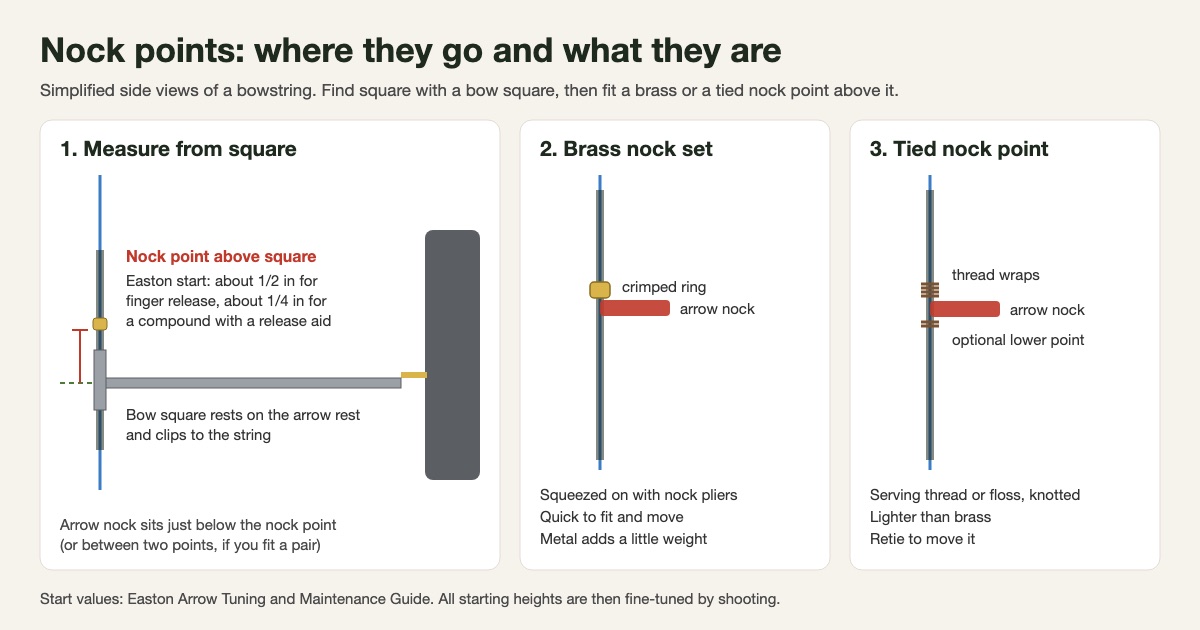
A recurve bow's nocking point usually starts about 1/2 in above square: clip a bow square to the string with its arm on the arrow rest, mark that height, then crimp on a brass nock set or tie on a thread nock point. Easton's tuning guide gives that figure for finger shooters and about 1/4 in for a compound with a release aid. Either is a starting height to confirm by shooting.
Tools you need
Shatterproof Archery describes three ways to add a nocking point: "Brass with nocking pliers," "Serving with the nail knot," and "Floss with overhand knots." You'll need:
- Bow square. It clips on the string and its long arm rests on the arrow rest to show where square is.
- Nock pliers, if you're using brass nock sets.
- Brass nock sets, or serving thread or waxed floss for a tied point.
- A fine marker and an arrow.
- Scissors and a lighter for tied points, used well away from the string strands.
Step 1: Find square and mark the starting height
Clip the bow square onto the string with its long arm on the arrow rest. Where the arm meets the string is "square", where an arrow would sit at 90 degrees to the string.
From there, measure up to your starting height and mark the serving:
- Recurve or compound, finger release: about 1/2 in above square, per Easton.
- Compound, release aid: about 1/4 in above square, per Easton. Hoyt's compound manual instead starts with "the arrow and string make a 90-degree angle," so check your own bow maker's guidance.
- Traditional bow with wood arrows: Mark Vogel, writing for Rose City Archery, says "the standard nocking point should be five-sixteenths above square."
The arrow nock sits directly below the nocking point. Some archers fit a second point just below the nock as well.
Step 2: Fit a brass or tied nock point
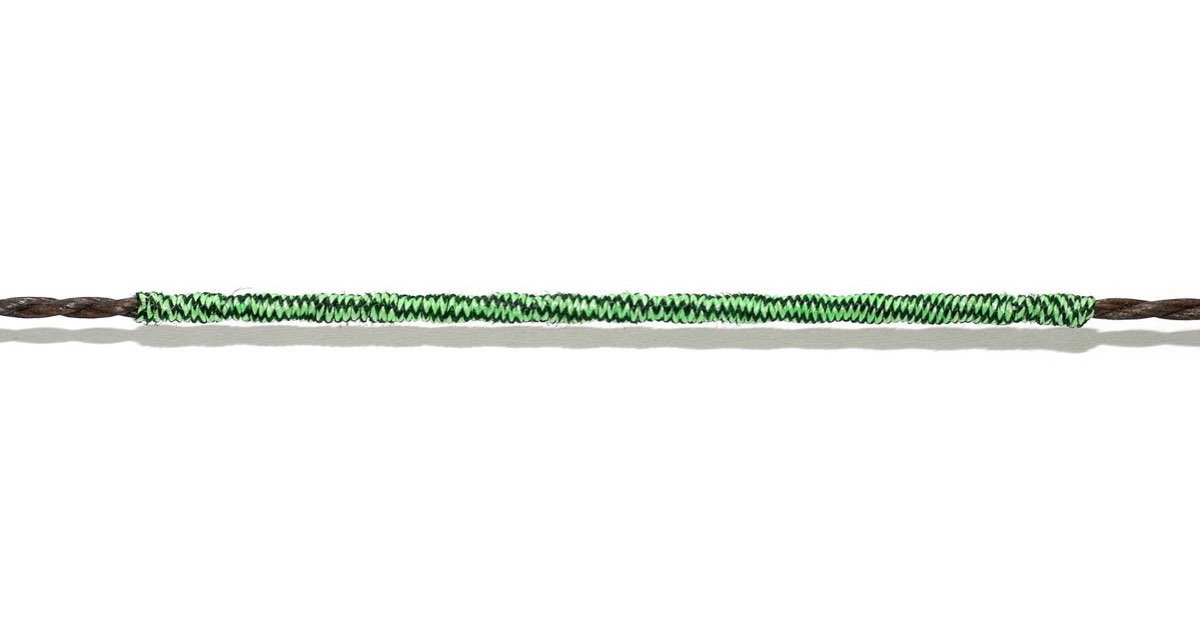
Brass nock set. Easton's setup advice is to "install a moveable nocking point on the bowstring. Clamp-on types are ideal." Open the brass ring, place it on the serving at your mark and close it with nock pliers. Recheck with the bow square.
Tied nock point. Shatterproof's favourite is serving thread tied with a nail knot. Its cheaper option is floss: "tie overhand knots over and over, cut off the extra floss, and lightly burn the ends." It calls floss "a great temporary or cheap nocking point option."
Weight is the trade-off. Easton says "simply changing from a metal nocking point to a 'tie-on' nocking point can have a noticeable effect on arrow spine, due to the weight difference." Hoyt goes further for its compounds: it "does not recommend the use of brass or other metal clamp on nocking point devices."
Step 3: Check it after shooting
Easton's bare shaft test confirms the height. Shoot at least three fletched arrows and two identically aimed unfletched shafts from 15 to 20 yards. If the bare shafts hit above the fletched ones, move the nocking point up; if below, move it down.
On paper, Easton says a low tear means raise the nocking point "1/16" (1.6 mm) at a time," and a high tear means lower it. Our paper tuning guide explains reading tears.
Fletching hitting the rest is a clearance problem, not nock height: Easton suggests rotating the arrow's nock, as our nock tuning guide covers.
You can browse brass nocking points and nocking pliers on Amazon; treat any listing as an example to consider.
Frequently asked questions
Where should the nocking point be on a recurve bow?
Easton's tuning guide starts it about 1/2 in (1.3 cm) above square for finger shooters, measured with a bow square resting on the arrow rest. Mark Vogel suggests five-sixteenths of an inch for wood arrows. Treat either as a starting point, then adjust using bare shafts or paper tuning.
Do compound bows need a nocking point?
Yes, though the type and height depend on your setup. Hoyt says arrow type, fingers or release aid and arrow rest "will determine the type and location of the nocking point," starting with the arrow at 90 degrees to the string. Easton starts release shooters about 1/4 in above square.
Brass or tied nock points: which is better?
Neither always wins. Brass is fast to fit, and Easton calls clamp-on points ideal while you're setting up. Tied points save weight, which Easton says can noticeably affect arrow spine. Hoyt doesn't recommend metal clamp-on points on its compounds.
Related articles
 Training
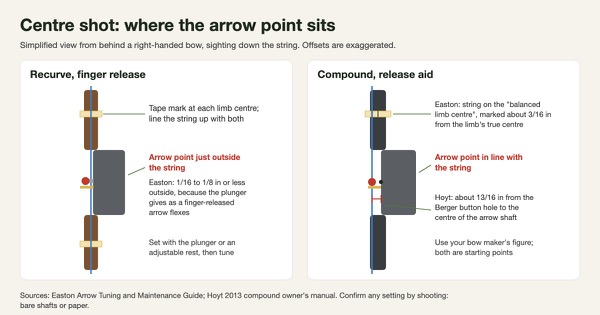
How to Set Centre Shot on a Bow
How should an arrow sit on a rest? Set centre shot by sighting down the string: just outside it on a recurve, in line on a compound, then confirm by shooting.
Updated October 8, 2026 · 5 min read
 Training
Paper Tuning a Bow: How to Read Tears and Fix Them
How to paper tune a bow: what it shows, frame setup, reading nock-high, low, left and right tears, the order of fixes, and when to see a pro shop.
October 8, 2026 · 10 min read
 Training
How to Install and Tie In a Peep Sight
How to install a peep sight on a compound bow: why you need a bow press, setting peep height, splitting strands, serving it in and checking alignment.
Updated October 6, 2026 · 5 min read