
How to Aim a Bow: Sights, Gap and Instinctive
How to aim a bow: eye dominance, anchor points, sights, gap shooting, string walking, face walking and instinctive aiming, with practice drills for each.
By Archery Insider Editorial Team
· 11 min read
In this article
Aiming is the part of archery everyone wants to learn first, and the part that matters least if your form is inconsistent. ImproveYourArchery puts it bluntly: "Your overall form and technique require much more work than your aiming technique." Still, every archer needs a reliable way to point the arrow, and the method you choose shapes your equipment, your practice and which competition classes you can enter.
This guide covers the foundations that every method needs, then explains each aiming method, who it suits and how to practise it.
The quick answer
| Method | How it works | Best for |
|---|---|---|
| Sight | A pin or dot is set for each distance | Compound, Olympic recurve, most bowhunters |
| Gap shooting | Hold the arrow point a set gap below (or above) the target | Barebow, traditional, field and 3D |
| String walking | Move your fingers down the string for closer shots so the point stays on the target | Barebow competition |
| Face walking | Move your anchor up or down your face to change elevation | Some traditional archers |
| Instinctive | Focus hard on the spot, draw and release without a conscious aim | Traditional bowhunters, fast close shots |
Foundations for every method
Find your dominant eye
Missouri's conservation department recommends a simple paper-towel-tube test, and notes "just because you're right-handed doesn't necessarily mean you're right-eye dominant." Another common test: make a small triangle with your hands at arm's length, centre a distant object in it with both eyes open, then close one eye at a time. "If you have the dominant eye open, you will still see the spot."
- If your dominant eye matches your dominant hand, shoot with that hand and you can keep both eyes open.
- If you are cross-dominant, either shoot with the hand that matches your dominant eye, or keep shooting with your strong hand and close or cover the dominant eye while aiming. ImproveYourArchery advises cross-dominant archers to "always close one eye while aiming."
Build a consistent anchor
Your anchor is where your string hand touches your face at full draw. It is your rear sight. Common anchors are the corner of the mouth (traditional and barebow), under the chin (Olympic recurve) and a release hand against the jaw with a peep sight (compound). Whatever you choose, it must be identical every shot. Our archery form guide explains anchors in detail.
Let the aim float
No one holds perfectly still. ImproveYourArchery recommends letting the pin or point "float naturally rather than forcing it centered," because trying to freeze it adds tension. Focus on the spot, keep the aim moving slowly around it, and keep pulling through the shot.
Aiming with a sight
"To aim a bow with a sight, you aim the sight pin in the center of the target." You set the sight for each distance by shooting: if your arrows group low, move the sight down; if they group left, move it left. In other words, move the sight toward the group.
- Compound bows usually use multi-pin or single-pin sights plus a peep in the string; see our single-pin vs multi-pin comparison.
- Olympic recurve archers use a single aperture on a sight bar, adjusted for each distance.
Sights are the most precise method at known distances, and the easiest for beginners to learn.
Aiming with a compound: peep, pin and level
Compound archers aim through a peep sight in the string. At full draw, centre the sight housing inside the peep, put the correct pin on the target and check the bubble level. The peep fixes your eye position; the level stops you tilting the bow, which pushes arrows left or right, especially at longer range. Multi-pin sights have a pin for each set distance; single-pin sliders are dialled to the exact yardage. Let the pin float gently over the spot while you keep pulling through the shot with your back muscles.
Aiming with an Olympic recurve sight
Olympic recurve archers use a single aperture on a sight bar, with no peep. The string itself is used as a rear reference: archers line up the blurred string with the edge of the sight or riser, a "string picture", the same way each shot. Combined with a consistent anchor under the chin and a clicker for consistent draw length, this lets them aim precisely without a peep.
Gap shooting
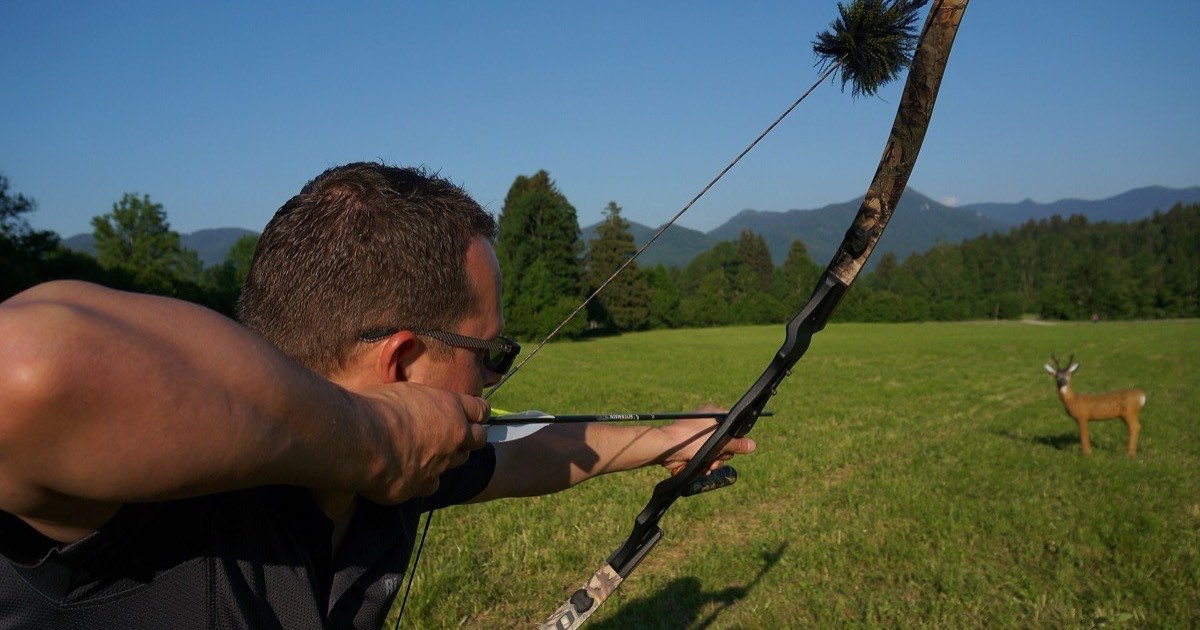
With gap shooting you look at the target and notice where the arrow point sits in your vision. You keep the same anchor and the same hand position on the string at every distance and change only "the gap between the point of the arrow and the center of the target."
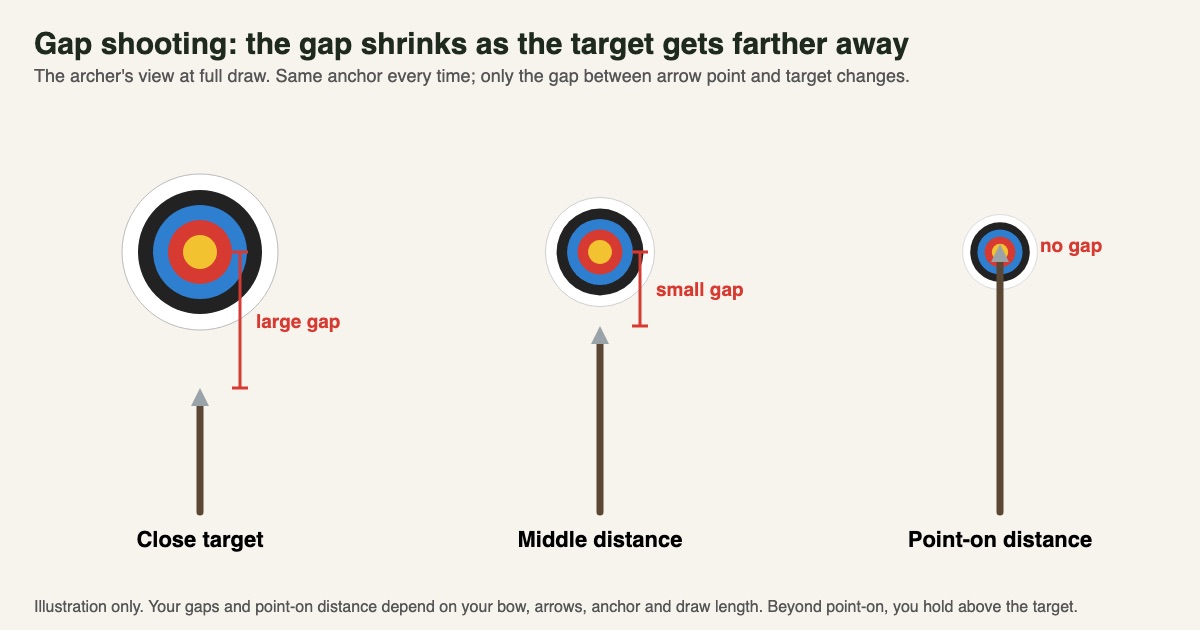
- Close targets need a large gap: you hold the point well below the spot.
- As distance increases, the gap shrinks.
- At your point-on distance, the point sits right on the spot.
- Beyond point-on, you hold the point above the target.
Your gaps depend on your bow, arrows, draw length and anchor, so you must learn your own. Shoot at marked distances and note how big the gap looks at each one.
Drill: stand at 10, 15, 20 and 25 yards. At each distance, shoot three arrows holding the point at different gaps until the group hits the centre. Note the gap. Repeat until you can predict it.
String walking
String walking is popular with barebow competitors. You place your string fingers at different heights below the arrow: "the further away the target is, the higher up the string the fingers will be placed (close to the arrow); the closer the target is, the lower down the string the fingers will be placed," in World Archery's description. The arrow point stays on the target at every distance, and the changing finger position changes the arrow's trajectory.
- World Archery allows it in barebow, where archers "must string-walk with nothing more than a simple scale on their tab."
- ImproveYourArchery notes it trades some consistency, because the bow's tune changes with finger position.
- Many barebow archers mark "crawls" for each distance on a tab scale.
Our barebow guide explains the rules and equipment.
Face walking
Face walking keeps your fingers in the same place on the string but changes your anchor height on your face: "You change the anchor point on your face to achieve the right elevation for your shot." Lower anchors raise the arrow for longer shots. The risk, ImproveYourArchery warns, is that it "reduces consistency and risks horizontal misalignment if the anchor shifts side-to-side."
Instinctive shooting
"You draw your bow and look at the target with two eyes open and shoot." Instinctive archers do not consciously aim the point; they focus intensely on the target and let practice teach the body where to hold. It is fast and adapts naturally to unknown distances, which is why many traditional bowhunters use it.
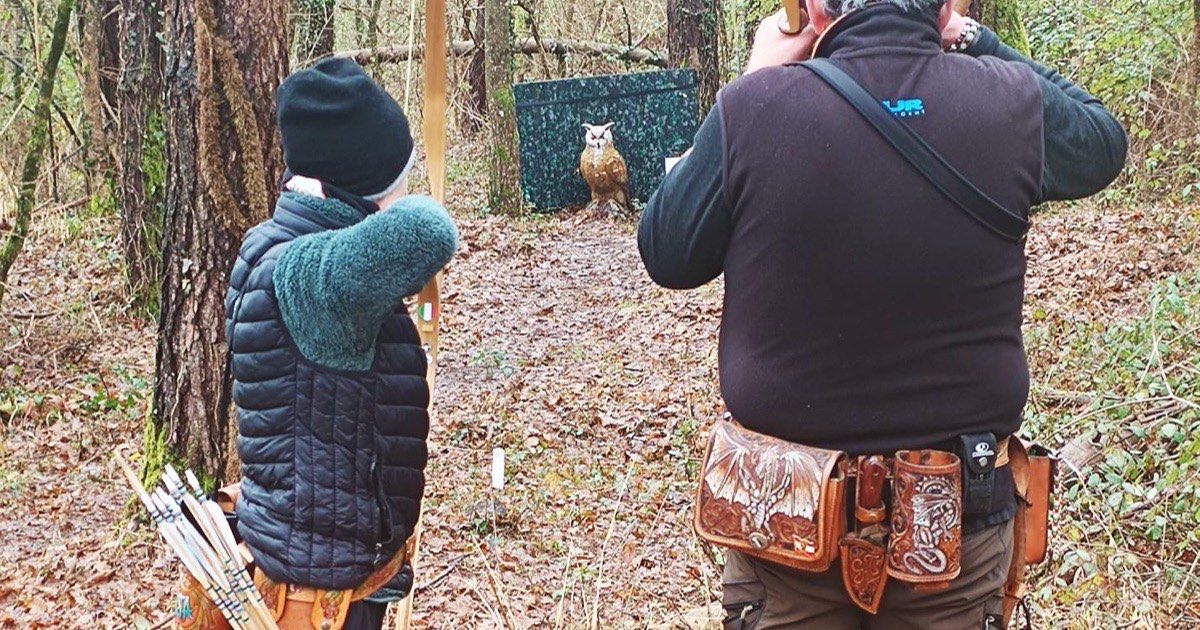
The catch is volume: instinctive accuracy takes a lot of consistent practice. A common starting tip is to begin very close, at 3 to 5 yards, focus on a small spot, and let your brain learn where the arrow goes before moving back.
Finding your point-on distance
For gap shooters and string walkers, the point-on distance is a key reference. To find yours:
- Stand about 30 yards from a target with a clear aiming spot.
- Anchor normally and put the arrow point directly on the spot.
- Shoot a group of three. If it lands high, move closer; if low, move back.
- Repeat until the group centres while the point sits on the spot. That distance is your point-on.
From there, closer targets need the point held below the spot, and farther ones above it. Note the gap at several distances and write them down.
Aiming in wind and on slopes
- Wind pushes arrows sideways, especially light arrows at long range. Aim slightly into the wind, and practise on windy days so you learn how much to hold off. Avoid long shots in strong or gusty wind when hunting.
- Uphill and downhill shots behave as if the target were closer, because gravity acts over the horizontal distance. Aim for the horizontal distance rather than the line-of-sight distance. Our effective range guide explains why this matters from tree stands.
- Bending at the waist, not dropping the bow arm, keeps your form the same on slopes.
Aiming in low light
Hunting often means aiming at dawn and dusk, when pins, arrow points and targets are hard to see. Sight archers can use fibre-optic pins, which gather light, or a sight light where legal, and a larger peep aperture. Gap and instinctive shooters rely on seeing the arrow point and the spot, so bright fletching and a light-coloured point wrap can help. In every case, practise in the light you will hunt in, and shorten your maximum distance as light fades. If you cannot see your pin or the vital zone clearly, do not shoot.
How your equipment affects aiming
- Arrows that are poorly spined or mismatched scatter, however well you aim. Tune them first; see our paper tuning guide.
- Draw weight that is too heavy makes the aim shake and collapse. Drop the weight and accuracy usually improves.
- Sight and peep setup must suit your anchor; a peep at the wrong height forces your head out of position.
- Bow balance matters: stabilizers and weights slow the movement of the aim. Barebow archers use riser weights for the same reason.
- Light, consistent tabs or releases help the string leave the same way every time.
Aiming and target panic
Target panic is the urge to release the moment the sight or point touches the centre, or the inability to hold the aim on the target at all. It affects archers of every level and is closely tied to aiming. Signs include punching the trigger, freezing below the target and flinching. The usual cures focus on separating aiming from releasing, through blank-bale shooting, holding drills and a surprise release. Our target panic guide covers the symptoms and cures in detail.
Drills for every method
- Blank bale: shoot at a target face-free bale from a few metres with your eyes closed to feel good form without aiming.
- Hold drill: draw, aim and hold on the spot for five seconds before releasing; build to ten seconds.
- One-arrow ends: shoot one arrow at a time, walk to the target and back. It trains the first-shot accuracy that counts in hunting and 3D.
- Unknown distances: set up targets at unmarked ranges and estimate the distance before shooting. Check with a tape afterwards.
- Small spot: put a small sticker in the middle of the target and aim at it, not the whole face. "Aim small, miss small."
Our practice plan builds these into a weekly routine.
Which method should you choose?
| If you... | Try |
|---|---|
| Want the most precision at known distances | A sight |
| Shoot a traditional bow and like simple gear | Gap or instinctive |
| Compete in barebow | String walking (with gaps for some distances) |
| Bowhunt with a compound | A multi-pin or single-pin sight |
| Bowhunt with a recurve or longbow | Instinctive or gap, with short shots |
| Are a complete beginner | Start with a sight or point-of-aim gaps on a club bow |
Your bow and class rules may decide for you. For example, World Archery's longbow and traditional classes ban sights, and barebow allows only a simple scale on the tab.
Common aiming mistakes
- Chasing the gold with the bow arm instead of letting the aim float.
- Changing anchor without noticing, which moves every shot up or down.
- Peeking at the arrow after release, which drops the bow arm early.
- Moving the sight after one bad arrow rather than a group.
- Closing the wrong eye when cross-dominant.
Shooting with a sight
Advantages
- Most precise at known distances
- Easier for beginners to learn
- Clear, repeatable adjustments
Trade-offs
- Not allowed in traditional or barebow classes
- Slower when the distance is unknown
- More equipment to set up
Aiming without a sight
Advantages
- Simple equipment
- Fast and adaptable once learned
- Required for barebow, traditional and longbow classes
Trade-offs
- Takes much more practice to become consistent
- Harder to diagnose mistakes
- Accuracy drops more at long range
You can browse recurve sights or finger tabs on Amazon. Check that the sight fits your riser before buying.
Frequently asked questions
How do you aim a bow without a sight?
Use gap shooting, string walking, face walking or instinctive aiming. Gap shooting is the most common: keep the same anchor and change the gap between the arrow point and the target with distance.
Should I close one eye when shooting a bow?
If your dominant eye matches your shooting hand, you can keep both open. If you are cross-dominant, close or cover the dominant eye, or shoot with the other hand.
Where should I anchor when aiming a bow?
At a consistent point on your face, such as the corner of your mouth or under your chin. Consistency matters more than the exact spot.
What is point-on distance?
The distance at which the arrow point sits directly on the target when you aim with gaps or string walking.
Is instinctive shooting accurate?
It can be very accurate at close range with plenty of practice, which is why it remains popular with traditional bowhunters.
Why do my arrows go left or right when I aim correctly?
Usually form, not aim: a tense grip, plucking the string, a tilted bow or a changing anchor. For compound archers, check the bubble level and peep alignment.
How long does it take to learn instinctive aiming?
It varies widely. Many archers become reasonably consistent at short range within a few months of regular practice, but true instinctive accuracy at varied distances takes much longer.
Is it better to aim with both eyes open?
Many archers aim with both eyes open because it gives better depth perception and a wider view, which helps instinctive shooters and hunters. It works best when your dominant eye matches your shooting side. Cross-dominant archers usually need to close or cover one eye.
Should a beginner start with a sight or without one?
Either is fine. A sight gives quick, clear feedback on whether your form is consistent, which many coaches like for beginners. Starting without one builds a feel for the bow and suits archers heading toward barebow or traditional shooting. Your coach or club will usually guide you.
Related articles
 Training
Archery Form: 11 Steps to a Consistent Shot
Archery form step by step: stance, hook and grip, set-up, draw, anchor, transfer, aiming, release and follow-through, plus common faults and fixes.
Updated March 21, 2025 · 10 min read
 Comparisons
Single-Pin vs Multi-Pin Bow Sights: Which Should You Choose?
Single-pin vs multi-pin bow sights compared: fixed pins vs sliders, speed in the field, long-range precision, low light, gap shooting, hybrids and scopes.
February 25, 2026 · 5 min read
 Comparisons
Longbow vs Recurve Bow: Differences for Traditional Archers
Longbow vs recurve compared: limb shape, draw feel, hand shock, speed, length, accessories, competition rules, hunting and which traditional bow suits you.
Updated September 30, 2026 · 6 min read