
Mathews ARC Review: Specs, Speed and Who It Suits
Mathews ARC review: ARC 30 vs ARC 34 specs, real chronograph speeds from two magazine tests, how it compares with the LIFT X, TITLE and Hoyt RX-10.

By Archery Insider Editorial Team
· 12 min read
Research-based: built from maker specs and official sources, fact-checked before publishing. How we review products
In this article
The Mathews ARC is a fast, light flagship hunting bow that two major 2026 magazine tests rated near the top for accuracy, and it suits hunters who want IBO-class speed without a heavy rig. This Mathews ARC review covers both sizes: the ARC 30 for tree stands and blinds, and the ARC 34 for archers who want a steadier, more forgiving hold. The short verdict: it's an excellent bow, but on paper it's close to the LIFT X, last year's flagship, which Mathews still lists. It's dealer-only: find a shop with Mathews' retailer locator.
Mathews ARC
Advantages
- Top accuracy results in Field & Stream's 2026 test (ARC 30)
- SWX-Z mod gives a much smoother draw for about 5 fps, per Outdoor Life
- Light for its length: 4.3 lb for the 34 in model
- Limb Shift tuning without a bow press, plus built-in Bridge-Lock ports
Trade-offs
- Field & Stream found the standard draw stiff; Outdoor Life notes a short valley
- Same IBO speed ratings as last year's LIFT X
- Draw length and weight changes mean new mods, usually through a dealer
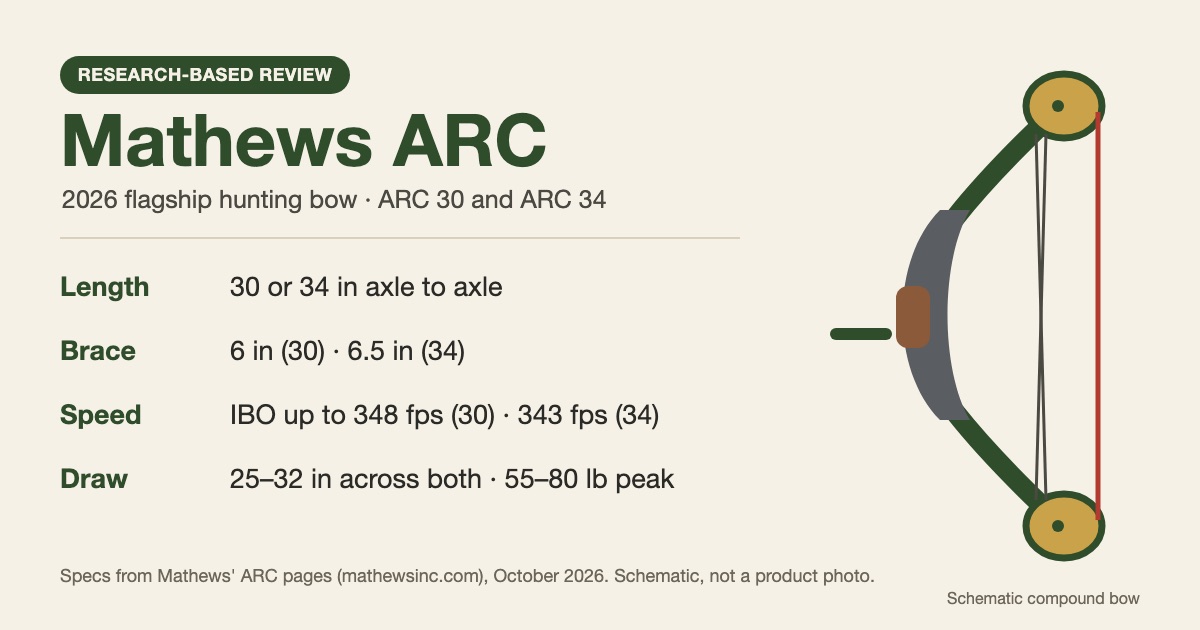
Mathews ARC specs: ARC 30 vs ARC 34
These are Mathews' own figures from its ARC page and ARC 30 product page.
| Spec | ARC 30 | ARC 34 |
|---|---|---|
| Axle-to-axle | 30 in | 34 in |
| Brace height | 6 in | 6.5 in |
| IBO rating | Up to 348 fps | Up to 343 fps |
| Peak draw weights | 55, 60, 65, 70, 75, 80 lb | 55–80 lb |
| Draw lengths | 25–30.5 in | 26.5–32 in |
| Let-off | 80 or 85% | 80 or 85% |
| Physical weight | 3.99 lb | 4.3 lb |
| Cam | SWX-2 (standard or SWX-Z mods) | SWX-2 (standard or SWX-Z mods) |
| Finishes | 13 solids, camos and fade-to-black | Same 13 |
| Warranty | Limited lifetime, original registered owner | Same |
Field & Stream sums up the split: the differences are "axle pin spacing, max speed, and physical weight." The longer bow also gets half an inch more brace height and a longer draw range, while the cam, limbs and accessory mounts are shared.
Design and features
The SWX-2 cam and why it matters
Mathews calls the SWX-2 a "second generation SWX Cam with Perimeter Weight Technology." Its headline claim isn't the IBO number, which matches the LIFT X. It's that the ARC holds speed "even once fully set up with a peep sight and d-loop that traditionally reduce performance." Mathews says that in side-by-side comparisons, setups that cost past models significant speed "maintain performance with the ARC."
That's a maker claim, so it helps to look at the independent numbers. Field & Stream's Jace Bauserman chronographed an ARC 30 at 70 lb with his 29-inch draw and 467-grain arrows: a three-shot average of 295 fps. Outdoor Life set every bow in its test at 60 lb and a 29.5-inch draw with a 389-grain arrow, and recorded the ARC 34 at 289 fps on the standard mod.
Those figures sit well below 343–348 fps, and that's normal. The Mission Archery FAQ on Mathews' site explains that IBO ratings assume a 70 lb bow, a 30-inch draw and a 350-grain arrow, and that any change, including items on the string, costs speed.
SWX-Z mods: speed for comfort
New for 2026, the SWX-Z mod set gives what Mathews calls "a more generous draw-force curve" for "an ultra-smooth draw with a modest tradeoff in peak speed ratings." Outdoor Life quantified the trade on its ARC 34: 289 fps on the standard mod and 284 fps on the Z mod. Its testers agreed the comfort "is definitely worth the 5 fps speed cost." Field & Stream's Bauserman tried an ARC 30 with SWX-Z mods at a pro shop and found it "notably smoother."
Mathews says SWX-Z mods also fit its 2024 and newer hunting bows, including all LIFT models.
Limbs, riser and tuning
Mathews says the redesigned limb assembly creates "a perfectly parallel limb path" to improve feel and cut post-shot vibration, and that the reinforced riser adds rigidity while staying light. Field & Stream measured the ARC 30 at 64.4 dB over three shots, against 67.5 dB for last year's LIFT X in the same writer's testing.
Limb Shift Technology carries over from the LIFT. Mathews describes it as a way to "micro-adjust the limb channel width without the need for a bow press." Field & Stream calls it one of the most straightforward on-bow tuning systems available, worked with a pair of Allen wrenches. If you do need to press the bow, the same review notes the press tips go into the Limb Shift pockets.
Bridge-Lock and the integrated extras
The riser has a Bridge-Lock port for Mathews' Integrated V-Bar, takes the 7° Angled Bridge-Lock Stabilizer, and has the Silent Connect sling anchor machined in. Field & Stream points out that the V-bar and angled stabilizer are sold separately. Its test bow wore a Cutter stabiliser and a Spot-Hogg sight on the Bridge-Lock mount, and the riser's Integrate Mounting System took a QAD Integrate MX2 rest, so you aren't locked into Mathews accessories.
Fit, setup and what else you need
Draw length and weight
The ARC 30 covers 25–30.5 in and the ARC 34 covers 26.5–32 in. Field & Stream notes the SWX-2 cam "is not draw-length adjustable," so get your draw length measured before ordering; our guide to measuring your draw length shows how. Mathews says draw length and peak weight are changed with mod sets, and its owner's manual sends owners to an authorised retailer for that work.
Peak weights run 55–80 lb in 5 lb steps. Mathews' manual says its bows have "approximately a ten pound range" below peak, so a 55 lb bow goes down to about 45 lb. If you need less, or a draw outside 25–32 in, look at Mathews' other models:
- LIFT RS: 23.5–29 in draw, with draw weights from 41 lb.
- LIFT XD: 32–33.5 in draw for long-draw archers.
Not sure what weight to order? Our guide to draw weight for deer hunting explains what you need and what your state may require.
Grip and brace height
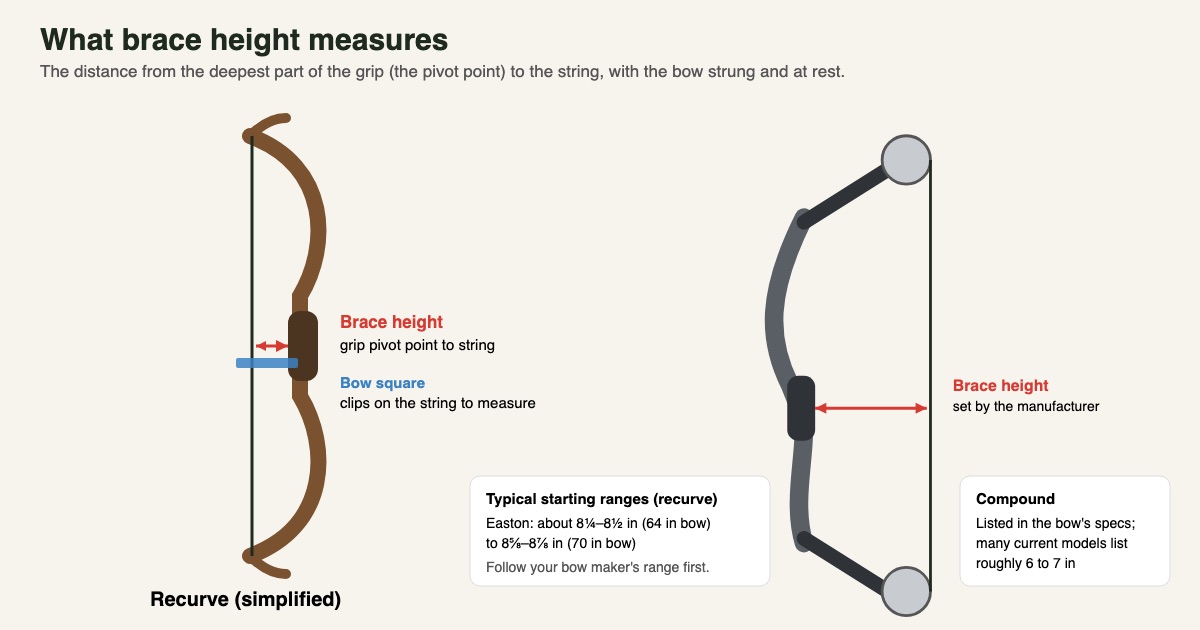
Mathews lists 6 in of brace height for the ARC 30. Bauserman points out that figure is "only achieved when the grip is removed," which he calls "a little disingenuous." That implies a slightly shorter figure measured from the grip itself. Outdoor Life's testers also weren't fans of the stock Engage grip for repeatability. They noted you can swap it for one of Mathews' alternatives or an aftermarket grip, or shoot off the bare riser.
Setting it up safely
- Order the right size, hand, draw length and peak weight from a dealer.
- Register the bow within three months, as the warranty requires.
- Add a rest, sight, peep, D-loop and stabiliser. Field & Stream's test bow used a QAD Integrate MX2 rest, a Spot-Hogg sight and a 12-inch stabiliser.
- Paper tune it, using Limb Shift for fine changes. Our paper tuning guide walks through reading tears.
- Sight in and check broadhead flight before the season.
How the ARC compares
Mathews ARC vs LIFT X
This is the comparison most owners care about. From Mathews' own pages:
| ARC 30 | LIFT X 29.5 | ARC 34 | LIFT X 33 | |
|---|---|---|---|---|
| Axle-to-axle | 30 in | 29.5 in | 34 in | 33 in |
| Brace height | 6 in | 6 in | 6.5 in | 6.5 in |
| IBO rating | 348 fps | 348 fps | 343 fps | 343 fps |
| Draw lengths | 25–30.5 in | 24.5–30 in | 26.5–32 in | 26–31.5 in |
| Weight | 3.99 lb | 3.99 lb | 4.3 lb | 4.26 lb |
| Cam | SWX-2 | SwitchWeight X | SWX-2 | SwitchWeight X |
The ARC is half an inch to an inch longer, and its draw range is half an inch longer, with identical IBO ratings. The real differences are the SWX-2 cam, the new limbs, the integrated V-bar port and the quieter shot Field & Stream measured.
Mathews ARC vs Hoyt RX-10
Hoyt's Carbon RX-10 is the rival flagship. Hoyt lists 30.5 in axle to axle, a 6 1/8 in brace, 342 fps, 4.1 lb, 25–30 in draw and 40–80 lb draw weights, on a carbon riser. Note that Hoyt quotes an ATA speed rating, while Mathews quotes IBO, so treat the speed gap as rough.
The bigger difference is adjustability. Hoyt says its HBX Gen 4 cam adjusts draw length in quarter-inch steps and also adjusts let-off, and its XTS Tuning System corrects both left-right and high-low paper tears without a press. Choose the RX-10 if you want a carbon riser or more on-bow adjustment. Choose the ARC if you value independent accuracy results; the ARC 30 also weighs a little less than the RX-10. We covered both launches in our 2026 flagship bow news.
Mathews TITLE vs ARC
The TITLE is Mathews' target bow, not a hunting alternative. The TITLE 34 lists 34 in, a 6.5 in brace, up to 332 fps, 24.5–30 in draw, 70, 75 or 80% let-off and 4.38 lb. It comes in 34, 36, 38 and 40 in lengths with an 8 oz brass anchor weight. Buy the TITLE for indoor leagues and target rounds. For hunting plus some 3D, the ARC 34 makes more sense.
What the testers said about rivals
In Field & Stream's 2026 test, the Hoyt Alpha AX-3 33 won Best Overall while the ARC 30 took Most Accurate. Bauserman wrote that a 30-inch bow winning his accuracy testing was "astounding." Outdoor Life's Editor's Choice went to the Elite Varos, with the AX-3 33 second and the ARC 34 third overall. There, the ARC 34 averaged 3.56-inch groups at 50 yards and had a measured holding weight of 12.5 lb at a 60 lb draw weight.
Who should buy the ARC, and who shouldn't
Good fits:
- Whitetail hunters in stands and blinds who want a short, light bow. Bauserman concluded you'd be "hard pressed to find a better bow" for that job.
- Western hunters and 3D shooters who want the steadier ARC 34, which Field & Stream recommends for that kind of shooting.
- Archers who like a solid back wall, which Outdoor Life's testers noted, and will hold steady pressure into the stops.
Look elsewhere if you are:
- Used to very high let-off and a deep valley. Outdoor Life says the ARC's valley is "relatively short" and you "have to maintain constant pressure on the stops."
- Outside a 25–32 in draw, or under about 45 lb. The LIFT RS and LIFT XD cover more archers.
- New to archery on a budget. An adjustable package such as the one in our Bear Cruzer G3 review is a cheaper way to learn.
Where to buy
Mathews sells the ARC through authorised retailers, so we don't link it on Amazon. Use the retailer locator. Buying there matters: Mathews' warranty covers only bows bought from an authorised retailer, and claims go through them.
If you'd rather buy a complete package online, see Bear Species XT RTH listings on Amazon. Check the hand, draw length and weight range before you order.
Frequently asked questions
Is the Mathews ARC 34 better than the ARC 30?
Neither is better overall. The ARC 34 is longer, has a 6.5-inch brace and is rated 5 fps slower; Field & Stream describes it as the more stable, forgiving choice. The ARC 30 is lighter at 3.99 lb and easier to handle in a stand or blind. Field & Stream points the ARC 34 at western hunters and 3D shooters.
How fast is the Mathews ARC in real hunting setups?
Slower than its 343–348 fps IBO ratings, like every bow. Field & Stream measured 295 fps from an ARC 30 at 70 lb with a 29-inch draw and 467-grain arrows. Outdoor Life measured 289 fps from an ARC 34 at 60 lb, 29.5 inches and 389 grains, and 284 fps with SWX-Z mods.
Can you adjust the draw length on a Mathews ARC?
Not on the cam itself. Field & Stream says the SWX-2 cam isn't draw-length adjustable, and Mathews changes draw length and peak weight with mod sets. Its owner's manual sends owners to an authorised retailer for the job. Get measured before you order, and the dealer can fit the right mods.
What draw weights does the Mathews ARC come in?
Mathews lists peak weights of 55, 60, 65, 70, 75 and 80 lb for both sizes. Its owner's manual says Mathews bows can be backed off about 10 lb from peak by turning the limb bolts equally. Ask your dealer for the safe maximum number of turns, and remember to match arrow weight to draw weight.
Is the Mathews ARC worth it over the LIFT X?
Only if you're buying new or upgrading from an older bow. The two have the same IBO ratings and near-identical weights. The ARC adds the SWX-2 cam, new limbs, an integrated V-bar port and, in Field & Stream's measurements, a quieter shot. Current LIFT X owners can get the smoother SWX-Z draw with a mod change instead.
Related articles
 News
NewsMathews ARC and Hoyt RX-10 Lead the 2026 Compound Bow Launches
Mathews ARC 30 and ARC 34, Hoyt Carbon RX-10, Alpha AX-3 and Enduro: the published specifications and technologies of the 2026 flagship compound bow launches.
Updated October 9, 2026 · 3 min read
 Guides
Is 60 lb Draw Weight Enough for Hunting?
Is 60 lb draw weight enough for deer and elk? Four agencies' legal minimums, our kinetic energy maths, and why arrow setup and shot placement matter more.
Updated October 6, 2026 · 5 min read
 Training
How to Shoot a Compound Bow: Beginner Steps
How to shoot a compound bow, step by step: stance, nocking, clipping a release to the D-loop, drawing to the wall, anchor, peep and pin, and release.
Updated October 7, 2026 · 5 min read