
How to Shoot a Compound Bow: Beginner Steps
How to shoot a compound bow, step by step: stance, nocking, clipping a release to the D-loop, drawing to the wall, anchor, peep and pin, and release.
By Archery Insider Editorial Team
· · 5 min read
In this article
To shoot a compound bow, stand side-on to the target, clip a release aid to the D-loop, draw through the peak weight until the cams settle against the wall, then anchor, line up peep and pin, and squeeze off the shot. Before your first arrow, have a pro shop fit the bow to your draw length.
Before you draw: fit and safety
A compound is built around a set draw length. Hoyt's owner's manual says its retailers are "trained in properly fitting the bow to your size and style of shooting," and its warnings say never to draw a bow "that is too heavy for your strength or that does not fit your draw length." Our guide to measuring your draw length explains the number the shop will use.
Steps 1–3: stance, nock and hook up
Our 11-step archery form guide covers these steps for any bow. Here's the compound version.
- Stance. Archery 360 says "your feet should be shoulder-width apart or slightly wider." It adds: "Roll your hips forward to keep your weight more toward the balls of your feet."
- Nock the arrow. With the bow pointed down range, lay the arrow on the rest and clip the nock onto the string inside the D-loop, so the loop sits around it.
- Hook up the release. Clip the release's jaw or hook into the D-loop. With a wrist-strap index release, which Archery 360 describes as "activated with the archer's index finger," keep that finger behind the trigger for now.
Step 4: draw through the valley to the wall
Point the bow at the target, not the sky, and pull the string straight back with your release arm. Hoyt warns never to let go of the bow handle while drawing, holding or shooting, so keep a relaxed, steady grip.
The compound's draw feels different from a recurve's. Archery 360 explains that the cams "reduce holding weight as the archer reaches full draw (also called let off)." The Pope and Young Club calls the point of lowest holding force "the bottom of the valley."
| Stage | What you feel | What to do |
|---|---|---|
| Start of draw | Weight builds quickly | Draw smoothly |
| Peak weight | The heaviest point | Keep pulling; don't stop here |
| Valley | Weight suddenly drops | Keep gentle pressure; don't creep forward |
| Wall | The draw stops hit | Settle into anchor and hold against it |
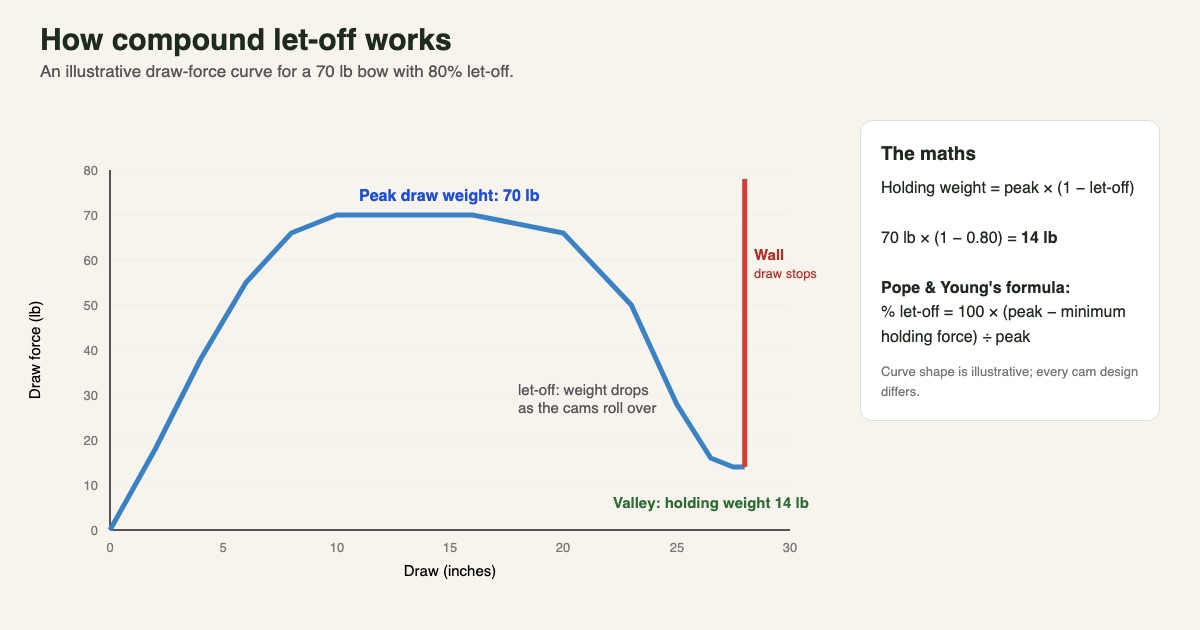
If you can't get past the peak without lifting the bow skyward or straining, let the string back down under control and ask the shop to lower the draw weight.
Steps 5–6: anchor, peep and pin
At the wall, bring your release hand to the same spot on your face every time; many compound archers anchor along the jaw. Through the peep, the sight housing should sit centred, the bubble level should be centred, and the pin goes on the spot you want to hit.

Archery 360 notes that let-off "allows the archer to comfortably stay at full draw while settling the pin and pulling through the shot." Our guide on how to aim a bow goes deeper on peep, pin and level.
Steps 7–8: release and follow-through
Now move your finger onto the trigger. Archery 360 describes an index release as fired by "slowly squeezing the trigger," and that's the habit to build: steady pressure while you keep pulling gently into the wall, so the shot surprises you.
After the shot, hold your position. Keep the bow arm up and your eyes on the target until the arrow lands. If anything feels wrong at full draw, don't fire: let down slowly, keeping your face and body out of the string's path, and start again.
You can browse wrist-strap release aids or archery arm guards on Amazon. Treat any listing as an example to consider, and try a release in a shop before you buy.
Frequently asked questions
How do you shoot a compound bow for beginners?
Get the bow fitted to your draw length first. Then stand side-on with feet about shoulder-width apart, nock an arrow, clip the release to the D-loop, draw to the wall, anchor, centre the sight in the peep, put the pin on target and squeeze the trigger. Start close to a large target.
How do you shoot a compound bow accurately?
Repeat the same steps every shot. Use the same anchor, hold gently against the wall so the cams stay in the valley, check the bubble level, let the pin float and squeeze the release slowly. Then follow through. Practise at short range first and move back as your groups tighten.
Can you shoot a compound bow without a release aid?
Some archers shoot compounds with their fingers. Hoyt's manual notes that the style of shooting, "fingers or release aid," affects how the nocking point is set up, so tell your shop which you'll use. Most compound beginners start with a release aid because it pairs naturally with the D-loop.
Related articles
 Training
Archery Form: 11 Steps to a Consistent Shot
Archery form step by step: stance, hook and grip, set-up, draw, anchor, transfer, aiming, release and follow-through, plus common faults and fixes.
Updated March 21, 2025 · 10 min read
 Training
How to Aim a Bow: Sights, Gap and Instinctive
How to aim a bow: eye dominance, anchor points, sights, gap shooting, string walking, face walking and instinctive aiming, with practice drills for each.
October 7, 2026 · 11 min read
 Gear
GearCompound Bow Maintenance Checklist
Compound bow maintenance by interval: what to check every session, how often makers say to wax, the yearly shop list, storage and the jobs never to DIY.
September 7, 2026 · 5 min read