
Hoyt Satori Review: ILF Hunting Recurve, Specs and Verdict
Hoyt Satori review: the ILF hunting recurve's three risers, Satori limbs, bow lengths, setup and how it compares with Bear, WNS and CD Archery rivals.

By Archery Insider Editorial Team
· 11 min read
Research-based: built from maker specs and official sources, fact-checked before publishing. How we review products
In this article
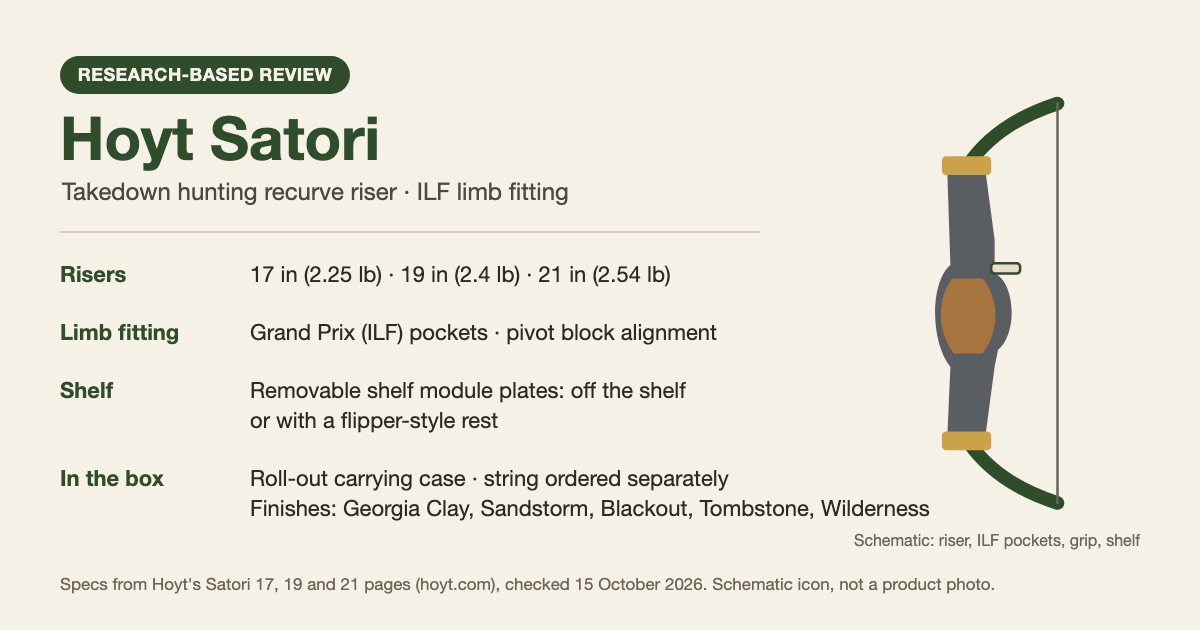
The Satori is Hoyt's only hunting recurve: a machined aluminium takedown riser (3Rivers Archery's description) in 17, 19 and 21 inch lengths with ILF (Grand Prix) limb pockets, a removable shelf module and Hoyt's original Earl Hoyt riser geometry. This Hoyt Satori review covers what that design means for a bowhunter. The short verdict is that it's a refined, adjustable riser for traditional hunters who want ILF limb choice and tuning control, but it costs more than mass-market takedowns and needs limbs and a string bought separately. Hoyt sells through dealers, so start with the Hoyt dealer locator.
Hoyt Satori
Advantages
- ILF pockets take Satori limbs or any ILF limb, so weight and length can change later
- Three riser lengths make 58–66 in bows with Satori limbs
- Shelf module plates allow centre-shot adjustment while shooting off the shelf
- Lifetime riser warranty for the registered original owner
Trade-offs
- Sold as a riser: limbs and the Flemish twist string cost extra
- Heavier than carbon rivals such as the WNS Black Wolf
- Dealer-only, and Hoyt publishes no brace height or bow length chart for it
Hoyt Satori specs: 17, 19 and 21 inch risers
Riser figures are Hoyt's own. Hoyt's current pages don't list brace height or bow lengths, so those rows come from the retailers named.
| Spec | Satori 17 | Satori 19 | Satori 21 |
|---|---|---|---|
| Riser length | 17 in | 19 in | 21 in |
| Riser weight (Hoyt) | 2.25 lb | 2.4 lb | 2.54 lb |
| Limb fitting | Grand Prix (ILF) | Grand Prix (ILF) | Grand Prix (ILF) |
| Riser style | Original Earl Hoyt | Original Earl Hoyt | Original Earl Hoyt |
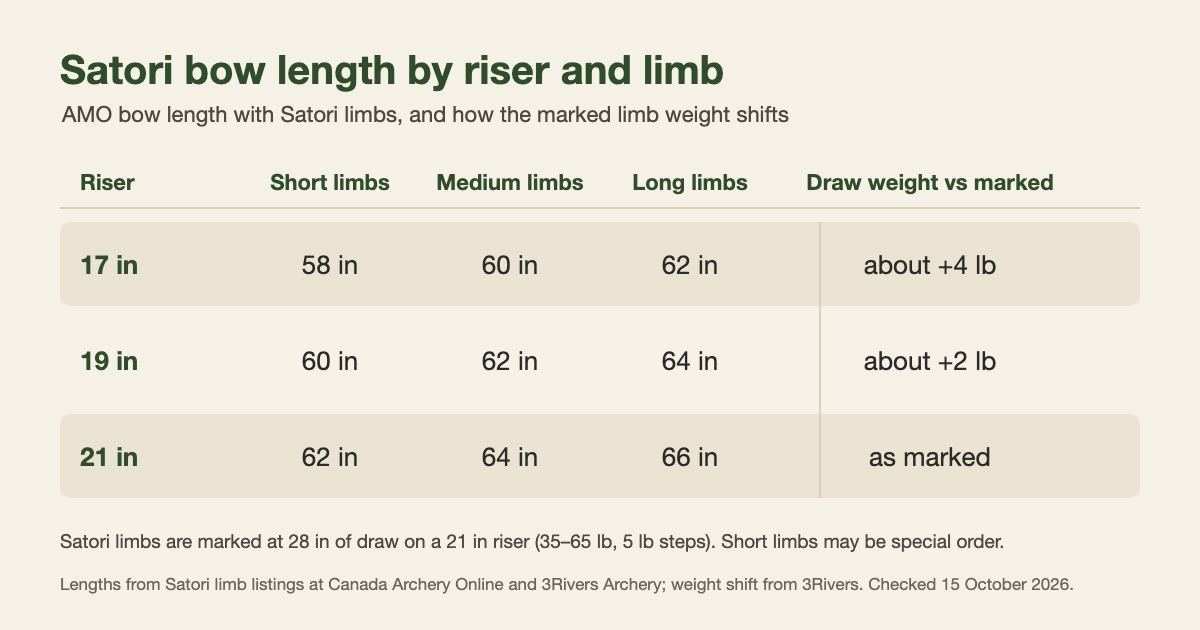
| Bow length, short / medium / long Satori limbs (retailers) | 58 / 60 / 62 in | 60 / 62 / 64 in | 62 / 64 / 66 in |
| Recommended brace height (Lancaster) | 7–8 in | 7–8 in | 7–8 in |
| Finishes (Hoyt) | Georgia Clay, Sandstorm, Blackout, Tombstone, Wilderness | Same five | Same five |
When we checked, Hoyt's pages showed all five finishes as sold out or unavailable, so ask a dealer about stock. Hoyt lists the pivot block limb alignment system, shelf module plates, a roll-out carrying case and compatibility with its Carbon SuperLite 2-Piece and QD Shorty quivers. Lancaster adds a calf hair side plate, rug rest and tiller bolt lock-down wrench to the box contents.
Design and features
Where the Satori came from
Bowhunter's January 2018 ATA Show roundup listed the Satori among the year's new traditional bows, built on Earl Hoyt's original geometry with a shelf module and centre-shot plates. Lancaster still calls it a Fred Eichler Signature Series riser and says Eichler worked with Hoyt's engineers on the design. It took over from the Buffalo, an earlier Eichler signature takedown that Australian retailer Abbey Archery lists as superseded by the Satori. Eichler now has his own signature takedown with Bear (more below), and Hoyt's current Satori pages no longer mention him.
Grand Prix (ILF) pockets and pivot block alignment
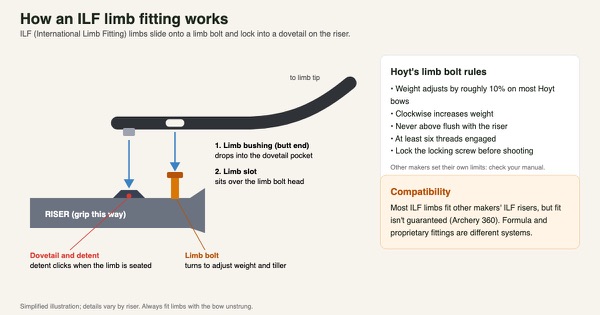
This is the main reason to choose the Satori. Hoyt notes that Earl Hoyt Jr. designed the Grand Prix fitting, now the international ILF standard. Any ILF limb fits, so you can move from Satori limbs to longer or carbon limbs without changing riser. Our guide to ILF limbs and risers explains the standard.
Hoyt's 2026 recurve manual covers its whole recurve range rather than naming the Satori, but its general instructions explain how the fitting works:
- The limb's dovetail slides into the pocket until a detent button clicks.
- Hoyt lists a pivot block alignment system on the Satori. The manual's pivot block section, written for Hoyt's RCRV target risers, describes left and right screws that shift the limb tip sideways, and says most riser and limb combinations need no adjustment, which is best left to a qualified technician.
- Tiller bolts change peak weight over about 10%. Hoyt warns never to back them out more than six turns from bottomed out, and the riser has a lock-down screw to stop them creeping.
Shelf module plates
Many hunting recurves have a fixed shelf, so centre shot is whatever the maker built in. The Satori's removable plates change that. Lancaster describes the module as a centre-shot alignment system that lets you fine-tune while still shooting off the shelf. Remove it and you can fit an elevated or flipper-style rest. Hoyt's page sums the riser up as "ready to shoot off-the-shelf or compatible with a flipper rest."
Satori limbs
Hoyt's current site lists only the three risers. An archived 2021 Hoyt page shows Satori limbs in medium and long lengths from 35 to 65 lb in 5 lb steps. Retailers still carry them. Canada Archery Online describes hard rock maple with carbon and glass and says short limbs are special order. 3Rivers Archery adds that weights are rated at 28 in on a 21 in riser: add about 2 lb on the 19 and 4 lb on the 17.
What Hoyt doesn't publish
There's no speed rating, draw-force curve or independent test of the Satori in the sources we found, and Hoyt's current pages carry no bow length chart or brace height. That's normal for a traditional riser, because performance depends on the limbs you fit. Treat any speed claim you see for a "Satori" as a claim about that particular limb and string setup.
Fit, setup and compatibility
Bow length, draw length and weight
Longer draws generally want longer bows, because short bows stack (get harder to pull) near full draw. Our guide to recurve bow length explains the usual match between draw and AMO length. Remember the riser offset too: a 50 lb Satori limb is about 54 lb at 28 in on a 17 in riser, by 3Rivers' rule of thumb, before you adjust the tiller bolts.
What else you need
- String: Hoyt sells Flemish twist strings separately. Its manual calls for genuine Hoyt or Fuse strings and no fewer than 10 twists.
- Rest: the shelf with its plate, or a flipper-style rest once the module is removed.
- Arrows: Hoyt's warranty excludes arrows under 5 grains per pound of draw weight, so at least 250 grains at 50 lb.
- Quiver: Hoyt's Carbon SuperLite 2-Piece or QD Shorty fit the riser.
- Stringer: the manual says always use one when stringing or unstringing the bow.
Setting it up
- Register the riser and limbs with Hoyt within 30 days of purchase.
- Fit the limbs into the pockets until the detent clicks, then string the bow with a stringer.
- Set brace height with string twists. Lancaster recommends 7–8 in; our brace height guide explains the effect on noise and forgiveness.
- Set the nocking point 0–1/2 in above square, as Hoyt's manual specifies.
- Set tiller between 0 and 3/8 in, Hoyt's suggested starting range, using the tiller bolts.
- Check limb alignment with the string centred down both limbs. If it's off, let a Hoyt dealer adjust the pivot block rather than guessing.
- Tune centre shot with the shelf plates or rest, then bare-shaft tune. Our recurve tuning guide walks through it.
Care and maintenance
Hoyt's manual says its limbs are low maintenance, and the advice is simple:
- Hardware: the most common issue is a loose button-head screw holding the limb detent. Re-tighten it now and then with an Allen key, without over-tightening.
- Moisture: dry the limbs and riser with a towel after wet hunts, and never use a heat source. Normal rain isn't a problem for the corrosion-resistant parts.
- Finish damage: wood-core limbs can take on moisture through a deep scratch. Hoyt suggests sealing it with clear nail polish or clear automotive touch-up paint.
- Lubricant: none is needed on limb parts used in Hoyt risers.
How the Satori compares
Hoyt Buffalo vs Satori
The Buffalo used a 19 in machined aluminium riser and Hoyt's own Paralever limb system. Abbey Archery's superseded listing gives a 60 in bow length in its specs (its feature list says 60 and 62 in), a 3.2 lb mass weight, a 7–8 in brace height and 55 lb limbs only. The Satori swapped the Paralever system for ILF pockets, which opens up far more limb weights and lengths, and added the shelf module. Paralever limbs aren't ILF, so don't expect Buffalo limbs to carry over to a Satori.
Satori vs Bear, WNS and CD Archery
| Hoyt Satori 17 | Bear Fred Eichler Take Down | WNS Black Wolf | CD Archery WF19 Stalker | |
|---|---|---|---|---|
| Riser | 17 in machined aluminium | 17 in machined aluminium | 17 in carbon | 19 in |
| Limb fitting | ILF | Bear latch (Take Down limbs) | ILF | ILF |
| Riser weight | 2.25 lb | not listed by Bear | 1.6 lb | 3.25 lb |
| Bow lengths | 58–62 in | 58 / 60 / 62 in | depends on limbs | 60 / 62 / 64 in |
| Shelf | Removable module | Adjustable strike plate, interchangeable shelf inserts | not listed | Built-in raised shelf |
Bear says it designed its first-of-its-kind aluminium Take Down riser in partnership with Fred Eichler, using the Fred Bear latch and Bear's #1, #2 and #3 limbs. That's the Satori's nearest rival in spirit, but you're limited to Bear's limbs. Lancaster lists the WNS Black Wolf as a 17 in carbon ILF riser at 1.6 lb with a 7 in brace height. The CD Archery WF19 Stalker is heavier at 3.25 lb, with a Berger hole and rest mount for bolt-on rests or a cushion plunger.
Satori vs a budget takedown
Our Samick Sage review covers a popular wooden takedown with its own limb fitting. It's far cheaper and comes complete, but it isn't ILF and lacks the Satori's alignment system and shelf module.
Who should buy the Satori, and who shouldn't
Good fits:
- Traditional bowhunters who shoot off the shelf and want to fine-tune centre shot.
- Archers growing into hunting weight, who can swap ILF limbs instead of buying a new bow.
- Travelling hunters who value a takedown in a roll-out case.
Look elsewhere if you are:
- A beginner on a budget. A complete bow such as the Samick Sage costs far less to start.
- Counting every ounce. Carbon ILF risers such as the Black Wolf weigh less.
- Shopping on Amazon or hoyt.com. Hoyt's product pages send buyers to a dealer, and warranty service runs through Genuine Hoyt Retailers.
Where to buy
Buy the Satori from a Genuine Hoyt Retailer through the dealer locator. Hoyt's manual requires a dated receipt, registration within 30 days and warranty claims through a dealer, and the warranty doesn't transfer to a second owner.
If you'd rather start with a cheaper complete takedown, compare Samick Sage takedown recurve listings on Amazon. For any recurve, a recurve bow stringer is the one accessory Hoyt's manual insists on.
Frequently asked questions
Is the Hoyt Satori good for hunting?
Hoyt designed it as a hunting recurve, and its riser lengths, shelf module and quiver compatibility all point that way. We haven't shot it, so we can't judge noise or hand shock ourselves. On paper it suits traditional hunters who want ILF limb choice and adjustable centre shot more than buyers who want a complete, low-cost bow.
What limbs fit the Hoyt Satori?
Any ILF (Grand Prix) limbs fit. Satori limbs were made in 35–65 lb weights in 5 lb steps, and retailers list short, medium and long lengths, with short limbs often special order. They're rated on a 21 in riser, so expect about 2 lb more on the 19 and 4 lb more on the 17.
What's the difference between the Hoyt Buffalo and the Satori?
The Buffalo used Hoyt's Paralever limbs on a 19 in riser, and Abbey Archery lists it as superseded by the Satori. The Satori moved to ILF pockets, added 17 and 21 in risers and introduced the removable shelf module. Paralever limbs aren't ILF, so plan on new limbs if you upgrade.
Which Satori riser length should I choose?
Match bow length to your draw and hunting style. The 17 makes 58–62 in bows for blinds and thick cover, the 19 makes 60–64 in, and the 21 makes 62–66 in for long draws. If you're unsure, a 19 with medium limbs (62 in) is a sensible middle choice to try at a dealer.
Does the Hoyt Satori come with a string?
No. Hoyt lists Flemish twist strings as "order separately", and its manual calls for genuine Hoyt or Fuse strings. Hoyt includes a roll-out carrying case, and Lancaster's listing adds a side plate, rug rest and tiller bolt lock-down wrench. Budget for limbs, a string, a stringer and arrows on top of the riser.
Related articles
 Reviews
Samick Sage Takedown Recurve Review: Still the Default First Bow?
Research-based Samick Sage review: the 62-inch takedown recurve's published specs, 25–60 lb limbs, who it suits, its limits and how it compares with rivals.
Updated May 21, 2025 · 5 min read
 Gear
ILF Limbs and Risers Explained: Fit, Lengths, Weight
What are ILF limbs? How the International Limb Fitting works, brand compatibility, ILF vs Formula, riser and limb length maths, and limb bolt adjustment.
November 5, 2026 · 12 min read
 Comparisons
Takedown vs One-Piece Recurve: Which Should You Buy?
Takedown vs one-piece recurve bows compared: how they differ, limb swaps and fittings, hunting and target use, travel, care and storage, and how to choose.
November 4, 2026 · 8 min read