
What Is a Clicker in Archery?
What a recurve bow clicker does, the three ways to mount one, how to set its position, how it relates to target panic, and why barebow archers can't use one.
By Archery Insider Editorial Team
· · 5 min read
In this article
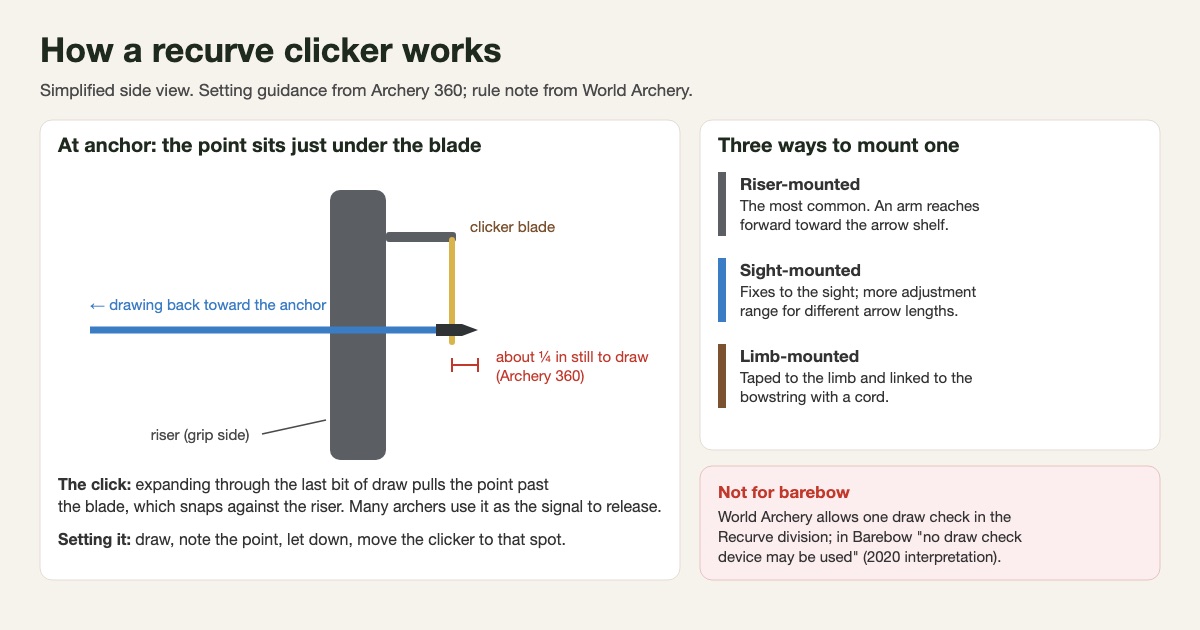
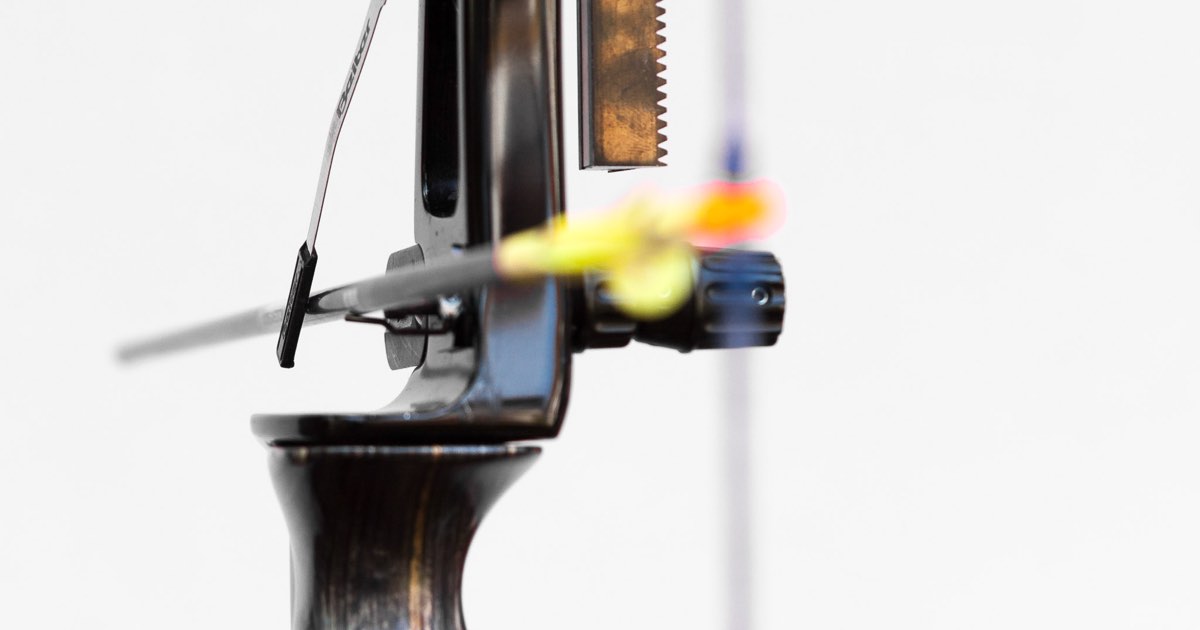
A clicker is a small spring blade on a recurve bow that the arrow point sits under at full draw. When you pull the last fraction of an inch, the point slips past the blade and it snaps against the riser with a click. A recurve bow clicker does two jobs: it checks that you reach the same draw length every shot, and many archers use the click as their signal to release.
What a clicker does
Archery 360 describes the clicker as an accessory that "makes an audible click, which has a dual purpose. It helps archers keep their draw length consistent, and it helps them mentally execute a consistent release by triggering their shot."
The first job is simple: no click means you haven't reached full draw, so you let down rather than shoot a short arrow. The second job matters more to many coaches. World Archery's Technical Committee put it bluntly in a 2020 rules interpretation: "the main advantage of a 'clicker' is as a subconscious trigger device, not as a draw check."
What it doesn't do is make you accurate. A clicker only rewards a shot process that's already consistent. That's why it usually arrives after the basics in our guide to archery form, not before.
The three types of clicker
Archery 360 lists three ways to fit one.
| Type | How it mounts | Notes from Archery 360 |
|---|---|---|
| Riser-mounted | Screws to the riser, with an arm that reaches toward the arrow shelf | The most common type |
| Sight-mounted | Attaches to the bow sight | "Provides more adjustment range for different arrow lengths" |
| Limb-mounted | Fixed to the limb with double-sided tape | Connects to the bowstring with a cord |
Arrow length and clicker position go together. With a riser clicker the blade's range is limited, so your arrows need to be long enough for the point to reach it. If your arrows are on the long side, a sight-mounted clicker may give you room to adjust. Our arrow selection guide explains how arrow length is chosen.
How to set a clicker
Archery 360's method is simple:
- Draw to your normal anchor and note where the arrow point sits relative to the clicker.
- Let down, then move the clicker until it's close to the point's position at full draw.
- Fine-tune so that, in Archery 360's words, "when you reach your anchor point, you should have about a ¼-inch remaining in the draw to make the clicker go off."
That last quarter inch comes from what coaches call expansion: continuing to pull through the shot with your back rather than stopping dead at anchor. If you set the clicker too far forward, you'll be straining to reach it. Too far back, and it will go off before you're settled.
Clickers and target panic
A clicker sits at the centre of two opposite stories. In our target panic guide, using or reinstating a clicker is one of the standard recurve tools, because the release is triggered by the process rather than by the sight picture.
But it can also cause trouble. Archery 360 warns that "if you can't reach your draw length consistently you'll endure lots of frustration." Fighting to get through the clicker shot after shot is a recipe for tension, which is the opposite of what it's there for. Archery 360's advice is that "a coach can help you with those aspects of form, and help you decide when you're ready to use a clicker."
Clickers and barebow
Barebow archers can't use one in World Archery events. The 2020 interpretation says that under the Barebow rules "no draw check device may be used," and explains that a clicker is "both a draw check and a subconscious trigger device," legal in Recurve and "illegal in the Barebow Division" because barebow is meant to have "far less 'additional aids'." National bodies run their own rules, so check the event you enter. Our barebow guide covers the rest of the kit rules.
If you're ready to try one, you can browse recurve bow clickers on Amazon.
Frequently asked questions
Do beginners need a recurve bow clicker?
Usually not. A clicker only works once your draw length and anchor are consistent, and Archery 360 warns that without that consistency you'll endure "lots of frustration." Most club archers add one later, with a coach helping decide when they're ready and setting the first position.
How do you set a clicker?
Draw to anchor and note where the point sits, let down, and move the clicker close to that spot. Archery 360 suggests leaving about ¼ inch still to draw at anchor, so that expanding through the shot makes the click. Reset it whenever your form or arrows change.
Can you use a clicker in barebow?
Not under World Archery rules. A 2020 interpretation from World Archery's Technical Committee says no draw check device may be used in the Barebow division, and names the clicker as exactly that kind of device. Other organisations may differ, so read the rules for your event.
Related articles
 Training
Target Panic in Archery: Symptoms, Causes and How to Fix It
Target panic explained: symptoms like freezing off target and snap shooting, what causes it, a self-test, and a step-by-step recovery plan for any bow.
February 19, 2025 · 8 min read
 Guides
Is Archery Worth Getting Into? Honest Pros and Cons
Is archery worth it? The honest pros and cons, how long it takes to learn, what drives the cost, and why a club taster session is the best first step.
January 7, 2025 · 5 min read
 Guides
Can You Teach Yourself Archery?
Can archery be self taught? Yes, with limits. How to learn safely on your own, use video feedback, and when a few coached lessons pay for themselves.
Updated October 6, 2026 · 5 min read