
Do Crossbows Need Broadhead Tuning?
How to broadhead tune a crossbow: why broadheads can hit apart from field points, the spin test, nock indexing, and when to re-zero for hunting heads.
By Archery Insider Editorial Team
· · 5 min read
In this article
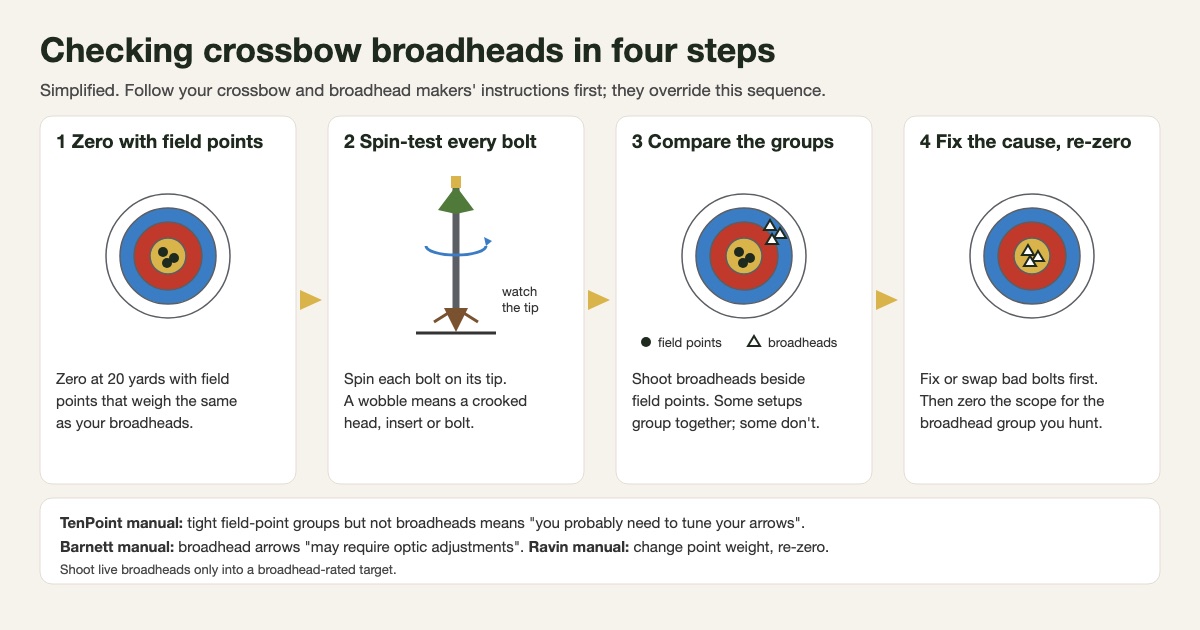
Crossbows aren't usually tuned like compound bows, by moving a rest or nock point. What they need is a check: shoot your hunting broadheads beside your field points and see whether they group together. If they don't, the fix is usually the bolt, the head or the zero, which is how to broadhead tune a crossbow in practice.
Why broadheads can hit away from field points
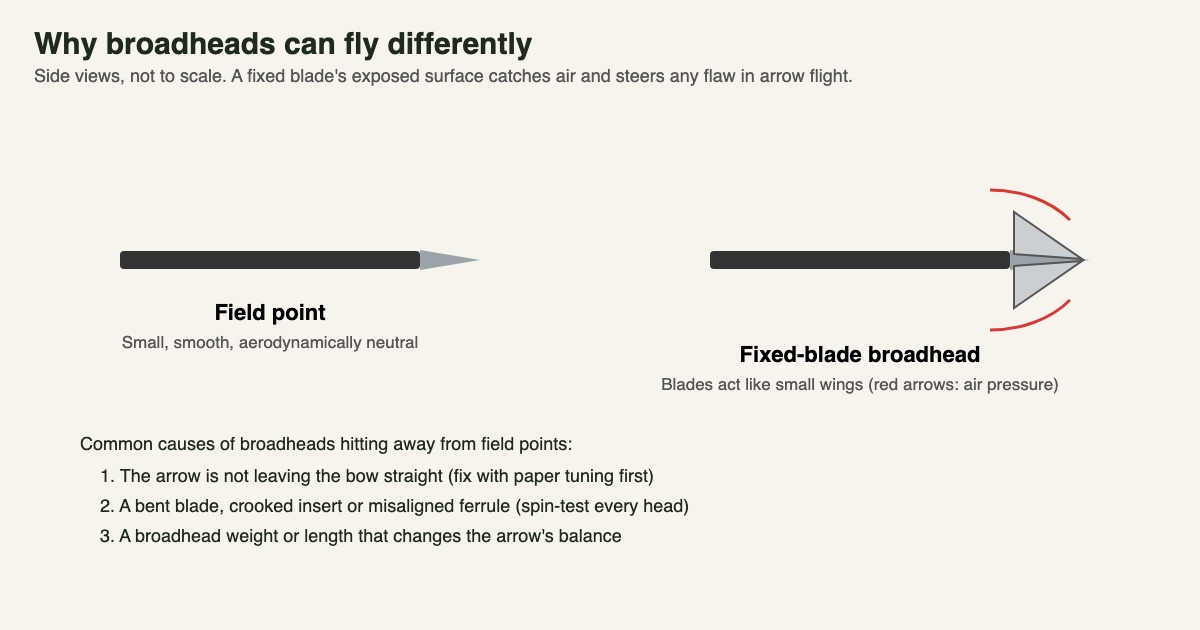
A field point is a small, smooth tip. A broadhead puts blades at the front of the bolt, and those blades meet the air. Barnett's FAQ explains the effect: with broadheads "you may be experiencing planing, which means that the blades of the broadhead catch air as they fly."
Blades amplify small faults: a crooked head, a slightly bent bolt, a damaged vane. Head design matters too. Barnett's manual says mechanical heads, flying with blades folded, "tend to fly more consistently than fixed blade broadheads", and that fixed heads wider than 1 3/16 in are not recommended in its crossbows "as they may fly erratically." Ravin's R26/R29 manual recommends "an expandable broadhead for best downrange accuracy" and a head "rated for crossbows and even more specifically for the speed of your bow."
Those are makers' rules for their own crossbows, so check yours. Our fixed-blade vs mechanical broadheads comparison covers the wider trade-offs.
Step 1: Spin-test every bolt
Fit each hunting head and spin the bolt on its tip. TenPoint's troubleshooting section says that if your arrows "wobble at the connection between the broadhead and insert when you spin them on their tips, they are not straight (out of tune)." It suggests a pro shop if you lack tuning equipment, and says to keep bolts "the same brand, weight, and size" and broadheads "the same brand and weight."
G5 describes its Montec, sold in a crossbow version, as having "100% spin-tested accuracy". Spin your own anyway: the insert and bolt matter too.
Step 2: Check nock and vane indexing
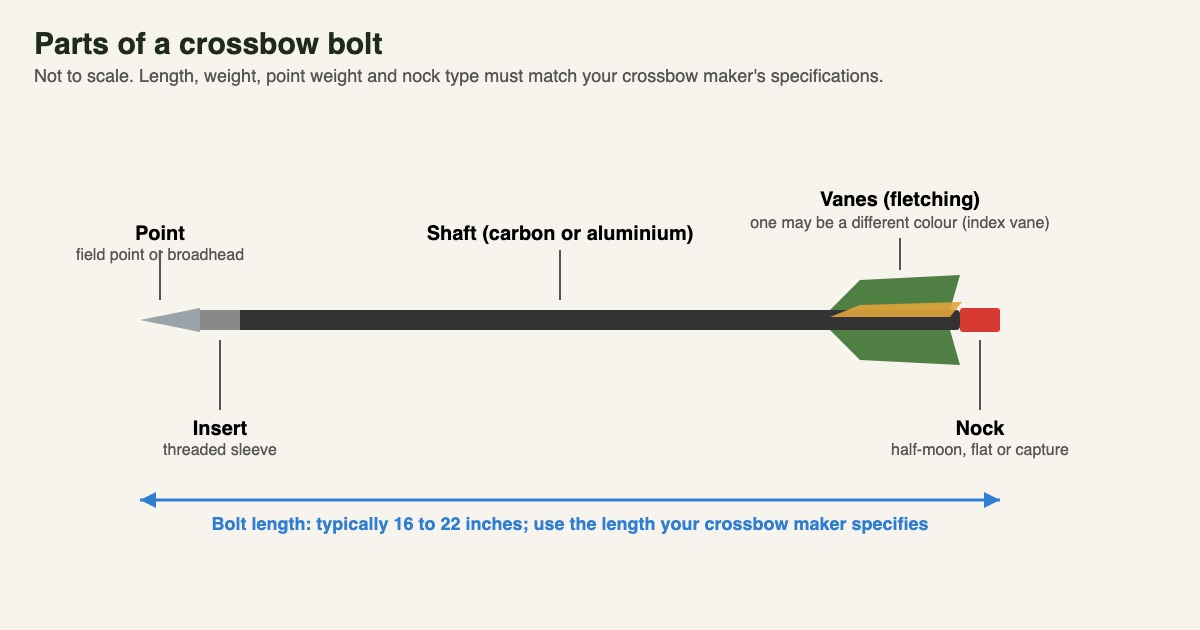
Crossbow bolts load one way. Ravin's manual says to load with "the odd colored fletching pointing straight down" and to "Confirm the nock is properly indexed with the fletching." Barnett's manual also loads with the odd-coloured vane down and says nocks should be "properly aligned (perpendicular to the odd colored vane)." Check for a twisted nock before you blame the broadhead.
Step 3: Compare groups, then re-zero
Excalibur's sight-in guide sets the order: zero with field points, then "shoot again with broadheads to see if your point of impact shifts. You can then adjust your zero based on your broadheads." It also suggests buying field points "to match the weight of your broadheads and minimize point of impact shift." Barnett's manual agrees that broadhead-tipped bolts "may require optic adjustments."
Ravin is stricter: if you switch to a heavier or lighter head or field point, "you must repeat the zeroing in process of your scope." Our crossbow scope sight-in guide walks through the zeroing itself.
| What you see | Likely cause | What to try |
|---|---|---|
| One or two bolts stray, the rest group | Bent bolt, crooked head or insert | Spin-test; replace or straighten that bolt |
| All broadheads group, but apart from field points | Planing, different weight | Re-zero for broadheads; match field-point weight |
| Broadheads scatter | Head not suited to your crossbow (check its speed rating) | Check your manual's rules; try another head |
When to switch heads
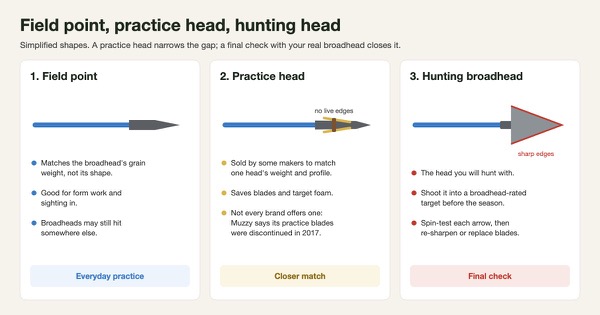
If straight, matched bolts still won't group with a fixed blade, try a head your maker recommends or a mechanical rated for crossbows. Re-zero only once broadheads group tightly; never chase scattered groups with the scope. Our article on practice broadheads explains why the final check always uses the real head.
For examples to consider, you can browse fixed-blade crossbow broadheads on Amazon or look at crossbow practice broadheads. Check your manual's limits first.
Frequently asked questions
Why are my crossbow broadheads not hitting with my field points?
The blades catch air, which Barnett calls planing, so small faults show up. Spin-test each bolt for wobble, check the nock is indexed to the odd vane, and confirm the head and field point weigh the same. If they then group together but apart from field points, re-zero for broadheads.
Should I sight in my crossbow with broadheads?
Zero with field points first, then confirm with your hunting heads. Excalibur says you can adjust your zero to your broadheads so your aim point matches in the field, and Barnett notes broadhead bolts may need scope adjustments. Use a broadhead-rated target, and re-check whenever you change head weight.
Related articles
 Training
How to Sight In a Crossbow Scope, Step by Step
How to sight in a crossbow scope: safety, mounting, a 20-yard zero, multi-reticle and speed-dial scopes, broadhead checks and fixes for wandering groups.
October 6, 2026 · 9 min read
 Gear
GearPractice Broadheads: Are They Worth Using?
Practice broadheads explained: what they match, when they help with mechanical heads, which makers still sell them and why the real broadhead decides.
Updated October 8, 2026 · 5 min read
 Training
Crossbow Shooting in Wind: Drift and Holdoff
How to adjust a crossbow scope for wind: why crosswinds push bolts, what makes drift worse, holding into the wind vs dialling, and when to shorten the shot.
Updated October 7, 2026 · 4 min read