
Changing a Bowstring: When You Need a Press
Changing a bow string without a press works on recurves and longbows with a stringer. Most compounds need a maker-approved press. Here's how to tell.
By Archery Insider Editorial Team
· 5 min read
In this article
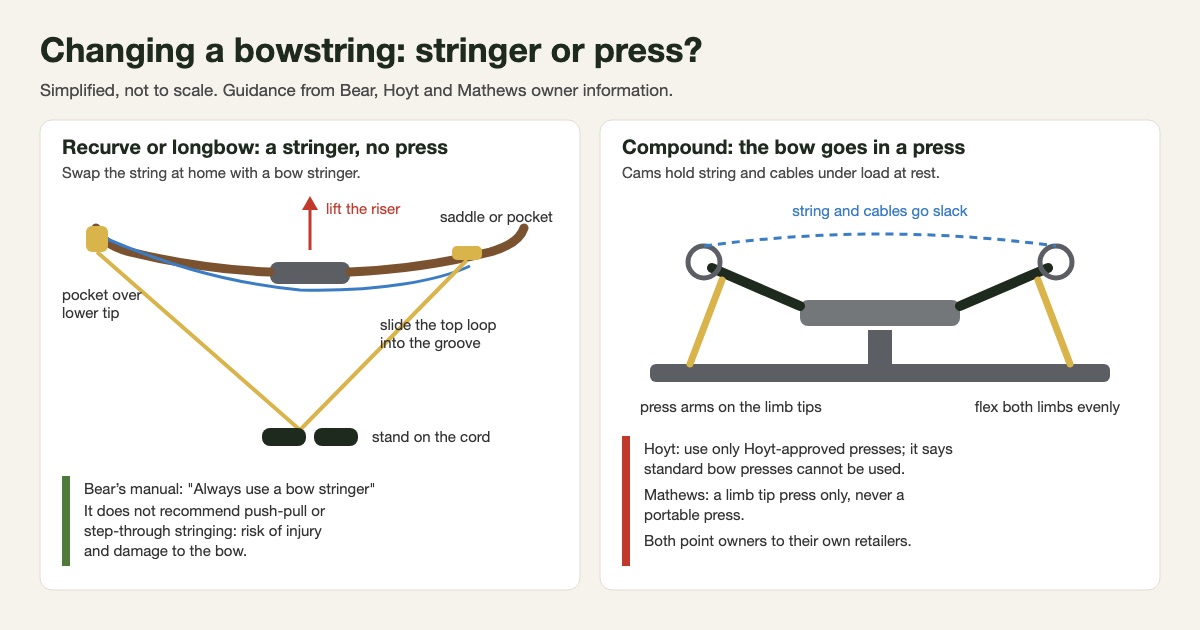
Changing a bow string without a press is normal on a recurve or longbow: a bow stringer is the only tool you need. Most compound bows are different. Their string and cables stay under load from the cams, and makers such as Hoyt and Mathews specify which presses may be used and send owners to their retailers for the job.
Recurves and longbows: a stringer swap
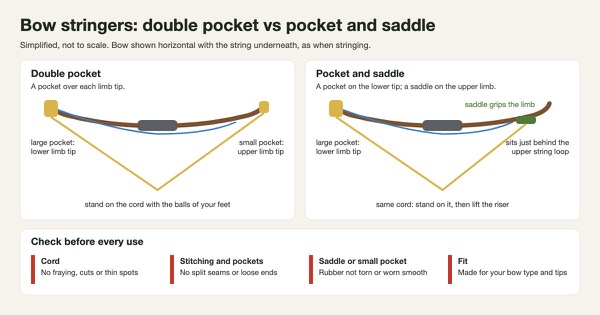
Once a stringer takes the bend out of the limbs, the string lifts off by hand.
- Unstring the bow with the stringer. Our recurve stringing guide shows each step.
- Lift the old string off both limb tips.
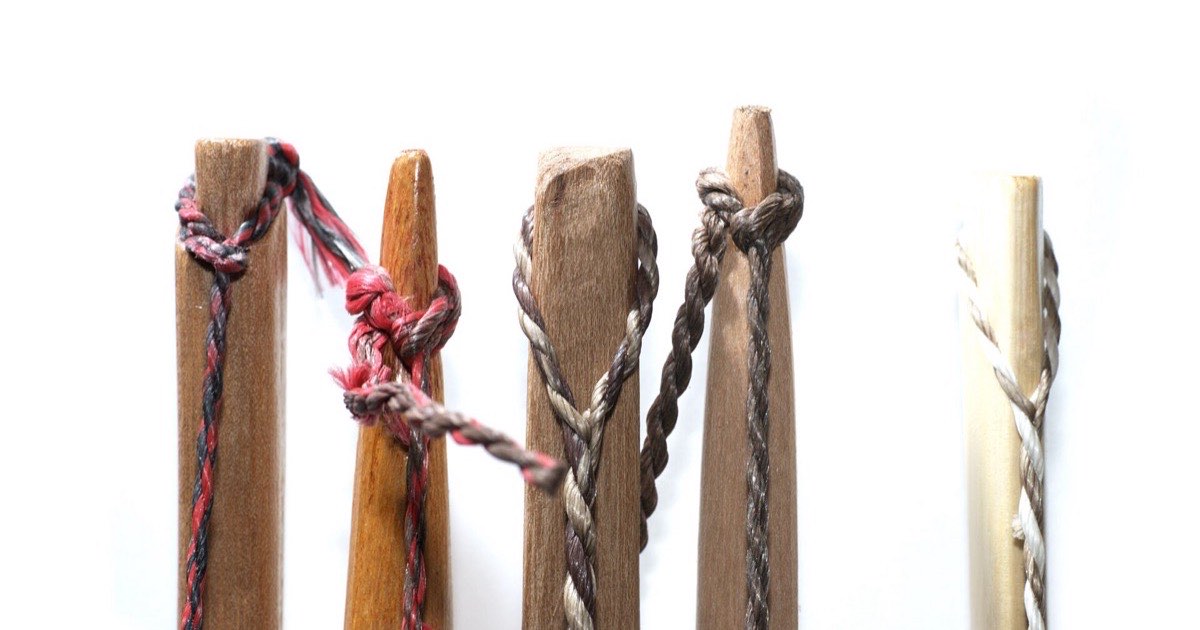
- Fit the new string. The Wyke Archers club guide notes that "usually the top loop is larger than the bottom loop," because it slides down the upper limb. Seat the small loop in the lower tip's groove.
- Restring with the stringer and check that both loops sit fully in their grooves before you remove it.
A new string has to be the right length. For its traditional bows, Bear's manual says to subtract approximately 3 inches from the bow's overall length. Check your own maker's figure before you order.
Compounds: a press is part of the job
A compound's cams keep the string and cables under tension even at rest, so they can't simply be lifted off. To fit new ones, the limbs must be flexed further in a bow press. Our compound vs recurve comparison covers that wider maintenance difference.
The makers are specific about which presses. Hoyt's safety page says only Hoyt-approved presses should be used on its bows, warns in capitals that "STANDARD BOW PRESSES CANNOT BE USED," and lists the approved models. Mathews' FAQ says "only a limb tip press should be used on your Mathews bow" and that "portable bow presses should not be used." Hoyt adds that "only Hoyt or a Genuine Hoyt Retailer should perform replacement of damaged parts."
Forums offer press-free tricks, but no maker source we read approves them. If your bow needs new strings and cables, ask the maker or take it to a pro shop with the right press.
| Recurve or longbow | Compound | |
|---|---|---|
| Tool | Bow stringer | Maker-approved bow press |
| Who usually does it | The archer | A pro shop or the maker's retailer |
| Maker interval example | Hoyt recurve: when worn or after two years | Hoyt: 2,000 shots or two years, whichever first |
| Check afterwards | Brace height, nocking point, kisser | Peep, D-loop, nocking point, draw specs |
Hoyt's intervals apply to Hoyt bows; other makers set their own.
After the swap: what to check
Brace height. Bear's manual gives a normal brace height of 7 to 8 inches for its traditional bows, and warns that even a pre-stretched string "will stretch slightly after being shot a few times." Twist or untwist the string to bring it back into your maker's range.
Nocking point and accessories. Everything on the old string has to be moved to the new one. Hoyt's recurve page says never to draw or shoot "without all string accessories (kisser button, nock points, string silencers) properly installed and secured to the string." On a compound that includes the peep sight and D-loop, and Hoyt recommends that "only a Genuine Hoyt Retailer install all string accessories."
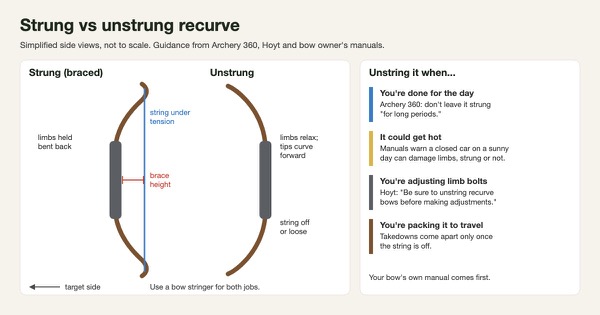
Storage. Our guide to leaving a recurve strung covers what to do between sessions.
For a traditional bow, you can browse recurve bow stringers on Amazon; the Bear Archery A100RS Recurve Stringer is one example to consider. Check it suits your bow's length and tips.
Frequently asked questions
Can you change a bow string without a press?
On a recurve or longbow, yes: use a bow stringer, never a step-through or push-pull method. On most compounds, no. Hoyt and Mathews both specify which presses may be used on their bows, so check your maker's guidance and use a shop with the right press.
Can you restring a bow yourself?
Traditional bows, yes: unstring with a stringer, fit the new string with the larger loop on the upper limb, restring and check brace height. Compound strings and cables are different: makers such as Hoyt point owners to their own retailers, and a press is needed.
How often should you change a bowstring?
It depends on the maker and on wear. Hoyt suggests replacing compound strings and cables after 2,000 shots or two years, whichever comes first, and recurve strings when worn or after two years. Replace any string that is frayed, damaged or has broken strands straight away.
Related articles
 Training
How to String and Unstring a Recurve Bow Safely
How to string and unstring a recurve bow with a stringer, why step-through stringing twists limbs, post-stringing checks, brace height and string care.
Updated February 1, 2025 · 8 min read
 Gear
GearBow Stringers: Types and Why You Need One
What a recurve bow stringer does, double-pocket vs pocket-and-saddle types, longbow fit, why makers warn against step-through stringing, and what to inspect.
July 19, 2025 · 4 min read
 Guides
Can You Leave a Recurve Bow Strung?
Can you leave a recurve bow strung? For a session, yes. What makers and coaches say about storage, heat, travel and limb adjustments, and when to unstring.
Updated October 6, 2026 · 4 min read