
QAD Exodus Broadheads Review
QAD broadheads explained: the Exodus full and swept blades, 100 and 125 grain, Deep Six and crossbow versions, blade-over-shaft design, legality and tuning.

By Archery Insider Editorial Team
· 10 min read
Research-based: built from maker specs and official sources, fact-checked before publishing. How we review products
In this article
If you search "broadheads QAD", you'll land on one family: the Exodus. Quality Archery Designs also makes the Ultrarest arrow rests, and the Exodus is its only broadhead line. It's a three-blade, fixed, cut-on-contact head with a 1-1/4 inch cutting diameter, sold in 100 and 125 grain, with a Full or Swept blade, and in standard, Deep Six and crossbow versions.
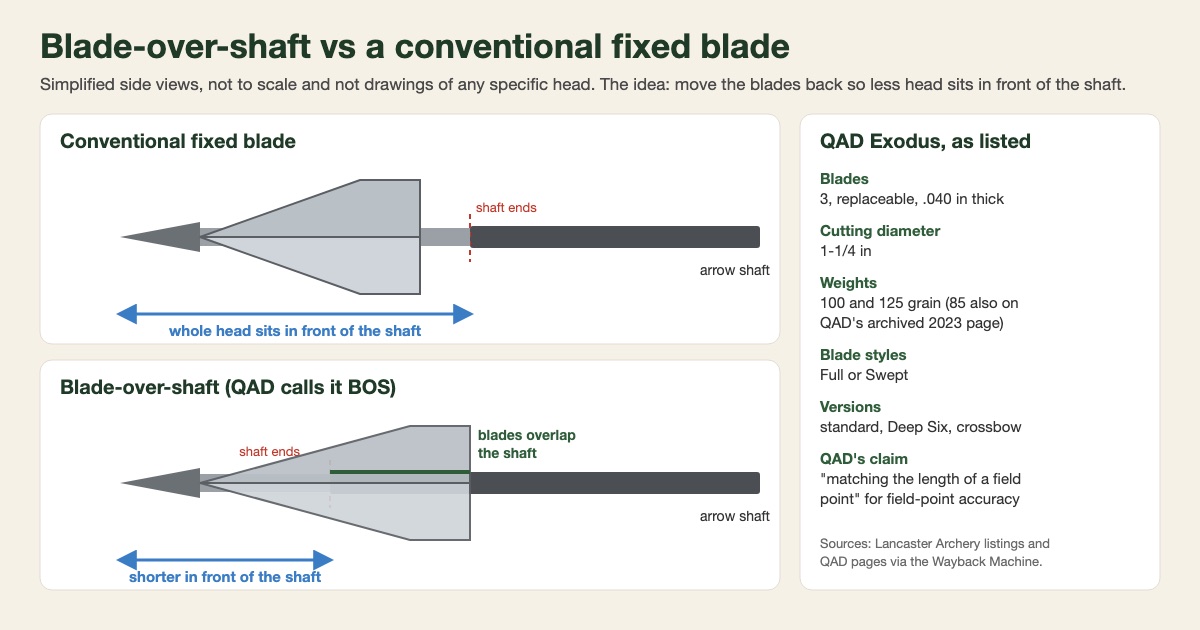
QAD's big idea is "BOS (Blade Over Shaft) technology": the blades extend back over the end of the arrow shaft, so the head is short. QAD says that by "matching the length of a field point", the Exodus gets field-point accuracy from a fixed blade. This review explains how that works, which version to choose, where the Swept blade runs into legal trouble, and how to check your own arrows fly true.
The Exodus line-up
These are the versions listed by Lancaster Archery in October 2026, with specs from those listings and QAD's archived pages.
| Version | Weight | Blade options | Cut | Blade thickness | Pack |
|---|---|---|---|---|---|
| Exodus 100 gr | 100 gr | Full or Swept (sold separately) | 1-1/4 in | .040 in | 3 heads |
| Exodus 125 gr | 125 gr | Full or Swept | 1-1/4 in | .040 in | 3 heads |
| Exodus Deep Six | 100 gr | Full or Swept | 1-1/4 in | .040 in | 3 heads |
| Exodus crossbow (XBow) | 100 gr at Lancaster; QAD's archived page also listed 125 gr | Full at Lancaster; QAD's archived page listed Full and Swept | 1.25 in | .040 in | Not stated |
The shared specs, in Lancaster's wording: "Tempered 400 series stainless steel", a "Rock-buster hardened SST tip", "# of Blades: 3" and "Fixed blade, cut-on-contact". Replacement blades are sold in packs of nine for each version. For the 100 grain head, Lancaster lists two packs: "Replacement Blades (Full Blade)" and "Replacement Blades (Barbed)", the second presumably for the Swept.
Every Exodus listing we read carries the same QAD sentence: "Exodus broadheads are 100% designed and manufactured in the good ol' USA." Our made-in-USA archery gear guide explains what that kind of claim means and lists other makers' wording.
How blade-over-shaft works
A conventional fixed-blade head sits entirely in front of the arrow: tip, blades, ferrule, then the threaded stud that goes into the insert. The longer that assembly, the more it can act like a little wing at the front of the arrow, which is one reason fixed blades often hit away from field points.
The Exodus moves the blades backwards. On QAD's description, BOS "allows for a super short head & precise accuracy", because part of each blade overlaps the end of the shaft instead of sitting in front of it. QAD's 2014 Deep Six page cited US patent 8,506,431. That patent describes a broadhead with removable blades "locked into a place by a lock washer that slides over the rear portion of the body and is secured between the broadhead point and the arrow shaft", and claims a design in which "at least 50% of the removable blade's mass is located behind the blade lock".
Two practical points follow from that design:
- Blades are held by the washer and the arrow. The head has to be screwed fully home against the shaft to lock everything together. Check each head is tight before every hunt.
- The blade sits over the shaft's end. That's the point of the design, but it also means the outside of the shaft and insert sit inside the blade circle. If you change arrow brands, make sure the head seats cleanly and spins true on your new shafts.
The accuracy claim is QAD's own. goHUNT's listing repeats it ("flies as true as field tips"), but neither is an independent test. Your bow's tune decides whether any fixed blade groups with your field points.
Full blade vs swept blade
Both blade styles share the same weight options, cutting diameter and thickness, so the choice isn't about cut size. It's about the shape of the rear edge, and that has legal consequences.
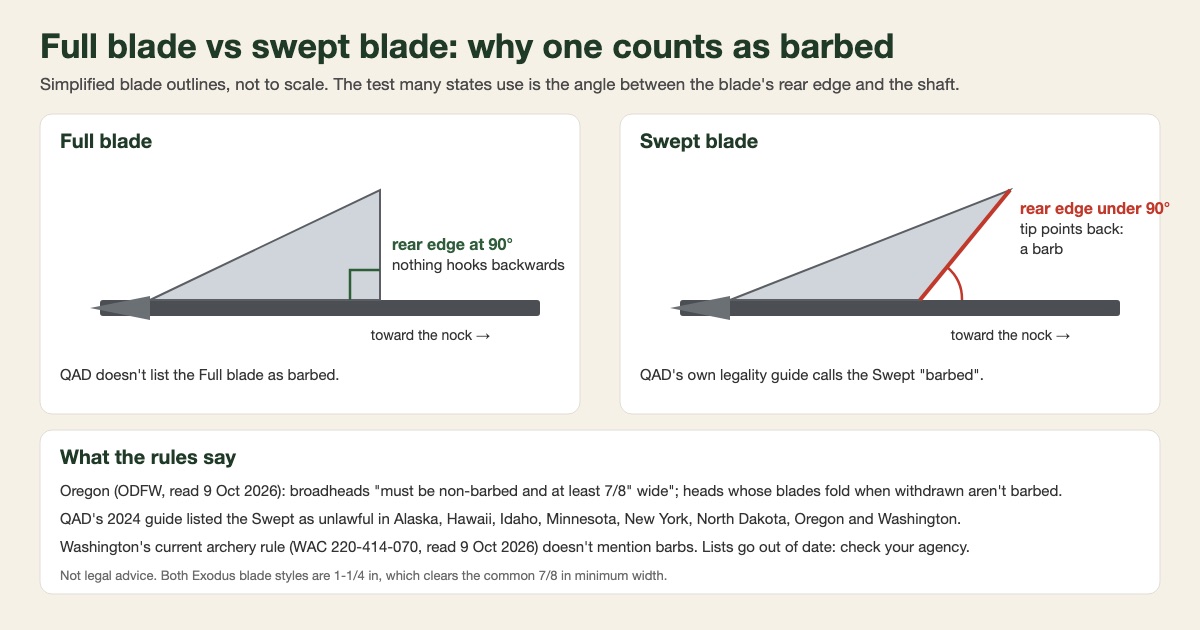
QAD's own "Broadhead Regulations" page, archived in April 2024, says it covers "the legality of the EXODUS® Swept broadheads across different states", where they can't be used "due to being classified as a barbed broadhead". QAD adds that hunters are responsible for checking their own regulations.
You can usually tell which you have by eye: on a Full blade the rear edge drops straight to the ferrule, while on a Swept blade the outer point trails back towards the nock. If the packet or listing doesn't say "Full" or "Swept", check before you hunt somewhere with a barb rule.
QAD doesn't publish a performance difference between the two, and we won't invent one. If you hunt in more than one state, or aren't sure of your rules, the Full blade avoids the barb question entirely.
Standard, Deep Six and crossbow versions
Standard Exodus. The 100 and 125 grain heads are for ordinary hunting arrows. Choose the weight your arrow set-up was built around; changing point weight changes dynamic spine and front-of-centre balance, so it can change where the arrow hits.
Exodus Deep Six. QAD's archived page says it's "Specifically designed for Deep Six arrows and inserts." If your arrows use Deep Six inserts, order this version; if they don't, order the standard head.
Exodus crossbow. Lancaster's listing says it has a "22/64" diameter collar for crossbow shaft alignment", a 1.25 inch cut and .040 inch blades. Check your crossbow maker's broadhead and bolt rules first; our crossbow broadheads guide explains what matters for crossbow heads.
Legality: mechanicals, cutting width and barbs
Broadhead rules usually test three things. Here's how the Exodus fares on each.
| Rule type | What states regulate | How the Exodus fits |
|---|---|---|
| Mechanical (expanding) heads | Some states restrict or ban them | The Exodus is fixed-blade, so mechanical bans don't touch it |
| Minimum cutting width | Often 7/8 inch for big game | The 1-1/4 inch cut clears that figure |
| Barbed heads | Some states ban heads whose rear edge angles back | QAD classes the Swept as barbed; the Full isn't on QAD's list |
Oregon is a clear example of a barb rule. ODFW's page says: "Broadheads must be non-barbed and at least 7/8" wide. Broadheads with moveable blades that fold/collapse when withdrawn are not considered barbed."
QAD's own 2024 list named Alaska, Hawaii, Idaho, Minnesota, New York, North Dakota, Oregon and Washington as states where the Swept was unlawful. Treat that list as a starting point: Washington's current archery rule (WAC 220-414-070), which we read in October 2026, doesn't mention barbs. Lists like QAD's age quickly.
Rules checked on 9 October 2026; this isn't legal advice and regulations change, so confirm with your state wildlife agency before you hunt. Our fixed-blade vs mechanical broadheads comparison covers the wider rules and trade-offs.
A field-point flight checklist for the Exodus
QAD's pitch is that the short head flies like a field point. Here's how to check that claim on your own bow.
- Match the weight. Shoot field points of the same grain weight as your Exodus heads (100 or 125).
- Spin-test each head. Screw it fully home and spin the arrow on its point. Any wobble at the tip means a crooked insert, a dirty thread or a head not seated.
- Check the blades are locked. With the head tight, the blades shouldn't move. Re-check after every shot into a target.
- Tune the bow first. Paper tune or bare-shaft tune before you blame the broadhead.
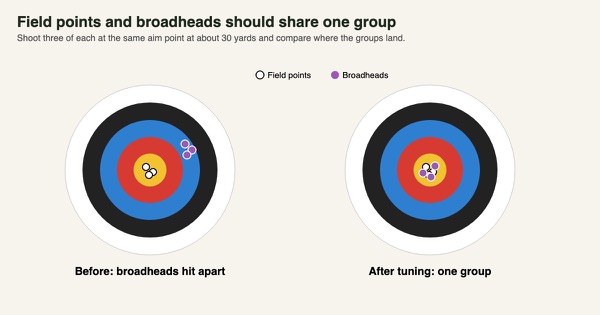
- Shoot side by side at 20, then 30 and 40 yards. Use a dedicated broadhead target and a separate aiming spot for each.
- Micro-tune, don't re-sight. If broadheads group apart from field points, small rest moves usually fix it; moving the sight only hides the problem.
- Practise with the real heads. Swap in fresh blades for hunting so the edges you shoot into game are sharp.
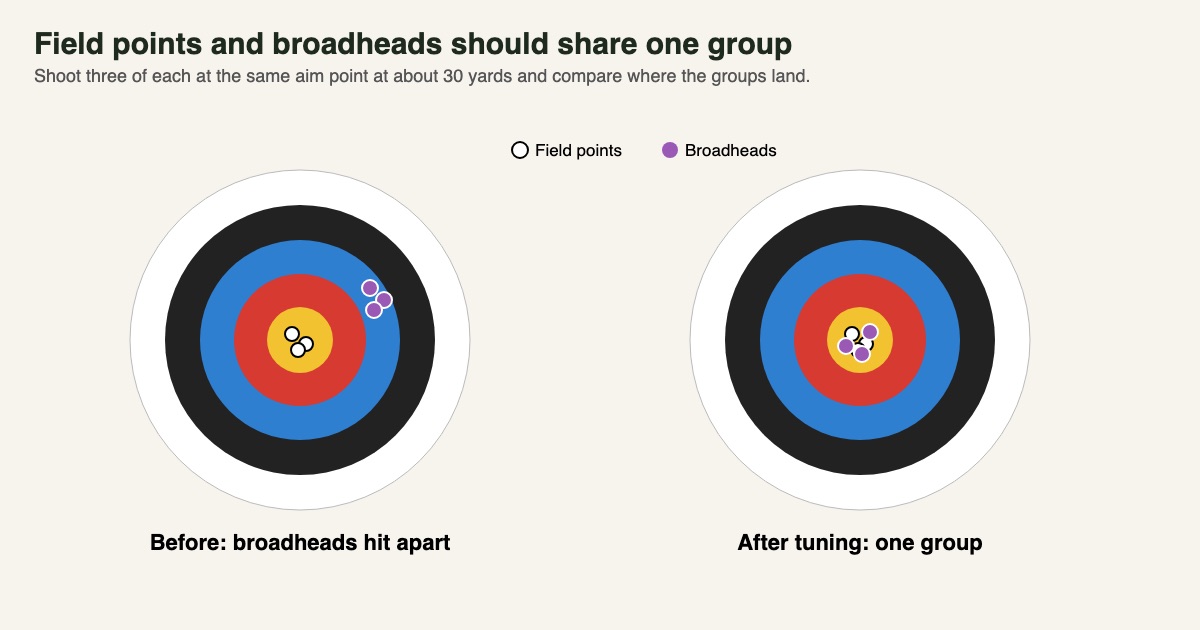
Our field points vs broadheads guide walks through each step, including how far to move the rest.
Blade care and replacement
Because the Exodus uses replaceable blades, upkeep is mostly about swapping and checking rather than sharpening.
- Keep practice and hunting heads separate. Shoot a set into a broadhead target for tuning, then fit new blades to the heads you'll carry. Our guide to practice broadheads covers when a dedicated practice head makes sense.
- Buy the matching blade pack. Lancaster lists separate QAD replacement packs for the 100 grain Full, 100 grain "Barbed", 125 grain, Deep Six and crossbow heads. They aren't presented as interchangeable, so match the pack to the head.
- Re-tighten after every shot. QAD's patent describes the blades as locked by a washer held between the point and the shaft, so a head that has backed off slightly may not hold its blades firmly.
- Inspect the tip and blades. A bent blade or rolled edge after hitting bone or a rock means replacing the blade before the next hunt.
- Store heads in a broadhead case or quiver hood, both for safety and to protect the edges.
Who each Exodus suits
- Exodus 100 gr, Full blade: the default choice for most compound hunters using 100 grain points, and the safest pick if you hunt in several states.
- Exodus 125 gr: archers whose arrows are built around 125 grain points, or who want more weight up front for front-of-centre balance.
- Swept blade: only for hunters who've confirmed that their state allows it for the species they're hunting.
- Deep Six: owners of Deep Six arrows and inserts.
- Crossbow version: crossbow hunters whose bolts suit the 22/64 inch collar and whose crossbow maker allows a 100 grain head.
QAD Exodus
Advantages
- Short blade-over-shaft head designed to fly like a field point (QAD's claim)
- 1-1/4 inch three-blade cut, wider than common 7/8 inch minimums
- Replaceable .040 inch stainless blades, sold in packs of nine
- Standard, Deep Six and crossbow versions
- QAD says it's 100% designed and made in the USA
Trade-offs
- QAD classes the Swept blade as barbed, so it's illegal for big game in some states
- Blade lock relies on the head being screwed fully home
- Only 100 and 125 grain in current dealer listings
- QAD's own site is hard to reach, so current specs come via dealers
- Like any fixed blade, needs a tuned bow to group with field points
You can browse QAD Exodus 100 grain listings on Amazon or look for the 125 grain version. Check the blade style (Full or Swept), the version (standard, Deep Six or crossbow) and the pack size in each listing.
Frequently asked questions
Are QAD Exodus broadheads legal everywhere?
The Full blade meets common rules: it's fixed, has three edges and cuts 1-1/4 inches. The Swept blade is the problem. QAD's own guide classes it as barbed, and states such as Oregon require non-barbed heads for game mammals. Check your state's current rules before choosing the Swept version.
QAD broadheads 125 or 100 grain: which should I choose?
Choose the weight your arrows are built and spined for. Most compound hunters use 100 grain points; 125 grain adds weight up front, which raises front-of-centre balance but can change dynamic spine and impact point. If you switch weights, re-tune and re-check your groups against matching field points.
Do QAD Exodus broadheads really fly like field points?
That's QAD's claim, based on a short head whose blades sit over the shaft. No head flies like a field point on a poorly tuned bow, though. Shoot Exodus heads and matching field points side by side at 20, 30 and 40 yards; if they group apart, tune the rest rather than moving the sight.
Who makes QAD broadheads, and where?
Quality Archery Designs, which also makes Ultrarest arrow rests, makes the Exodus. Its archived product pages say "Exodus broadheads are 100% designed and manufactured in the good ol' USA", and an archived 2020 about page says QAD manufactures its products in Madison Heights, Virginia. Confirm current details with QAD or your dealer.
Can I replace Exodus blades?
Yes. Lancaster lists QAD replacement blades in packs of nine for each version: 100 grain Full, 100 grain "Barbed", 125 grain, Deep Six and crossbow. Match the pack to your head, fit the blades with the head screwed fully home, and spin-test each arrow before shooting it.
Related articles
 Comparisons
Fixed-Blade vs Mechanical Broadheads: Pros, Cons and Rules
Fixed-blade vs mechanical broadheads compared: flight, tuning, cutting diameter, energy needs, durability, hybrid designs, regulations and which suits your bow.
Updated October 9, 2026 · 6 min read
 Training
Field Points vs Broadheads: Why Impact Changes
Why broadheads hit differently from field points, and how to fix it: paper tuning, spin-testing, micro-tuning the rest at 30 yards, FOC and re-sighting.
October 14, 2026 · 9 min read
 Gear
Crossbow Broadheads: What's Different, How to Choose
Crossbow broadheads explained: why crossbow versions exist, fixed vs mechanical at crossbow speeds, broadhead and bolt weight, legal rules and safe handling.
October 9, 2026 · 9 min read