
Hoyt Alpha AX-3 Review: Specs, Speed and Who It Suits
Hoyt Alpha AX-3 review: specs for all four models, the XTS tuning system explained, measured speeds from two magazine tests and how it compares with the ARC.

By Archery Insider Editorial Team
· 12 min read
Research-based: built from maker specs and official sources, fact-checked before publishing. How we review products
In this article
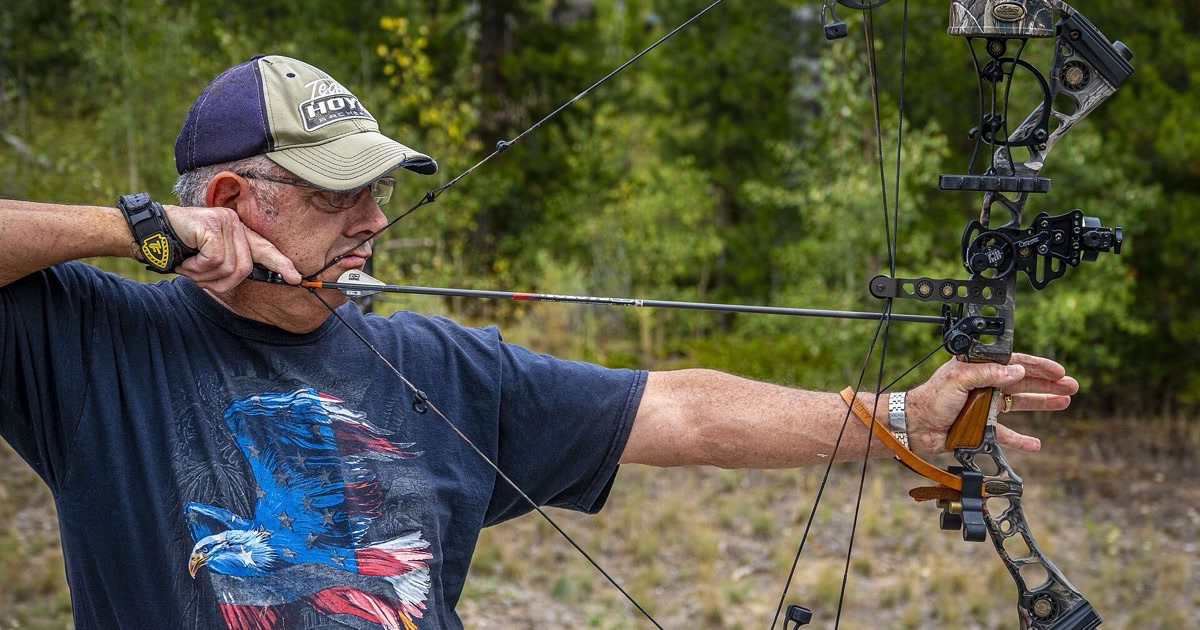
Field & Stream named the Hoyt Alpha AX-3 33 its best overall compound bow of 2026, and Outdoor Life's testers placed it second of their whole field. This Hoyt Alpha AX-3 review explains why: a smooth, adjustable cam, an easy-to-use tuning system and four models that fit draw lengths from 23 to 33 inches. The short verdict is that it's one of the easiest flagship bows to fit and tune, at the cost of a little extra weight over carbon rivals. Hoyt sells it only through dealers, so start with the Hoyt dealer locator.
Hoyt Alpha AX-3
Advantages
- XTS tuning corrects vertical tears too, without a bow press
- Quarter-inch draw-length steps and three let-off settings on the cam
- Best grip and back wall in Outdoor Life's 2026 test
- SD and LD models stretch the range to 23–33 in of draw
Trade-offs
- Heavier than carbon rivals: 4.75 lb for the AX-3 33
- Dealer-only, and online purchases void the warranty
- Outdoor Life scored its features 3 out of 5
Hoyt Alpha AX-3 specs: all four models
All figures below are Hoyt's own, from its product pages and tune charts.
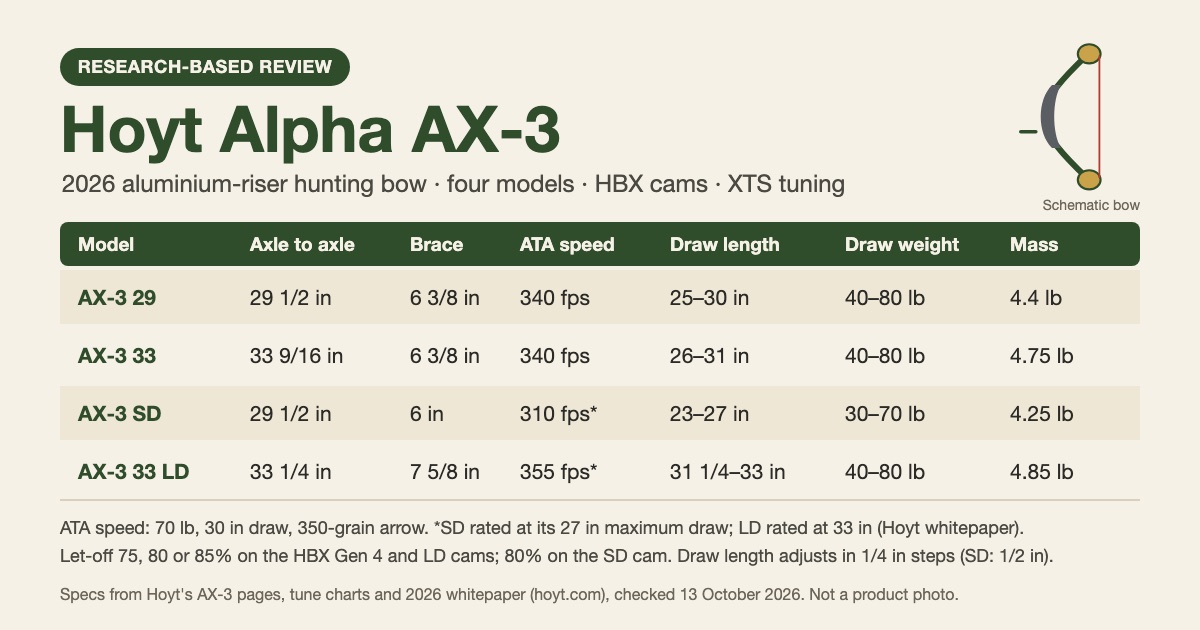
| Spec | AX-3 29 | AX-3 33 | AX-3 SD | AX-3 33 LD |
|---|---|---|---|---|
| Axle to axle | 29 1/2 in | 33 9/16 in | 29 1/2 in | 33 1/4 in |
| Brace height | 6 3/8 in | 6 3/8 in | 6 in | 7 5/8 in |
| Speed (ATA) | 340 fps | 340 fps | 310 fps (at 27 in) | 355 fps (at 33 in) |
| Mass weight | 4.4 lb | 4.75 lb | 4.25 lb | 4.85 lb |
| Draw length | 25–30 in | 26–31 in | 23–27 in | 31 1/4–33 in |
| Draw weight | 40–80 lb | 40–80 lb | 30–70 lb | 40–80 lb |
| Cam and let-off | HBX Gen 4, 75–85% | HBX Gen 4, 75–85% | HBX SD, 80% | HBX LD, 75–85% |
| Limbs | AXL | AXL | AXL | TXL |
Hoyt lists 12 finishes for both main sizes, from Realtree APX and Mossy Oak Bottomland to Sitka Gore Optifade Subalpine and blackout versions.
Design and features
XTS Tuning System
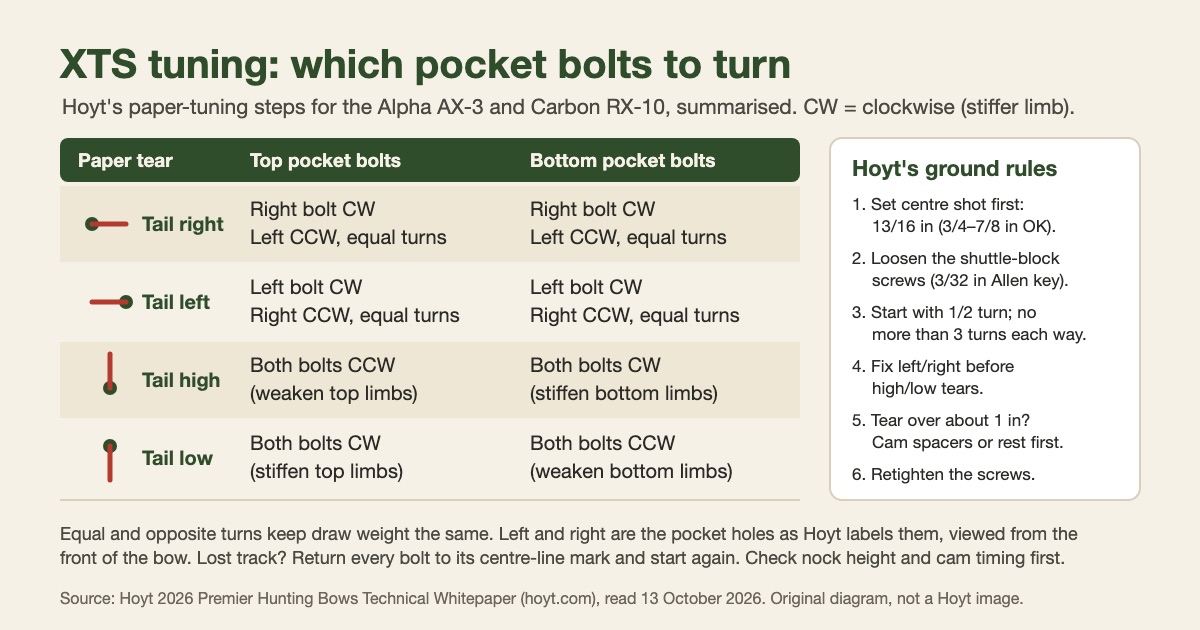
XTS is the headline. Hoyt says most tuning systems only fix left and right tears, while XTS "also corrects high & low tears" and won't change your point of impact once you've tuned. Each limb pocket has two tuning bolts: turning one clockwise stiffens that side of the limb. Hoyt's product page puts it simply: "If you can turn a wrench, you can tune this bow."
Hoyt says it works on tears up to about an inch. Bigger tears need a cam spacer swap or a rest move first. The whitepaper also suggests using XTS to bring broadheads onto field-point impact, or to add a couple of pounds by turning every bolt clockwise when a string beds in and your sight tape stops matching.
HBX Gen 4 cam: draw length, let-off and back wall
The 29 and 33 use five draw-length modules (each covers 3/4 in, the shortest a full inch), set in quarter-inch steps; Field & Stream notes no press is needed. Hoyt says each module is optimised for its own inch of draw, rather than tuning the cam for the longest advertised length. A movable mod foot sets let-off at 75, 80 or 85%, and swapping the top and bottom feet changes the back wall from "extra hard" to "hard", which Hoyt says gives a longer-feeling valley. Bows ship at 85% with the extra-hard wall. A split harness balances cable load on both sides of the cam to cut cam lean.
The SD cam is simpler: one module covering 23–27 in in half-inch steps, fixed at 80% let-off. The LD cam uses the same feet and options with TXL limbs.
Hoyt Optimized Geometry: 29 or 33?
Hoyt notes that longer bows are generally considered steadier, partly because the string angle at full draw is less acute. Hoyt says the AX-3 29 behaves like a 31-1/16 in bow at full draw, which brings the peep closer to your eye than on a typical 29 in bow. That's a maker claim nobody has tested independently: both magazine tests below used the 33, so shoot the 29 at a dealer before trusting it.
In-Line accessories and the Short Stop 2.0
The sight bolts to a Picatinny rail on the front of the riser, and an Integrate-style rest mounts to the back, keeping weight in line with the riser and letting the quiver sit closer. Every AX-3 comes with a 2-inch Short Stop 2.0 stabiliser in a lower, forward bushing. Hoyt says that spot puts the weight about as far forward as a 7-inch stabiliser in the usual position. The bare bow is about a quarter-pound lighter than the original Alpha X, and Hoyt dropped the Shock Pods.
Riser and speed ratings
Every Hoyt riser design, built around its TEC bar, must survive 1,500 dry fires before production (never dry-fire yours). Hoyt also claims a 38% torque reduction from the Alpha X. On speed, Hoyt rates to the ATA standard (70 lb, 30 in draw, 350-grain arrow) and argues that IBO ratings, which Mathews and Elite quote, can be inflated. Compare like with like.
What the testers measured
| Test | Setup | Speed | Other results |
|---|---|---|---|
| Outdoor Life, July 2026 (AX-3 33) | 59.6 lb, 29.5 in, 389 gr | 285.6 fps | 8.6 lb holding weight; 3.64 in average 50-yard groups; second overall |
| Field & Stream roundup, March 2026 (AX-3 33) | About 70 lb, 29 in, 467 gr | 285 fps | 62.2 dB; 99/100; Best Overall |
| Field & Stream review, June 2026 (AX-3 33) | 73.12 lb, cams at 29 in as shipped, arrow weight not stated | 316 fps | Sub 1 1/2 in 50-yard groups with field points |
Outdoor Life's tester Connor Kaufhold called it the "most comfortable grip and back wall in the test", and the team judged XTS "neck-and-neck" with Elite's S.E.T. system. In the March roundup, Field & Stream's Jace Bauserman called XTS "the best on-bow tuning system on the market right now" and wrote that the bow "draws like butter". In his June review he paper-tuned it in under three minutes. That review lists let-off as 70, 75 and 80%; the roundup and Hoyt's manual say 75, 80 or 85%.
Note the gaps. Every published test used the AX-3 33, so the 29, SD and LD have no independent results yet, and the 316 fps figure came from a bow pulling over 73 lb with an unstated arrow weight, so it isn't comparable with the other two rows.
Fit, setup and compatibility
Draw length and weight
Get measured before ordering: our guide to measuring your draw length shows how. Hoyt's manual says AX-3 bows come down 10 lb from peak in three turns of the limb bolts, and it advises against backing out further. A 70 lb bow covers roughly 60–70 lb. Hoyt adds that any bow at peak may draw up to 4 lb heavy; Field & Stream's "70 lb" test bow scaled 73.12 lb.
Rests, sights, stabilisers and arrows
- Rest: Hoyt sets centre shot at 3/4–7/8 in from the Berger hole, starting at 13/16 in. The riser takes Integrate-mount rests; Outdoor Life used a QAD Ultrarest.
- Sight: a Picatinny-mount sight on the riser's front rail keeps the in-line balance Hoyt designed for.
- Arrows: never under 5 grains per pound of peak weight (350 grains at 70 lb); lighter arrows void the warranty. Pick spine from the arrow maker's chart; our arrow spine, length and weight guide explains how.
- Strings: only Hoyt or Fuse strings and cables. Hoyt suggests waxing every two weeks in peak use and replacing after 2,000 shots or two years.
Setting it up
- Order the right model, hand, draw length and peak weight.
- Register the bow with Hoyt within 30 days.
- Fit a rest, sight, peep and D-loop, with the nock set square to the string (within 3/16 in).
- Paper tune: macro problems first (nock height, cam timing, vane clearance), then XTS. Our paper tuning guide explains reading tears.
- Check broadheads against field points and fine-tune with XTS.
How the Alpha AX-3 compares
Hoyt Alpha AX-3 vs Mathews ARC 30
| AX-3 29 | AX-3 33 | Mathews ARC 30 | Carbon RX-10 | Elite Varos | |
|---|---|---|---|---|---|
| Axle to axle | 29 1/2 in | 33 9/16 in | 30 in | 30 1/2 in | 32 in |
| Brace | 6 3/8 in | 6 3/8 in | 6 in | 6 1/8 in | 6 5/8 in |
| Rated speed | 340 ATA | 340 ATA | 348 IBO | 342 ATA | 338 IBO |
| Weight | 4.4 lb | 4.75 lb | 3.99 lb | 4.1 lb | 4.75 lb |
| Draw length | 25–30 in | 26–31 in | 25–30.5 in | 25–30 in | 25.5–31 in |
The ARC 30 is lighter, and Field & Stream named it the Most Accurate bow of 2026; in the same test it was 10 fps faster than the AX-3 33 (295 against 285 fps) but slightly louder. Peak weights start at 55 lb on the ARC, against 40 lb on the AX-3, and its let-off options are 80 or 85%. Read our Mathews ARC review for the details.
Hoyt Alpha X vs AX-3
From Hoyt's tune charts, the 2024 Alpha X 30 measured 30 3/8 in with a 6 3/16 in brace and HBX Xact cams, and the Alpha X 33 measured 33 7/16 in. The 2025 AX-2 had already moved to the HBX Gen 4 cam and added a short-draw version with the HBX SD cam. The AX-3 adds XTS pockets and the first long-draw Alpha, the 33 LD. Going from an Alpha X, you gain the Gen 4 cam, XTS and the lighter in-line setup; going from an AX-2, XTS is the main change.
Carbon RX-10, Elite Varos and Bowtech Alliance
The RX-10 shares the cam and XTS on a carbon riser, 0.3 lb lighter than the AX-3 29. Outdoor Life's winner, the Elite Varos, grouped tighter (2.72 in) at the same speed with a lower holding weight, but its draw has a "severe dump into the valley". Bowtech's Alliance lists 30.5 in, 338 fps and 4.09 lb, with 60–75 lb peak weights only.
Who should buy the AX-3, and who shouldn't
Good fits:
- Hunters who tune their own bows. XTS and quarter-inch modules mean fewer pro-shop trips.
- Short- and long-draw archers. The SD and LD put a flagship within reach from 23 to 33 inches.
- Western and 3D shooters who want the steadier, still-quiet AX-3 33.
Look elsewhere if you are:
- Counting ounces. The ARC 30 weighs 3.99 lb.
- Shopping online. Hoyt's warranty excludes online and mail-order purchases.
- A beginner on a budget. A package bow like the one in our Bear Cruzer G3 review is a cheaper start.
Where to buy
Buy the AX-3 from a Genuine Hoyt Retailer through the dealer locator. Hoyt's warranty requires a dated receipt from one, registration within 30 days and claims through the dealer, and it doesn't transfer to a second owner.
If you'd rather order a package bow online, compare Bear Legit Maxx RTH listings on Amazon. For any new bow, bowstring wax covers Hoyt's two-weekly waxing advice.
Frequently asked questions
Is the Hoyt Alpha AX-3 33 better than the AX-3 29?
Neither is better overall. The 33 has a longer frame for steadier aiming and was the version both magazine tests used, with strong results. The 29 is 0.35 lb lighter and easier in a stand or blind, and Hoyt says its geometry makes it hold like a longer bow. Both share the cam, brace height and 340 fps rating.
How fast is the Hoyt Alpha AX-3 in a real hunting setup?
Slower than its 340 fps ATA rating, as with any bow. Outdoor Life measured 285.6 fps at 59.6 lb with a 389-grain arrow. Field & Stream's roundup recorded 285 fps at about 70 lb with 467 grains. Your speed depends on draw weight, draw length, arrow weight and string accessories.
Hoyt Alpha AX-3 or Mathews ARC 30: which should I buy?
Choose the ARC 30 if low weight and Field & Stream's accuracy result matter most. Choose the AX-3 for more adjustment: quarter-inch draw steps, three let-off settings, peak weights from 40 lb and XTS vertical tuning. Both are dealer-only flagships, so shoot each at a shop before deciding.
What's the difference between the Hoyt Alpha X and the AX-3?
The AX-3 is the third generation. It swaps the Alpha X's HBX Xact cam for the HBX Gen 4 (already on the 2025 AX-2), adds XTS tuning pockets, drops the Shock Pods and comes in SD and LD versions. Hoyt says the bare bow is about a quarter-pound lighter.
Can you adjust the Alpha AX-3's draw length at home?
Yes, with care. Draw length changes by rotating both cam modules to the same position without a press, and XTS tuning needs only an Allen key. Hoyt still recommends a Genuine Hoyt Retailer for press work, let-off changes and string accessories, and module screws need 30–35 in-lb of torque.
Related articles
 Reviews
Mathews ARC Review: Specs, Speed and Who It Suits
Mathews ARC review: ARC 30 vs ARC 34 specs, real chronograph speeds from two magazine tests, how it compares with the LIFT X, TITLE and Hoyt RX-10.
October 10, 2026 · 12 min read
 News
Mathews ARC and Hoyt RX-10 Lead the 2026 Compound Bow Launches
Mathews ARC 30 and ARC 34, Hoyt Carbon RX-10, Alpha AX-3 and Enduro: the published specifications and technologies of the 2026 flagship compound bow launches.
Updated October 9, 2026 · 3 min read
 Training
Paper Tuning a Bow: How to Read Tears and Fix Them
How to paper tune a bow: what it shows, frame setup, reading nock-high, low, left and right tears, the order of fixes, and when to see a pro shop.
October 8, 2026 · 10 min read