
How Does a Crossbow Work? Recurve, Compound, Reverse
How does a crossbow work? The parts, how the latch and trigger release the string, what the power stroke is, and how recurve, compound and reverse-draw differ.
By Archery Insider Editorial Team
· · 5 min read
In this article
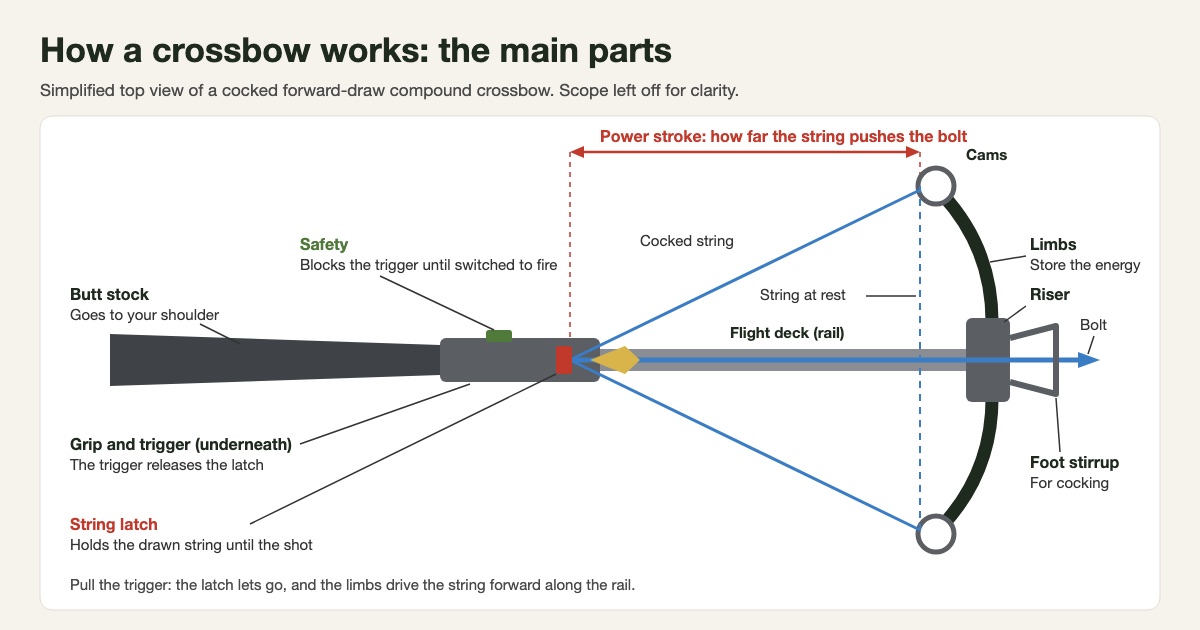
How does a crossbow work? Short, stiff limbs mounted across a stock store energy when you pull the string back to a latch. Pull the trigger and the latch lets go, so the limbs drive the string along the rail and push the bolt out. Recurve, compound and reverse-draw crossbows all work this way, but deliver the energy differently.
The parts of a crossbow
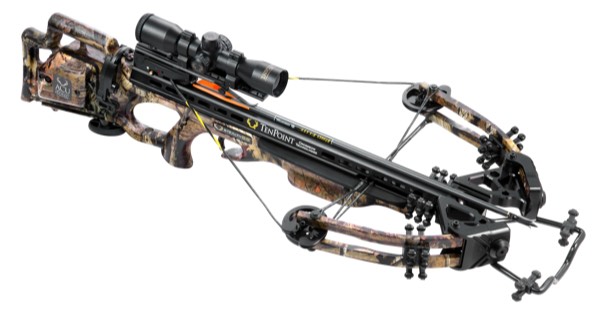
Stock. The back of the crossbow, held against your shoulder like a rifle. It carries the grip and trigger housing.
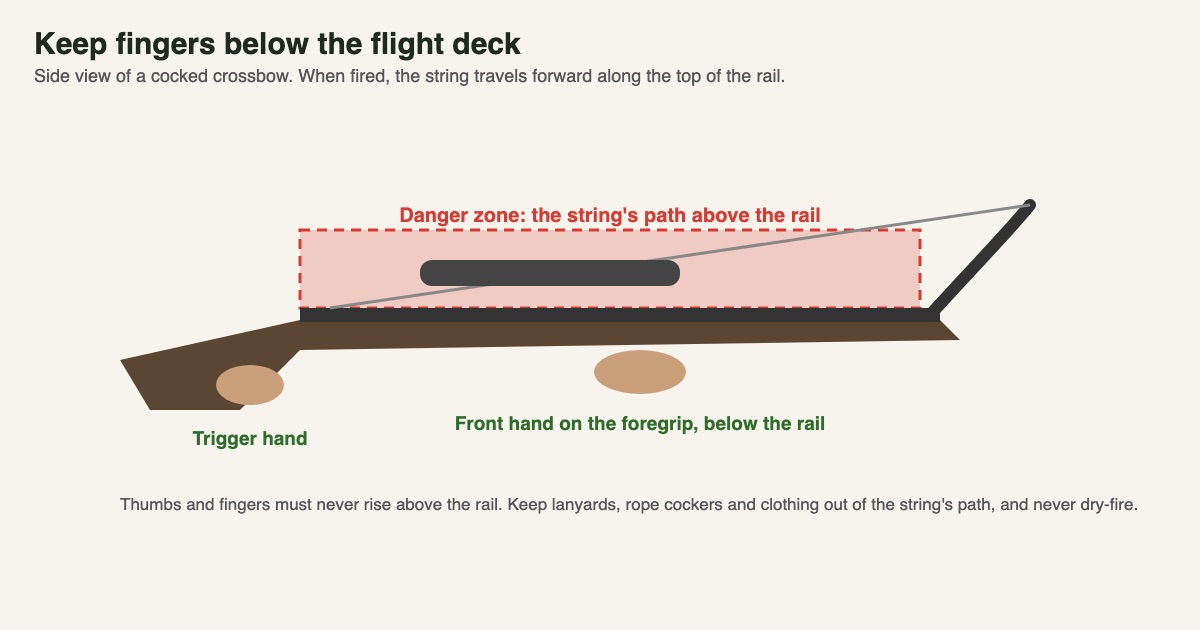
Rail or flight deck. The track where the bolt lies. The string slides along it during the shot, so keep your fingers off it.
Riser and limbs. The riser holds the limbs, which bend when the crossbow is cocked and so store the energy. On a compound crossbow, cams sit at the limb tips.
String latch and trigger. Cocking pulls the string back until the latch catches it; the trigger releases the latch.
Safety. A switch that blocks the trigger. TenPoint's 2019 owner's manual says that on its crossbows the safety moves to the safe position automatically when you cock correctly.
Stirrup. The loop at the front for your foot while cocking.
Most hunting crossbows also carry a scope; see our guide to sighting in a crossbow scope.
Recurve vs compound vs reverse draw
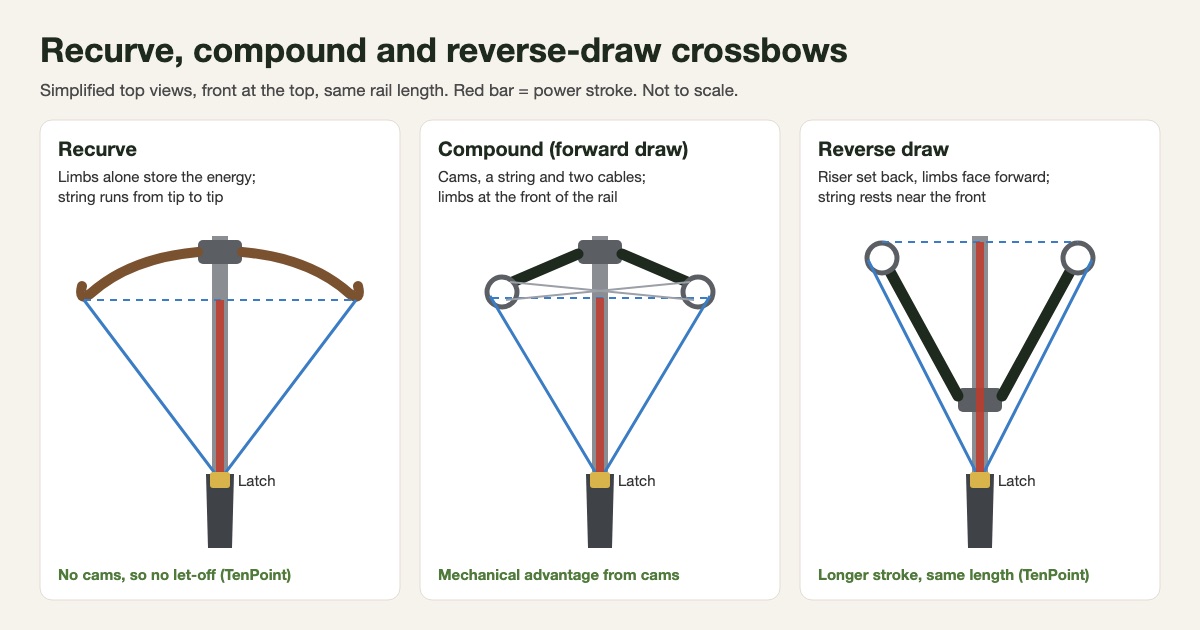
TenPoint's guide to crossbow styles describes three designs. It sells compound crossbows, so treat its view of recurves as a maker's.
| Recurve | Forward-draw compound | Reverse-draw compound | |
|---|---|---|---|
| How it stores energy | Limbs alone, no cams | Cams with a string and two cables for "mechanical advantage" | Cams, with the riser set further back |
| Speed and draw weight | "Inherently slower", or needs "much higher draw weights" to match compounds | "Much higher speeds" than recurves, per TenPoint | Lower draw weights "to achieve high speeds", per TenPoint |
| Cocking | No let-off, so harder to cock by hand | Cams give mechanical advantage | Lower draw weight for the speed |
| Efficiency and feel | "The least efficient crossbow design", per TenPoint | "Narrower bow" and "quieter shot" | "Quietest shot" and no "front heavy feel", per TenPoint |
The power stroke and energy
Cocking bends the limbs. At the shot they straighten, and their stored energy passes through the string to the bolt, but only while the string is still pushing it: the length of the power stroke.
TenPoint's reverse-draw article explains the trade-off. Moving the riser back means "the string's resting position is extended farther down the rail which creates a longer power stroke than forward draw crossbows measuring the same length." It says the longer stroke "generates more speed with less draw weight", which it links to "a smoother, quieter shot, with less shock and vibration".
Makers also refine the cams. Ravin, for example, says its HeliCoil system "allows the cams to rotate an incredible 340 degrees, while both cams remain perfectly level", and lists its R29X at 450 fps with a 400-grain arrow. Those are maker claims for one model.
Bolt weight matters too, so shoot only bolts your maker approves; our guide to bolts and quarrels touches on this.
Safety basics
TenPoint's 2019 manual says the string "moves with such force it can cause significant injury if it contacts any part of the body during release." It tells shooters to keep the thumb and fingers "below the flight deck and away from the cables".
Treat the safety as a backup, not a guarantee. The same manual says: "Never rely upon a mechanical device for safety," and "assume that whenever you place your finger on [the trigger], it will fire."
You can browse cocking ropes or crossbow bolts on Amazon; treat listings as examples to consider and check your manual first. If cocking feels too hard, our article on crossbow draw weight explains your options.
Frequently asked questions
What is the difference between a recurve and a compound crossbow?
A recurve crossbow stores energy in its limbs alone. A compound adds cams, a string and two cables, which TenPoint says create "a mechanical advantage" and "much higher speeds". TenPoint adds that recurves have no let-off, so they need higher draw weights and are harder to cock by hand.
What is a reverse draw crossbow?
A crossbow with its riser set further back and its limbs facing forward, so the string rests nearer the front of the rail. TenPoint says this gives "a significantly longer powerstroke" than a forward-draw crossbow and moves the weight back, removing the "front heavy feel". Treat speed and accuracy claims as the maker's.
Why shouldn't you dry-fire a crossbow?
Because the energy stored in the limbs has no bolt to go into. TenPoint's 2019 manual says shooting without an arrow "is damaging to the crossbow and could cause serious personal injury", and that a dry-fired crossbow must be inspected by an authorised dealer or the maker before it is cocked or shot again.
Related articles
 Comparisons
Crossbow vs Compound Bow: Which Is Better for You?
Crossbow vs compound bow compared: how each works, speed and energy, weight, holding and follow-up shots, accuracy, learning curve, hunting rules and costs.
August 12, 2026 · 5 min read
 Gear
GearCan You Adjust a Crossbow's Draw Weight?
Can you adjust draw weight on a crossbow? Usually not: most are set at the factory. Why, what makers warn against, and how cocking aids make it easier.
Updated October 6, 2026 · 4 min read
 Guides
Is a Crossbow Considered Archery?
Is a crossbow considered archery? In some hunting laws yes, in others no, and target archery's governing body leaves it out. How each one draws the line.
Updated October 6, 2026 · 4 min read